A commercial kitchen fire needs the right extinguisher in the first 30 seconds or it becomes a suppression-system event, a shutdown, and a call to the fire marshal. This guide ranks the five extinguisher types that actually belong in a commercial kitchen, what each one covers, and where it fails.
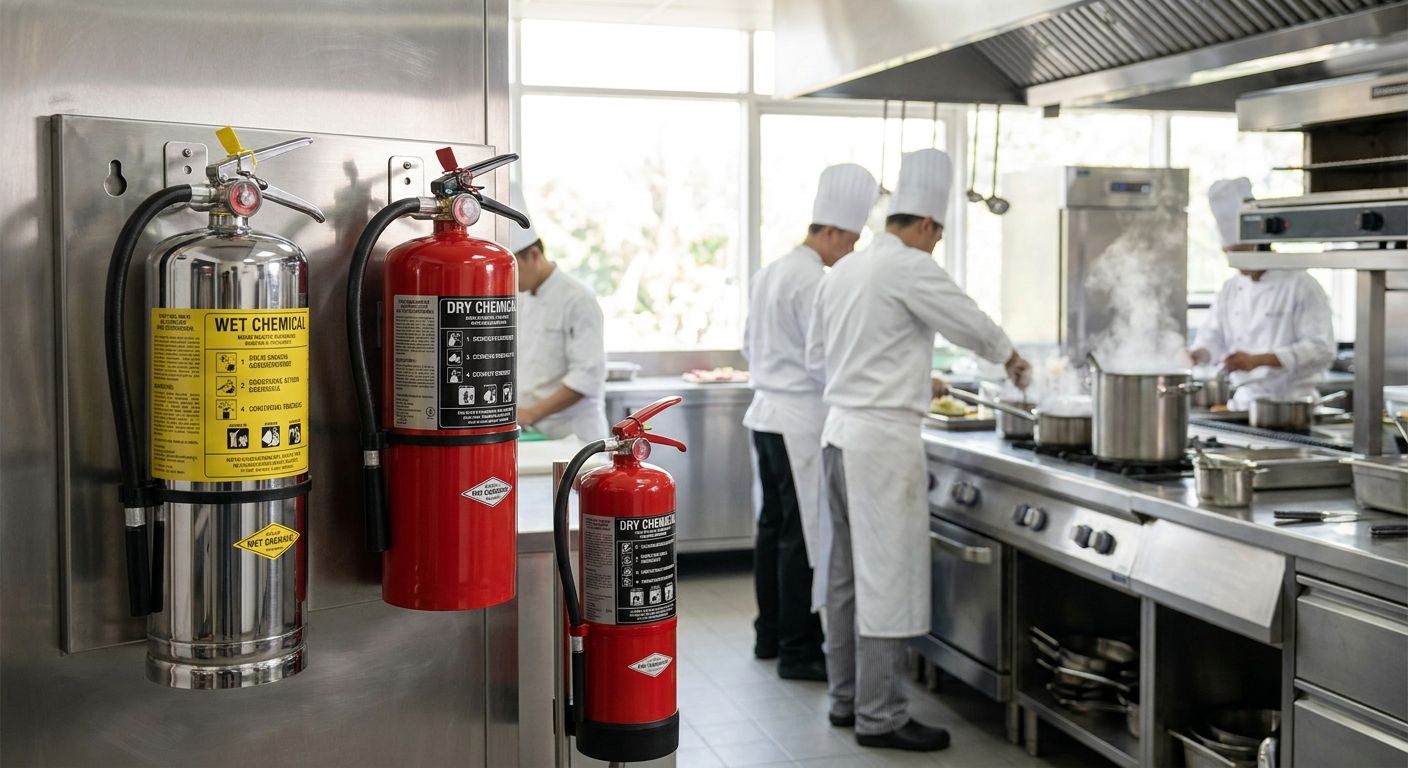
- Class K wet chemical wins for deep fryers and grease fires — it's the only extinguisher rated for UL 300 cooking oil fires.
- CO2 extinguishers are the pick for electrical panels and compressors near the cook line.
- ABC dry chemical covers dining rooms and dry storage but leaves a residue that ruins food-prep surfaces.
- NFPA 96 requires a Class K extinguisher within 30 feet of any commercial cooking appliance.
- Best overall for the cooking line: Class K wet chemical. Best for electrical: CO2. Best budget coverage for non-cooking areas: ABC dry chemical.
Best overall for grease fires: Class K wet chemical. Best for electrical equipment near the line: CO2. Best budget option for dining rooms and dry storage: ABC dry chemical. Those three cover most kitchens; foam and water mist fill narrower gaps below.
Why this matters
A kitchen fire is not one fire — it's three or four different fuel sources sitting a few feet apart. Cooking oil, electrical wiring, paper products, and cleaning solvents each need a different extinguishing agent, and the wrong one on a grease fire can spread burning oil instead of smothering it. First-Line Fire Extinguisher Co. services kitchens across Kentucky, Illinois, Indiana, Tennessee, Missouri, and Alabama, and the mismatch between what's mounted on the wall and what's actually cooking is the single most common code violation found on inspection.
NFPA 96 sets the baseline: any commercial cooking appliance producing grease-laden vapors needs a Class K extinguisher rated for UL 300 within 30 feet. That's not optional and it's not covered by a general-purpose ABC unit. Get this wrong and the kitchen fails inspection even if every other extinguisher in the building is current.
What makes the best fire extinguisher for a commercial kitchen
- UL 300 rating for cooking oil — required for any extinguisher covering fryers or high-volume grills
- Coverage matched to fuel type — grease, electrical, paper, and flammable liquids each need a different agent
- Residue and cleanup impact — dry chemical coats every surface it touches, which matters in a food-prep environment
- Placement distance — NFPA 96 sets a 30-foot rule for Class K near cooking equipment
- Recharge and hydro-test interval — how often the unit needs service to stay code-compliant
- Ease of use under stress — weight and discharge time matter when staff are the ones pulling the pin
At a glance
| Type | Best for | Standout feature | Key limitation |
|---|---|---|---|
| Class K wet chemical | Deep fryers and grease fires | Only agent UL 300-rated for cooking oil | Useless on electrical or paper fires |
| CO2 | Electrical panels and compressors | Leaves zero residue on equipment | Short discharge range, no cooling effect on grease |
| ABC dry chemical | Dining rooms and dry storage | Covers wood, paper, and electrical in one unit | Corrosive residue on stainless and food-prep surfaces |
| Class B foam | Flammable liquid storage | Blankets liquid fuel to stop reflash | Heavier and slower to deploy than dry chemical |
| Water mist | Server closets and POS equipment | Safe on live electrical near sensitive gear | Not rated for grease or deep fryer fires |
1. Class K wet chemical extinguisher: best for deep fryers and grease fires
Class K wet chemical is the extinguisher NFPA 96 requires within 30 feet of any grease-producing cooking appliance. The agent is a potassium-based solution that reacts with hot cooking oil to form a soapy layer, cooling the fire and cutting off the vapor that feeds it — a process called saponification.
Class K wet chemical pros:
- Only extinguisher type UL 300-listed for deep fryer and grill fires
- Cools the oil instead of just smothering the flame, which stops reignition
- Required by code for any kitchen with a fryer, flat-top, or char-broiler
Class K wet chemical cons:
- Does nothing for electrical or paper fires — needs a second extinguisher type nearby
- Heavier discharge stream can splash hot oil if aimed poorly
Class K units need annual inspection and a 5-year hydrostatic test cycle under NFPA 10. Best for: any kitchen running a fryer, flat-top grill, or char-broiler. Buy.
2. CO2 extinguisher: best for electrical equipment near the cook line
Carbon dioxide extinguishers discharge a non-conductive gas that displaces oxygen without leaving residue, which makes them the right call for electrical panels, walk-in compressors, and equipment sitting near — but not directly over — the cooking surface.
CO2 pros:
- Zero residue means no cleanup on sensitive electronics or stainless equipment
- Safe to use on live electrical fires without shock risk
- No corrosive powder to contaminate food-prep surfaces
CO2 cons:
- Short discharge range compared to dry chemical, so the operator has to get close
- No cooling effect, so grease fires can reignite after the gas disperses
NFPA 10 sets a 5-year hydrostatic test interval for CO2 cylinders. Best for: electrical panels, compressors, and equipment rooms adjacent to the kitchen. Buy.
3. ABC dry chemical extinguisher: best for dining rooms and dry storage
ABC dry chemical is the general-purpose extinguisher most people picture — a monoammonium phosphate powder rated for wood, paper, flammable liquids, and electrical fires. It belongs in dining rooms, dry storage, and office areas, not directly on the cook line.
ABC dry chemical pros:
- Covers three fire classes with one extinguisher, which simplifies non-cooking areas
- Long discharge range and shelf-stable agent
- Lower service cost than specialized units for spaces without grease exposure
ABC dry chemical cons:
- Powder residue is corrosive to stainless steel and contaminates open food
- Not UL 300-rated, so it does not satisfy the Class K requirement near fryers
Stored-pressure ABC units carry a 12-year hydrostatic test interval under NFPA 10. Best for: dining rooms, hallways, and dry storage rooms away from cooking oil. Buy for non-cooking zones.
4. Class B foam extinguisher: best for flammable liquid storage
Foam extinguishers spread an aqueous film across the surface of a flammable liquid, cutting off vapor and stopping reflash. In a commercial kitchen that means the room where fryer oil gets stored or transferred, or where cleaning solvents sit in bulk.
Class B foam pros:
- Blankets liquid fuel surfaces to prevent reflash, better than dry chemical for pooled liquids
- Works on Class A ordinary combustibles as well as flammable liquids
Class B foam cons:
- Heavier and slower to deploy than dry chemical or CO2
- Not a substitute for Class K on an active fryer fire
Best for: bulk oil storage and chemical-transfer areas away from the active cook line. Hold — only add this if the kitchen stores liquid fuel in volume.
5. Water mist extinguisher: best for server closets and sensitive electronics
Water mist units discharge a fine de-ionized spray that's safe near live electrical equipment and doesn't damage sensitive gear the way dry chemical powder does. In a kitchen, that's the POS terminal closet, the security DVR, or a back-office server rack.
Water mist pros:
- Safe on electrical equipment without the conductivity risk of plain water
- No residue on screens, keyboards, or circuit boards
Water mist cons:
- Not rated for grease or deep fryer fires
- Narrower application than CO2 for most kitchen electrical needs
Best for: back-office electronics and POS closets adjacent to the kitchen. Buy only if that equipment exists on-site.
How we ranked
Each type is scored against the criteria above: code compliance (NFPA 96 and NFPA 10), fuel-type match, residue impact on food surfaces, and service interval. Class K ranks first because it's the only agent that satisfies the mandatory grease-fire requirement; everything else fills a gap Class K doesn't cover.
Get your kitchen extinguishers inspected
First-Line Fire Extinguisher Co. services commercial kitchens across six states.
Which fire extinguisher type should you choose?
If the kitchen has a fryer, flat-top, or char-broiler, Class K wet chemical is non-negotiable — code requires it and no other agent covers cooking oil fires. Pair it with a CO2 unit for the electrical panel and compressor, an ABC dry chemical extinguisher for the dining room and dry storage, and add foam or water mist only if bulk liquid storage or sensitive electronics are actually on-site in 2026. Most commercial kitchens end up running three extinguisher types, not one.
FAQ
What's the best fire extinguisher for a commercial kitchen?
Class K wet chemical is the best fire extinguisher for a commercial kitchen with a fryer or grill because it's the only agent UL 300-rated for cooking oil fires. NFPA 96 requires it within 30 feet of grease-producing equipment.
Is Class K better than ABC dry chemical for kitchens?
Class K is better for grease and deep fryer fires; ABC dry chemical is better for dining rooms and dry storage. Neither replaces the other — most kitchens need both.
Can you use a regular fire extinguisher in a commercial kitchen?
A general-purpose ABC extinguisher is not code-compliant for cooking areas with grease exposure. NFPA 96 specifically requires a Class K unit near any grease-producing appliance.
How often does a Class K extinguisher need to be serviced?
Class K wet chemical extinguishers need annual inspection under NFPA 10 and a hydrostatic test every 5 years.
What extinguisher works best on electrical fires in a kitchen?
CO2 is the best choice for electrical panels and equipment because it's non-conductive and leaves no residue. Dry chemical also covers Class C fires but leaves corrosive powder behind.
Do commercial kitchens need more than one extinguisher type?
Yes. Most commercial kitchens need Class K near the cook line, CO2 or ABC near electrical equipment, and ABC in dining and storage areas to cover every fuel type on-site.
Why does dry chemical damage kitchen equipment?
Dry chemical powder is corrosive to stainless steel and contaminates open food, which is why it's kept away from active cooking surfaces and used instead in dining rooms and dry storage.
What's the NFPA rule for fire extinguisher placement in kitchens?
NFPA 96 requires a Class K extinguisher within 30 feet of any appliance that produces grease-laden vapors, and NFPA 10 governs inspection and hydrostatic testing for every extinguisher type in the building.
One last thing
The extinguisher that fails inspection most often in commercial kitchens isn't missing — it's mislocated. A Class K unit mounted 40 feet from the fryer because that's where the wall space was doesn't satisfy the 30-foot rule in NFPA 96, even though the extinguisher itself is current and charged. Check placement before you check the tag.