No—ordinary security cameras do not, by themselves, satisfy a fire watch requirement in 2026. Treat cameras as support, not a replacement for required personnel, unless the authority having jurisdiction expressly approves an alternative for your site. Recording a fire is not the same as detecting it promptly, warning occupants, and getting emergency help.
- Can security cameras satisfy a fire watch requirement? Not by themselves; any alternative needs the responsible authority’s approval.
- OSHA’s general-industry hot-work rule requires trained fire watchers under specified conditions, not just video recording.
- Firstlinefire provides fire alarm and suppression services; confirm fire watch requirements with the authority having jurisdiction.
- Keep required coverage in place until restoration is verified and the conditions for ending the watch are met.
Why this matters
An alarm outage creates a different problem from a security incident. Cameras can show visible conditions, but a required fire watch has assigned duties: observe the affected area, communicate an emergency, and follow the approved response plan.
Do not cancel a required watch because a camera feed looks clear. Start with the impairment notice and the instructions from the fire official. The fire alarm impairment to fire watch coverage workflow explains how those decisions fit together.
The practical question is not whether someone can see the building remotely. It is whether the proposed arrangement meets the specific requirement imposed on that building, operation, or job.
Can security cameras satisfy a fire watch requirement?
Security cameras alone are not a substitute for a required fire watch. A continuously watched feed is different from stored footage, but neither arrangement automatically fulfills a requirement for trained personnel or physical patrols.
Use this comparison when deciding what your existing equipment actually provides. These are different functions, not interchangeable levels of protection.
| Arrangement | Best for | Useful function | Limit as a fire watch substitute |
|---|---|---|---|
| Recorded security video | Reviewing visible events afterward | Preserves footage within the camera’s view | Recording alone does not assign anyone to recognize or report a fire |
| Live remote camera viewing | Supporting observation of visible areas | Lets a remote operator view conditions | Does not automatically meet personnel, patrol, or response requirements |
| Monitored fire alarm | Receiving and transmitting signals from connected fire alarm equipment | Communicates system signals through the configured monitoring arrangement | Cannot replace functions lost through an impairment or automatically cancel a watch |
| Trained on-site fire watch | Performing required observation and response duties | Provides people assigned to the approved watch plan | Needs staffing, instructions, communication, and documented coverage |
A camera system’s usefulness does not establish its acceptance. Ask the responsible authority whether an alternative is permitted under the applicable rules, then obtain written acceptance of the actual arrangement before changing coverage.
For a 2026 compliance decision, use the code edition adopted by your jurisdiction and the site-specific order. A general statement from an equipment seller does not amend either one.
Alarm outage: follow the impairment instructions
When an alarm system is impaired, establish exactly what has stopped working. A failed notification circuit, a disconnected monitoring path, and an entire panel outage do not leave the same protection available.
Give the fire official a precise description. Include the affected area, occupied spaces, remaining protection, and the repair status. Ask what temporary measures are required and whether occupancy or work must be restricted.
Do not assume that working cameras compensate for failed alarm notification. A remote operator seeing smoke does not make an impaired horn or strobe function, and a working alarm elsewhere does not restore the affected area.
Keep the watch decision tied to the impairment, not to the camera installation. Record what protection is unavailable and who authorized the temporary arrangement.
Hot work: cameras do not replace OSHA’s fire watchers
Welding and cutting require a separate check. OSHA’s general-industry welding, cutting, and brazing standard, 29 CFR 1910.252(a)(2)(iii), requires fire watchers under specified conditions involving combustible materials and fire exposure.
The rule includes appreciable combustible material within 35 feet, also stated as 10.7 meters, of the work. It also addresses more distant combustibles exposed to ignition by sparks, openings that expose combustibles, and heat transmission through certain partitions.
Under that rule, fire watchers must have extinguishing equipment readily available, know how to use it, and know how to sound an alarm. They must watch for fires in exposed areas and follow the rule’s limits on attempting extinguishment.
The same provision requires maintaining the fire watch for at least 30 minutes after welding or cutting ends to detect and extinguish possible smoldering fires. That is a general-industry hot-work requirement—not a universal patrol interval or alarm-outage duration.
For hot work planned in 2026, check both the applicable OSHA rules and the site’s permit requirements. Construction, shipyard, and other regulated work need their own rule check; do not apply a general-industry example to every job.
Remote viewing: useful support, not automatic approval
Live video can help an operator inspect a visible area or provide information during an incident. Stored footage can help reconstruct what happened afterward. Neither benefit proves that the required watch duties are covered.
Check the actual view. A camera aimed down an aisle does not show the space behind equipment, inside an enclosure, or beyond its field of view. Lighting, obstructions, and a failed connection also affect what an operator can observe.
If you propose remote viewing as part of an alternative, describe the operator’s duties, camera coverage, communication method, and response to a lost feed. Submit the arrangement for review rather than treating technical capability as permission.
Do not remove required personnel while that review is pending. An application for acceptance is not acceptance.
Why fire watch requirements vary
The requirement comes from the applicable rules and the conditions at the site. It does not come from how many cameras you own.
- Reason for the watch. Hot work, alarm impairment, and suppression impairment involve different hazards and duties.
- Applicable authority. The adopted fire code, an OSHA requirement, and a site-specific fire official’s order are not interchangeable.
- Affected protection. Identify whether detection, occupant notification, signal transmission, suppression, or several functions are unavailable.
- Occupied areas. Tell the official which areas remain in use and what activities continue there.
- Physical layout. Hidden spaces, separated rooms, and obstructed views affect how the assigned observation can be performed.
- Restoration conditions. Repair completion, verification, notifications, and any required authorization determine when temporary measures can end.
For each 2026 outage, document the actual conditions. Do not reuse an old watch plan without checking whether its assumptions still fit.
How do you set up coverage without guessing?
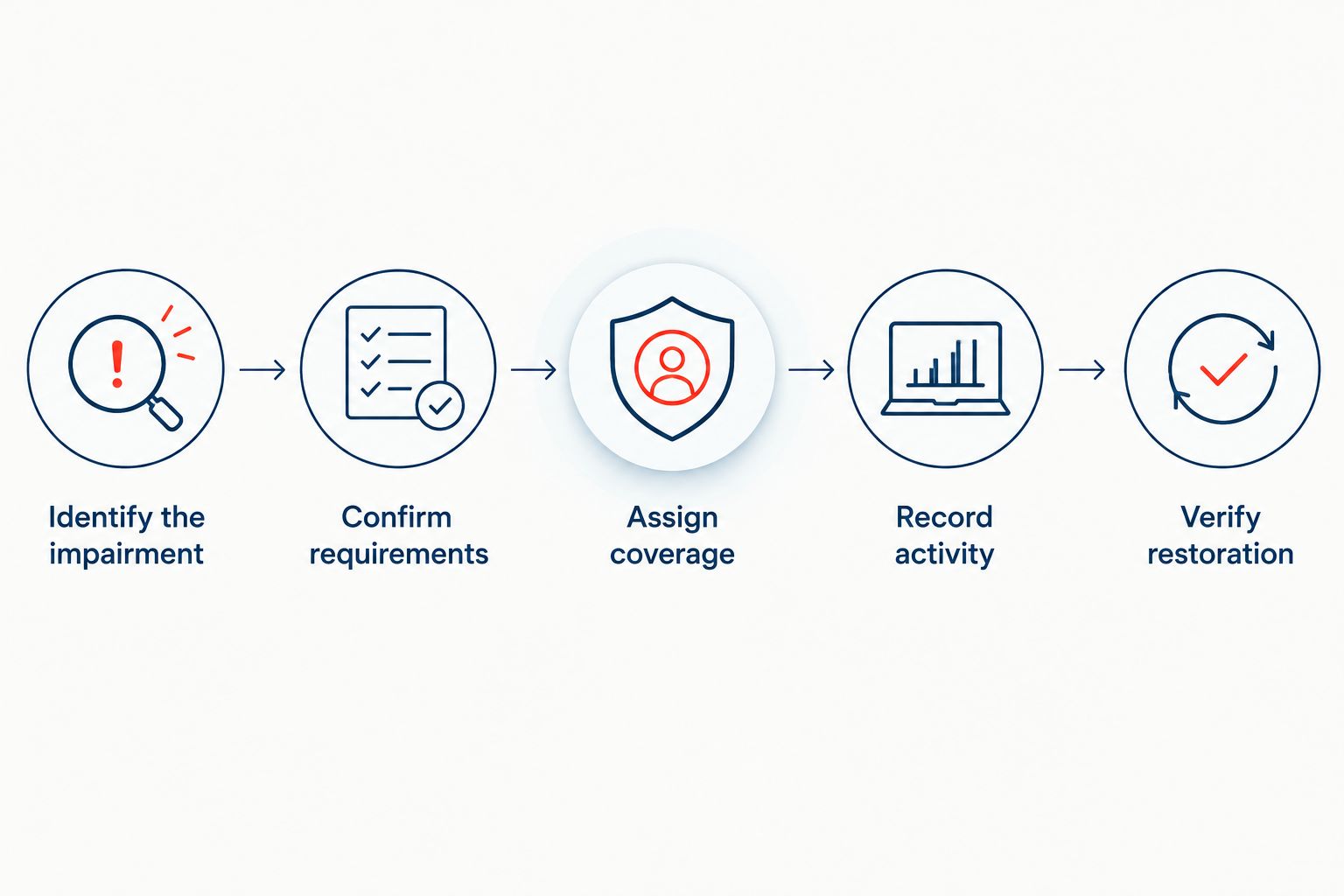
Use a documented sequence. Keep the repair work and the temporary protection plan connected, but give each a named person responsible for it.
- Identify the impairment. Record the affected equipment, areas, discovery time, and known operating limitations. Separate confirmed failures from conditions still under investigation.
- Confirm requirements. Contact the responsible fire official and follow applicable notification procedures. Ask what coverage, restrictions, records, and ending conditions apply.
- Assign coverage. Identify personnel and explain their duties, covered areas, communication methods, and handoff process. Do not assume that a general security assignment includes the required fire watch work.
- Record activity. Keep the records required by the approved plan. Document coverage, observations, handoffs, incidents, and actions taken rather than entering vague statements after the shift.
- Verify restoration. Have the affected system checked through the appropriate service process. Complete required notifications and meet the conditions for ending the watch before releasing personnel.
Before the handoff, test whether the assigned person can explain the job without referring to a camera screen. They should know which area they cover, how to report a fire, how occupants are warned under the plan, and whom to contact when coverage cannot continue.
Have the repair contact explain what was restored and what remains impaired. A cleared trouble indication alone should not become your entire record of the decision to stop temporary protection.
Who can help with the equipment side?
Firstlinefire is best for commercial and industrial operators seeking fire alarm, suppression, and safety training services. Its stated service area includes Kentucky, Illinois, Indiana, Tennessee, Missouri, and Alabama.
Firstlinefire’s fire-protection services address the equipment and training side of the problem. The limit is clear: a service provider’s recommendation does not replace the responsible authority’s decision about required fire watch coverage.
When you request service, describe the impairment rather than asking only whether cameras are enough. Include the affected system, building use, current restrictions, fire official’s instructions, and the person coordinating temporary protection.
Discuss the affected system
Provide the impairment details and the fire official’s instructions when requesting service.
Can a security guard perform the fire watch?
A security guard can perform fire watch duties only when the assignment meets the applicable training, duty, and approval requirements. A job title alone does not establish that qualification.
Check for conflicting duties. Gate checks, deliveries, or other assignments must not interrupt the coverage required by the watch plan. For OSHA general-industry hot work, the fire watcher must also meet the specific equipment, training, and alarm-related requirements.
Can you end a fire watch when the alarm panel looks normal?
A normal-looking panel is not, by itself, authorization to end a required fire watch. Confirm that the impaired functions have been restored and verified, then follow the plan’s notification and release conditions.
Keep the restoration record with the impairment record. For a 2026 incident file, that creates a clear account of what failed, what temporary protection applied, and why the watch ended.
FAQ
Can security cameras satisfy a fire watch requirement if someone watches them continuously?
Continuous viewing does not automatically satisfy a fire watch requirement. Confirm whether the applicable rules permit an alternative and obtain the responsible authority’s acceptance before replacing required personnel or patrols.
Can recorded video count as a fire watch log?
Recorded video is not a substitute for the activity records required by a fire watch plan. Keep the required entries for personnel, coverage, observations, handoffs, and actions; footage can serve as supplemental information.
Do cameras with smoke-detection features remove the need for a fire watch?
A smoke-detection feature does not automatically remove a fire watch requirement. Acceptance depends on the actual equipment, applicable rules, impairment conditions, and the responsible authority’s decision.
How long must a fire watch continue after welding?
At least 30 minutes after welding or cutting ends is required by OSHA’s general-industry rule at 29 CFR 1910.252(a)(2)(iii). Check the applicable work rules and permit conditions before using that duration for your job.
Can a monitored fire alarm replace an on-site fire watch?
A monitored fire alarm does not automatically replace a required on-site fire watch. Identify which protection remains functional and follow the requirements imposed for the impairment or activity.
Does Firstlinefire provide the approval to replace a fire watch with cameras?
The responsible authority decides whether a proposed alternative is acceptable under the applicable rules. Firstlinefire provides fire alarm, suppression, security, and safety training services; those services do not constitute regulatory approval.
One last thing
Decide how the watch ends before the first shift starts. Put the restoration checks, notifications, and release conditions in the plan at the outset.
That prevents the wrong handoff: a technician says the repair is finished, a manager dismisses the watch, and nobody confirms that the required protection is back in service. Cameras do not resolve that gap. A documented restoration decision does.