Yes—remote fire alarm monitoring can remain reliable during a power outage when the alarm panel, communicator, and required network equipment have working backup power and a usable transmission path. Panel batteries alone do not prove that signals can reach the monitoring station. For your 2026 outage plan, require a documented test of the complete connection, not just a battery check.
- Is remote fire alarm monitoring reliable during a power outage? Yes, with tested backup power and a working communication path.
- A powered fire alarm panel does not prove the monitoring station can receive its signals.
- Cellular monitoring avoids dependence on your building’s internet connection, but still needs power and network service.
- Firstlinefire provides fire alarm services for commercial and industrial customers; confirm your site’s monitoring requirements directly.
Why this matters
An alarm sounding inside your building and an alarm reaching a monitoring station are separate results. A power outage can leave the first working while interrupting the second. Your staff need to know which protection remains available.
Trace the alarm monitoring to central dispatch workflow before reviewing individual batteries or communication equipment. The question is whether a signal gets through and reaches the people responsible for acting on it.
A lit panel is not proof of working remote monitoring. Keep that distinction in your 2026 emergency procedures, especially when the building is empty overnight or during a weather-related closure.
Is remote fire alarm monitoring reliable during a power outage?
Yes, provided the installed system maintains power and communication throughout the outage. Reliability depends on the complete installation: the panel, communicator, transmission equipment, outside network, and receiving station.
Use these 3 checks to organize the review. Each addresses a different failure point; passing one does not establish that the others work.
| Check | What you need to establish | What does not prove it |
|---|---|---|
| Backup power | Required alarm and communication equipment operates without normal building power | A normal display before the outage |
| Signal transmission | The installed path carries alarm signals while normal power is unavailable | An internet connection that works only with utility power |
| Station receipt | The monitoring station receives and correctly identifies the test event | A sounder operating inside the building |
Have a qualified fire alarm technician perform the outage test under the applicable inspection and testing procedures. Coordinate with the monitoring station and other required parties before testing so a planned test does not cause an unintended emergency response.
Do not disconnect power or disable equipment yourself. The test must preserve the required safeguards, account for any temporary impairment, and end with confirmation that normal service has been restored.
IP monitoring: check every powered network device
IP monitoring uses a network connection to transmit signals. Its strength is that it uses an installed data connection. Its outage weakness is dependence on the equipment needed to keep that connection running.
A backed-up alarm panel does not automatically power a router, modem, network switch, or optical network terminal. Identify every device between the alarm communicator and the provider’s connection. Then establish how each device receives backup power.
For your 2026 review, ask for the network dependencies to be written down. A statement that the building has battery backup is not enough; the record must identify which equipment that backup actually supplies.
Best for: Sites where the approved installation includes backed-up network equipment and verified signal delivery. Limitation: Local backup power cannot guarantee that the outside provider’s network remains available.
Cellular monitoring: independent of local internet, not every failure
Cellular monitoring sends signals through a cellular network rather than your building’s internet connection. That removes the local router and internet service from that transmission path. It does not remove the need for power at the communicator.
The communicator needs suitable backup power, an acceptable signal at its installed location, and an operating cellular network. A phone showing reception elsewhere on the property does not establish the performance of the installed fire alarm communicator.
Ask the technician to verify the communicator’s status and test signal delivery with normal building power unavailable. Do not treat a successful test on utility power as proof of outage operation.
Best for: Sites seeking an approved monitoring path that does not depend on local internet equipment. Limitation: Cellular service still depends on coverage, powered equipment, and the carrier’s network.
Dual-path monitoring: check what the paths share
Dual-path monitoring uses 2 communication paths. The benefit is an alternate route when one route fails. The limitation is that apparently separate routes can still share a power supply, communicator, or other failure point.
For example, an IP path and a cellular path avoid some of the same network dependencies. But both still need the installed alarm equipment to operate. Two paths do not compensate for an exhausted power supply serving both.
| Monitoring arrangement | Best for | Main strength | Main outage limitation |
|---|---|---|---|
| IP monitoring | Sites with approved, backed-up network infrastructure | Uses the building’s data connection | Depends on local network equipment and outside internet service |
| Cellular monitoring | Sites avoiding reliance on local internet | Bypasses the building’s router and internet connection | Depends on communicator power and cellular service |
| Dual-path monitoring | Sites needing an approved alternate transmission route | Provides another route after a path failure | Shared equipment or power can affect both routes |
Choose based on documented site performance, not the number of paths on a proposal. Compatibility, listing, installation instructions, and acceptance by the authority having jurisdiction still control the installation.
Why outage reliability varies
Outage reliability changes with the condition and design of the installed system. These are the dependencies to review with your technician:
- Battery condition. Batteries need inspection and testing; age alone does not establish available capacity.
- Connected load. Backup power must support the equipment it actually supplies, including the applicable alarm operating condition.
- Network dependencies. IP transmission depends on the local equipment and outside service needed to carry the signal.
- Path independence. Alternate paths provide less protection when a shared failure disables both.
- Outage duration. Battery-backed equipment has a finite operating time. Extended outages require an established response plan.
- System changes. Added equipment, network replacements, and altered wiring can change the assumptions behind an earlier test.
A standby generator is not proof by itself. Confirm that the required circuits are supplied and that the alarm system handles the transfer as intended. Have qualified personnel assess the complete arrangement rather than assuming generator coverage from a building-wide description.
How do you verify outage operation safely?
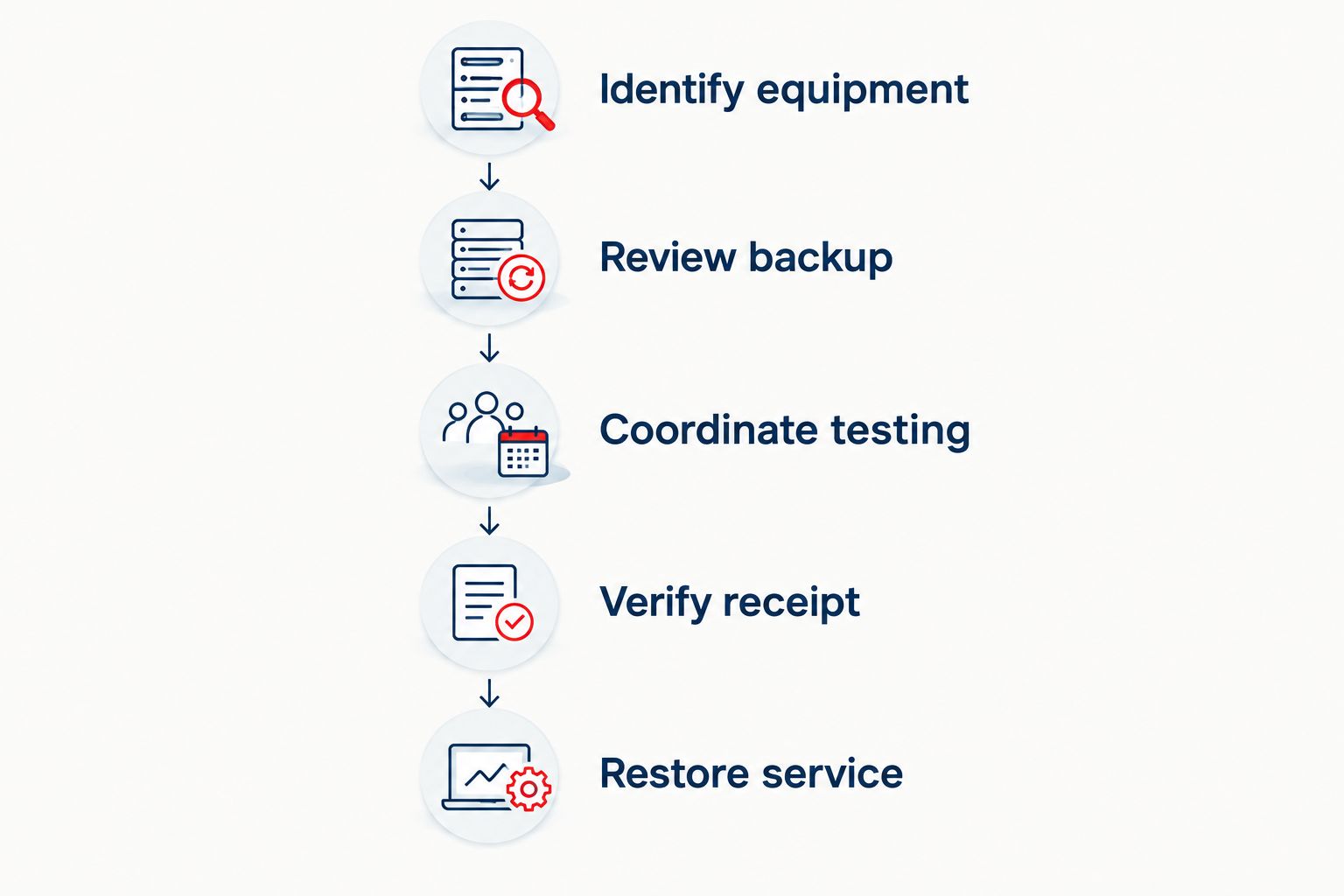
Schedule a coordinated test and require a written result. Use this sequence for your 2026 service discussion; the qualified technician determines the actual test procedure.
- Identify equipment. Record the panel, communicator, power supplies, and network devices required for transmission. Include equipment outside the alarm cabinet.
- Review backup. Have the technician review battery condition, applicable capacity requirements, and the equipment each backup source serves.
- Coordinate testing. Notify the monitoring station and other required parties. Establish the safeguards and authorizations needed before any interruption.
- Verify receipt. Under the approved procedure, test transmission without normal power and confirm the receiving station’s record. For alternate paths, verify the intended failover operation.
- Restore service. Confirm normal power, communication status, and monitoring arrangements. Record unresolved trouble conditions and assigned corrective work.
Ask for a report that distinguishes an alarm event from a power-loss or communication-trouble event. Those events tell you different things. Receipt of a power-loss notification does not, by itself, document every function required during the outage.
Keep the test results with your fire alarm service records. Include deficiencies, corrective actions, and any limits on what the test established. A useful report tells the next technician what was checked, not merely that someone visited.
How long will monitoring stay online without power?
There is no single runtime that applies to every installation. Your actual operating time depends on the approved system design, connected load, battery capacity and condition, and the communication equipment involved.
Ask for the applicable backup-power requirements and supporting calculations for your system. Have the technician identify the adopted code requirements, equipment instructions, and any site-specific conditions. Do not substitute a general battery-runtime claim for that review.
For 2026 planning, distinguish the required standby condition from operation during an alarm. Equipment load changes matter. Also identify which component would lose power first; a panel that outlasts its communicator does not preserve remote signal delivery.
Does the monitoring station know when power fails?
A monitoring station can receive power-loss and trouble signals when the system is configured to send them and a working path remains available. The event type, reporting behavior, and response depend on the installed equipment and monitoring arrangement.
Ask which events the station receives, who gets notified, and what happens when communication is lost altogether. Do not assume that a power failure triggers the same action as a fire alarm.
Keep your contact list current. Name the person authorized to arrange service and the person responsible for site decisions during an impairment. Remote notification has limited value when nobody can act on it.
What should you do if monitoring fails during an outage?
Treat lost monitoring as a fire-protection impairment and follow your site’s impairment procedure. Contact your alarm service provider and the required local authority to establish the necessary precautions. Do not assume that an audible local alarm makes continued occupancy acceptable.
The required response depends on the affected protection, occupancy, and local direction. A fire watch or other temporary measure needs the appropriate authorization and procedures; it is not an automatic substitute for restoring the system.
If there is smoke, fire, or an immediate danger, follow your evacuation procedure and call emergency services. Do not wait for a monitoring connection to recover.
Who should review your installation?
Use qualified fire alarm personnel who can review power, communication, and receiving-station records together. Ask who is responsible for the network equipment as well. Splitting those responsibilities without a named coordinator leaves gaps.
Firstlinefire is a fit for commercial and industrial operators seeking fire alarm and other fire-protection services. Its stated service area covers Kentucky, Illinois, Indiana, Tennessee, Missouri, and Alabama.
Review available fire-protection services and confirm the scope needed for your site. Firstlinefire provides fire alarm services; the exact monitoring arrangement, equipment compatibility, and outage-test scope need site-specific confirmation. A general service description is not an outage-performance guarantee.
Ask about your alarm installation
Discuss your panel, communication path, and backup-power questions with Firstlinefire.
FAQ
Will my fire alarm still be monitored if the building loses electricity?
Yes, if the panel, communicator, and required transmission equipment retain power and a working connection. Verify the complete installation through a coordinated test with qualified personnel.
Does the alarm panel battery also power my internet router?
Do not assume the panel battery powers your router. Have the technician identify every required network device and confirm its actual backup-power source.
Is cellular fire alarm monitoring better than internet monitoring during an outage?
Cellular monitoring avoids dependence on your building’s internet equipment, but it still needs power and cellular service. The better arrangement is the approved installation whose outage operation has been verified at your site.
Does having two communication paths guarantee reliable monitoring?
No, two communication paths do not guarantee monitoring if shared equipment or power fails. Have qualified personnel verify both path operation and the dependencies they share.
Can I unplug the alarm panel to test its backup battery?
Do not unplug or disable fire alarm equipment yourself. Arrange a qualified, coordinated test with the required notifications, safeguards, and restoration checks.
Does a generator mean my monitoring cannot fail?
No, a generator does not prove that every required component has power or that the outside network works. Verify circuit coverage, transfer behavior, and signal receipt under the approved test procedure.
Who should I contact about fire alarm outage readiness?
Contact a qualified fire alarm service provider and coordinate with your monitoring station. Firstlinefire provides fire alarm services within its stated six-state service area; confirm the scope for your installation directly.
One last thing
Put the communicator on the checklist. It is easy to focus on the panel because that is where staff see lights and hear trouble signals. The separate communicator and network equipment deserve the same attention.
Before closing your 2026 review, ask one plain question: did the monitoring station receive the required test signal while normal power was unavailable? Keep the answer and the supporting record together.