OSHA requires monthly visual inspections and an annual maintenance check for workplace portable fire extinguishers covered by 29 CFR 1910.157. For your 2026 schedule, those checks are separate from the internal maintenance and hydrostatic testing that certain extinguishers also need; an annual service tag does not replace the monthly inspection.
- How often does OSHA require fire extinguisher inspections? Monthly visual inspections and an annual maintenance check.
- OSHA requires additional internal maintenance and hydrostatic testing for specified extinguisher types.
- Firstlinefire provides fire extinguisher service for commercial and industrial customers across its six-state service area.
- Keep monthly checks, annual maintenance, and cylinder testing on separate schedules.
How often does OSHA require fire extinguisher inspections?
Inspect portable extinguishers visually every month and complete maintenance annually. OSHA states these requirements in 29 CFR 1910.157(e)(2) and (e)(3). The employer remains responsible for inspection, maintenance, and testing, even when a service company performs the work.
Use the guide to inspecting extinguishers between annual visits to organize your workplace checks. Keep those checks separate from the service technician’s maintenance work.
| Task | OSHA interval | What it establishes | What it does not replace |
|---|---|---|---|
| Visual inspection | Monthly | The extinguisher is present and has no obvious readiness problem | Annual maintenance or cylinder testing |
| Maintenance check | Annually | The extinguisher receives its required maintenance examination | Monthly inspections |
| Internal maintenance for applicable stored-pressure dry chemical units | Every 6 years | The extinguisher is emptied and receives applicable maintenance procedures | Hydrostatic testing |
| Hydrostatic testing | Commonly every 5 or 12 years, depending on type | The cylinder receives its required pressure test | Routine inspection and maintenance |
Source for the federal general-industry schedule: OSHA, 29 CFR 1910.157(e)–(f) and Table L-1. Use these provisions when building your 2026 calendar, then check applicable state and local requirements.
Why this matters
An extinguisher can have a current annual service tag and still be blocked, missing, damaged, or discharged. Monthly inspections address conditions that develop between service visits. Annual maintenance addresses a different task.
A current tag is not proof that the extinguisher is ready today. Your inspection program needs both scheduled work and a way to correct problems as employees find them.
Monthly visual inspection: Every month
OSHA’s monthly requirement is a visual inspection, not a monthly teardown. Assign someone who understands what to check and how to report a defect. Give that person a location list so an empty bracket does not disappear from the inspection route.
A practical monthly inspection checks the following:
- Location: The extinguisher is where your inventory says it belongs.
- Access: Equipment, stock, doors, or other objects do not block it.
- Condition: The cylinder, handle, hose, and nozzle have no obvious damage.
- Readiness: The pin and tamper seal are intact, and the pressure indicator is acceptable where fitted.
- Instructions: Operating instructions are legible and face outward.
- Service status: Missing records, overdue service, or signs of discharge receive follow-up.
Not every extinguisher has a pressure gauge. Carbon dioxide extinguishers, for example, require checks appropriate to their design; a missing gauge is not automatically a defect. Follow the manufacturer’s inspection instructions for each type.
Do not open the cylinder, release agent to test it, or attempt pressure-vessel repairs during a visual check. Report the problem and arrange the appropriate service.
Annual maintenance: Every year
OSHA requires an annual maintenance check under 1910.157(e)(3). This is separate from walking the building and checking that each extinguisher is present. The maintenance examination follows the equipment’s applicable procedures and condition.
For your 2026 service visit, identify every extinguisher by location and equipment identifier. Have the previous maintenance and testing records available. That helps keep a replacement cylinder from inheriting the service history of the unit it replaced.
Firstlinefire is best for commercial and industrial operators seeking fire extinguisher service within its Kentucky, Illinois, Indiana, Tennessee, Missouri, and Alabama service area. Its stated services include extinguisher sales and hydro testing. The limit is clear: hiring a provider does not transfer the employer’s OSHA responsibility or eliminate monthly workplace checks.
You can review Firstlinefire’s fire-protection services when arranging maintenance. Confirm the scope of work for your equipment rather than treating inspection, recharge, and hydrostatic testing as interchangeable terms.
Internal maintenance: Every 6 years for applicable units
OSHA 1910.157(e)(4) requires stored-pressure dry chemical extinguishers that require a 12-year hydrostatic test to be emptied and receive applicable maintenance procedures every 6 years. This requirement does not apply to every extinguisher in the building.
The same paragraph exempts dry chemical extinguishers with nonrefillable, disposable containers from this internal-maintenance requirement. That exemption does not remove the monthly inspection or annual maintenance requirements that otherwise apply.
When recharging or hydrostatic testing includes the required maintenance procedures, OSHA states that the 6-year requirement begins again from that date. Record what work actually occurred. A new tag alone does not establish that internal maintenance was completed.
Hydrostatic testing: Every 5 or 12 years for common types
Hydrostatic testing checks cylinder integrity under controlled test conditions. OSHA requires trained people with suitable equipment and facilities to perform it under 1910.157(f)(1). It is not a task for the employee doing the monthly inspection route.
| Extinguisher type listed in OSHA Table L-1 | Hydrostatic interval | Important distinction |
|---|---|---|
| Carbon dioxide | Every 5 years | Do not use the ordinary dry chemical interval |
| Stored-pressure water | Every 5 years | Water units have their own listed interval |
| Dry chemical with a stainless steel shell | Every 5 years | Shell material changes the interval |
| Dry chemical with mild steel, brazed brass, or aluminum shells | Every 12 years | Confirm the actual shell and equipment type |
These are selected examples, not the entire OSHA table. Match each extinguisher to its listed category before assigning a due date. Do not decide from cylinder color or the fact that two units hang next to each other.
Damage can also require action before the scheduled test date. OSHA 1910.157(f)(2) addresses conditions requiring hydrostatic testing and conditions that make an extinguisher unsuitable for testing. Send questionable equipment for evaluation instead of waiting for its calendar deadline.
Why extinguisher service intervals differ
The monthly and annual baseline does not become optional because equipment differs. What changes is the additional work required for a particular cylinder and its condition.
- Extinguishing agent: Carbon dioxide, water, and dry chemical units have different listed testing requirements.
- Shell construction: OSHA Table L-1 distinguishes stainless steel dry chemical cylinders from specified other shell materials.
- Container design: Nonrefillable dry chemical containers have a specific exemption from the 6-year internal-maintenance requirement.
- Previous maintenance: Qualifying recharge or hydrostatic work can restart the applicable internal-maintenance interval.
- Equipment condition: Damage, corrosion, leakage, or discharge requires evaluation rather than waiting for routine service.
- Applicable rules: State-plan requirements, adopted fire codes, and workplace-specific regulations must be checked alongside the federal general-industry standard.
A coal mine, construction site, or vessel should not assume this general-industry article covers every applicable rule. Identify the governing requirements for that operation before adopting a company-wide schedule.
Build a schedule that keeps the tasks separate
Set up your 2026 inspection calendar around individual extinguishers, not just a recurring appointment with a vendor. A building-level reminder cannot tell you which cylinder is due for internal maintenance or hydrostatic testing.
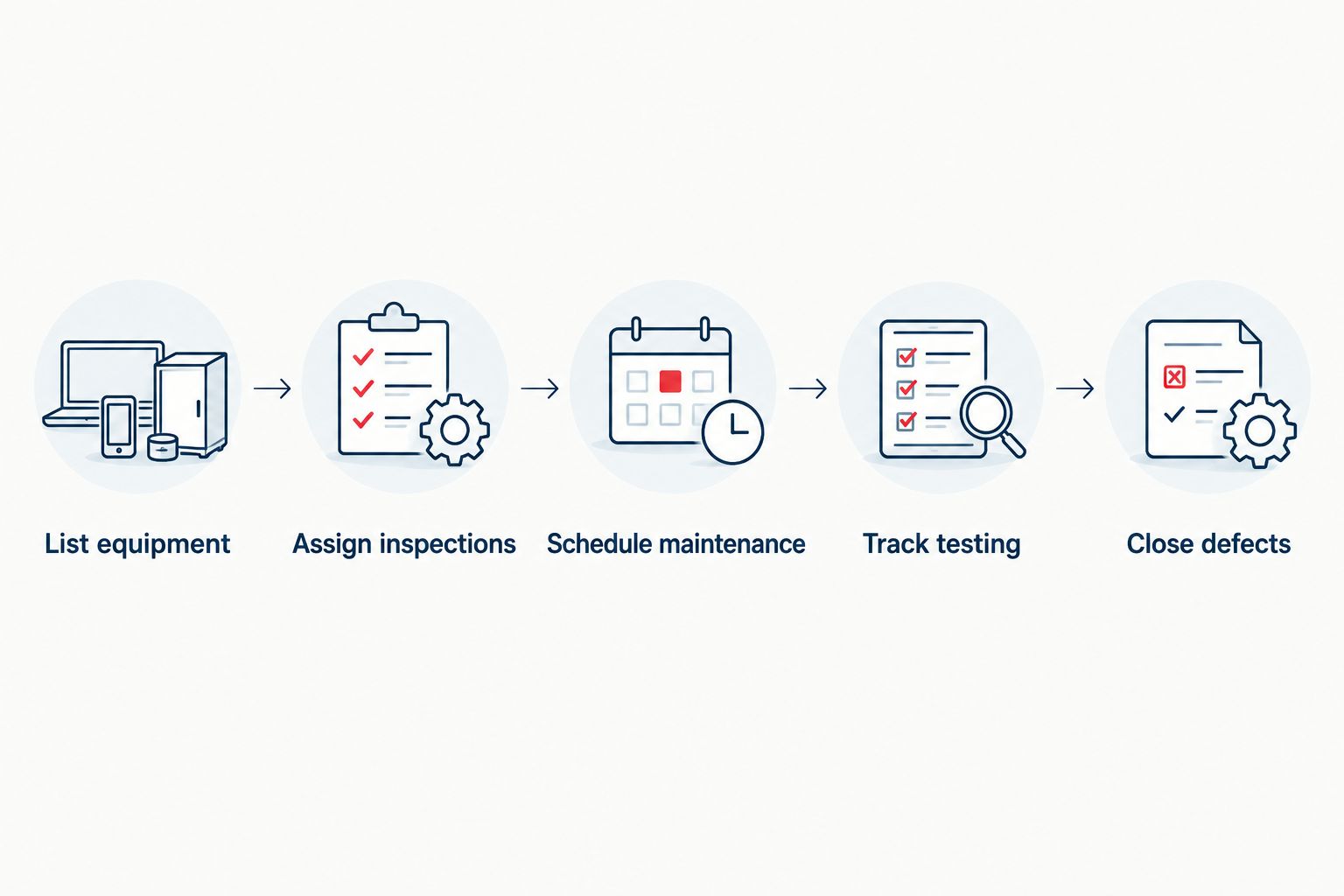
- List equipment. Record an identifier, location, extinguisher type, and available service history for each unit.
- Assign inspections. Name the person responsible for monthly visual checks and a backup for absences.
- Schedule maintenance. Track annual maintenance separately from monthly inspection completion.
- Track testing. Enter applicable internal-maintenance and hydrostatic-test dates from equipment records.
- Close defects. Record the problem, corrective action, and return-to-service status.
When an extinguisher leaves its location for maintenance or recharge, address the protection gap. OSHA 1910.157(e)(5) requires alternate equivalent protection when portable extinguishers are removed from service for maintenance and recharging. Do not leave the bracket empty without addressing coverage.
Keep records that match the work performed
OSHA 1910.157(e)(3) requires a record of the annual maintenance date. Retain that record for 1 year after the last entry or the life of the shell, whichever is less, and make it available to OSHA on request.
Hydrostatic testing has a separate certification-record requirement under 1910.157(f)(16). The record includes the test date, the tester’s signature, and the serial number or other identifier of the extinguisher tested. Keep it until the next hydrostatic test or until the extinguisher is taken out of service, whichever comes first.
The federal monthly visual-inspection provision does not itself specify a written monthly log. A dated checklist still helps you manage missed checks and corrections; local requirements or adopted standards can impose additional documentation duties.
For your 2026 files, keep these records distinguishable:
- Monthly inspection completion and reported defects.
- Annual maintenance dates and service reports.
- Applicable internal-maintenance work.
- Hydrostatic-test certification records.
- Equipment replacements and location changes.
Do not record work as complete until it is complete. An appointment confirmation, purchase order, or planned service date is not a maintenance record.
Questions that come up before service
Does an annual service visit replace monthly inspections?
Monthly visual inspections remain required even when annual maintenance is current. The annual visit does not establish that access stayed clear or that the extinguisher remained undamaged afterward.
Can an employee perform the monthly inspection?
Monthly visual inspections can be assigned to an employee who understands the inspection procedure. OSHA does not require a third-party company for this visual check; hydrostatic testing has separate personnel and equipment requirements.
Is extinguisher training also required annually?
Annual education is required under 1910.157(g)(1)–(2) where an employer provides extinguishers for employee use. Employees designated to use firefighting equipment also need the training addressed in (g)(3)–(4), initially and at least annually; inspection and employee training are separate obligations.
FAQ
How often does OSHA require fire extinguisher inspections?
OSHA requires monthly visual inspections and an annual maintenance check for portable extinguishers covered by 29 CFR 1910.157. Applicable internal maintenance and hydrostatic testing follow separate schedules.
Does OSHA require a fire extinguisher inspection every 30 days?
OSHA 1910.157(e)(2) says monthly, rather than specifying every 30 days. Set a recurring monthly inspection schedule and check any additional applicable requirements.
Does a current annual tag mean my extinguisher passes the monthly check?
No. A current annual maintenance tag does not establish that the extinguisher is accessible, undamaged, and ready when you perform the monthly inspection.
Do all fire extinguishers need maintenance every 6 years?
No. OSHA’s 6-year internal-maintenance rule applies to stored-pressure dry chemical extinguishers that require a 12-year hydrostatic test, with an exemption for nonrefillable disposable containers.
How often does a carbon dioxide extinguisher need hydrostatic testing?
Carbon dioxide extinguishers have a 5-year hydrostatic-test interval under OSHA Table L-1. Condition-related requirements can require earlier action.
Who is responsible if a service company misses an extinguisher?
The employer remains responsible under OSHA 1910.157(e)(1). Reconcile the service report against your equipment inventory and arrange any missed work.
Can I leave an extinguisher location empty while it is being serviced?
OSHA requires alternate equivalent protection when extinguishers are removed for maintenance and recharging. Arrange that protection rather than leaving the location uncovered.
One last thing
Start your next check at the empty brackets, not the tags. An inspection route based only on visible extinguishers can miss equipment that has disappeared. Compare the floor with your inventory before signing off.
For 2026, use Firstlinefire’s extinguisher service alongside an assigned monthly inspection route—not instead of one. Keep the equipment list, correct defects, and track each separate due date.