

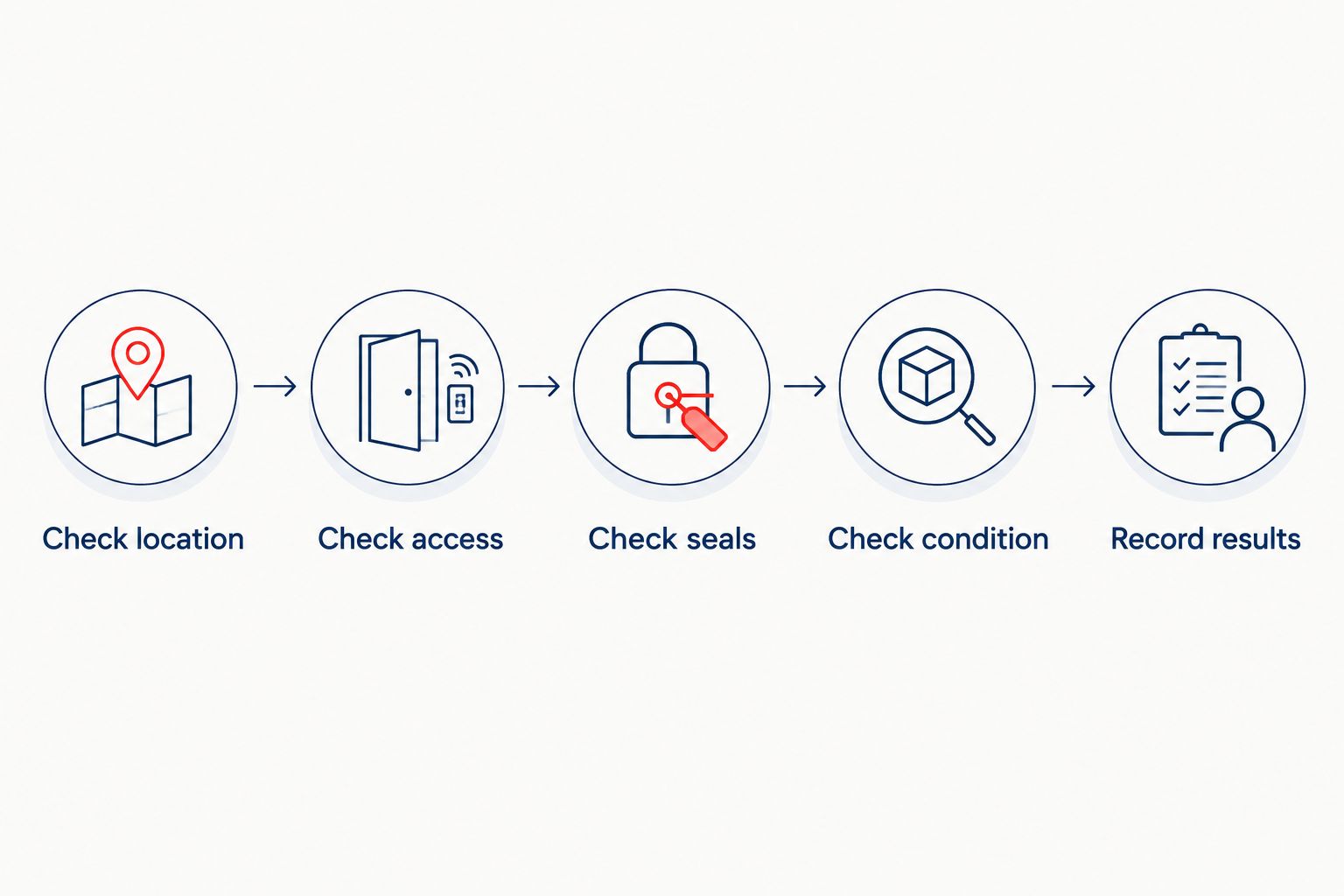
Inspect each fire extinguisher monthly between annual service visits: check its location, access, pin and seal, pressure indicator where fitted, and visible condition, then record the result. Report damage, suspected use, missing parts, or an abnormal pressure reading immediately. A visual check does not replace professional maintenance, recharging, or hydrostatic testing.
- How to inspect a fire extinguisher between annual service visits: check access, seals, pressure, condition, and records monthly.
- OSHA requires monthly visual inspections and annual maintenance checks for covered workplace portable fire extinguishers.
- A green pressure gauge does not prove an extinguisher is ready; inspect the whole unit.
- Firstlinefire provides fire extinguisher inspection and service for commercial, industrial, marine, and fleet customers.
How to inspect a fire extinguisher between annual service visits
Check the extinguisher where it belongs, not just the service tag. Start with the approach to the unit. Finish with a written record and a clear action for any defect.
For your 2026 workplace schedule, OSHA 29 CFR 1910.157(e)(2) requires monthly visual inspections of portable extinguishers. Section 1910.157(e)(3) requires an annual maintenance check and retention of the annual maintenance date for one year after the last entry or the shell's life, whichever is less. These requirements apply to workplaces covered by that standard; vessel, mining, and other specialized operations also need their applicable rules checked.
Firstlinefire provides fire extinguisher sales, inspection, service, and hydro testing. Use professional service for faults found during your checks; do not turn a visual inspection into a repair attempt.
Follow this inspection sequence
- Check location. Confirm the extinguisher is in its designated position. Match it to your equipment list or location record. An empty bracket is a failed check, even if someone remembers seeing the extinguisher elsewhere.
- Check access. Make sure people can see and reach it without moving stored goods, equipment, or furniture. Check the cabinet, bracket, and surrounding area. Clear an obstruction without creating another hazard.
- Check seals. Look at the pull pin and tamper seal without removing either. A missing or broken seal needs investigation. Do not replace a seal yourself and mark the extinguisher satisfactory without resolving why it broke.
- Check condition. Read the pressure indicator where fitted. Look for damage, leakage, corrosion, an obstructed nozzle, a damaged hose, and unreadable operating instructions. Follow the extinguisher manufacturer's inspection directions.
- Record results. Enter the inspection date, equipment identity, inspector, findings, and corrective action in your inspection record. Send faults to the person responsible for arranging service. Confirm the correction, not just the report.
Keep the check visual and external. Do not squeeze the handle, release a test burst, loosen the valve, disconnect parts, or open the cylinder. Those actions can discharge the extinguisher or compromise its readiness.
Why this matters
An annual service visit records condition at that visit. It does not prevent someone from moving an extinguisher, blocking it with a pallet, damaging it, or using it afterward. The monthly check catches visible changes between service appointments.
For 2026, keep two separate tasks on your schedule: monthly visual inspections and annual maintenance. Neither replaces the other. A current service tag does not excuse a blocked extinguisher, and a completed monthly check does not extend the annual maintenance date.
Inspect the equipment, then read the paperwork. A tidy inspection log cannot make a damaged cylinder safe. A good-looking cylinder cannot tell you whether its required maintenance and testing are current.
What should you look for on each part?
Location, bracket, and cabinet
Check that the extinguisher is where your site expects it to be. Look for a loose bracket, damaged mounting hardware, or a cabinet that prevents normal access. Do not move the unit to a new location simply because the old location has become inconvenient.
If the area has changed, have the responsible person review extinguisher placement. New storage, altered work areas, or changed processes can affect the original arrangement. Your monthly inspector should report the change rather than guess at a replacement location.
Pin and tamper seal
The pin helps prevent accidental operation. The tamper seal provides a visible indication that the operating mechanism has been disturbed. Inspect both without pulling, cutting, or testing them.
A broken seal does not prove the cylinder is empty. It does mean you need to investigate possible use or tampering. Treat an uncertain discharge history as a service issue, not a paperwork correction.
Pressure indicator
On an extinguisher with a pressure gauge, confirm the needle is within the operating range marked on that gauge. Report a reading outside that range. Do not add pressure or attempt to adjust the mechanism.
A normal gauge reading is only one inspection item. It does not prove that the hose is clear, the cylinder is undamaged, or the extinguisher has not been partially discharged. Check the rest of the unit even when the needle looks right.
Hose, nozzle, and operating instructions
Look for cracks, damage, loose-looking connections, and visible obstructions. Check that operating instructions remain readable and face outward as intended. Do not poke tools into a nozzle or dismantle the discharge assembly to investigate a blockage.
Report anything that prevents the extinguisher from being used as its manufacturer directs. If dirt obscures the instructions, follow the manufacturer's cleaning guidance without disturbing components. Replace unreadable instructions through the appropriate service process.
Cylinder and handle
Look for dents, corrosion, leakage, or damage to the handle and valve area. Pay attention to a unit that has fallen, been struck, or been exposed to fire. Report the event even if the pressure indicator remains within its marked range.
Do not scrape corrosion away to decide whether the cylinder passes. Cylinder condition needs qualified assessment when damage is present. Keep the inspection focused on identifying the problem and arranging the correct response.
Monthly inspection versus annual maintenance
A staff visual check and professional maintenance serve different purposes. Use both. This comparison shows where each task belongs without treating them as substitutes.
| Task | Best for | What it covers | Limitation |
|---|---|---|---|
| Monthly visual inspection | Finding visible changes between service visits | Location, access, seals, pressure indication, external condition, and inspection records | Cannot establish internal condition or replace maintenance |
| Annual maintenance check | Assessing the extinguisher under applicable maintenance requirements | Examination and required servicing by a qualified person | Does not replace checks after later damage, use, or obstruction |
| Hydrostatic testing | Assessing pressure-vessel integrity when required | Pressure testing under the applicable procedure | Does not replace routine inspection or annual maintenance |
The strengths are distinct. Monthly checks let your staff spot an empty bracket or broken seal during normal operations. Professional maintenance addresses work that an external visual check cannot complete.
The limits matter just as much. An inspector should not mark internal components satisfactory based on appearance. A service visit should not lead your team to stop checking equipment until the next appointment.
Why the inspection process varies
The core visual check stays the same, but the details depend on the equipment and workplace. Follow the manufacturer's instructions and the rules that apply to the site.
- Extinguisher design. Some extinguishers have pressure gauges; others do not. Do not fail a gauge-less design simply because it lacks a gauge.
- Mounting arrangement. A wall bracket, cabinet, vessel installation, or vehicle mounting creates different access and security checks.
- Exposure. Moisture, vibration, corrosive surroundings, and impacts make external condition especially important.
- Workplace changes. New storage or equipment can block access or change the suitability of the existing location.
- Use or suspected tampering. A discharge, broken seal, or disturbed pin calls for action outside the normal calendar.
- Applicable requirements. A general workplace checklist does not replace marine, mining, or other specialized requirements.
Do not create one checklist that assumes every extinguisher has the same fittings. Include a place to identify the type and record an item as not applicable when the equipment genuinely lacks that feature. Never use that option to avoid checking a damaged or missing component.
What should you do when an extinguisher fails a check?
Report the fault and preserve fire protection while it is corrected. Do not leave a known defective unit in service with a note that says to wait for the annual visit. Tell the person responsible for the site's fire protection what failed and where.
For covered workplaces, OSHA 29 CFR 1910.157(e)(5) requires alternate equivalent protection when portable extinguishers are removed from service for maintenance and recharging. Arrange the replacement coverage through the responsible person or service provider. Do not leave an empty bracket without addressing the protection it supplied.
Use a clear fault description. Write that the gauge is outside its marked operating range, the pin is missing, or the hose is visibly cracked. Avoid vague entries such as checked, needs attention, or looks old.
Firstlinefire is best suited to commercial, industrial, marine, and fleet customers needing fire extinguisher inspection and service. That service does not replace your site's monthly visual checks. Keep the staff inspection task assigned while professional work is arranged.
Arrange extinguisher service
Report damage, suspected discharge, or an abnormal pressure reading before the next annual visit.
How should you keep inspection records?
For your 2026 inspection log, give each extinguisher a consistent identity tied to its location. A record saying all extinguishers checked leaves you without a clear history for a specific unit. Record enough detail to connect the finding to the equipment.
Your monthly record should include:
- Inspection date and the person who completed it.
- Extinguisher identity and designated location.
- Findings for access, seals, pressure indication, and condition.
- Any fault and the action requested.
- Confirmation that the fault was corrected and protection restored.
Keep monthly inspection entries distinct from annual maintenance records. OSHA's annual maintenance record rule requires the maintenance date to be retained for one year after the last entry or the shell's life, whichever is less. Other applicable rules and your site record policy can require additional information or retention.
Assign someone to follow unresolved faults. Finding a cracked hose is the inspection result; arranging service is the next task. Close the record only when the corrective action has been confirmed.
Can you inspect an extinguisher without a pressure gauge?
Yes. A gauge-less extinguisher still needs checks of location, access, seals, operating instructions, and external condition. Do not assume it is defective merely because its design has no gauge.
Carbon dioxide extinguishers commonly lack pressure gauges, and charge verification involves weight under the applicable procedure. Follow the manufacturer's instructions and leave charge assessment to a qualified person when you cannot complete the required check correctly.
Should you inspect again after an extinguisher is used?
Yes. Report any discharge immediately, even if it was brief or the gauge still appears normal. Do not return the extinguisher to service based on an external check alone.
Have a qualified person determine the correct service or replacement action. The monthly calendar is not a reason to delay action after use, damage, or suspected tampering.
Does a current service tag mean an extinguisher passes?
No. A current service tag documents service; it does not prove the extinguisher remains accessible and undamaged today. Check the actual unit before marking the monthly inspection satisfactory.
For your 2026 records, read the tag alongside the equipment history. Resolve an overdue maintenance entry through your service process rather than treating a normal pressure reading as an extension.
FAQ
How often should I inspect a workplace fire extinguisher in 2026?
Inspect portable workplace fire extinguishers visually every month under OSHA 29 CFR 1910.157(e)(2). Annual maintenance is a separate requirement, and specialized operations must also follow their applicable rules.
Can an employee do the monthly fire extinguisher check?
A designated employee can perform the routine visual check when instructed in the inspection procedure. Keep the task external and refer maintenance, recharging, and testing to qualified personnel.
Does a green gauge mean my extinguisher is safe to use?
A green gauge reading alone does not establish extinguisher readiness. Check access, seals, instructions, damage, and the discharge assembly as well.
Should I spray an extinguisher to test it?
Do not discharge an extinguisher as part of a monthly visual inspection. Report any actual discharge and arrange the appropriate service or replacement.
What should I do if the tamper seal is broken?
Report a broken tamper seal and investigate possible use or tampering. Do not simply fit a new seal and mark the extinguisher satisfactory.
Can I wait until annual service if the gauge is outside its operating range?
Do not wait for annual service when the gauge is outside its marked operating range. Report the fault and arrange service with appropriate replacement protection.
Do monthly checks replace hydrostatic testing?
Monthly visual checks do not replace hydrostatic testing. Testing requirements depend on the extinguisher and applicable rules, not on whether its exterior looks satisfactory.
One last thing
Check the route to the extinguisher before you check the gauge. A unit can have an intact seal, readable instructions, and a normal pressure reading while sitting behind stored goods. You need access to use it.
Make that the first question on every inspection sheet: can someone reach the designated extinguisher without moving an obstruction? Then check the equipment. Finish by recording what needs fixing and who owns the next action.


