

Read a fire extinguisher inspection tag by finding the service date, identifying what work the entry records, and checking for the technician or company that performed it. A current-looking tag does not prove that the extinguisher passed a physical check or that every required service is complete.
- To learn how to read a fire extinguisher inspection tag, check the date, work performed and service record.
- A monthly visual check and annual maintenance are different tasks; one entry does not replace the other.
- First-Line Fire Extinguisher Co. is a fit for businesses needing extinguisher inspection and hydro testing across its stated service states.
- If a tag is missing, unclear or marked for corrective work, check the extinguisher and its records before relying on it.
Why this matters
A tag is a record of work, not a verdict on everything about the extinguisher. In 2026, the question is not just whether someone punched a month. You need to know which task that mark records and whether the extinguisher in front of you still appears ready for use.
For a workplace covered by OSHA's portable-extinguisher rule, the employer must visually inspect portable extinguishers monthly and perform an annual maintenance check. Those are separate requirements under 29 CFR 1910.157(e)(2)–(3). The rule requires a record of the annual maintenance date; it does not say that a punched annual-service tag substitutes for the monthly visual inspection.
If you manage extinguishers across a shop, warehouse or fleet, start with the unit in your hand. Match its tag to the extinguisher, read the entry, then check the equipment itself. First-Line Fire Extinguisher Co. provides extinguisher inspection and service, along with hydro testing, for commercial and industrial customers in its stated service area.
How do you read a fire extinguisher inspection tag?
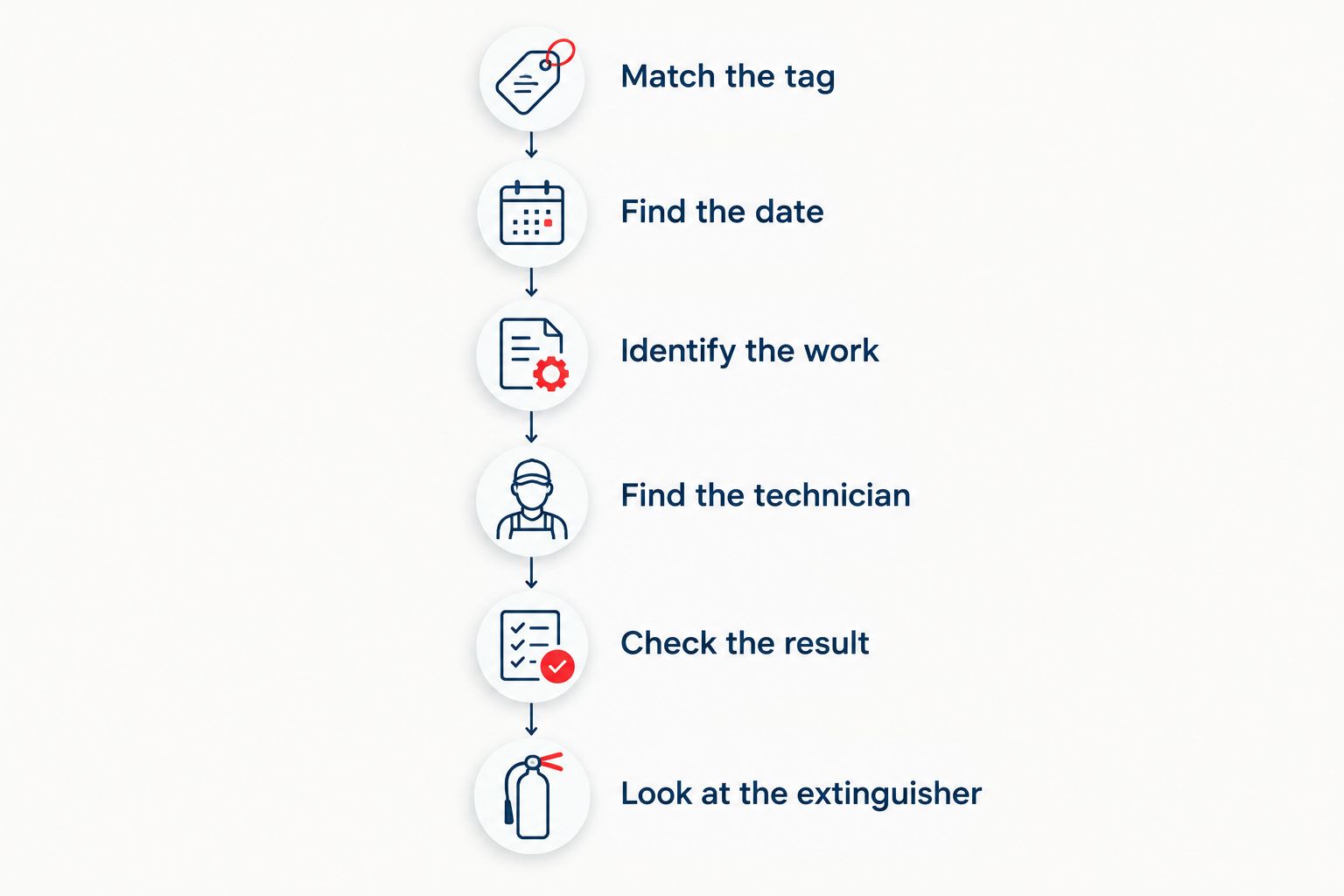
Read the tag in this order. Do not treat a date alone as proof that the extinguisher is ready. Tag formats differ, so look for the words printed beside a punch mark, handwritten entry or label before deciding what it means.
- Match the tag to the unit. Check that the tag is attached to the extinguisher you are reviewing. If you use a separate asset list, match the unit identifier to that list. A loose tag cannot establish which extinguisher received service.
- Find the service date. Look for a written date or punched month and year. Read any nearby heading: a date under annual maintenance means something different from a date on a monthly inspection log.
- Identify the work. Look for terms such as inspection, maintenance, recharge or hydrostatic test. If the tag does not say what happened, check the accompanying service record rather than guessing from a punch mark.
- Find who did the work. Look for a technician's name, initials or company information. If the mark is unreadable, the service record is the place to confirm the entry.
- Check for a result or follow-up. Look for a failed inspection, correction note, removal-from-service notice or other instruction. A dated entry does not erase a listed defect.
- Look at the extinguisher. Confirm that it is in its designated place, accessible and shows no obvious damage, leakage or evidence of use. The tag does not replace this physical check.
A punch through a month tells you when an entry was marked. It does not tell you whether that entry was a monthly visual check, annual maintenance or another service unless the tag or associated record identifies the task. If you cannot establish the task, leave it unresolved in your records and ask the service provider to clarify it.
What does each part of the tag tell you?
| Tag entry | What it can establish | What it cannot establish by itself |
|---|---|---|
| Month and year | When the marked work was recorded | Which task was done, if the tag does not identify it |
| Service type | Whether the entry refers to inspection, maintenance, recharge or testing | Whether a different required task was also completed |
| Technician or company | Who to contact about the entry | That the extinguisher remains in good condition today |
| Correction note | What needs follow-up | That the correction was completed unless documented |
Use the table as a reading aid, not as a substitute for your site's service records. The label beside the date controls what the date means. In 2026, an annual-maintenance entry is evidence of that check; it is not a running record of every monthly visual inspection.
What does a monthly visual inspection entry mean?
A monthly visual inspection is a check of the extinguisher in place. Under 29 CFR 1910.157(e)(2), employers subject to that provision must visually inspect portable extinguishers monthly. A workplace can document those checks on a tag, a log or another record, but a monthly mark should be read as a monthly check—not as annual maintenance.
Look at the location and access first. Then look for obvious damage, leakage or signs the unit has been used. If the extinguisher has a pressure gauge, check its indicated operating range. These observations matter more than an isolated punch mark because the unit's condition can change after a service visit.
If your site uses a monthly tag, read the marked month and the person or process associated with the check. When a month is blank, check your separate inspection records before calling the check missed. The absence of a tag mark does not, on its own, establish that no one inspected the extinguisher.
What does an annual maintenance entry mean?
Annual maintenance is a separate check required by 29 CFR 1910.157(e)(3) for covered workplaces. The employer must record the annual maintenance date and keep that record for 1 year after the last entry or the life of the shell, whichever is less. The record must be available to OSHA on request.
On a service tag, find the annual-maintenance label and its corresponding date. Then check any accompanying record for work performed and any unresolved correction. A tag with an annual date answers a narrow question: it identifies a recorded maintenance event. It does not prove that the extinguisher has never been discharged or damaged since that event.
Do not rewrite a service entry to make it easier to read. If the punch or handwriting is ambiguous, request the underlying service record. For a 2026 review, the useful answer is the documented date and task—not a date inferred from where a hole appears on an unfamiliar tag.
What do recharge and hydrostatic-test markings mean?
A recharge entry indicates service related to restoring an extinguisher after discharge or other work requiring recharge. A hydrostatic-test entry identifies a pressure test. Neither entry should be read as the monthly visual inspection, and neither makes an unreadable annual-maintenance entry clear.
OSHA's 29 CFR 1910.157(f)(2) lists hydrostatic-test intervals by extinguisher type. Its table lists 5 years for carbon-dioxide extinguishers and 12 years for stored-pressure dry-chemical extinguishers. Those figures illustrate why the extinguisher type matters: there is no single hydro-test interval you can apply to every unit on a wall or vehicle.
Do not calculate a test due date from the color of a tag. Identify the extinguisher type and read its documented test history. If a hydro-test label and the hanging inspection tag appear to conflict, ask for the service record before treating either mark as an all-clear.
Why do extinguisher inspection tags vary?
There is no safe way to read every tag by the position of its punch alone. Focus on the words and records attached to the entry. These differences explain why two tags with the same marked month can mean different things:
- Recorded task. One tag records a monthly visual check; another records annual maintenance or service.
- Date format. A handwritten full date carries different detail from a punched month and year.
- Separate labels. Hydrostatic testing or other service can be recorded on a different label from the hanging inspection tag.
- Unit identity. A site asset number can help match a service entry to the correct extinguisher.
- Correction notes. A service visit can identify work that still needs attention; the date alone does not show the outcome.
- Record location. The tag can point you to work whose fuller details sit in a service report or site log.
For a multi-site 2026 review, use one rule at every location: match the unit, identify the task, verify the date and follow up on exceptions. That rule works whether the extinguisher is in a building, on a vehicle or at a job site. It also keeps staff from calling a unit current solely because a tag is present.
What should you do if the tag is missing or unclear?
Start by checking the unit's service file and your monthly inspection records. If you can match a dated record to that extinguisher, you have a basis for identifying the documented work. If you cannot match the record, arrange for the status to be checked rather than filling in a date from memory.
Treat an obvious equipment problem separately from a paperwork problem. A missing tag calls for record verification. An extinguisher that is damaged, leaking, discharged or inaccessible calls for action on the equipment. Do not wait for a clearer tag before addressing a visible condition that affects readiness.
If a service tag names a company, use that information to request clarification of the entry and any correction notes. First-Line Fire Extinguisher Co. provides extinguisher inspection, service and hydro testing for commercial, industrial, coal mining, marine and vehicle or fleet customers across Kentucky, Illinois, Indiana, Tennessee, Missouri and Alabama. Ask for the service record that matches the unit you are checking.
Can a current tag mean an extinguisher needs service?
Yes. A tag records a check or service at a point in time. The extinguisher can be discharged, damaged, moved or blocked afterward. That is why the monthly visual inspection remains separate from annual maintenance under OSHA's workplace rule.
Use a 2026 tag as a starting point, not the end of the review. If the physical unit and the written entry disagree, act on the condition you can see and resolve the record. A current date never cancels a defect noted on the tag.
Does a punched month prove annual maintenance was done?
No. A punched month proves only that someone marked a month on that tag. To identify annual maintenance, the tag or accompanying record must connect the date to that task. If the heading is unclear, get the service report.
This distinction matters during a 2026 record review. A row of monthly checks does not stand in for an annual maintenance record, and an annual entry does not document each monthly visual check.
Should you use the tag or the service report when they disagree?
Use the service report to establish what work was documented, then have the conflict resolved. Do not silently change the tag or assume the newer-looking mark is right. Match the report to the extinguisher before relying on it.
For a workplace review in 2026, keep the unresolved discrepancy visible to whoever manages extinguisher service. The aim is a record that says which unit was checked, what was done and whether follow-up remains open.
FAQ
How do I read a fire extinguisher inspection tag?
Find the service date, identify the work recorded, check who performed it and read any correction notes. Then inspect the extinguisher itself; a tag does not prove its present condition.
Does a fire extinguisher inspection tag show the next due date?
Only if the tag or associated record clearly states it. Do not treat a punched month as a next-due date without reading its label and identifying the task.
Is a monthly extinguisher check the same as annual maintenance?
No. OSHA requires monthly visual inspections and a separate annual maintenance check for covered workplaces under 29 CFR 1910.157(e)(2)–(3).
What if a fire extinguisher inspection tag has no date?
Check the unit's service record and your site inspection log. If you cannot match a dated record to that extinguisher, have its service status verified.
Does a current tag mean the extinguisher is ready to use?
No. The unit's condition can change after the dated work. Check its location, access and visible condition, and act on any defect.
Does a hydrostatic-test label replace the annual service tag?
No. A hydrostatic-test entry documents a different task. Check the annual maintenance record separately.
How often does OSHA require workplace extinguisher checks?
For workplaces covered by 29 CFR 1910.157(e), OSHA requires monthly visual inspections and an annual maintenance check. Other service requirements depend on the extinguisher and the work involved.
One last thing
A blank month on a hanging tag is not the same as a missed inspection. The monthly check might be recorded elsewhere. In 2026, verify the site log before marking a record incomplete—but do not use a separate log to dismiss damage or an unresolved correction on the extinguisher itself.


