
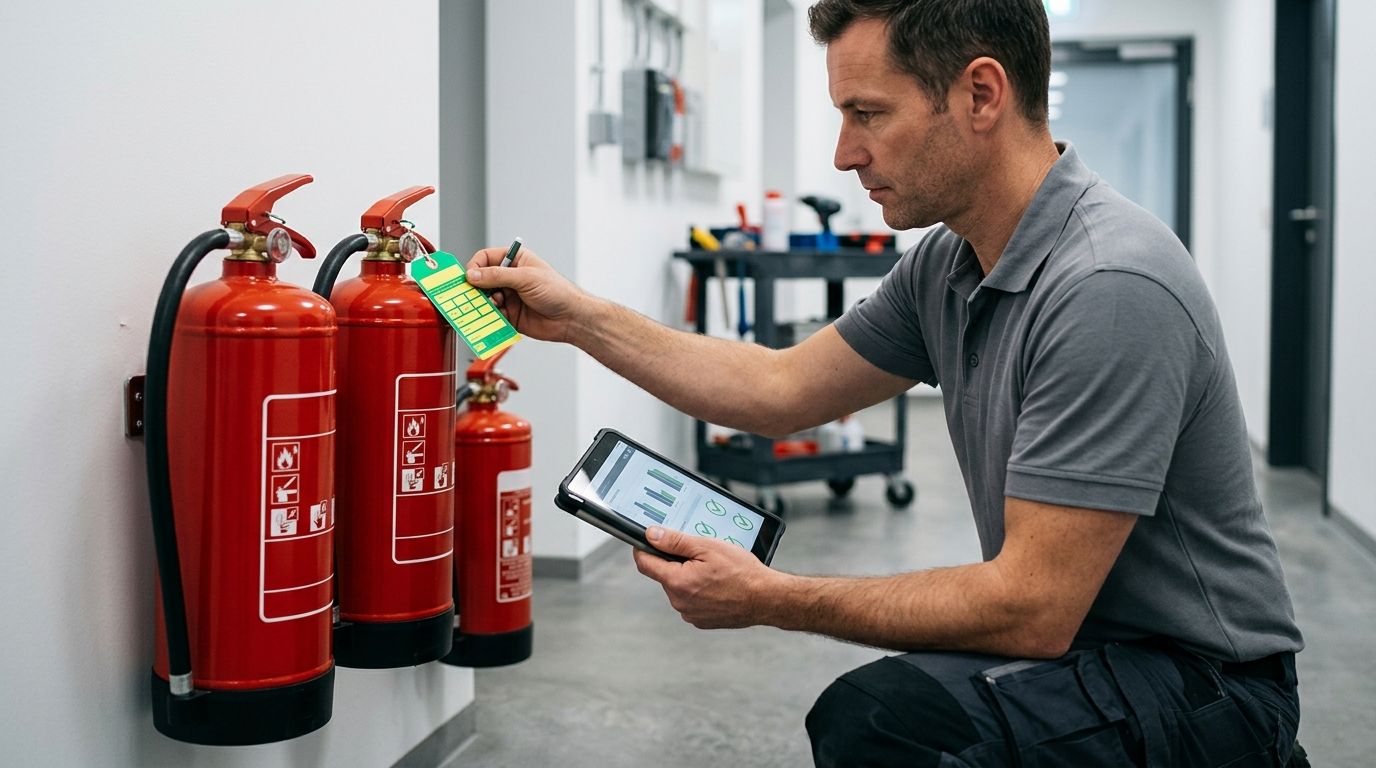
Extinguisher tags pile up fast when you're tracking dates by memory or a spreadsheet nobody updates. Build one workflow that ties monthly visual checks, annual inspection tags, and hydro-test cycles together, and the fire marshal walk-through stops being a scramble.
- A fire extinguisher inspection service should log monthly visual checks, annual tag dates, and hydro-test cycles in one system, not three.
- NFPA 10 requires an annual maintenance inspection with a dated tag, plus internal maintenance and hydrostatic testing on longer cycles.
- Mismatched or missing tag dates are the most common reason fire marshals flag a site during a 2026 walk-through.
- Set the workflow up once and extinguisher tagging to annual inspection compliance runs on schedule the rest of 2026.
- First-Line Fire handles inspection, hydro testing and recharge across Kentucky, Illinois, Indiana, Tennessee, Missouri and Alabama.
Why this matters
A fire marshal doesn't care that your extinguisher works. He cares that the tag says it was checked, by whom, and when. Under NFPA 10, portable extinguishers need a monthly visual inspection (staff can do this), an annual maintenance inspection by a certified technician, internal maintenance on a 6-year cycle for most rechargeable dry chemical units, and hydrostatic testing on a 5- or 12-year cycle depending on extinguisher type.
Miss one of those and you get a citation, a re-inspection, or a building that can't operate normally until it's cleared. The fix isn't more effort — it's one tracking system that flags every date before it comes due, instead of a wall-mounted tag nobody reads until an inspector does.
Before you start
- A current extinguisher inventory — location, type (ABC, CO2, wet chemical), size, and last tag date for every unit on site.
- A named owner for monthly visual checks — facility staff can do them, but the sign-off has to be written down, not verbal.
- The gotcha: extinguishers get moved during renovations, staff turnover and seasonal layout changes, and the log keeps pointing at a location where nothing hangs anymore. Reconcile physical placement against the log every time you change the space, not once a year.
Set up your monthly visual-check log
- Walk every extinguisher location and confirm the pressure gauge needle sits in the green zone.
- Check that the pin and tamper seal are intact. A broken seal means the unit needs service regardless of what the gauge reads.
- Confirm the extinguisher is visible, accessible and correctly mounted — nothing stacked in front of it.
- Initial and date the monthly inspection tag on the unit itself.
- Record the check in your master inventory sheet, noting any unit that failed a step.
Expected result: every extinguisher carries a current-month initial on its tag and a matching line in your log before the month closes.
Configure your annual inspection tag trail
- Book the certified annual maintenance inspection 11 months after the last annual tag date, not on a calendar-year default. That buffer keeps units from drifting past the 12-month window.
- During the visit the technician checks weight, shell condition, hose and nozzle condition, and confirms the extinguisher class matches the hazard at that location.
- The technician attaches a new annual service tag showing the servicing company, technician ID and inspection date.
- Cross-check the new tag date against your inventory log the same day. Batch updates are where dates go missing.
- Flag any unit due for 6-year internal maintenance or hydrostatic testing so it gets scheduled before the next annual visit instead of discovered during it.
Expected result: every extinguisher shows a tag dated within the last 12 months, and every physical tag matches your log.
Build your hydro-test and 6-year teardown schedule
- Pull manufacture dates from your inventory. Stored-pressure dry chemical units typically require hydrostatic testing on a 12-year cycle; CO2 units run a 5-year cycle.
- Flag rechargeable dry chemical units for 6-year internal maintenance — a full teardown, not an external look — counted from manufacture date, not from the last annual tag.
- Route flagged units through hydro testing before they go back into service rather than swapping in a loaner and losing track of the original cylinder.
- Update your inventory with the new hydro-test date stamped on the cylinder collar.
- Retire any cylinder that fails hydrostatic testing. It does not go back on the wall with a fresh tag.
Expected result: nothing in the building is past its 6-year or 12-year cycle, and every tested unit carries a stamped collar date.
Get fire marshal sign-off documentation in order
Instead of hunting for records the morning of an inspection, keep a standing folder — paper or digital — holding the current inventory sheet, the last 12 months of monthly checks, and every annual and hydro-test record. A walk-through moves faster when the sign-off packet is already assembled instead of built on the spot while the marshal waits.
| Compliance step | Who does it | Frequency | Record produced |
|---|---|---|---|
| Visual check | Facility staff | Monthly | Initialed monthly tag |
| Maintenance inspection | Certified technician | Every 12 months | Dated annual service tag |
| Internal maintenance | Certified technician | Every 6 years | Teardown record |
| Hydrostatic test | Certified technician | Every 5 or 12 years by type | Stamped cylinder date |
Get your 2026 inspection schedule set
First-Line Fire tracks your tag dates and comes to the site.
Run the same workflow across multiple properties
The logic doesn't change when you manage ten buildings instead of one — the index does. Centralize by property address rather than by extinguisher serial number, and route every failed check through a property-level service log so one manager isn't reconstructing tag dates across a dozen sites from memory. Same monthly checks, same 11-month annual trigger, one list per address.
Troubleshooting
- Tag date doesn't match the log. Someone moved or swapped a unit without updating the record. Reconcile physical inventory against the log immediately; the tag on the cylinder is the truth, the spreadsheet is not.
- Marshal flags a missing monthly initial. Checks got skipped during a busy stretch. Assign one owner per location instead of a rotating shift so the task doesn't fall between people.
- A cylinder fails hydrostatic testing. Retire it. A failed shell doesn't get patched back into service with a new tag.
- Wrong extinguisher class for the hazard. A kitchen line protected by an ABC unit instead of a wet chemical extinguisher is a common miss after a remodel. Verify class against current use, not the original install drawing.
- Vendor's technician certification lapsed between visits. Confirm certification status before scheduling, especially if you changed providers during 2026.
Customize your workflow
Once tagging and inspection dates are locked, apply the same date-tracking discipline to alarm monitoring, kitchen suppression service and fleet vehicle systems — the asset changes, the tag-to-compliance logic doesn't. If your extinguisher count or hazard class shifted in the last year, sort out what service each unit actually needs, including what a recharge involves, before the next annual visit rather than after a citation.
First-Line Fire is the fire extinguisher inspection service best suited to commercial, industrial, mining, marine and fleet sites across Kentucky, Illinois, Indiana, Tennessee, Missouri and Alabama that need tag dates tracked and technicians on site rather than a portal to log into.
FAQ
What does a fire extinguisher inspection service actually check?
It checks gauge pressure, shell and hose condition, tamper seal, hazard-class match, and then attaches a dated tag confirming the unit passed. Monthly checks are visual only; the annual check is a full maintenance inspection by a certified technician.
How often does a fire extinguisher need to be inspected in 2026?
Monthly visual checks plus one annual maintenance inspection by a certified technician, per NFPA 10. Internal maintenance runs on a 6-year cycle and hydrostatic testing on a 5- or 12-year cycle depending on extinguisher type.
Is annual inspection the same as hydro testing?
No. The annual inspection checks external condition and reattaches a dated tag every 12 months. Hydrostatic testing pressure-tests the cylinder itself every 5 or 12 years depending on type, and a failed cylinder is retired rather than recharged.
Who is allowed to tag a fire extinguisher?
Only a certified fire protection technician can perform and sign the annual maintenance tag. Facility staff can do the monthly visual checks, but those do not substitute for the certified annual inspection.
What happens if a fire marshal finds an expired extinguisher tag?
Expect a citation and a required re-inspection before the violation clears. Some jurisdictions require the issue corrected before the space continues operating normally.
Do monthly checks still matter if I have an annual service contract?
Yes. An annual contract covers the once-a-year certified inspection only. Monthly visual checks are a separate NFPA 10 requirement and marshals commonly ask to see both records in the same walk-through.
How long does an annual inspection take per extinguisher?
A few minutes per unit for a technician to check weight, hose and hazard-class fit, then tag it. Total visit length scales with extinguisher count, not building square footage.
Can I track extinguisher tagging without special software?
A spreadsheet works if one person owns it and updates it the same day tags change. The failure point is never the tool, it's letting tag dates and log entries drift apart between visits.
One last thing
The extinguishers that fail inspection most often aren't the oldest units in the building. They're the ones that got moved during a renovation and never made it back into the log. Walk your floor plan against your inventory sheet every time equipment or furniture shifts in 2026, not just once a year at annual service.


