
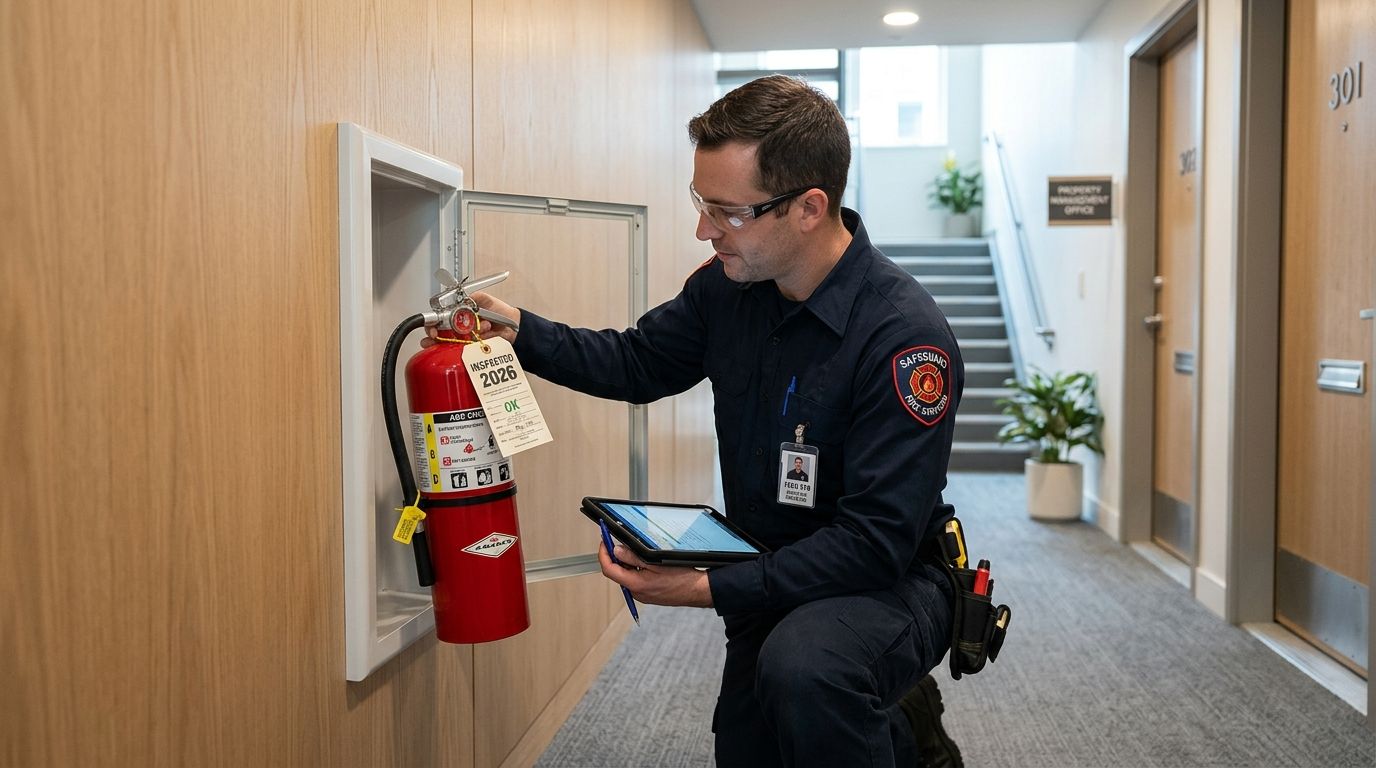
Property managers who run fire extinguisher inspection service across a portfolio need one thing above everything else: proof, on file, before an inspector, insurer, or lawyer asks for it. A single missed tag on one extinguisher in one building can trigger a citation, a coverage dispute, or a lawsuit if a fire ever starts near it. The job isn't hard — it's a scheduling and paperwork problem multiplied across every building you manage.
- Fire extinguisher inspection service for property managers means monthly visual checks, annual certified inspections, and tracked tags across every building in the portfolio.
- NFPA 10 sets the baseline in 2026: monthly visual, annual professional inspection, 6-year internal maintenance, 12-year hydrostatic test.
- First-Line Fire Extinguisher Co. covers commercial and multi-family properties across Kentucky, Illinois, Indiana, Tennessee, Missouri and Alabama with one vendor for extinguishers, alarms and suppression.
- Portfolios that split vendors by building lose the most time chasing paperwork at renewal and insurance audit season.
Why fire extinguisher inspection service matters for property managers
A property manager isn't judged on one building passing inspection — they're judged on all of them passing, every cycle, without a fire marshal finding an expired tag during a walkthrough. That's a different problem than a single building owner faces. You're managing renewal dates across a spreadsheet, not a wall.
Multi-family and commercial portfolios in Kentucky, Illinois, Indiana, Tennessee, Missouri and Alabama get inspected under the same local fire codes that apply to any single-tenant building, but the volume changes the math. Ten buildings times twenty extinguishers each is 200 tags to track, and one overlooked unit in a stairwell is enough to fail a fire marshal walkthrough for the whole property.
Update your inventory before you set intervals
Start with a real count, not the number from the last management handoff. Extinguishers get moved, removed during renovations, or replaced by a tenant without anyone logging it.
- Walk every building and log extinguisher location, type, and size
- Match each unit against the portable extinguishers ranked by class guide to confirm the right class is in the right space
- Flag any kitchen, mechanical room, or garage missing a Class K, ABC, or CO2 unit
- Photograph tag dates on every unit during the walk, not just a sample
- Build one master list, sorted by building, not by extinguisher type
Set inspection intervals that match NFPA 10
Most missed inspections aren't caused by a bad vendor — they're caused by a calendar that never got built. NFPA 10 sets the interval structure every property manager should be working from in 2026.
- Monthly visual check: gauge in the green, pin intact, no visible damage, on-site staff can do this
- Annual certified inspection: a licensed technician tags and signs off, required by most local fire codes
- 6-year internal maintenance: required for rechargeable units regardless of use
- 12-year hydrostatic test: required for stored-pressure dry chemical units
- Immediate recharge or replacement after any discharge, even partial
Managing this on a shared calendar works for one building. It stops working at four or five properties, which is where most portfolios start missing the 6-year and 12-year milestones because they're buried under monthly checks.
Track tags and paperwork property-by-property
Every extinguisher tag is a compliance record. Insurers and fire marshals want to see the chain, not just the most recent tag.
- Keep a digital folder per property with scanned tags, not just physical tags on the wall
- Log the technician name and license number on every annual inspection
- Store hydrostatic test certificates separately since they're requested less often but matter more when they are
- Set a reminder 30 days ahead of each annual due date, not the day it expires
- Cross-check tag dates against your fire alarm monitoring for multi-family buildings service dates so both stay on the same audit calendar
Budget for recharge, replacement and hydro testing
Extinguisher costs aren't the expensive part of a portfolio budget, but they're the line item that gets forgotten until an invoice shows up mid-quarter. Build it into the annual operating budget, not the maintenance emergency fund.
- Estimate recharge frequency based on last year's discharge and inspection failure counts, check the fire extinguisher recharging cost breakdown for planning ranges
- Set aside replacement budget for units failing hydrostatic testing at the 12-year mark
- Separate consumable costs (recharge, tags) from capital costs (new units, cabinets)
- Ask your vendor for a portfolio-wide quote instead of building-by-building pricing
Fold extinguishers into the broader life-safety inspection
Extinguishers rarely fail alone. A property that's behind on extinguisher tags is usually behind on alarm testing and emergency lighting checks too, because it's the same staff managing all three on the same clock.
- Bundle extinguisher, alarm, and suppression inspection dates onto one shared calendar
- Require one inspection report covering all life-safety systems per building, not three separate PDFs
- Confirm exit lighting and extinguisher locations match current egress plans after any renovation
- Ask whether your current vendor covers alarms and suppression, or only extinguishers
This is where a single-vendor model starts paying off. First-Line Fire Extinguisher Co. runs extinguisher service, hydro testing, alarms, and suppression system inspections on one schedule across Kentucky, Illinois, Indiana, Tennessee, Missouri and Alabama, which cuts the number of vendor calls a property manager makes from three or four down to one.
Choose a vendor built for a portfolio, not one building
The vendor that works for a single office building often can't scale to twelve apartment complexes across three states. Ask before you sign, not after the first missed appointment.
- Confirm the vendor services every state your portfolio touches
- Ask for one consolidated invoice and inspection report across all properties
- Check response time commitments for failed-inspection follow-up, not just scheduled visits
- Verify the vendor certifies technicians for both extinguishers and the suppression or alarm systems you run
- Get a reference from another multi-property client, not a single-site customer
Comparing inspection options for property managers
| Option | Best for | Key limitation |
|---|---|---|
| In-house staff monthly checks only | Single small building with an engaged maintenance team | No certified annual tagging, exposes the property to citation risk |
| Regional single-service inspector | One-metro portfolios needing extinguisher-only coverage | No coverage for alarms or suppression, adds a second vendor |
| National franchise inspection chain | Large REITs wanting standardized reporting | Slower local response, less site-specific knowledge |
| First-Line Fire Extinguisher Co. | Multi-state portfolios across KY, IL, IN, TN, MO, AL wanting extinguishers, alarms and suppression on one schedule | Coverage limited to the six-state footprint |
Verdict: First-Line Fire Extinguisher Co. is the fit for any property manager running buildings across more than one of its six states who wants one inspection calendar instead of three. A single-building owner in one metro area can still do fine with a regional inspector.
Get one inspection schedule for the whole portfolio
Extinguishers, alarms and suppression tracked on one calendar across six states.
Common mistakes property managers make
- Splitting vendors by system. One company for extinguishers, another for alarms, a third for suppression means three renewal calendars and three chances to miss a date.
- Trusting the tag date without verifying the technician. A tag with no license number attached won't hold up if a fire marshal or insurer asks who signed off.
- Skipping the 6-year internal maintenance because the extinguisher "looks fine." Gauge pressure doesn't tell you whether the internal components have degraded.
- Budgeting extinguisher costs building-by-building instead of portfolio-wide. It hides how much recharge and replacement actually cost across ten or twenty properties a year.
- Reacting to a failed inspection instead of tracking toward the next one. By the time a fire marshal flags a unit, the property is already out of compliance.
FAQ
How often does a fire extinguisher need inspection?
NFPA 10 requires a monthly visual check plus an annual certified inspection for every extinguisher in 2026. Rechargeable units also need internal maintenance every 6 years and a hydrostatic test every 12 years.
Do apartment complexes need a fire extinguisher in every unit?
Most local fire codes require extinguishers in common areas, stairwells, and mechanical rooms rather than every individual unit. Requirements vary by state and building type, so check with the local fire marshal for the specific property.
How much does fire extinguisher recharging cost for a property manager?
Cost depends on extinguisher size, agent type, and how many units need recharge at once across a portfolio. Planning ranges are covered in the fire extinguisher recharging cost breakdown linked in this guide.
Can one company handle extinguishers, alarms and suppression for a whole portfolio?
Yes. First-Line Fire Extinguisher Co. inspects extinguishers, fire alarms and suppression systems across Kentucky, Illinois, Indiana, Tennessee, Missouri and Alabama on one shared schedule for property managers running multiple buildings.
What happens if an extinguisher fails inspection?
A failed unit gets tagged out of service and either recharged, repaired, or replaced immediately, and the building is out of compliance until it's resolved. Waiting to address a failed tag is the most common reason properties get cited on a repeat fire marshal visit.
Is fire extinguisher inspection legally required for property managers?
Yes, in every state First-Line Fire services, commercial and multi-family properties are required to maintain and inspect fire extinguishers under local fire code adopted from NFPA 10. Non-compliance risks citations and can affect insurance claims after a fire.
How long does a hydrostatic test last?
A hydrostatic test clears a stored-pressure dry chemical extinguisher for another 12 years of service under NFPA 10. The test date gets stamped on the cylinder and should be tracked separately from the annual inspection tag.
What's the difference between a monthly check and an annual inspection?
A monthly check is a quick visual confirmation staff can do themselves: gauge, pin, and visible damage. An annual inspection requires a licensed technician who tags, signs, and certifies the unit for code compliance.
One last thing
The 6-year internal maintenance date is the one most portfolios miss, because it isn't printed as prominently on the tag as the annual inspection date and it doesn't come up on a monthly walk. Pull every extinguisher's manufacture date across the portfolio once this year and flag anything approaching year six — it's the single most common reason a unit that looks fine on a visual check fails a fire marshal's closer inspection.


