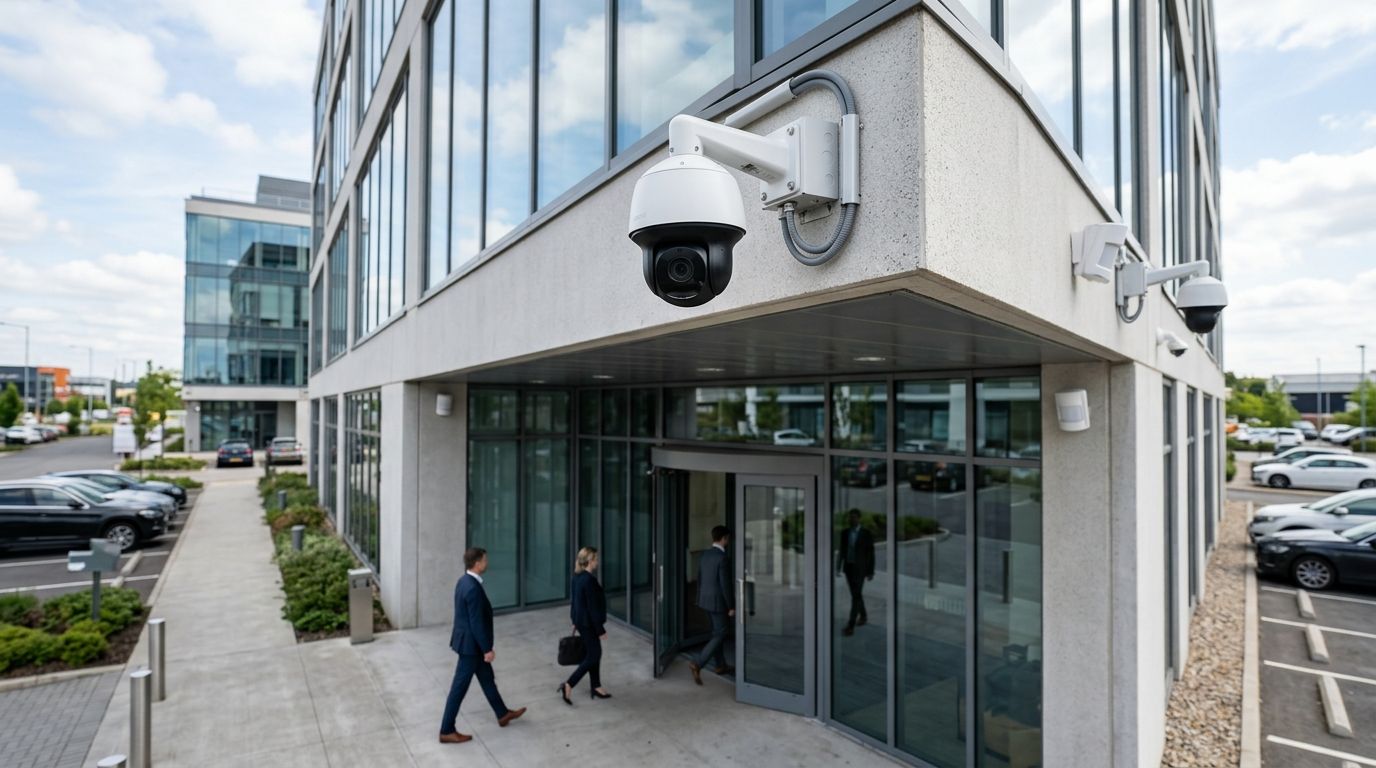
Offices need two things from an emergency lighting system in 2026: 90 minutes of runtime the moment power drops, and a way to prove it works without someone climbing a ladder every month. This guide ranks the six system types you'll actually be choosing between, what each one is built for, and where each one falls short.
- LED combo exit/emergency units are the best exit and emergency lighting systems for offices under 10,000 square feet — Buy for standard layouts.
- Self-testing LED units cut manual test labor and fit compliance-heavy multi-tenant buildings — Buy if you manage 3+ tenants.
- Centralized inverter systems handle large multi-floor offices from one battery bank — Buy for 20,000+ sq ft buildings.
- Standalone battery backup exit signs are the budget pick for single-room or small offices — Hold for anything bigger.
- NFPA 101 requires 90 minutes of emergency illumination on power loss, tested monthly and annually.
Why this matters
Exit and emergency lighting isn't optional decor near your doors. NFPA 101, the Life Safety Code, requires emergency lighting to operate for a minimum of 90 minutes after normal power fails, and it requires a 30-second functional test monthly plus a full 90-minute discharge test annually. OSHA's 29 CFR 1910.37 backs this up on the federal side, requiring exit routes to stay adequately lit at all times employees are present.
The part most offices get wrong isn't the initial install — it's the testing cadence. A unit that passed inspection in 2024 can fail its battery test by 2026 with nobody noticing until an AHJ walkthrough or, worse, an actual outage. That's the gap this ranking is built to close: which system type actually keeps itself provably compliant, and which one just looks compliant on install day.
First-Line Fire Extinguisher Co. installs and services all six of these system types for commercial customers across Kentucky, Illinois, Indiana, Tennessee, Missouri and Alabama, and the same crew that hydro tests your extinguishers can check your emergency lighting on the same visit.
What makes the best exit and emergency lighting system
- 90-minute minimum runtime on battery backup, per NFPA 101 — non-negotiable, not a nice-to-have
- Self-diagnostic testing that logs pass/fail without a technician on a ladder every 30 days
- Photometric spread along the actual egress path, not just a bright spot over the door
- Install flexibility for retrofitting existing offices without rewiring whole floors
- Serviceability — can a technician swap a battery or head without replacing the whole fixture
- Documentation trail an AHJ or fire marshal can review in one visit
At a glance
| System | Best for | Standout feature | Key limitation |
|---|---|---|---|
| LED combo exit/emergency unit | Standard offices under 10,000 sq ft | Single fixture covers exit sign + emergency light | Manual monthly test still required |
| Self-testing LED unit | Compliance-heavy multi-tenant buildings | Logs its own 30-second and 90-minute tests | Higher unit cost than standard combo |
| Centralized inverter system | Large multi-floor offices | One battery bank feeds every fixture on the circuit | Single point of failure if inverter fails |
| Remote satellite head lighting | Open floor plans, long corridors | Extends coverage from one power supply | Needs low-voltage wiring runs |
| Wireless monitored exit lighting | Facilities managers with multiple sites | Remote dashboard across every location | Requires network/gateway setup |
| Standalone battery backup exit sign | Small offices, single-room tenants | Lowest install complexity | No self-test, no coverage beyond the door |
1. LED combo exit/emergency unit: best exit and emergency lighting system for standard offices
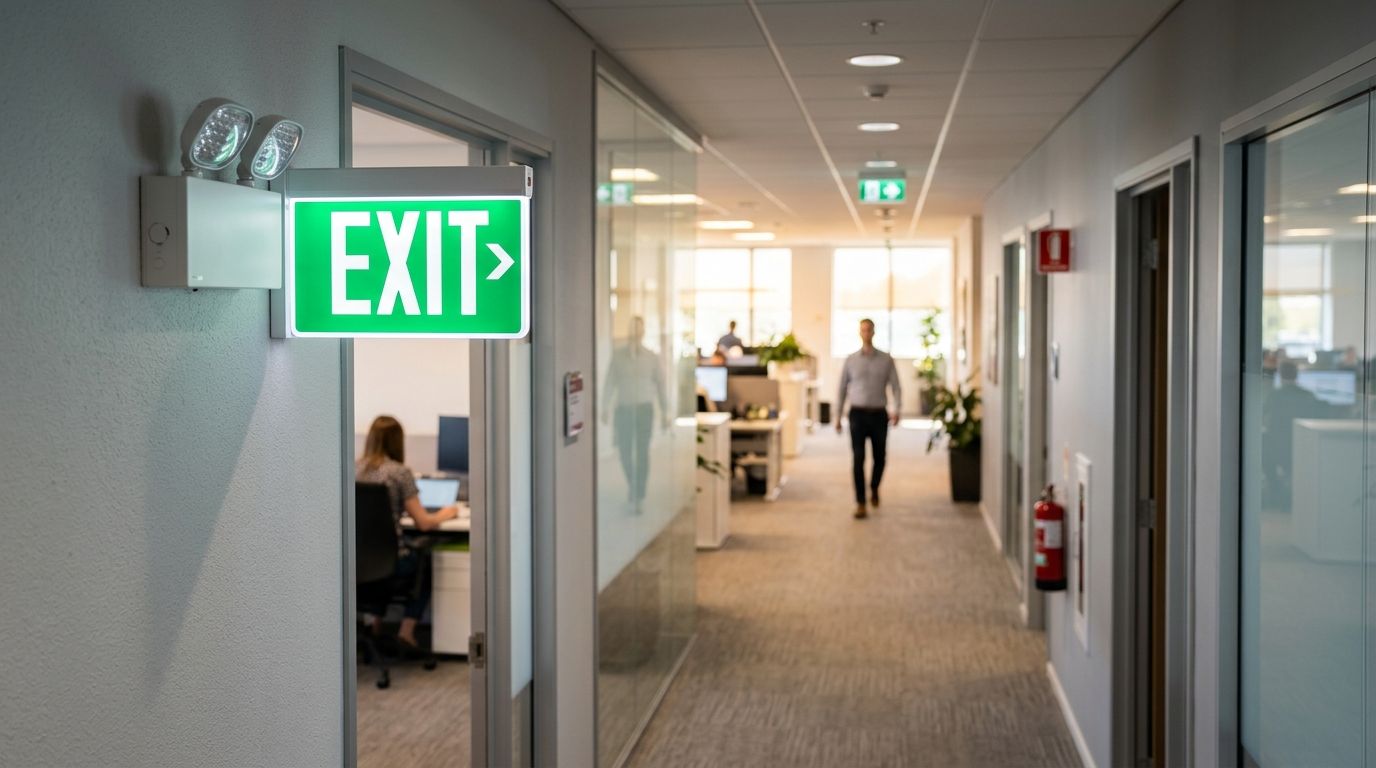
This is the fixture you already picture — a lit exit sign with two adjustable LED heads mounted below it, running off an internal battery. It's the default recommendation for a single-floor or small multi-room office because one unit covers both the sign requirement and the path illumination requirement in one box.
LED combo unit pros:
- Meets the 90-minute NFPA 101 runtime in a single fixture
- Simple retrofit into existing electrical boxes
- Widely stocked, easy to source replacement heads and batteries
LED combo unit cons:
- Still needs a human to run and log the monthly 30-second test
- Battery degradation isn't visible until the unit fails a test
LED combo unit verdict: Buy for any standard office under 10,000 square feet where someone is assigned to run the monthly test.
2. Self-testing LED unit: best for compliance-heavy multi-tenant buildings
Same form factor as the combo unit, but with a built-in microprocessor that runs the monthly 30-second test and the annual 90-minute test on its own schedule, flashing a fault indicator if it fails. This matters most in buildings with multiple tenants where no single facilities team is walking every floor every month.
Self-testing unit pros:
- Automates the exact test cycle NFPA 101 requires
- Fault indicator flags a bad battery before an inspection catches it
- Cuts technician labor hours on routine testing visits
Self-testing unit cons:
- Costs more per unit than a standard combo fixture
- Fault indicators still need someone checking them regularly
Self-testing unit verdict: Buy if you manage a multi-tenant building or can't guarantee monthly manual testing — pairs well with a monitored fire alarm system for small businesses on the same service schedule.
3. Centralized inverter system: best for large multi-floor offices
Instead of a battery in every fixture, one central inverter and battery bank powers every emergency light on a circuit or floor. This is the standard for larger commercial buildings where dozens of individual batteries would mean dozens of points of failure and dozens of replacement cycles to track.
Centralized inverter pros:
- One battery bank to maintain instead of 30+ individual batteries
- Consistent runtime across every connected fixture
- Lower long-term maintenance labor per fixture
Centralized inverter cons:
- If the inverter itself fails, every connected light goes dark
- Higher upfront install cost, requires dedicated electrical work
Centralized inverter verdict: Buy for buildings over roughly 20,000 square feet or multiple floors — Skip for a single small office, the complexity isn't justified.
4. Remote satellite head lighting: best for open floor plans and long corridors
Satellite heads are separate light fixtures wired back to a central power supply or a nearby combo unit, letting you extend illumination down a corridor or across an open floor without a battery in every fixture. Warehouses and open-plan offices with long sightlines to the nearest exit use this most.
Satellite head pros:
- Extends coverage well beyond what one fixture's LED heads can reach
- Fewer batteries to track than a fixture-per-location approach
Satellite head cons:
- Requires low-voltage wiring runs during install
- Coverage gaps if the wiring run isn't planned against the actual egress path
Satellite head verdict: Buy for open floor plans or corridors over roughly 100 feet — Hold for compact offices where a combo unit already reaches the exit.
5. Wireless monitored exit lighting: best for facilities managers overseeing multiple sites
This adds a wireless gateway to self-testing fixtures so test results, battery status, and fault alerts show up on a dashboard instead of a paper log. It's built for the facilities manager responsible for lighting compliance across several buildings, not just one office.
Wireless monitored pros:
- Remote visibility across every site from one dashboard
- Fault alerts arrive before a scheduled site visit, not after
- Generates the documentation trail an AHJ wants to see
Wireless monitored cons:
- Needs a network or gateway setup most single-office tenants don't have
- Highest per-fixture cost of any option on this list
Wireless monitored verdict: Buy if you manage multiple locations — Skip for a single small office where the dashboard adds cost without adding value.
6. Standalone battery backup exit sign: best budget option for small offices
A basic lit exit sign with an internal battery and no adjustable emergency light heads. It satisfies the exit sign requirement but not the path illumination requirement on its own, so it's typically paired with separate emergency lights rather than used alone in anything but the smallest spaces.
Standalone exit sign pros:
- Lowest install complexity of any option here
- Meets the exit sign portion of code in single-room or small-tenant spaces
Standalone exit sign cons:
- No self-test capability
- Doesn't provide egress path illumination by itself
Standalone exit sign verdict: Hold for a single-room office paired with separate lighting — Skip as a full solution for anything larger.
Get your exit lighting checked in 2026
First-Line inspects exit and emergency lighting alongside extinguisher service visits.
How we ranked
Each system type was weighed against the six criteria above: runtime compliance, self-diagnostic capability, photometric coverage, install flexibility, serviceability, and documentation. Combo units and self-testing units rank highest because they solve the compliance problem with the least operational overhead for a typical office. Centralized and wireless systems rank by building scale, not by being universally "better."
Which exit and emergency lighting system should you choose?
For most single-floor offices in 2026, the LED combo exit/emergency unit is the default answer — it's the simplest path to meeting NFPA 101's 90-minute runtime requirement without added infrastructure. Step up to a self-testing unit the moment you can't guarantee someone runs the monthly test by hand, and move to a centralized inverter system once you're managing multiple floors or dozens of fixtures. Don't buy a wireless monitored system for a single small office — that's paying for a dashboard you don't need yet.
FAQ
What's the best exit and emergency lighting system for a small office?
An LED combo exit/emergency unit is the best exit and emergency lighting system for offices under roughly 10,000 square feet in 2026. It covers both the exit sign requirement and the 90-minute path illumination requirement in one fixture.
How often does emergency lighting need to be tested?
NFPA 101 requires a 30-second functional test monthly and a full 90-minute discharge test annually. Self-testing LED units automate both cycles and log the results.
Is self-testing emergency lighting worth the extra cost?
Yes for multi-tenant or multi-floor buildings where no one is reliably running manual monthly tests. For a small single-office space with an assigned tester, a standard combo unit is usually enough.
How long does emergency lighting need to stay on during a power outage?
NFPA 101 requires a minimum of 90 minutes of illumination after normal power fails. OSHA 1910.37 requires exit routes to stay lit whenever employees are present.
Do I need separate exit signs and emergency lights?
Not if you use a combo unit, which combines both in one fixture. A standalone exit sign alone doesn't meet the path illumination requirement and needs separate emergency lights paired with it.
What's the difference between a centralized and a standard emergency lighting system?
A standard system puts a battery in every fixture; a centralized inverter system runs every fixture on a circuit from one shared battery bank. Centralized systems suit large multi-floor buildings; standard combo units suit single-floor offices.
Can wireless monitored lighting integrate with a fire alarm system?
Wireless monitored lighting runs on its own gateway and dashboard, separate from a fire alarm panel, though both can be serviced on the same inspection schedule by the same technician.
One last thing
The most common failure point in 2026 isn't the fixture — it's the battery hitting end-of-life between annual inspections with no one noticing until the 90-minute test fails. If your office is still running standard combo units with nobody logging the monthly 30-second test, that's the gap to close first, before you spend on anything more advanced.