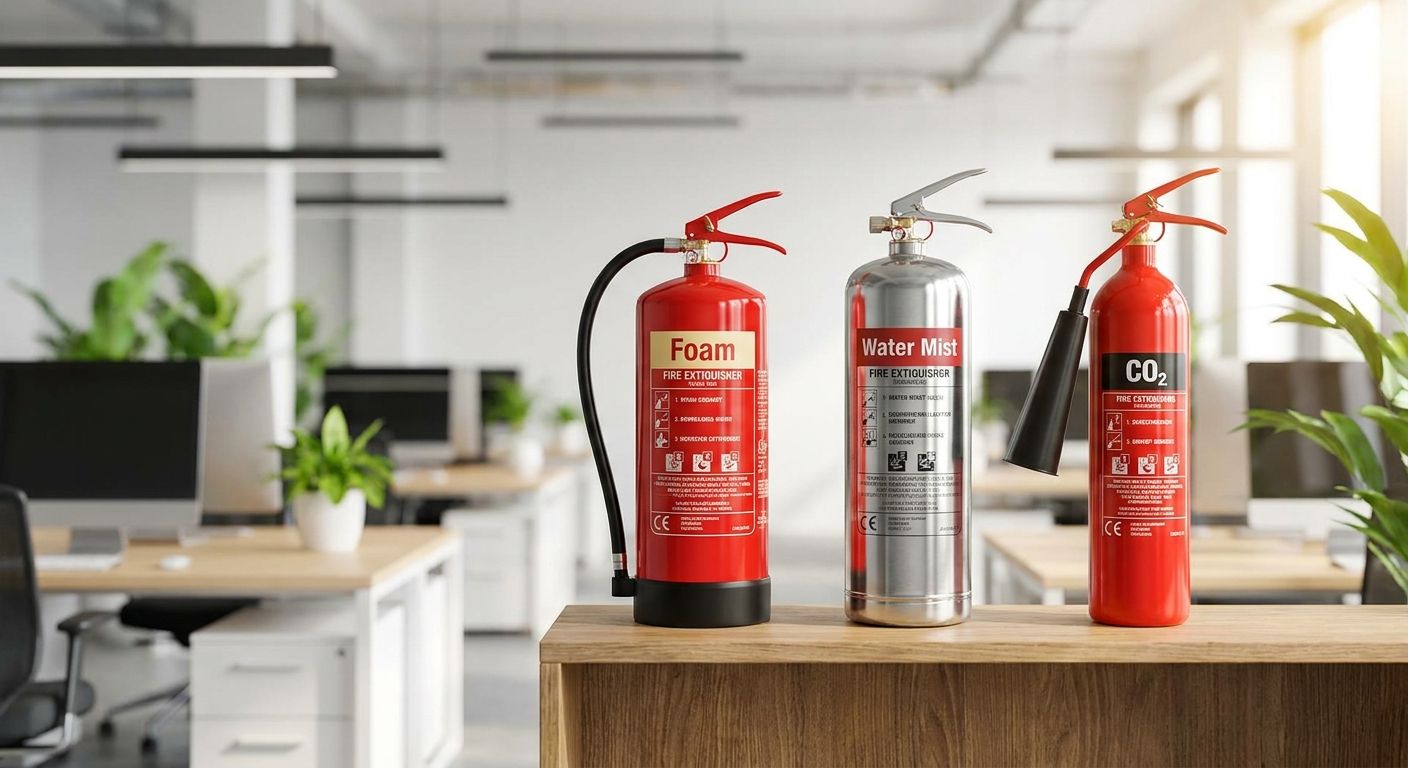
Offices carry three fire hazards in different corners of the same floor plan — paper and furniture in the bullpen, live electronics in the server closet, and a microwave or hot plate in the break room. No single fire extinguisher type covers all three well, and picking the wrong one is the most common gap First-Line Fire finds during commercial inspections across Kentucky, Indiana, Illinois, Tennessee, Missouri and Alabama.
Best overall: ABC dry chemical extinguisher. Best for server rooms and electronics: clean agent (Halotron I) extinguisher. Best for occupied work areas: water mist extinguisher.
- ABC dry chemical is the best overall fire extinguisher type for offices in 2026 — one unit covers Class A, B and C fires.
- Clean agent (Halotron I) extinguishers protect server rooms without leaving corrosive residue on hardware.
- CO2 extinguishers clear electrical panels fast but lose pressure outdoors or in cold hallways.
- OSHA requires a Class A extinguisher within 75 feet of travel distance in every occupied office.
- Water mist extinguishers work in occupied desks and lobbies where dry chemical powder would ruin equipment.
Why this matters
Most office fires start in three places: overloaded outlets and power strips, kitchenettes, and server or IT closets running hot equipment. Mixing up extinguisher types doesn't just fail a fire marshal walk-through — it puts an employee in front of the wrong tool during the ninety seconds that matter most.
Code enforcement in 2026 hasn't gotten looser. NFPA 10 still sets monthly visual checks and annual professional inspections, and OSHA still enforces the 75-foot travel distance rule for Class A hazards. First-Line Fire tracks those due dates for commercial clients so extinguisher placement and testing don't slide.
What makes the best fire extinguisher type for an office
- Fire class match — the unit has to be rated for the hazard actually present (paper, electronics, cooking oil), not just "whatever's cheapest."
- Residue and cleanup impact — dry chemical powder ruins keyboards, servers and paper files; some spaces can't afford that cleanup.
- Discharge range and duration — bigger open floors need more range than a single desk or closet.
- OSHA and NFPA compliance — travel distance, mounting height, and signage all get checked during inspection.
- Maintenance schedule — hydrostatic test intervals run 12 years for dry chemical, 5 years for CO2; budget for that.
- Ease of use — staff with no training need to pull the pin and aim correctly under stress.
Fire extinguisher types for offices at a glance
| Extinguisher Type | Best For | Standout Feature | Key Limitation |
|---|---|---|---|
| ABC Dry Chemical | General office coverage | Rated for Class A, B and C fires in one unit | Leaves corrosive powder residue on electronics |
| Clean Agent (Halotron I) | Server rooms and electronics | Non-conductive, leaves no residue | Smaller units, shorter discharge range |
| CO2 | Electrical panels and equipment closets | Displaces oxygen, no residue | Loses effectiveness in cold or drafty areas |
| Water Mist | Occupied office space | Safe near people, no toxic byproduct | Not rated for flammable liquid or live electrical fires |
| Wet Chemical Class K | Break rooms and kitchenettes | Cools cooking oil fires through saponification | Only rated for Class K, not general office hazards |
1. ABC Dry Chemical Extinguisher: best fire extinguisher type for general office coverage
This is the default unit in most office hallways and stairwells because it covers Class A (paper, wood, fabric), Class B (flammable liquids) and Class C (energized electrical) fires from one canister. A typical office unit carries a 2-A:10-B:C rating, enough for a standard 3,000-square-foot floor.
ABC dry chemical pros:
- Covers three fire classes with one unit
- Lowest cost per square foot of coverage among multi-class extinguishers
- Widely stocked, easy to source replacement units and refills
ABC dry chemical cons:
- Powder residue corrodes circuit boards and ruins paper files near the discharge zone
- Requires full cleanup after any use, even a small one
- Not the right choice for server rooms or archive rooms
Best for: hallways, open floor plans, stairwells, general storage. Verdict: Buy — this is the extinguisher every office needs as its baseline, regardless of what else gets added.
2. Clean Agent (Halotron I) Extinguisher: best fire extinguisher type for server rooms and electronics
Halotron I extinguishers discharge a vaporizing liquid agent that starves a fire of oxygen without leaving powder or moisture behind. That makes them the standard choice for server rooms, IT closets and areas full of sensitive hardware where a dry chemical unit would cause more damage than the fire itself.
Clean agent pros:
- No residue — safe to discharge near live servers and electronics
- Rated for Class B and C fires
- Non-conductive, so it won't create a secondary electrical hazard
Clean agent cons:
- Shorter discharge range than dry chemical units of similar size
- Not rated for Class A materials like paper or cardboard
- Costs more per unit than a comparable ABC extinguisher
Best for: server rooms, network closets, and any space that mirrors what's covered in fire suppression systems for server rooms and data centers. Verdict: Buy for any room housing IT hardware.
3. CO2 Extinguisher: best fire extinguisher type for electrical panels and equipment closets
CO2 extinguishers work by displacing oxygen at the fire's surface, leaving zero residue. They're common near electrical panels, mechanical rooms and equipment closets where the hazard is strictly electrical and the space is small enough for a shorter discharge range to matter less.
CO2 pros:
- Leaves no residue, no cleanup
- Effective and fast on Class C electrical fires
- Non-conductive, safe on energized equipment
CO2 cons:
- Loses pressure and effectiveness in cold hallways or outdoor-facing entries
- Not rated for Class A materials
- Discharge horn gets cold enough to cause frostbite if handled wrong
Best for: electrical panel rooms, mechanical closets, small equipment bays. Verdict: Hold — a good supplement next to an electrical panel, not a replacement for an ABC unit in open office space.
4. Water Mist Extinguisher: best fire extinguisher type for occupied office space
Water mist units discharge a fine, deionized spray that cools Class A fires without the toxicity or residue issues of chemical agents. They're increasingly common in lobbies, open desk areas and conference rooms where people are present and a chemical cloud isn't acceptable.
Water mist pros:
- Safe to use near occupants, minimal toxic byproduct
- No residue on furniture, carpet or paper
- Good for Class A fires in high-occupancy areas
Water mist cons:
- Not rated for flammable liquid (Class B) or live electrical (Class C) fires unless specifically listed
- Heavier than a comparable dry chemical unit
- Less common, so replacement parts take longer to source
Best for: lobbies, open desk floors, conference rooms. Verdict: Buy as a complement to ABC coverage in high-traffic, people-heavy zones.
5. Wet Chemical Class K Extinguisher: best fire extinguisher type for break rooms and kitchenettes
Any office with a stove, deep fryer, or grease-heavy cooking setup in the break room needs a dedicated Class K unit. Wet chemical agents cool burning oil through a saponification reaction — the same principle used in fire extinguisher types for commercial kitchens, just scaled down for a break room stove instead of a full line.
Wet chemical pros:
- Purpose-built for cooking oil and grease fires
- Cools the fire surface, reducing flashback risk
- Required by code anywhere commercial cooking equipment is present
Wet chemical cons:
- Only rated for Class K — no use outside the kitchen area
- Adds a second unit type to track and inspect
- Overkill for a break room with just a microwave and coffee maker
Best for: break rooms with a stove, grill, or deep fryer. Verdict: Buy only if actual cooking equipment is present; Skip for a microwave-only break room.
Get your office extinguishers checked
First-Line Fire tracks inspection and hydro test dates so nothing lapses.
How we ranked these
Each fire extinguisher type on this list gets weighed against the same six criteria: fire class match, residue impact, discharge range, code compliance, maintenance interval, and ease of use under stress. ABC dry chemical wins overall because it's the only single unit that clears three fire classes for the price of one canister. Clean agent, CO2, water mist and Class K each earn their spot by solving a hazard ABC handles poorly — electronics, cold equipment rooms, occupied space, and cooking oil, respectively.
Which fire extinguisher type should you choose?
Start with ABC dry chemical as the baseline for every hallway and open floor — it's the extinguisher OSHA's 75-foot travel distance rule is built around. Add a clean agent unit in any room with servers or networking gear, a CO2 unit near electrical panels, and a Class K unit only if the break room has real cooking equipment. Layer in water mist for lobbies and open desk areas if chemical residue near people and paperwork is a concern. Offices with industrial-scale equipment or warehouse space attached should also check fire extinguisher types for industrial facilities for coverage the standard office list doesn't address.
FAQ
What's the best fire extinguisher type for a general office?
ABC dry chemical is the best fire extinguisher type for general office coverage in 2026 because it handles paper, flammable liquid and electrical fires from a single canister. Most offices mount one every 3,000 square feet of open floor.
Is CO2 or ABC dry chemical better for an office?
ABC dry chemical covers more fire classes and works better in open floor space, while CO2 is better reserved for electrical panels and equipment closets where residue-free discharge matters more. Most offices need both, not one instead of the other.
Do offices need a Class K extinguisher?
Only if the break room has a stove, grill or deep fryer — a microwave and coffee maker don't trigger the Class K requirement. Any office with real cooking equipment needs a dedicated wet chemical unit under NFPA 10.
How many fire extinguishers does an office need under OSHA rules?
OSHA 29 CFR 1910.157 requires a Class A extinguisher within 75 feet of travel distance anywhere in the occupied space. The exact count depends on floor layout and square footage, not a flat number per employee.
How often do office fire extinguishers need inspection?
NFPA 10 requires a monthly visual check and an annual professional inspection for every extinguisher. Hydrostatic testing runs on a longer cycle — 12 years for dry chemical units and 5 years for CO2.
Can you use a water-based extinguisher on electrical fires?
No — standard water and most water mist extinguishers aren't rated for Class C electrical fires unless specifically listed for it. Use a CO2 or ABC dry chemical unit on anything energized instead.
What size ABC extinguisher is right for a typical office?
A 5-pound, 2-A:10-B:C rated unit covers most standard office rooms and hallways in 2026. Larger open floors or warehouses attached to office space need higher-rated or additional units.
One last thing
The extinguisher that fails an inspection most often in office settings isn't the wrong type — it's the right type past its hydrostatic test date. A dry chemical unit sitting quietly in a hallway for 12+ years without testing looks fine on the wall and fails the moment someone needs it to work.