
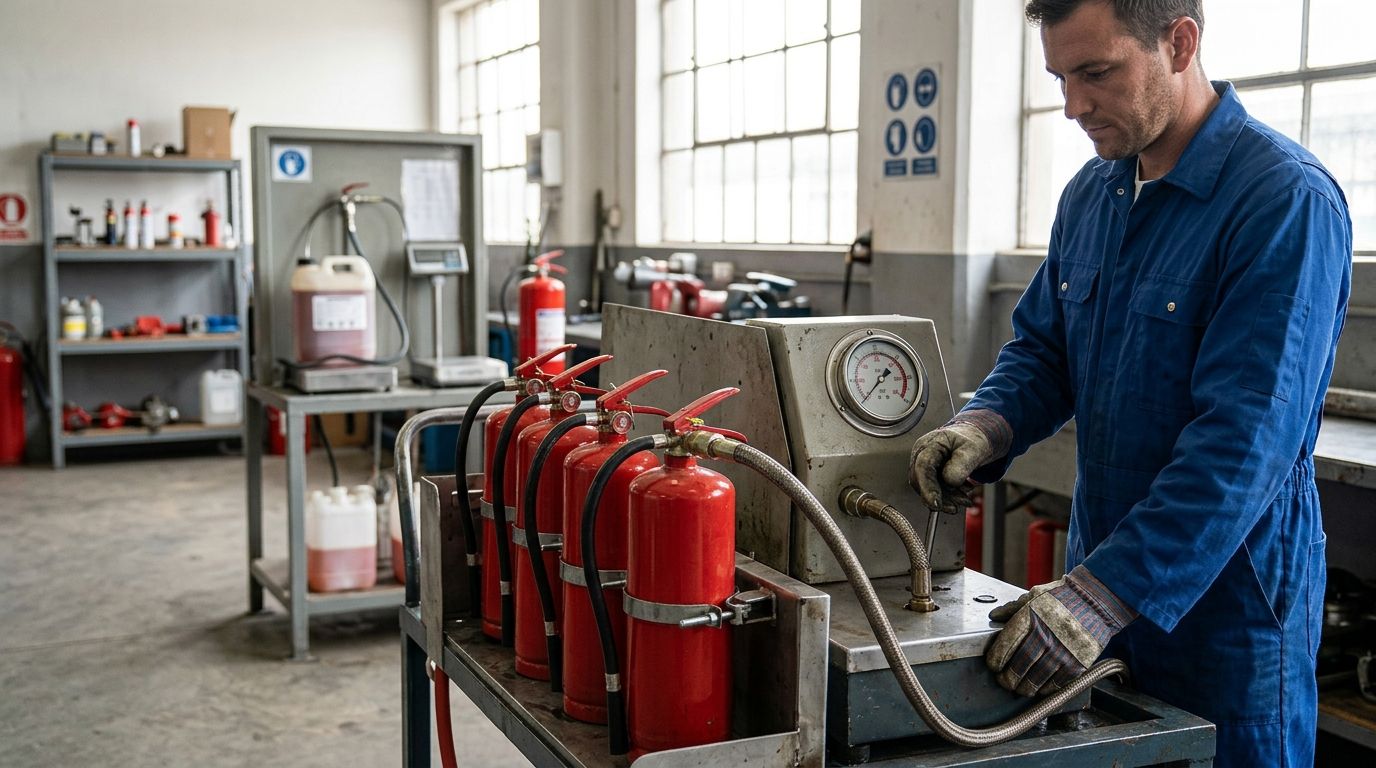
A cylinder that's past its hydrostatic test date is not a maintenance footnote — it's a violation an inspector writes down on the spot. The fix runs on a fixed sequence: confirm the interval, pull the unit, run the pressure test, recharge, tag it, log it. Skip a step and you either fail the inspection twice or hand a customer a extinguisher that looks serviced but isn't code-compliant.
- Fire extinguisher hydrostatic testing runs on a fixed NFPA 10 interval: 5 years for CO2 and water units, 12 years for dry chemical stored-pressure cylinders.
- A cylinder that fails the pressure test gets condemned on the spot — it does not get recharged.
- Moisture left in a dry chemical cylinder after testing voids the recharge; dry the cylinder fully before loading agent.
- First-Line Fire Extinguisher Co. runs hydro test and recharge as one job across Kentucky, Illinois, Indiana, Tennessee, Missouri and Alabama in 2026.
- Batch-pulling units by due date beats testing one extinguisher at a time and cuts repeat truck rolls.
Why this matters
Fire extinguisher hydrostatic testing isn't optional paperwork — it's a pressure test that confirms the cylinder can still hold service pressure without rupturing. NFPA 10 sets the interval by cylinder type, and the interval doesn't move for a slow year or a light-use site. A tag that reads five years old on a CO2 cylinder is due. A tag that reads six is out of code.
Most sites don't fail inspection because the extinguisher is missing. They fail because the hydro test tag lapsed and nobody caught it before the walk-through. Knowing the recharge cost side of the job matters too — testing and recharge get billed and scheduled together, not as two separate visits.
Before you start
- Pull the manufacture date first. It's stamped on the cylinder collar or nameplate, not the service tag — the service tag only tells you when it was last serviced, not when the clock started.
- Have reclaim and refill agent on hand before discharge. You don't want a discharged, empty cylinder sitting on a shelf for three days waiting on stock.
- The gotcha: a dry chemical cylinder that isn't bone-dry inside before recharge will clump the agent and jam the valve within months. Dry time is not a step you shortcut to save an afternoon.
Confirm the test interval and cylinder type
- Check the manufacture date stamped on the cylinder collar or valve body.
- Match the extinguisher type to its NFPA 10 interval — CO2 and water/APW cylinders test every 5 years, dry chemical stored-pressure units every 12 years.
- Flag any unit that's past due before it goes back on the wall.
Expected result: a confirmed test date and interval for every cylinder on the pull list, with overdue units separated from the rest.
Pull the unit and prep for testing
- Remove the extinguisher from its mounting bracket.
- Discharge remaining agent into an approved reclaim container.
- Strip the valve assembly and inspect the cylinder body for corrosion, dents, or pitting.
Expected result: a bare cylinder staged for the pressure test, with the valve, hose, and pin set aside separately.
Run the hydrostatic pressure test
- Fill the cylinder with water and connect it to the test rig.
- Pressurize to the test pressure stamped on the cylinder nameplate.
- Hold pressure for the required dwell time and check for permanent expansion beyond the rejection limit or visible leaks.
Expected result: the cylinder either passes — no expansion beyond limit, no leaks — or fails and gets condemned on the spot. There's no partial pass on a hydro test.
“If the tag says five years and it's been six, the extinguisher is out of code the day the inspector walks in.”
Recharge and reassemble
- Dry the cylinder fully before recharge — moisture left inside a dry chemical unit clumps the agent and jams the valve.
- Weigh and load the correct agent type and charge weight per the nameplate.
- Reinstall the valve assembly with new O-rings and gaskets.
- Pressurize to service pressure and confirm the gauge reads in the green band.
Expected result: the extinguisher holds pressure, the gauge sits in the correct range, and the hose and pin are seated properly.
Tag, date, and log
- Attach a new hydro test tag stamped with the test date and technician or agency identifier.
- Update the service tag with the recharge date and next due date.
- Log the cylinder serial number into the site's inspection record.
Expected result: the extinguisher goes back on its bracket with a current hydro test tag and recharge tag both visible and legible.
Recharge without a hydro test (annual service cycle)
Not every visit is a hydro test visit. If a cylinder was discharged mid-year, or an annual inspection turns up a low gauge reading, it gets recharged on the spot without a full pressure test — as long as the hydro test date isn't already due.
- Confirm the last hydro test date is still inside its interval before skipping the pressure test.
- Discharge any remaining agent, dry the cylinder, and recharge per the standard steps above.
- Update the service tag with the recharge date only — the hydro test tag stays as-is until its interval comes up.
This is the more common visit for sites with active kitchens, garages, or industrial floors where extinguishers get used, not just inspected. Property managers running multiple sites on a rolling schedule handle this differently than a single-site owner — the fire extinguisher service guide for property managers covers how to stagger recharge visits across a portfolio without stacking every due date in the same month.
Troubleshooting
- Cylinder fails the hydro test. Condemn it. It gets discarded or replaced with a new unit — it does not get patched or recharged.
- Gauge won't hold pressure after recharge. Usually a bad valve seat or O-ring. Disassemble, replace the seal, and retest before it goes back on the wall.
- Charge weight is off after recharge. Reweigh on a calibrated scale and correct the load before reinstalling the valve — a light charge fails the next inspection.
- Hydro tag is missing prior test data. Check the nameplate for the manufacture date and interval before dating a new tag — don't assume the last visible tag was accurate.
- A site inspection turns up several units past due at once. Batch-pull them for testing in one visit instead of one truck roll per extinguisher — it's the difference between one service call and five.
Customize your workflow
Marine environments and coal operations don't run this workflow on the same clock as an office building. Salt air corrodes cylinder bodies faster, which means visual inspection between hydro tests matters more — the hydro testing guide for marinas covers the corrosion checks that get added to the standard steps above.
Fleet and vehicle-mounted extinguishers get pulled on a different schedule too, tied to DOT inspection windows rather than a fixed calendar date — the fire extinguisher inspection guide for trucking fleets walks through how that interacts with the hydro test cycle.
Get your cylinders on schedule
First-Line tracks hydro test due dates and handles recharge in the same visit.
FAQ
How often does fire extinguisher hydrostatic testing need to happen?
CO2 and water/APW cylinders test every 5 years under NFPA 10; dry chemical stored-pressure units test every 12 years. The interval is fixed by cylinder type, not by how often the extinguisher gets used.
Can an extinguisher be recharged without a hydro test?
Yes, as long as the cylinder's hydro test date isn't already due. Recharge after a discharge or a low gauge reading is a separate, more frequent event than the pressure test itself.
What happens if a cylinder fails hydrostatic testing?
It gets condemned. A failed cylinder is taken out of service and discarded or replaced — it is never recharged or returned to a mounting bracket.
Does moisture affect a dry chemical recharge?
Yes. Moisture left inside the cylinder after testing clumps the dry chemical agent and can jam the valve within months, so the cylinder has to be fully dry before it's reloaded.
How long does a full hydro test and recharge take per extinguisher?
The pull, test, dry, and recharge steps run in sequence per unit, which is why sites with several units past due get batched into one visit rather than serviced one at a time.
Is hydrostatic testing different for marine and coal mining extinguishers?
The interval is the same, but corrosion from salt air or coal dust means visual inspection between tests matters more for marine and coal mining equipment than for office or retail sites.
What's on the tag after a hydro test and recharge?
Two tags: a hydro test tag stamped with the test date, and a service tag showing the recharge date and next due date. Both need to be current and legible on the cylinder.
Who tracks hydro test due dates across multiple sites?
Property managers and multi-site operators typically run a rolling schedule so due dates don't stack in the same month — a service provider tracking the calendar catches lapses before an inspection does.
One last thing
The cylinders that fail an inspection almost never fail because of the extinguisher itself — they fail because the hydro test tag lapsed months earlier and nobody was tracking the date. In 2026, that's a scheduling problem, not an equipment problem, and it's solved by batching due dates instead of reacting to inspection notices one at a time.


