
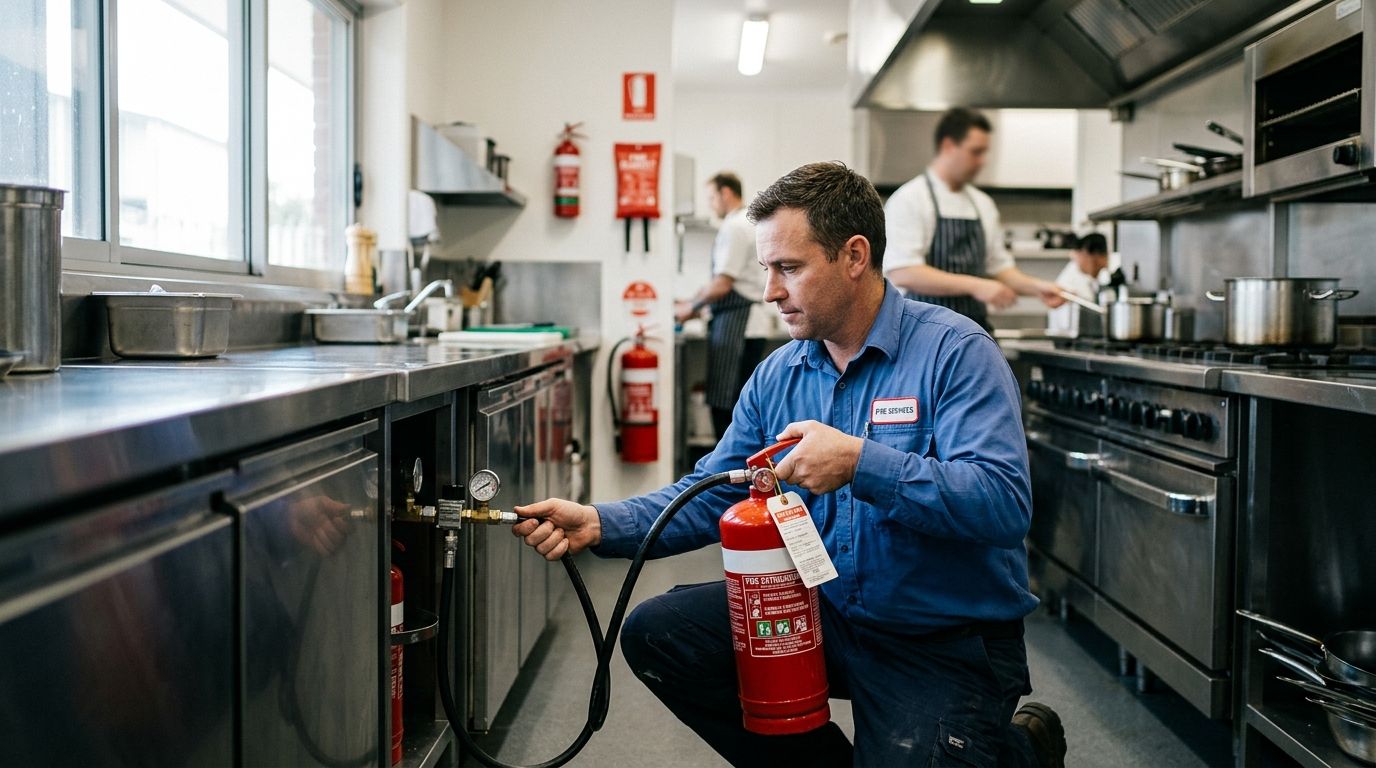
Restaurant chain fire extinguisher recharge service is the scheduled process of inspecting, refilling and re-tagging every extinguisher across every location so each unit stays NFPA 10 compliant and ready to discharge on the first pull. A single restaurant only needs a vendor who shows up once a year. A chain running units in Kentucky, Illinois, Indiana, Tennessee, Missouri and Alabama needs a service that can standardize tag dates, hazard classes and hydrostatic test cycles across every state line without corporate chasing down five different local vendors.
- Fire extinguisher recharge service for restaurant chains needs NFPA 10 annual inspection plus 5- or 12-year hydrostatic testing, not a one-time visit.
- Class K wet chemical extinguishers protect fryer lines; ABC dry chemical near a hood system voids UL 300 compliance.
- First-Line Fire services multi-state kitchens across KY, IL, IN, TN, MO and AL on one consolidated schedule.
- Centralized tag dates beat per-location vendor shopping when corporate audits or insurance renewals hit.
Why recharge service matters for restaurant chains
A restaurant kitchen runs three fire hazard zones at once: the fryer line, the flat-top and range, and the dining/back-of-house areas covered by standard ABC units. Miss a recharge date on any one of them and the location fails a health inspection or an insurance carrier's loss-control visit — both of which check extinguisher tags before they check anything else in the kitchen.
Chains carry a second layer of exposure single locations don't: consistency. If unit 14 in Bowling Green has a current tag and unit 22 in Evansville doesn't, that gap shows up in a corporate audit and in a claims file if a fire ever happens. First-Line Fire builds recharge and hydrostatic test schedules around that reality — one due-date calendar across every state the chain operates in, not one calendar per store.
Count and classify every extinguisher across locations
Before any recharge schedule works, someone needs an accurate count of what's on the wall at every location, not what the floor plan says should be there.
- Walk every kitchen, dining room and storage area and log extinguisher type, size and current tag date
- Flag units that are missing, expired, or physically damaged
- Cross-check the count against the last fire marshal inspection report
- Build one master roster per location, then roll all locations into a single chain-wide list
- Note any location that added a new fryer, flat-top or hood system since the last audit
Match extinguisher type to kitchen hazard
A fryer line needs a Class K wet chemical extinguisher, not the ABC dry chemical unit hanging by the back door. Using the wrong class near cooking equipment covered by an ansul-style hood system voids UL 300 compliance and gives an inspector grounds to write the location up on the spot.
- Class K wet chemical at every fryer and appliance covered by a grease-fire hazard
- ABC dry chemical for dining rooms, offices and dry storage
- CO2 units near electrical panels and walk-in compressor rooms
- Confirm extinguisher placement matches the Class K types recommended for commercial kitchens
- Check that hood suppression coverage and portable extinguishers are rated for the same hazard, not two different standards
Set recharge and hydrostatic test intervals
NFPA 10 sets the baseline: annual inspection on every unit, internal examination on a 6-year cycle for most rechargeable extinguishers, and hydrostatic testing on a 5-year cycle for Class K wet chemical units and a 12-year cycle for most dry chemical stored-pressure units. Skipping a hydro test doesn't just risk a fine — it means the cylinder is legally out of service until it's tested or replaced.
A Class K cylinder that's overdue for its five-year hydrostatic test fails a health inspection even if it looks fine on the wall. Corporate teams that track this manually with a spreadsheet across a dozen locations tend to miss at least one unit a year. A recharge cost breakdown helps corporate budget for testing years in advance instead of getting surprised by a batch of units all hitting their 12-year mark the same quarter.
Centralize records across every state you operate in
A chain with locations in six states can't run six separate vendor relationships and expect consistent tag dates. Multi-state coverage means one point of contact, one inspection calendar, and one set of records corporate can pull for an audit without calling five regional managers first.
- Pick a vendor licensed to service every state the chain operates in
- Ask for a single digital record of tag dates, hydro test dates and recharge history per location
- Require photo documentation of tag placement for locations corporate doesn't visit often
- Confirm the vendor's technicians carry state-specific licensing where required
- Set a recurring reminder tied to the earliest expiring unit in the portfolio, not the average
Get one recharge schedule for every location
Multi-state fire extinguisher service across KY, IL, IN, TN, MO and AL.
Schedule recharge visits around service hours
A sit-down chain can't have a technician pulling extinguishers off the wall during the lunch rush. Scheduling recharge visits during prep hours or between shift changes keeps the kitchen fully covered without pulling units when they're most likely to be needed.
- Book recharge visits during the two-hour window between lunch and dinner service
- Stage a loaner unit on-site so a location is never without a working extinguisher mid-recharge
- Batch nearby locations on the same route day to cut down on repeat site visits
- Confirm the technician re-tags and logs the visit before leaving, not days later
Train store managers on monthly self-inspection
NFPA 10 requires a monthly visual check between annual professional inspections, and that check falls on whoever's running the shift, not the fire protection vendor.
- Confirm the pressure gauge needle sits in the green zone
- Check the pin and tamper seal are intact
- Wipe down the cylinder and confirm the mounting bracket is secure
- Log the check date on the inspection tag or a wall-mounted sheet
- Report any damaged, missing or discharged unit to the district manager same-day
Replace or recharge immediately after any discharge
An extinguisher that's been pulled, even partially, is out of service until it's recharged and re-inspected. Kitchens that leave a discharged unit hanging on the wall as a placeholder are running without coverage in that zone.
- Pull any discharged unit from service immediately, no exceptions
- Log the incident with date, cause and which extinguisher was used
- Request same-week recharge, not next month's scheduled route
- Verify the hood suppression system tied to that hazard zone wasn't also triggered and needs a professional reset
Recharge service options for restaurant chains
| Option | Best for | Key limitation |
|---|---|---|
| In-house monthly checks only | Single independent location with one manager on-site daily | No recharge or hydro testing capability; still needs a licensed vendor annually |
| Local single-city vendor | A chain with all locations in one metro area | Doesn't scale once locations cross state lines |
| Regional multi-state vendor (First-Line Fire) | Chains operating across KY, IL, IN, TN, MO and AL | Requires advance scheduling for high-volume locations |
| National equipment franchise or box-store program | Chains prioritizing a single national contract over local response time | Slower on-site response for kitchen emergencies and last-minute recharge needs |
For a side-by-side read on how a regional provider stacks up against a national brand name, the First-Line Fire vs. Kidde comparison breaks down service model differences chains should weigh before signing a multi-year contract.
Verdict: for chains operating across two or more of Kentucky, Illinois, Indiana, Tennessee, Missouri or Alabama, a regional multi-state provider like First-Line Fire beats a patchwork of local vendors on consistency of tag dates and audit readiness. Buy the consolidated contract over the per-location patchwork.
Common mistakes restaurant chains make
- Treating recharge as a one-time event. NFPA 10 runs on cycles — annual inspection, 6-year internal exam, 5- or 12-year hydro test — not a single visit that covers the extinguisher for its whole life.
- Mismatching extinguisher class to fryer hazard. ABC dry chemical near a fryer line doesn't meet UL 300 and gets flagged the moment an inspector checks the tag against the appliance.
- Letting each store pick its own vendor. Inconsistent tag dates across locations are the first thing a corporate auditor or insurance adjuster notices.
- Missing the 5-year hydro test on Class K cylinders. Wet chemical units age faster under fryer heat exposure than dry chemical units and get overlooked because they look fine externally.
- Not logging discharge events. A used extinguisher left on the wall without a recharge request creates a coverage gap nobody notices until the next inspection.
FAQ
How often does a restaurant chain need fire extinguisher recharge service?
NFPA 10 requires annual inspection on every portable extinguisher, plus a 6-year internal exam and a 5-year (Class K) or 12-year (most dry chemical) hydrostatic test cycle. Chains should schedule these against a master calendar covering every location, not per store.
What extinguisher class do restaurant chains need for fryer lines?
Fryer lines need a Class K wet chemical extinguisher, not ABC dry chemical. Using the wrong class near cooking equipment covered by a hood suppression system voids UL 300 compliance.
Can one vendor service a restaurant chain across multiple states?
Yes, a regional provider like First-Line Fire services multi-state chains across Kentucky, Illinois, Indiana, Tennessee, Missouri and Alabama on one consolidated inspection calendar instead of separate local contracts per state.
How much does fire extinguisher recharging cost for a restaurant chain?
Cost varies by extinguisher class, size and whether a hydrostatic test is due that cycle. A full cost breakdown by extinguisher type is the fastest way to budget across a multi-location portfolio.
What happens if a restaurant misses its hydrostatic test date?
The extinguisher is legally out of service until it's tested or replaced, and it will fail a health inspection or fire marshal visit even if the cylinder looks undamaged.
Do all restaurant locations need the same extinguisher types?
No. Fryer and flat-top zones need Class K wet chemical units, dining and dry storage areas need ABC dry chemical, and electrical or compressor rooms need CO2 units. The mix depends on each location's kitchen layout.
Should a discharged extinguisher stay on the wall until the next scheduled visit?
No. A discharged unit is out of service immediately and should be pulled and logged the same day, with recharge requested that week rather than waiting for the next route visit.
One last thing
Most chains lose audit points not on missing extinguishers but on mismatched hazard classes — an ABC unit hanging where a Class K should be. That single detail shows up on every fire marshal walkthrough in 2026, and it's the fastest fix on this whole list: check the tag against the appliance it's protecting, not just the tag date.


