
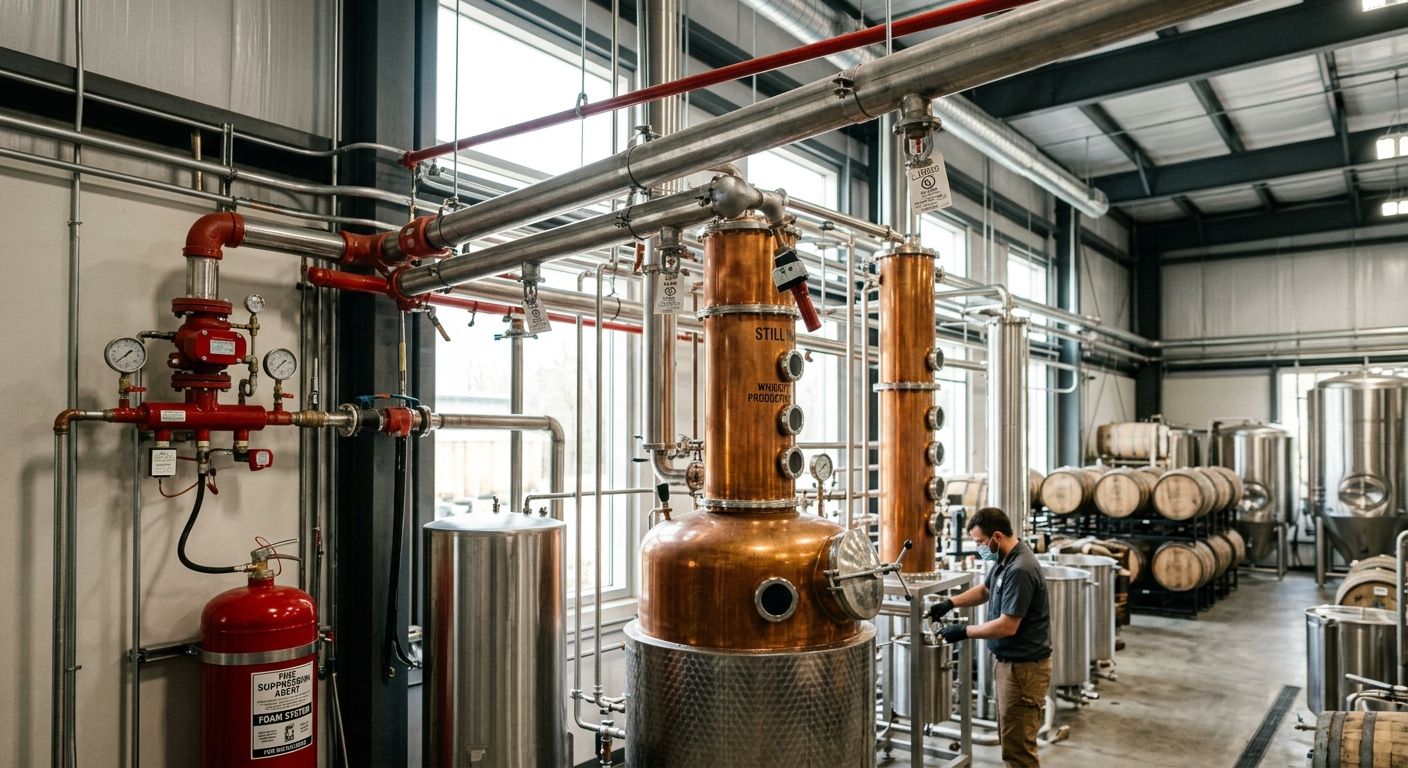
Fire suppression systems for distilleries are ethanol-vapor-rated and grain-dust-rated protection systems built to stop still fires, barrel warehouse fires, and dust explosions before they spread through wood-frame aging buildings and open production floors. A distillery's fire load isn't like a restaurant or a warehouse — you've got flammable vapor rising off fermenters, oak barrels soaked in evaporating spirit (the angel's share), and grain dust that can flash in the right concentration. Standard sprinkler design doesn't cover all of that, and a lot of distilleries find that out only after an insurance audit or a near-miss.
- Fire suppression systems for distilleries need ethanol-vapor and grain-dust coverage, not standard sprinkler design alone.
- Barrel warehouses need foam-water rated for Class B flammable liquid fires under NFPA 30.
- Clean agent systems protect control rooms and electrical panels but aren't built for open barrel storage.
- First-Line Fire services suppression systems across Kentucky, Illinois, Indiana, Tennessee, Missouri and Alabama.
- NFPA 25 inspection cycles apply to distillery suppression systems the same as any commercial facility.
Why fire suppression matters for distilleries
Ethanol vapor has a flash point around 55°F (13°C), which means it can ignite at temperatures most people would call cool. A barrel warehouse holding thousands of ricks isn't just a fire risk — it's a fuel load that grows every year as spirit evaporates into the air inside the rickhouse. That's a Class B flammable liquid fire, not the Class A wood-and-paper fire most portable extinguishers are rated for.
Grain handling adds a second hazard most operators underestimate: dust explosions. Milling and moving grain generates fine particulate that can ignite in a suspended cloud, and grain elevator suppression design follows a different code path than the still house does. Distilleries running their own grain intake need both systems designed around the same building, not bolted on separately.
Insurance carriers know this. Distillery fire losses tend to be catastrophic rather than contained, because barrel racking and open floor plans let fire travel fast. A suppression system sized and agent-matched to the actual hazard is what keeps a single-barrel fire from becoming a total-loss event in 2026.
Step-by-step: building out distillery fire protection
Map your fire risk zones first
A distillery isn't one building risk — it's four or five different ones under one roof or across a campus. Walk the site and separate:
- Still house and fermentation area (ethanol vapor, open flame heat sources)
- Barrel warehouse or rickhouse (flammable liquid storage, high fuel load)
- Grain intake and milling (combustible dust)
- Bottling and packaging line (cardboard, plastic, standard Class A)
- Tasting room and offices (kitchen equipment, electrical panels, server closets)
Each zone needs its own suppression logic. Treating the whole facility as one hazard class is the single most common design mistake distilleries make.
Match the agent to the hazard
Water alone doesn't stop an ethanol fire — it can spread the burning liquid instead of knocking it down. The right agent depends on the zone:
- Foam-water sprinkler systems for barrel warehouses and still house floors
- Clean agent systems for electrical rooms and control panels
- Wet chemical for any cooking equipment in a tasting room kitchen
- Dry chemical for portable coverage at loading docks and grain intake points
- Water mist for cooling exposure protection around barrel racking
A clean agent comparison is worth reading before you spec electrical room protection — the wrong clean agent for the room volume means underprotection.
Design detection around vapor behavior, not just heat
Ethanol vapor behaves differently depending on temperature and airflow, so detection has to account for more than rising smoke. Standard smoke detectors miss vapor buildup entirely.
- Vapor and gas detection near fermenters and still condensers
- Heat detection rated for the ambient temperature swings in a rickhouse
- Combination smoke and heat detection for bottling and packaging areas
- Dust monitoring at grain milling points
- Manual pull stations at every exit path, tested on the same cycle as detection
Protect the barrel warehouse specifically
Rickhouses are the highest-value, highest-risk structure on most distillery properties. NFPA 30 governs flammable and combustible liquid storage, and barrel warehouse suppression design has to follow it, not a generic warehouse sprinkler spec.
- Foam-water density rated for the actual rack storage height
- Aisle spacing that meets code separation distances between ricks
- Deluge or pre-action systems where freeze risk or accidental discharge is a concern
- Fire-rated separation between warehouse sections
- Water supply capacity tested to match the design density, not just installed and forgotten
A rickhouse with foam-water coverage rated for the actual storage height beats a generic sprinkler retrofit every time — the agent has to match the fuel, not the building code minimum.
Build in dust explosion controls for grain handling
If grain is milled or handled on-site, dust explosion protection is a separate discipline from liquid fire suppression.
- Dust collection systems with explosion venting
- Spark detection and extinguishing on pneumatic conveying lines
- Housekeeping schedules that control dust accumulation on beams and equipment
- Isolation devices to stop flame propagation between connected vessels
Set an inspection and testing cadence
NFPA 25 sets inspection intervals for water-based suppression systems, and clean agent and foam systems carry their own testing schedules. Skipping a cycle is the fastest way to fail an insurance audit or, worse, have a system that doesn't discharge when it needs to.
- Monthly visual checks on gauges, valves and control panels
- Quarterly inspections on foam concentrate levels and detection wiring
- Annual full system testing including flow testing
- Five-year internal pipe inspections on water-based systems
This is the part distilleries hand off. First-Line Fire tracks due dates and comes to the site across Kentucky, Illinois, Indiana, Tennessee, Missouri and Alabama, so the inspection calendar isn't something your production manager has to keep in a spreadsheet through 2026.
Train staff on manual actuation and evacuation
Automatic suppression buys time, but staff still need to know the manual actuation points and evacuation routes for each zone.
- Walk-through drills for still house, warehouse and bottling staff separately
- Manual pull station locations posted at every zone entrance
- Annual refresher training tied to the same schedule as system testing
- Clear roles for who calls it in and who evacuates first
Get your distillery fire risk assessed
Suppression, alarms and inspection across KY, IL, IN, TN, MO and AL.
Suppression system options for distilleries compared
| System type | Best for | Key limitation |
|---|---|---|
| Foam-water sprinkler | Barrel warehouses and still house floors | Requires foam concentrate maintenance and periodic discharge testing |
| Clean agent | Electrical rooms, control panels, server closets | Not rated for open barrel storage areas |
| Wet chemical | Tasting room cooking equipment | Doesn't address ethanol vapor or flammable liquid risk |
| Dry chemical | Portable coverage at loading docks and grain intake | Leaves residue and doesn't cool barrel char after knockdown |
| Water mist | Exposure cooling around barrel racking | Higher install complexity than standard sprinkler |
Foam-water sprinkler design is the right call for any distillery with an active barrel warehouse — clean agent and dry chemical fill gaps around it, they don't replace it.
Common mistakes distilleries make on fire protection
- Treating the whole facility as one hazard class. A still house, a rickhouse and a bottling line don't share a suppression spec, and copying one system across all three leaves gaps.
- Relying on portable extinguishers as the only barrel warehouse protection. A rack fire outpaces manual response before staff can reach it with a handheld unit.
- Skipping NFPA 25 test cycles because the system looks fine. A foam system that hasn't been flow-tested in years may not discharge at design density when it matters.
- Ignoring dust accumulation on beams and equipment. Housekeeping is part of dust explosion prevention, not a separate maintenance line item.
- Letting hydro testing on portable units run past due. Distilleries running mixed equipment ages lose track of which cylinders are actually due — extinguisher recharging and testing costs run on a fixed schedule regardless of how the units look.
FAQ
What fire suppression system is best for a distillery barrel warehouse?
Foam-water sprinkler systems rated for open rack storage under NFPA 30 are the standard for barrel warehouses in 2026. They address the flammable liquid fuel load that standard water sprinklers aren't rated for.
Is clean agent suppression enough for a whole distillery?
No. Clean agent systems protect electrical rooms and control panels but aren't rated for open barrel storage or still house floors, so most distilleries need a mix of agent types across zones.
Do distilleries need dust explosion protection?
Any distillery milling or handling grain on-site needs dust explosion controls separate from liquid fire suppression, including dust collection venting and spark detection on conveying lines.
How often do distillery fire suppression systems need inspection?
Water-based systems follow NFPA 25 cycles: monthly visual checks, quarterly detailed inspections and annual testing. Clean agent and foam systems carry their own separate testing intervals.
Can standard sprinklers protect a distillery still house?
Standard water sprinklers aren't designed for Class B flammable liquid fires from ethanol. Still houses need foam-water or another agent matched to flammable liquid hazards.
What's the biggest fire risk in a distillery rickhouse?
Evaporating spirit, known as the angel's share, raises flammable vapor concentration inside a rickhouse over time. Combined with high-density barrel racking, that's the fuel load behind catastrophic rickhouse fires.
Does First-Line Fire service distilleries outside Kentucky?
First-Line Fire covers commercial and industrial fire protection across Kentucky, Illinois, Indiana, Tennessee, Missouri and Alabama, including beverage production sites.
How much does a distillery fire suppression system cost?
Cost depends on square footage, rack height, agent type and water supply capacity, so it's quoted per site. Ask for a walkthrough that prices each hazard zone separately.
One last thing
Most distillery fire losses trace back to a warehouse designed under a generic sprinkler spec instead of NFPA 30 flammable liquid storage rules. If your rickhouse suppression was installed before your current rack height or barrel count, get it re-rated before your next insurance renewal in 2026 — not after a claim.


