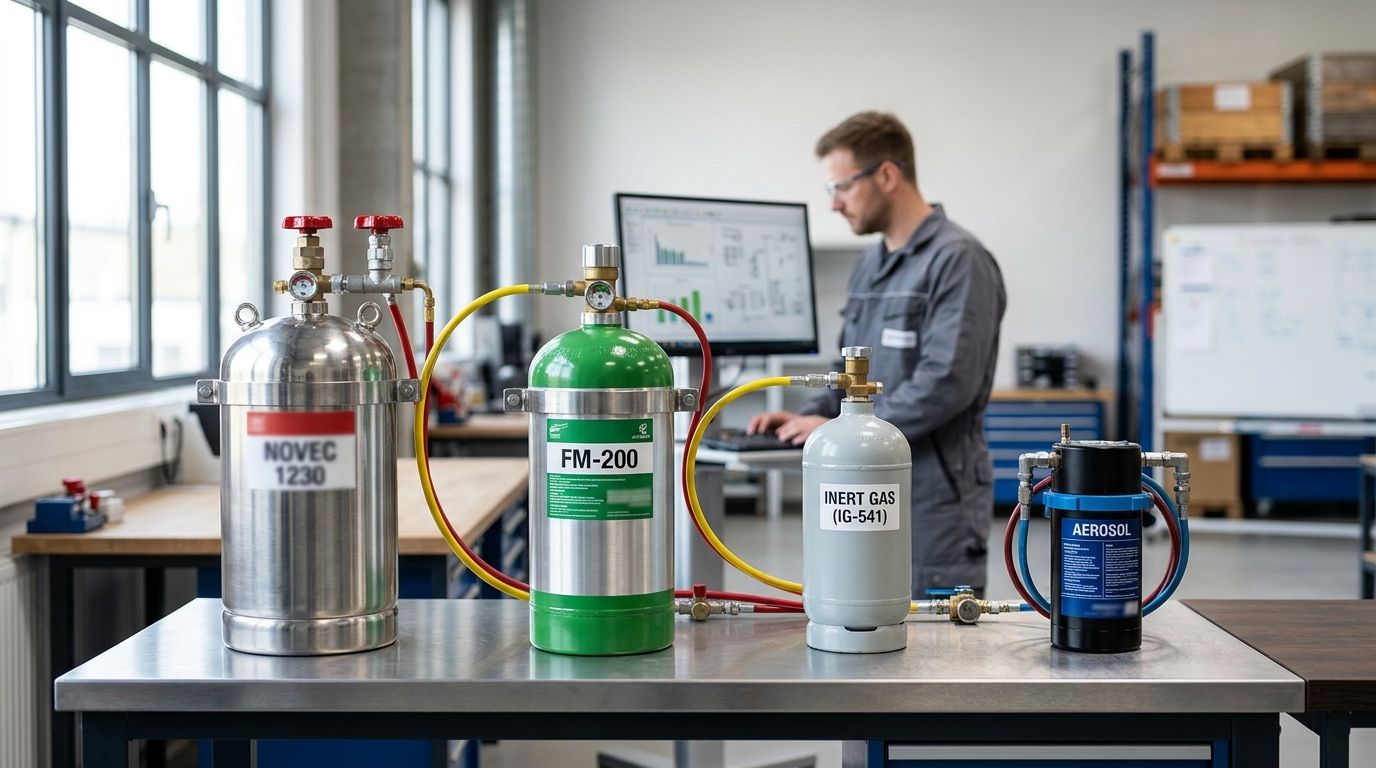
Clean agent fire suppression covers a specific family of extinguishing agents — halocarbon blends and inert gases — that suppress fire without leaving residue, without water damage, and (for most of them) without knocking a server room or control room offline for cleanup. Picking the wrong one means paying for cylinders you don't need or leaving an occupied space under-protected.
- Novec 1230 wins for server rooms and data centers on best clean agent fire suppression systems compared for 2026 — near-zero environmental footprint, safe at design concentration.
- Inergen is the pick for occupied control rooms where the highest human safety margin matters more than agent cost.
- FM-200 still makes sense for retrofitting legacy Halon piping on a budget, but its GWP of roughly 3,220 is a real long-term liability.
- CO2 total flooding stays the standard for unoccupied engine rooms, marine vessels, and coal mining equipment enclosures — never for occupied spaces.
- FE-25 fits tight electrical cabinets and enclosures where cylinder space is the constraint, not the room.
Why this matters
NFPA 2001 governs halocarbon and inert gas clean agents; NFPA 12 governs CO2 total flooding systems separately, because CO2 discharges at concentrations that are lethal in an occupied space. That distinction alone should narrow your options before you look at brands or cylinder sizes.
First-Line Fire installs and services all five agent types below across commercial, industrial, coal mining, marine, and fleet accounts in Kentucky, Illinois, Indiana, Tennessee, Missouri, and Alabama in 2026 — the ranking below reflects which agent fits which hazard, not which one pays a bigger commission.
Best overall: Novec 1230 for data centers and server rooms. Best for occupied high-risk spaces: Inergen. Best budget retrofit: FM-200. Best for unoccupied industrial and marine spaces: CO2 total flooding. Best for tight electrical enclosures: FE-25.
What makes the best clean agent fire suppression system
- Occupied-space safety margin — how close the design concentration sits to the agent's No Observed Adverse Effect Level (NOAEL)
- Discharge speed — NFPA 2001 requires under 10 seconds for normal hazard classes
- Environmental profile — Global Warming Potential and atmospheric lifetime
- Piping and cylinder footprint — whether existing Halon or FM-200 piping can be reused
- Hazard volume fit — enclosure size versus open-room flooding
- Maintenance cadence — cylinder weighing and inspection frequency required to keep the system code-compliant
Clean agent systems at a glance
| Agent | Best for | Standout feature | Key limitation |
|---|---|---|---|
| Novec 1230 (FK-5-1-12) | Server rooms and data centers | GWP under 1, breaks down in days | Higher cylinder count than FM-200 for the same volume |
| Inergen (IG-541) | Occupied control rooms and archives | Zero ODP, wide human safety margin | Larger cylinder bank, more floor space needed |
| FM-200 (HFC-227ea) | Legacy Halon retrofit on a budget | Reuses existing pipe runs in most retrofits | GWP around 3,220, atmospheric lifetime near 34 years |
| CO2 total flooding | Unoccupied engine rooms, marine, coal mining equipment | Effective on Class B and electrical fires with no residue | Lethal at flooding concentration — occupied-space use is prohibited |
| FE-25 (HFC-125) | Tight electrical cabinets and enclosures | Small cylinder footprint for confined spaces | Not economical for whole-room flooding |
1. Novec 1230 (FK-5-1-12): best clean agent for server rooms and data centers
Novec 1230 is a fluoroketone agent developed as a lower-impact alternative to HFC-based clean agents. It suppresses fire through heat absorption rather than chemical chain-breaking, and it discharges as a fine mist that evaporates without wetting equipment.
Novec 1230 pros:
- GWP rated under 1, with an atmospheric lifetime measured in days instead of decades
- Wide margin between design concentration and the agent's NOAEL, so it's approved for occupied rooms
- No cleanup after discharge — electronics stay dry
Novec 1230 cons:
- Needs a larger cylinder bank than FM-200 to protect the same cubic footage
- Agent cost per pound runs higher than older halocarbon blends
Best for: data centers, server rooms, and telecom equipment rooms. Firms weighing this can check the server room and data center suppression guide for room-sizing specifics. Verdict: Buy — for new data center builds in 2026, this is the default agent unless a facility manager has a specific reason to avoid it.
2. Inergen (IG-541): best clean agent for occupied control rooms and archives
Inergen is an inert gas blend of nitrogen, argon, and a small percentage of carbon dioxide. It suppresses fire by lowering oxygen concentration to a level that stops combustion while still supporting human respiration for the time it takes to evacuate.
Inergen pros:
- Zero ozone depletion potential and effectively zero GWP
- No chemical decomposition byproducts at design concentration, which matters in continuously staffed rooms
- Long-established track record in museums, archives, and 24/7 control rooms
Inergen cons:
- Cylinder banks take up meaningfully more floor or mechanical room space than halocarbon systems
- Piping design is less forgiving on retrofits with tight existing runs
Best for: control rooms, switchgear rooms, and archives that are staffed around the clock. Verdict: Buy for any occupied space where cylinder footprint isn't the constraint.
3. FM-200 (HFC-227ea): best clean agent for retrofit of legacy Halon systems
FM-200 was the first widely adopted Halon 1301 replacement and still sits in a huge number of commercial buildings installed in the 1990s and 2000s. It's a halocarbon agent that suppresses through both heat absorption and chemical interruption of combustion.
FM-200 pros:
- Smaller cylinder footprint than Novec 1230 or Inergen for the same hazard volume
- Often reuses existing Halon piping runs, cutting retrofit labor
- Decades of field data and widely available service parts
FM-200 cons:
- GWP near 3,220 makes it the weakest environmental profile on this list
- Some jurisdictions and corporate sustainability policies are phasing it out of new installs
Best for: buildings retrofitting out of aging Halon systems where budget and pipe reuse outweigh the environmental profile. Verdict: Hold — fine for like-for-like replacement in 2026, but plan the next system change around a lower-GWP agent.
4. CO2 total flooding: best suppression for unoccupied industrial and marine engine spaces
CO2 systems flood an enclosure with carbon dioxide to displace oxygen below combustion-supporting levels. Governed by NFPA 12 rather than NFPA 2001, they're built for spaces nobody is standing in when the system fires.
CO2 pros:
- Effective against Class B liquid fires and energized electrical equipment
- No agent residue, no cleanup on machinery or vessel components
- Long service history in marine engine rooms and coal mining equipment enclosures
CO2 cons:
- Lethal at flooding concentration — never approved for occupied spaces
- Requires strict pre-discharge alarms, time delays, and lockout procedures
Best for: marine engine rooms, coal mining equipment housings, and industrial paint booths. See the marine vessel suppression breakdown and the coal mining equipment suppression guide for hazard-specific layouts. Verdict: Buy for unoccupied enclosures only — never substitute this for an occupied-space agent.
5. FE-25 (HFC-125): best clean agent for tight electrical cabinets and enclosures
FE-25 is a halocarbon agent typically deployed in small, self-contained enclosure protection rather than whole-room flooding. It's common in switchgear cabinets and telecom enclosures where a full room system is overkill.
FE-25 pros:
- Small cylinder size fits inside or adjacent to the cabinet it protects
- Fast discharge suits localized electrical fire risk
FE-25 cons:
- Not cost-effective for flooding an entire room
- Coverage is limited to the enclosure it's engineered for, not adjacent equipment
Best for: individual electrical cabinets and enclosures rather than open rooms. Verdict: Buy specifically for cabinet-level protection — skip it if you're trying to cover a whole mechanical room.
How this ranking works
Each agent was scored against the six criteria above — occupied-space safety margin, discharge speed, environmental profile, piping fit, hazard volume, and maintenance cadence — rather than ranked on agent cost alone. That's why CO2, the cheapest option per pound, sits at the bottom of the occupied-space use cases and only wins where nobody's in the room.
“CO2 is the cheapest agent on this list and the one you should never put in an occupied room.”
Which clean agent system should you choose?
If you're protecting a server room or data center in 2026, Novec 1230 is the default choice — the environmental profile and occupied-space safety margin outweigh the higher cylinder count. If the space is a staffed control room or archive, Inergen earns its larger footprint. Retrofitting an old Halon install on a fixed budget, FM-200 still works, with a plan to move off it eventually. Anything in an unoccupied engine room, marine hull, or coal mining equipment housing goes to CO2 total flooding. Anything smaller than a room — a single cabinet — goes to FE-25.
Get your space evaluated
First-Line Fire surveys the room and specs the right agent for your hazard.
FAQ
What is the best clean agent fire suppression system for 2026?
Novec 1230 is the best overall clean agent fire suppression system for 2026 for server rooms and data centers, thanks to a GWP under 1 and a wide occupied-space safety margin. Inergen is the better pick for staffed control rooms where inert gas is preferred over a halocarbon agent.
Is CO2 a clean agent system?
CO2 total flooding is governed by NFPA 12, a separate standard from NFPA 2001, which covers true clean agents like Novec 1230, FM-200, and Inergen. CO2 leaves no residue like a clean agent but is lethal at flooding concentration, so it's restricted to unoccupied spaces.
Is FM-200 or Novec 1230 better?
FM-200 costs less per cylinder and often reuses existing Halon piping, but its GWP near 3,220 is far higher than Novec 1230's rating under 1. For new installs in 2026, Novec 1230 is the better long-term choice; FM-200 fits budget-driven retrofits.
How much does a clean agent suppression system cost?
Cost depends on room volume, agent choice, and whether existing piping can be reused, so pricing varies by site. Get a room survey to spec the right agent and cylinder count before comparing costs.
Can clean agent systems be used in occupied rooms?
Novec 1230 and Inergen are both approved for occupied spaces at their design concentrations because they stay below the agent's NOAEL. FM-200 is also approved for occupied use at normal design concentrations, but CO2 total flooding is never approved for occupied rooms.
How often do clean agent systems need inspection?
NFPA 2001 requires periodic weighing or pressure checks of agent cylinders along with a full annual system inspection, since a slow leak isn't visible from the outside. Marine and coal mining equipment installations often need more frequent checks given vibration and environmental exposure.
Which clean agent works best for a marine engine room?
CO2 total flooding is the standard choice for unoccupied marine engine rooms because it handles Class B fuel fires and energized equipment without agent residue. It requires strict alarm and time-delay procedures before discharge given the lethal concentration.
What's the difference between Inergen and Novec 1230?
Inergen is an inert gas blend of nitrogen, argon, and carbon dioxide that suppresses fire by lowering oxygen levels; Novec 1230 is a fluoroketone liquid agent that suppresses primarily through heat absorption. Inergen needs more cylinder space for the same hazard volume, while Novec 1230 fits a smaller footprint.
One last thing
Most facilities never check whether their clean agent cylinders have actually lost pressure — a slow leak in a Halon-era FM-200 system can sit undetected for years because the room looks and smells normal until the day it doesn't discharge enough agent. NFPA 2001's periodic cylinder weighing requirement exists specifically because visual inspection alone misses this.