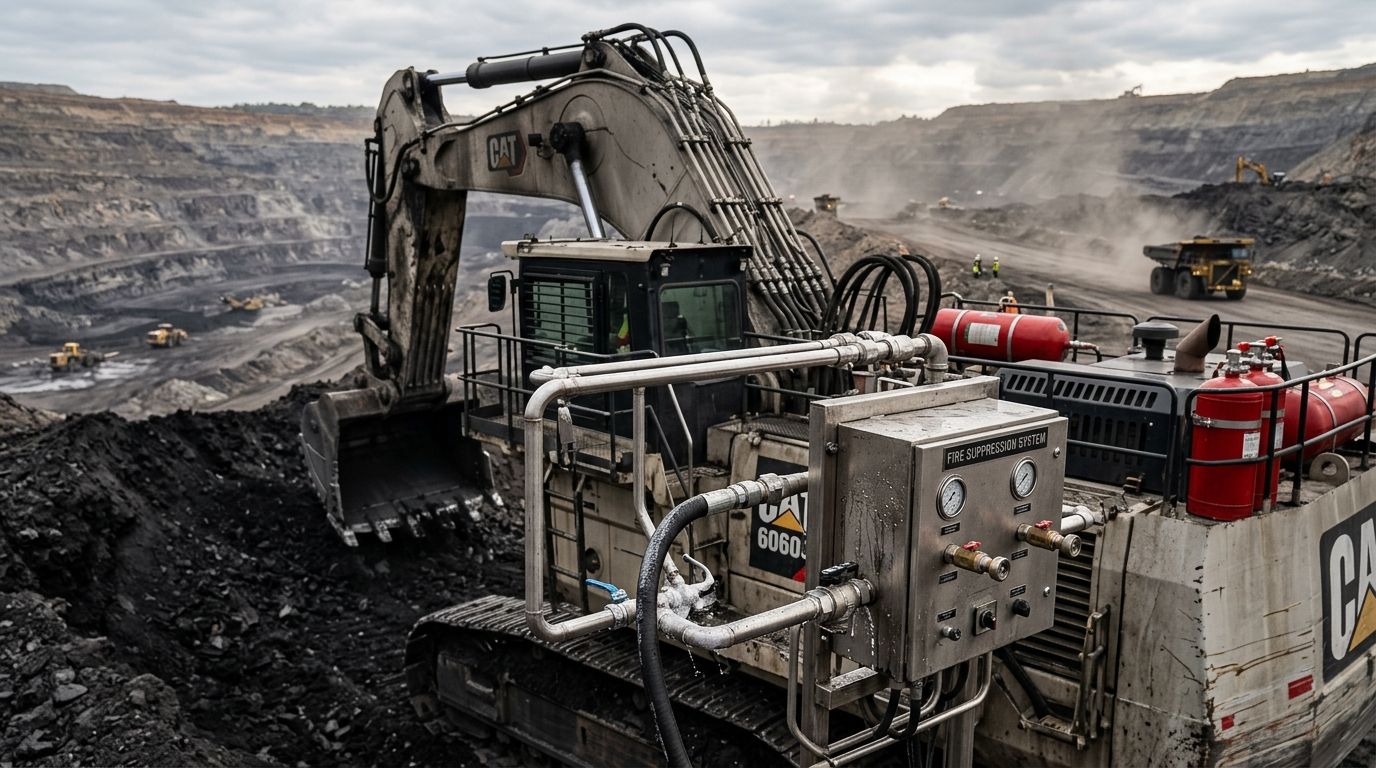
Coal mining equipment fires start in three places nearly every time: the engine compartment, the hydraulic lines, and the electrical cabinet. The right suppression system matches the fire risk to the compartment, not the other way around.
Best overall for coal mining equipment: automatic dry chemical suppression systems. Best for enclosed cabs and control panels: clean agent (FM-200) systems. Best for underground continuous miners and junction boxes: CO2 total flooding systems. Best for fuel tanks and hydraulic reservoirs on large surface equipment: foam-based suppression.
- Automatic dry chemical systems are the default choice for haul trucks, dozers and loaders in 2026.
- Clean agent (FM-200) systems protect enclosed cabs and electrical cabinets without residue cleanup.
- CO2 total flooding suits continuous miner electrical enclosures but needs strict evacuation interlocks underground.
- Foam-based systems handle diesel fuel and hydraulic fluid pool fires on large surface equipment.
- MSHA rules under 30 CFR Part 75 require automatic fire suppression on underground diesel-powered equipment.
Why this matters
Coal mining equipment runs diesel engines and hydraulic systems under continuous load in dusty, confined, or underground environments — conditions that turn a small fuel leak or electrical short into a fast-moving fire. A haul truck engine fire that starts on a surface pit can be knocked down with a hand extinguisher if crews reach it in the first 60 seconds; underground, that same fire on a continuous miner has no easy escape route for smoke or heat.
That's why MSHA regulations treat mobile mining equipment differently from a warehouse forklift. Automatic detection and suppression is often not optional on underground diesel equipment, and the system you choose has to match both the compartment it protects and the environment it operates in. First-Line Fire services suppression systems, extinguishers, and inspection schedules for coal, industrial, and fleet customers across Kentucky, Illinois, Indiana, Tennessee, Missouri, and Alabama, and the pattern holds across every site: mismatched systems fail inspections and mismatched agents fail fires.
What makes the best fire suppression system for coal mining equipment
- MSHA compliance — meets 30 CFR Part 75 (underground) or Part 77 (surface) requirements for the equipment class
- Detection speed — linear heat/flame detection wired to actuate before the fire spreads past the compartment of origin
- Agent-to-risk match — dry chemical for open engine bays, clean agent or CO2 for enclosed electrical, foam for fuel pools
- Manual backup — pull stations at the operator seat and ground level, independent of the automatic trigger
- Cleanup and downtime — how long the equipment sits idle after a discharge before it's back in service
- Regional service availability — inspection and recharge support close enough to the site to hit due dates
At a glance: fire suppression systems for coal mining equipment
| System | Best for | Standout feature | Key limitation |
|---|---|---|---|
| Automatic dry chemical | Haul trucks, dozers, loaders | Fast knockdown across engine bay and hydraulics | Messy cleanup, full recharge after discharge |
| Clean agent (FM-200) | Enclosed cabs, control panels | No residue on electronics | Needs a sealed enclosure to hold concentration |
| Water mist | Turbocharger and exhaust zones | Cools re-ignition sources better than dry agents | Needs clean water supply, nozzle upkeep |
| Foam-based | Fuel tanks, hydraulic reservoirs | Blankets liquid fuel to stop flash reflash | Heavier system, more plumbing to maintain |
| CO2 total flooding | Continuous miner enclosures, junction boxes | No residue, effective on electrical fires | Asphyxiation risk without interlocks |
1. Automatic dry chemical suppression: best for haul trucks, dozers, and surface mobile equipment
A tank of dry chemical agent — typically monoammonium phosphate — sits mounted on the frame with discharge nozzles aimed at the engine compartment, turbocharger, and hydraulic lines. Linear heat detection wire runs through the highest-risk zones and triggers automatic discharge before a fire spreads past the compartment where it started. Manual pull stations back up the automatic trigger at the cab and at ground level.
Automatic dry chemical pros:
- Fast knockdown on the Class A/B/C fire mix common in diesel engine bays
- Reliable in dusty, high-vibration surface conditions where the equipment already lives
- Manual pull stations give operators and ground crew a second trigger
- Widest service and recharge network across coal-producing regions
Automatic dry chemical cons:
- Discharge leaves agent residue that has to be cleaned from cab surfaces and connectors
- Doesn't cool hot metal as effectively as water mist, so re-ignition risk lingers
- Full cylinder recharge required after every discharge, even a partial one
Best for: surface haul trucks, dozers, loaders, and graders with open engine compartments. Verdict: Install.
2. Clean agent (FM-200) systems: best for enclosed cabs and electrical control panels
Clean agent systems flood a sealed enclosure with a gaseous agent that extinguishes fire without leaving residue behind. That makes them the right call for anything with sensitive electronics nearby — operator cabs, motor control centers, and equipment control panels where dry chemical would ruin the wiring it's supposed to protect.
Clean agent pros:
- Zero residue means no downtime scrubbing electronics after a discharge
- Safe to use in occupied spaces at the rated design concentration
- Total-flood design extinguishes fast in small, sealed volumes
Clean agent cons:
- Needs a genuinely sealed enclosure to hold the agent concentration long enough to work
- Loses effectiveness in large, open engine bays with constant airflow
- Not a substitute for dry chemical on fuel or hydraulic fires outside the enclosure
Best for: enclosed electrical cabinets, control rooms, and operator cabs. Verdict: Install.
3. Water mist systems: best for high-heat turbocharger and exhaust compartments
Water mist systems atomize water into a fine spray that cools hot surfaces and displaces oxygen around the engine's hottest points — the turbocharger and exhaust manifold, where dry chemical often knocks down flame but leaves metal hot enough to reignite fuel vapor.
Water mist pros:
- Superior cooling cuts re-ignition risk compared to dry agents alone
- Minimal cleanup versus dry chemical discharge
- Compatible with most equipment materials and coatings
Water mist cons:
- Requires a clean water supply and routine nozzle inspection to prevent clogging
- Fewer installers service water mist in some coal regions, which can stretch repair timelines
- Not effective on live electrical fires without an additive package
Best for: turbocharger and exhaust manifold zones on diesel-powered equipment. Verdict: Consider.
4. Foam-based suppression: best for fuel tanks and hydraulic reservoirs on large surface equipment
Foam concentrate mixes with water to blanket spilled diesel fuel or hydraulic fluid, smothering vapor before it flashes back into flame. On large excavators and haul trucks carrying hundreds of gallons of hydraulic fluid, that vapor blanket matters more than raw knockdown speed.
Foam-based pros:
- Effective on liquid fuel pool fires that dry chemical struggles to fully extinguish
- Blankets vapor to prevent reflash after the initial knockdown
- Well suited to large-volume hydraulic systems on surface equipment
Foam-based cons:
- Heavier system adds weight and requires a water/foam concentrate reservoir on the equipment
- Slower knockdown on electrical fires than clean agent or CO2
- More plumbing and maintenance points than a straight dry chemical setup
Best for: fuel tank and hydraulic reservoir zones on large surface excavators and haul trucks. Verdict: Consider.
5. CO2 total flooding: best for underground continuous miner enclosures and junction boxes
CO2 systems flood a small, enclosed compartment with carbon dioxide gas, displacing the oxygen a fire needs. On continuous miners and enclosed junction boxes underground, that no-residue, electrically safe knockdown is hard to beat — but the same oxygen displacement that kills a fire can hurt a person in an unventilated space.
CO2 pros:
- Leaves no residue and no cleanup on electrical components
- Effective on electrical fires in tight enclosures where dry chemical can't reach
- Doesn't damage sensitive miner electronics the way agent residue can
CO2 cons:
- Asphyxiation risk in occupied underground spaces without proper interlocks and evacuation alarms
- Not suited to large, open compartments where the gas concentration disperses too fast
- Requires strict interlock and ventilation coordination per MSHA guidance
Best for: continuous miner electrical enclosures and junction boxes underground. Verdict: Consider, interlocks required.
How this ranking works
Ranking weighs MSHA compliance for the equipment class first, then how closely the agent matches the compartment's actual fire risk — engine bay versus electrical cabinet versus fuel reservoir. Detection speed, cleanup time, and service availability across coal-producing counties in Kentucky, Illinois, Indiana, Tennessee, Missouri, and Alabama break ties between systems that otherwise score close.
“The system that matches the compartment beats the system that's easiest to install every time.”
Which fire suppression system should you choose?
Most coal operations running a mixed fleet in 2026 land on a layered setup rather than one system for everything: automatic dry chemical on the engine compartment and hydraulics of every haul truck, dozer, and loader, clean agent or CO2 wherever electronics sit in a sealed enclosure, and foam on any large surface machine carrying a big hydraulic reservoir. If your fleet mixes surface and underground equipment, don't standardize on one agent — match the system to the compartment, then check the fit against your current MSHA classification. Related coverage on fire extinguisher types for coal mining operations and vehicle fire suppression systems for fleet trucks covers the portable and mobile-fleet side of the same decision.
Get a suppression system checked before season
First-Line Fire tracks inspection due dates across KY, IL, IN, TN, MO and AL.
FAQ
What is the best fire suppression system for coal mining equipment in 2026?
Automatic dry chemical systems are the best default for surface mobile equipment like haul trucks, dozers, and loaders in 2026. Enclosed electrical cabinets and cabs do better with clean agent or CO2, since those agents leave no residue.
Is clean agent or dry chemical better for mining equipment?
Clean agent works better on enclosed electrical panels and cabs because it leaves no residue; dry chemical works better on open engine compartments and hydraulic lines because it knocks down a wider range of fire classes fast.
Does MSHA require automatic fire suppression on mining equipment?
MSHA regulations under 30 CFR Part 75 require automatic fire suppression on underground diesel-powered equipment in many configurations. Surface equipment falls under separate requirements in 30 CFR Part 77, so the exact rule depends on the equipment class and where it operates.
How often should fire suppression systems on coal mining equipment be inspected?
Suppression systems on mining equipment need scheduled inspections to stay compliant and functional, and the interval depends on the system type and manufacturer requirements. Missing a due date is the most common reason a system fails inspection, not a mechanical defect.
Can CO2 systems be used in underground coal mines?
Yes, but only with strict evacuation interlocks and ventilation coordination, since CO2 displaces the oxygen a fire needs and can create an asphyxiation risk in an unventilated underground space. CO2 works best on small enclosed compartments like junction boxes rather than areas where people work continuously.
What's the difference between automatic and manual fire suppression on haul trucks?
Automatic systems trigger from heat or flame detection wired into the engine compartment without operator action, while manual systems rely on a pull station the operator or ground crew activates. Most haul truck setups run both, with the manual pull station as backup to the automatic trigger.
How much does a fire suppression system for mining equipment cost?
Cost varies by equipment size, agent type, and how many compartments need protection, so there's no single number that applies across a fleet. Get a site-specific quote from an installer who can inspect the actual equipment and compartments involved.
Which fire suppression system works best in underground continuous miners?
CO2 total flooding is the standard choice for continuous miner electrical enclosures and junction boxes because it leaves no residue and doesn't damage sensitive components. It has to be paired with proper ventilation interlocks given the underground environment.
One last thing
MSHA's automatic fire suppression requirement for underground diesel equipment under 30 CFR Part 75 exists because smoke and heat have nowhere to vent the way they do on a surface pit — the same fire that gives a surface crew a minute to react gives an underground crew far less. Check your equipment's classification against that rule before assuming your current system is compliant in 2026, not after an inspection flags it.