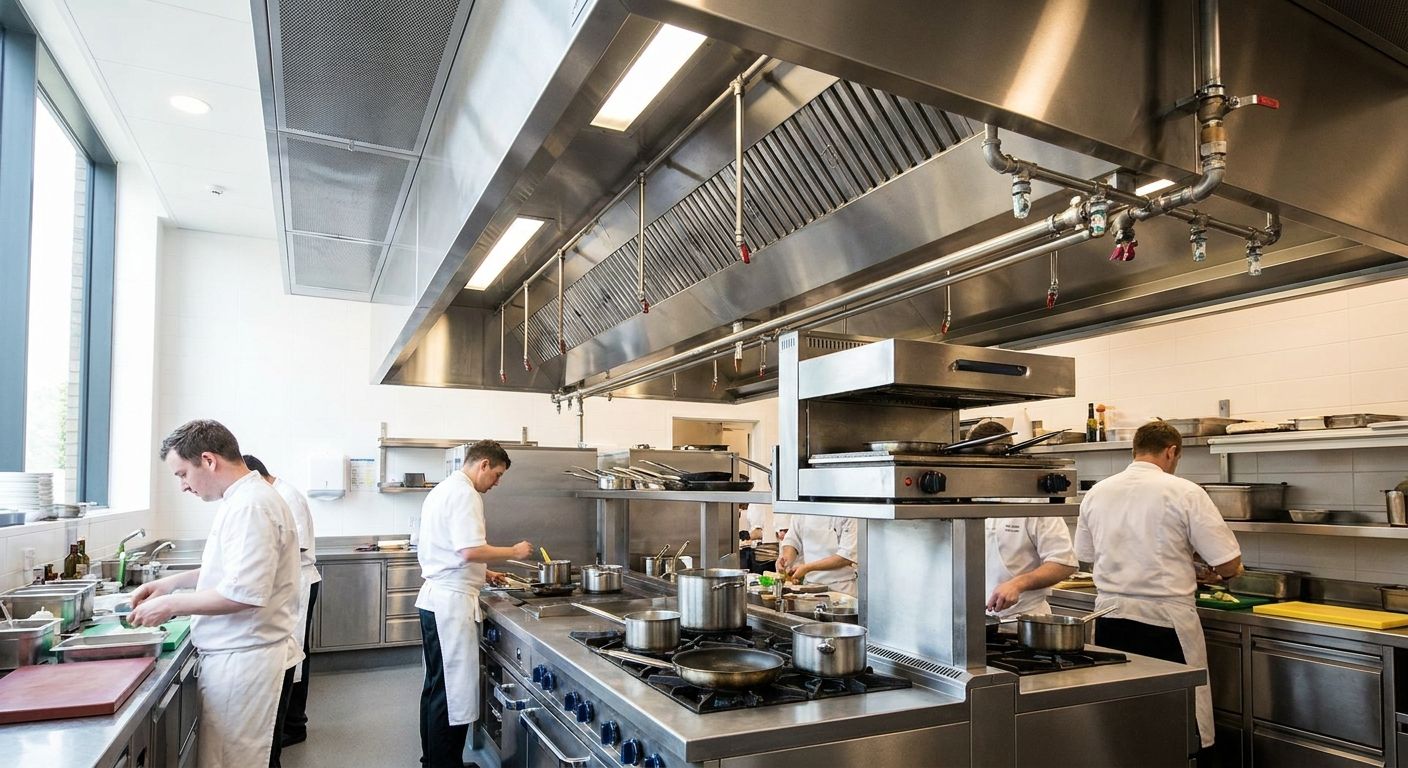
Commercial kitchen fire suppression comes down to one real choice: a UL 300-listed wet chemical system installed and serviced by people who actually show up for the inspection. Ansul R-102 wins for most full-service kitchens, Kidde Fenwal wins for high-BTU multi-appliance hood lines, and Amerex KP wins for single-hood operations that don't need a heavy-duty setup. Every system on this list meets UL 300, the standard rewritten in 1994 specifically because older dry chemical systems couldn't knock down grease fires burning at modern fryer oil temperatures.
- Ansul R-102 is the best overall pick among fire suppression systems for commercial kitchens in 2026 — most parts and techs available.
- Kidde Fenwal fits multi-appliance hood lines with heavy BTU loads better than lighter wet chemical setups.
- Amerex KP Series suits single-hood kitchens and smaller operations that don't need multi-tank coverage.
- Pyro-Chem is built for food trucks and mobile kitchen units with tight mounting space.
- All five require UL 300 compliance and NFPA 96 semi-annual inspection — no system is 'install and forget.'
Why this matters
A hood suppression system that isn't rated for your appliance lineup won't discharge fast enough on a deep fryer fire, and an outdated system won't pass your next fire marshal inspection. Insurance carriers in Kentucky, Illinois, Indiana, Tennessee, Missouri and Alabama are increasingly asking for proof of UL 300 compliance before renewing commercial kitchen policies, not just a sticker on the tank. First-Line Fire installs and services these systems across all six of those states, so the picks below reflect what actually gets specified on real hood jobs, not a spec sheet comparison.
Get this wrong and you're either overpaying for suppression capacity a food truck doesn't need, or underbuilding a system that can't cover six fryers and two char-broilers on one hood line.
What makes the best fire suppression system for a commercial kitchen
- UL 300 listing — mandatory since the 1994 rewrite of the standard for any kitchen with modern high-efficiency fryers
- Appliance coverage match — fryers, griddles, char-broilers, ranges, and woks each need specific nozzle placement
- Automatic and manual actuation — the system has to fire on its own and let staff pull a manual station
- Fuel shutoff integration — gas or electric shutoff tied to the discharge, not a separate step someone has to remember
- NFPA 96 semi-annual service compatibility — every wet chemical system needs inspection twice a year; parts availability matters more than the brand name
- Local technician coverage — a system nobody nearby can service is a liability, not a safety feature
At a glance
| System | Best for | Standout feature | Key limitation |
|---|---|---|---|
| Ansul R-102 | Full-service restaurant kitchens | Widest installed base, broadest parts and nozzle catalog | Overbuilt for a single-fryer setup |
| Kidde Fenwal | High-BTU, multi-appliance hood lines | Higher-capacity tanks for heavy cook lines | Larger footprint, needs more mounting space |
| Amerex KP Series | Single-hood, smaller kitchens | Compact tank sizing for tight kitchens | Limited capacity for large multi-appliance lines |
| Pyro-Chem | Food trucks and mobile kitchens | Low-profile mounting for confined spaces | Fewer regional service techs than Ansul or Kidde |
| Buckeye | Retrofit on existing hood systems | Straightforward install onto standard hood duct runs | Smaller nozzle configuration library |
1. Ansul R-102: best overall for full-service restaurant kitchens
Ansul's R-102 wet chemical system is the one most fire marshals across Kentucky, Illinois and Tennessee have inspected the most times, which matters when something needs a replacement part on short notice. It covers fryers, griddles, char-broilers and ranges under one hood with a nozzle layout that's been refined since the system's original UL 300 listing decades ago. Most kitchen hood retrofits default to it because parts, cartridges and trained techs are easier to source than any competing brand.
Ansul R-102 pros:
- Broadest parts and cartridge availability across the region
- Nozzle configurations cover almost every standard appliance layout
- Most fire suppression technicians are already trained on it
Ansul R-102 cons:
- Costs more to service than it needs to on a single-appliance kitchen
- Tank sizing can be overkill for a small satellite kitchen
Best for: full-service restaurant kitchens with multiple appliance types under one hood. Verdict: Buy if you're running a standard full-service line with fryers, griddles and a char-broiler.
2. Kidde Fenwal: best for high-BTU, multi-appliance hood lines
Kidde Fenwal's kitchen suppression line is built around higher-capacity wet chemical tanks, which makes sense for cook lines pushing six or more appliances under one long hood. It's a common spec on high-volume commercial kitchens in Illinois and Indiana where the hood run stretches well past what a standard single-tank system can cover.
Kidde Fenwal pros:
- Higher tank capacity handles longer hood runs without adding extra cylinders
- Solid fit for heavy-BTU line cooking with multiple fryers
- Automatic fuel shutoff integration is straightforward on new installs
Kidde Fenwal cons:
- Larger tanks need more clearance than a compact kitchen has
- Not the right pick for a single fryer or small kitchen footprint
Best for: high-volume kitchens with long hood lines and multiple high-BTU appliances. Verdict: Buy if your hood line covers more than four major cooking appliances.
3. Amerex KP Series: best for single-hood, smaller kitchens
Amerex's KP Series wet chemical system scales down well, which is the whole point for a single-hood kitchen that doesn't need Ansul or Kidde-level capacity. It still meets the same UL 300 standard and covers the standard appliance types, just with a smaller tank footprint that fits kitchens with limited mechanical room space.
Amerex KP pros:
- Compact tank size fits kitchens with tight mechanical space
- Meets the same UL 300 requirements as larger systems
- Lower complexity install on a single hood
Amerex KP cons:
- Capacity runs out fast if the kitchen adds appliances later
- Fewer nozzle configuration options than Ansul's catalog
Best for: single-hood kitchens like coffee shops, small diners, or satellite kitchens. Verdict: Buy if you're covering one hood with two or three appliances, not a full line.
4. Pyro-Chem: best for food trucks and mobile kitchen units
Pyro-Chem's low-profile system design is a common spec on food trucks and mobile kitchen trailers across Missouri and Alabama, where mounting space is the limiting factor, not appliance count. It still requires the same NFPA 96 semi-annual inspection as a fixed kitchen, which is easy to overlook once the truck is on the road for months at a time.
Pyro-Chem pros:
- Low-profile tank mounting fits mobile kitchen constraints
- Meets the same UL 300 listing as fixed-kitchen systems
- Handles typical food truck appliance loads (griddle, fryer) fine
Pyro-Chem cons:
- Fewer regional technicians trained on it compared to Ansul or Kidde
- Not the right fit for a large fixed-location kitchen
Best for: food trucks and mobile kitchen trailers with limited mounting space. Verdict: Hold until you confirm a local tech actually stocks Pyro-Chem parts before committing.
5. Buckeye: best for straightforward retrofit on existing hood systems
Buckeye's kitchen suppression system is a common retrofit choice when a kitchen already has ductwork and hood infrastructure in place and just needs a compliant system dropped in. It's not the first system most techs reach for on a new build, but it does the job on a standard retrofit without complicating the install.
Buckeye pros:
- Straightforward install onto existing hood and duct runs
- Meets UL 300 without added complexity
- Works fine on standard single or dual-appliance retrofits
Buckeye cons:
- Smaller nozzle configuration library than Ansul or Kidde
- Less common, so replacement parts can take longer to source
Best for: retrofitting an existing hood system that already has compatible ductwork. Verdict: Hold for retrofits, but confirm parts lead time before signing off on a new install.
How we ranked
Each system got measured against the six criteria above: UL 300 listing, appliance coverage match, automatic and manual actuation, fuel shutoff integration, NFPA 96 semi-annual service compatibility, and local technician coverage across Kentucky, Illinois, Indiana, Tennessee, Missouri and Alabama. No system failed UL 300 — that's table stakes in 2026 — so the actual differentiator was appliance coverage fit and how easy each system is to keep serviced twice a year without waiting weeks on parts.
Get your kitchen system inspected
Sales, install and semi-annual service across KY, IL, IN, TN, MO and AL.
Which fire suppression system should you choose?
If you're running a standard full-service kitchen with fryers, griddles and a char-broiler under one hood, Ansul R-102 is the default pick in 2026. Step up to Kidde Fenwal once your hood line stretches past four major appliances, and step down to Amerex KP if you're covering a single small hood. Food trucks lean Pyro-Chem, and retrofits onto existing ductwork lean Buckeye — either way, the system is only as good as the semi-annual inspection that keeps it compliant.
FAQ
What is the best fire suppression system for commercial kitchens in 2026?
Ansul R-102 is the best overall wet chemical system for most full-service commercial kitchens in 2026 because of its broad appliance coverage and parts availability. Kitchens with heavier appliance loads often do better with Kidde Fenwal instead.
Is Ansul or Kidde Fenwal better for a commercial kitchen?
Ansul R-102 fits standard full-service kitchens with a mix of fryers, griddles and char-broilers under one hood. Kidde Fenwal is the better call once the hood line covers more than four high-BTU appliances.
How often does a kitchen fire suppression system need inspection?
NFPA 96 requires wet chemical kitchen suppression systems to be inspected at least twice a year, or semi-annually. This applies regardless of which UL 300-listed system is installed.
What does UL 300 mean for a kitchen fire suppression system?
UL 300 is the fire suppression standard rewritten in 1994 to address modern high-efficiency fryer oils, which older dry chemical systems couldn't extinguish reliably. Any commercial kitchen hood system installed in 2026 needs to meet this standard.
Can a food truck use the same suppression system as a restaurant kitchen?
Food trucks need a UL 300-listed system just like a fixed kitchen, but mounting space usually pushes the choice toward a low-profile design like Pyro-Chem. Ansul and Kidde systems are built for larger fixed installations.
Does a fire suppression system replace fire extinguishers in a commercial kitchen?
No — a hood suppression system and portable fire extinguishers cover different scenarios and both are required under NFPA 96 and most local fire codes. The suppression system handles the hood and cooking surface; extinguishers cover everything else in the kitchen.
How much does it cost to service a kitchen suppression system?
Service costs vary by system size, appliance count and region, so get a direct quote rather than relying on a rule of thumb. Semi-annual inspection is required regardless of the quoted price.
What happens if a kitchen suppression system fails inspection?
A failed inspection typically means the kitchen can't legally operate the affected cooking line until the system is repaired or replaced. Insurance carriers in states like Kentucky and Tennessee are increasingly checking for current inspection tags before renewing commercial policies.
One last thing
Most kitchens that fail an inspection in 2026 aren't failing because the system is the wrong brand — they're failing because nobody tracked the semi-annual service date. Ansul, Kidde Fenwal, Amerex, Pyro-Chem and Buckeye all meet UL 300; the system that keeps your kitchen open is the one somebody actually shows up to service on schedule.