Warehouses don't fail fire alarm inspections because the panel is broken — they fail because the system doesn't match how the building actually runs: multiple zones, high ceilings, forklift exhaust, or nobody on-site after the night shift leaves. Best overall: addressable fire alarm systems. Best for small or single-zone buildings: conventional fire alarm systems. Best for older buildings without existing wiring: wireless (mesh) fire alarm systems.
- Addressable fire alarm systems win for warehouses over 50,000 sq ft split into multiple zones.
- Conventional systems still make sense for single-zone warehouses under 25,000 sq ft in 2026.
- Multi-criteria detectors cut nuisance alarms in dusty, high-bay space with forklift exhaust.
- Wireless mesh systems fit retrofit jobs where conduit runs aren't practical.
- Central station monitoring matters most for warehouses that sit unmanned overnight.
Why this matters
A warehouse alarm system that's wrong for the building doesn't just annoy staff with false alarms — it delays the response that actually matters when there's smoke in the racking. Distribution centers and industrial warehouses across Kentucky, Illinois, Indiana, Tennessee, Missouri and Alabama run different layouts, different ceiling heights, and different staffing patterns, and the alarm architecture has to match all three.
First-Line Fire installs and services alarm systems alongside fire extinguishers for warehouses and distribution centers, and the same building assessment that sizes extinguisher classes also decides whether a panel needs to be addressable, conventional, wireless, or monitored. NFPA 72, the National Fire Alarm and Signaling Code, sets the testing and inspection schedule every system has to hit regardless of which type you pick — that part doesn't change with the technology.
What makes the best fire alarm system for a warehouse
- Location precision — does the panel tell you a zone or the exact device
- Detector match to environment — dust, forklift exhaust, and high ceilings need different sensing than a clean office
- Wiring flexibility — new construction, retrofit, and leased space all have different constraints
- Expansion room — can zones or devices get added without ripping out the panel
- Monitoring capability — does it notify a central station or just make noise on-site
- NFPA 72 compliance — annual system testing and documented inspection records
Fire alarm systems for warehouses at a glance
| System type | Best for | Standout feature | Key limitation |
|---|---|---|---|
| Addressable fire alarm system | Large multi-zone warehouses | Pinpoints the exact device, not just a zone | Higher upfront programming cost |
| Conventional fire alarm system | Small, single-zone warehouses | Simple zone wiring keeps install straightforward | Only identifies the zone, not the device |
| Wireless (mesh) fire alarm system | Retrofit installs without conduit | No trenching or conduit runs needed | Battery and RF checks add recurring maintenance |
| Multi-criteria (multi-sensor) detection | High-ceiling warehouses with dust or exhaust | Cross-checks smoke, heat and CO before alarming | Costs more per head than single-sensor detectors |
| Monitored fire alarm system | Warehouses unmanned overnight | Dispatches the fire department with no one on-site | Depends on a working phone/cell/IP connection |
1. Addressable fire alarm systems: best fire alarm system for large multi-zone warehouses
Every device on an addressable loop reports its own address back to the panel, so the alarm points to the exact pull station or detector instead of an entire zone. On a 100,000 sq ft distribution floor split into a dozen zones, that detail matters because staff aren't searching a quarter of the building at 2 a.m.
Addressable fire alarm system pros:
- Pinpoints the exact device that tripped, not just a zone
- Scales cleanly as racking sections and zones get added
- Programs around HVAC shutdowns, door releases and other tie-ins without rewiring
Addressable fire alarm system cons:
- Panel and programming cost more upfront than conventional
- Changes typically require a licensed technician, not a facilities generalist
Best for: warehouses over 50,000 sq ft with multiple zones or racking sections. Verdict: Buy.
2. Conventional fire alarm systems: best fire alarm system for small, single-zone warehouses
Conventional wiring reports by zone, not by device, so the panel tells you which zone tripped rather than which unit inside it. For a single open bay under 25,000 sq ft, that resolution is plenty and keeps the wiring simple to install and service.
Conventional fire alarm system pros:
- Lower install complexity than addressable
- Easier for a small maintenance team to understand and troubleshoot
- Straightforward to service alongside routine hydro testing and extinguisher checks
Conventional fire alarm system cons:
- No pinpoint location once the building splits into multiple zones
- Adding zones later usually means rewiring, not just reprogramming
The same logic shows up in fire alarm systems for small businesses — size the panel to the space you actually have, not the space you might have in five years.
Best for: single-zone warehouses under 25,000 sq ft. Verdict: Buy for the right size, Skip once you're multi-zone.
3. Wireless (mesh) fire alarm systems: best fire alarm system for retrofit installs without conduit
Wireless mesh devices talk to the panel over radio instead of hard wiring, which matters in a warehouse with tilt-up concrete walls, high open ceilings, or a leased space where cutting into the structure isn't an option.
Wireless fire alarm system pros:
- No conduit runs or trenching required
- Faster install timeline than a fully wired retrofit
- Works in leased buildings where structural changes aren't allowed
Wireless fire alarm system cons:
- Battery and RF signal checks become a recurring maintenance task
- Dense metal racking can interfere with mesh signal strength
Best for: older or leased warehouses needing a retrofit without conduit access. Verdict: Buy for retrofit, Hold if you're pouring new construction.
4. Multi-criteria (multi-sensor) detection: best fire alarm system for high-ceiling warehouses with dust or exhaust
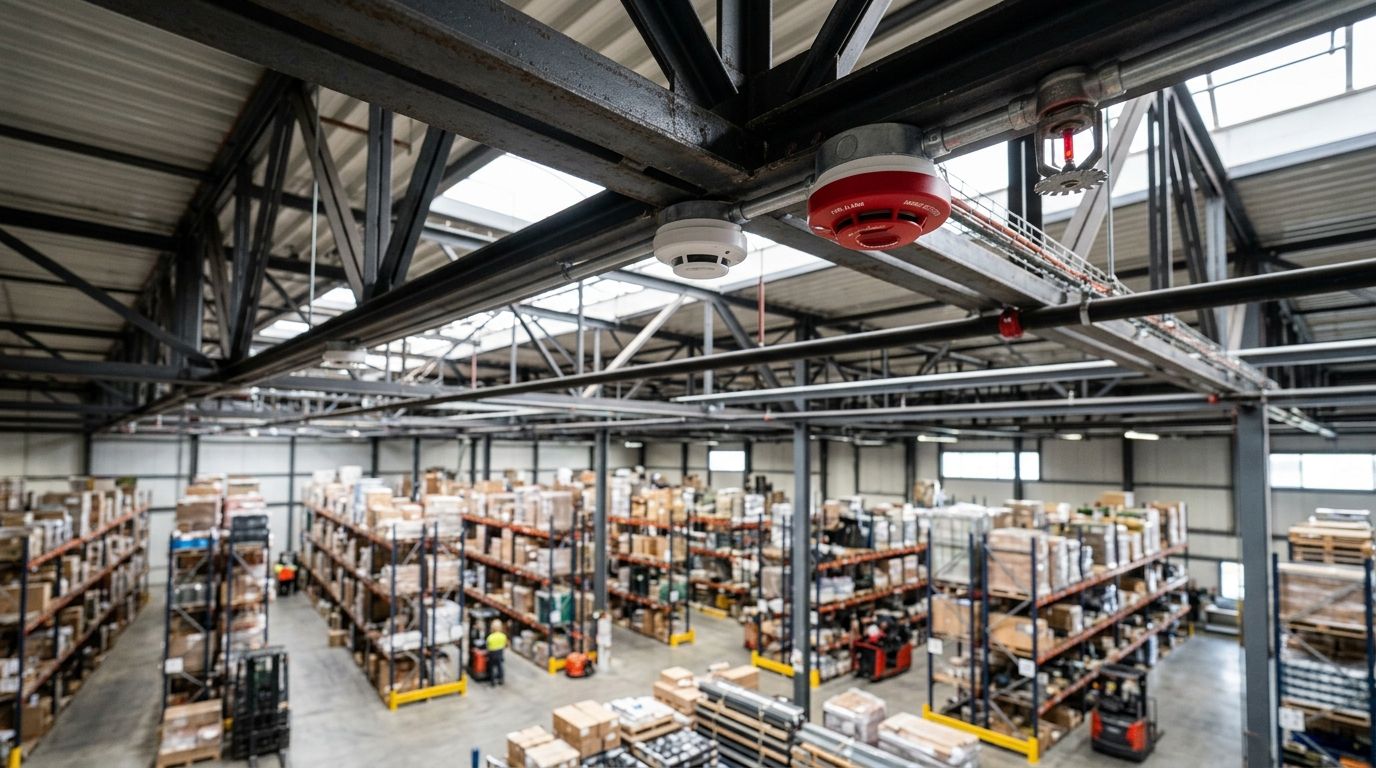
Multi-criteria detectors combine smoke, heat and sometimes CO sensing in one head, cross-checking readings before triggering an alarm. In warehouses running forklifts, storing dusty bulk material, or built with ceilings over 30 feet, that cross-check cuts nuisance alarms a single-sensor detector would trigger on its own.
Multi-criteria detection pros:
- Fewer false alarms from dust and forklift exhaust
- Better suited to smoke stratification under high ceilings
- One head does the job of separate smoke and heat detectors
Multi-criteria detection cons:
- Costs more per head than single-sensor detectors
- Still requires correct spacing and placement under NFPA 72 — it's not a substitute for proper layout
Best for: dusty, high-bay warehouse space with forklift traffic. Verdict: Buy for dust or high-bay space, Skip for a clean, low-ceiling combo office-warehouse.
5. Monitored fire alarm systems: best fire alarm system for warehouses unmanned overnight
A monitored system ties the panel to an off-site central station that's notified the moment a device trips, and that station can dispatch the fire department even when the building is empty. For a distribution center running a skeleton night shift, or none at all, that's the difference between a fire caught at minute one and one caught the next morning.
Monitored fire alarm system pros:
- Dispatch happens without anyone on-site to make the call
- Creates a documented event log useful for insurance
- Layers on top of addressable, conventional or wireless panels
Monitored fire alarm system cons:
- Monthly monitoring adds a recurring cost line
- Dispatch depends on the phone, cell or IP path to the monitoring center staying up
Best for: any warehouse that sits unmanned for part of the day or night. Verdict: Buy.
Get Your Warehouse System Assessed
Serving KY, IL, IN, TN, MO and AL warehouses in 2026.
How we ranked these
Each system type was weighed against the six criteria above: location precision, detector match to the environment, wiring flexibility, room to expand, monitoring capability, and NFPA 72 compliance. No single type wins every category — that's why the list is built around use case, not a single winner.
Which fire alarm system should you choose?
For most warehouses over 50,000 sq ft with more than one zone, addressable is the default in 2026. Small, single-zone operations under 25,000 sq ft do fine on conventional wiring. Add multi-criteria heads anywhere dust or forklift exhaust causes nuisance trips, choose wireless mesh for a retrofit without conduit access, and put central station monitoring on top of any of them if the building runs unmanned at any point in the day.
“The alarm system that matches your zones and your staffing schedule beats the one with the most features on the spec sheet.”
FAQ
What's the best fire alarm system for a warehouse?
For warehouses over 50,000 sq ft with multiple zones, an addressable fire alarm system is the best fit in 2026 because it identifies the exact device that tripped instead of just a zone. Smaller, single-zone buildings under 25,000 sq ft do fine on conventional wiring.
Is an addressable fire alarm system better than conventional for a warehouse?
Addressable systems are better once a warehouse has more than one zone, since they pinpoint the exact device rather than just the zone. Conventional systems are the simpler, adequate choice for a single open bay.
Do warehouses need a monitored fire alarm system?
Any warehouse that sits unmanned overnight or during off-hours benefits from central station monitoring, since it dispatches the fire department without anyone on-site to call it in. Warehouses staffed around the clock can rely on local notification alone.
How often does a warehouse fire alarm system need to be tested?
NFPA 72 sets the testing and inspection schedule for fire alarm systems, including annual full-system testing regardless of whether the panel is addressable, conventional, or wireless. Specific devices like smoke detectors have their own testing intervals under the same code.
What detector type works best for dusty warehouses?
Multi-criteria detectors that combine smoke, heat and CO sensing cut down on nuisance alarms in dusty or high-bay warehouse space with forklift exhaust. A single-sensor smoke detector alone tends to false-alarm more often in that environment.
Can a wireless fire alarm system work in an older warehouse?
Yes, wireless mesh systems are built for retrofit jobs where conduit runs aren't practical, such as older buildings with tilt-up concrete walls or leased space. The tradeoff is ongoing battery and RF signal checks.
How many zones does a warehouse fire alarm system need?
There's no fixed number — zoning depends on the building's layout, racking sections, and how staff move through the space during an evacuation. A single open bay under 25,000 sq ft often needs just one zone; larger, segmented warehouses need several.
Does a fire alarm system replace fire extinguishers in a warehouse?
No, a fire alarm system detects and reports a fire but doesn't suppress it — extinguishers, and in some cases suppression systems, handle that job. Warehouses typically need both, sized and placed according to the building's layout and hazard class.
One last thing
The system type on the spec sheet matters less than whether someone is actually tracking the NFPA 72 test dates once it's installed. A warehouse with a top-tier addressable panel that missed its annual inspection is worse off on paper than a conventional system that's been tested on schedule every year since it went in.