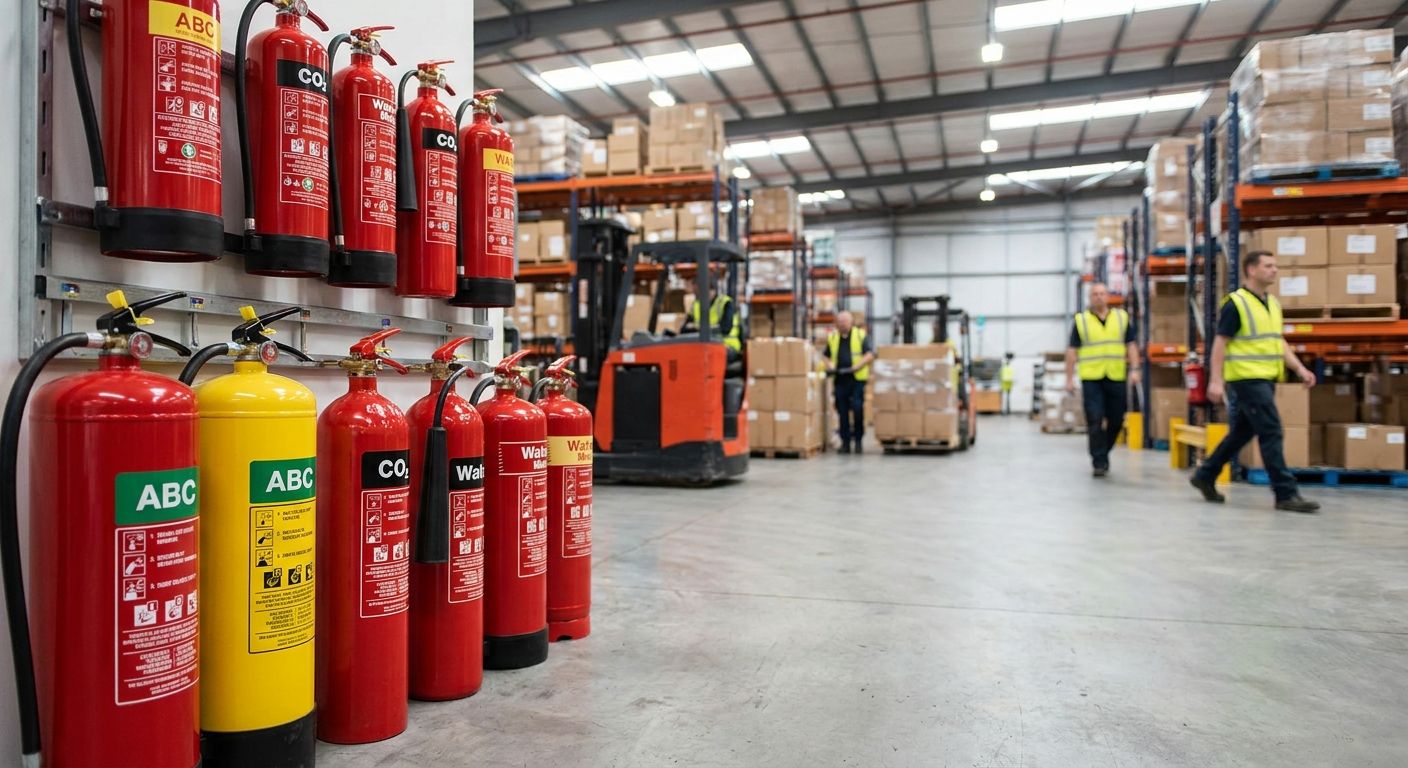
Warehouses and distribution centers pack tall steel racking, forklift traffic, cardboard, shrink wrap, and live electrical panels into one open floor plan, and that mix is what decides which fire extinguisher belongs where in 2026.
- ABC multipurpose dry chemical extinguishers are the best fire extinguishers for warehouses and distribution centers with mixed Class A and B hazards in 2026.
- CO2 extinguishers protect electrical rooms and server closets without leaving residue on equipment.
- Foam extinguishers cover flammable liquid storage near loading docks and fuel islands.
- NFPA 10 caps travel distance at 75 feet for Class A hazards and 50 feet for Class B hazards.
- Class D extinguishers are required wherever metal powders or bulk lithium battery stock sit on the floor.
Why this matters
A distribution center isn't one hazard, it's four or five stacked on top of each other: high-piled corrugated stock, propane or electric forklifts charging in a corner, a maintenance shop with solvents, and a server closet running the WMS. One extinguisher type doesn't cover all of it, and NFPA 10 doesn't let you guess your way through placement.
Insurance carriers and local fire marshals check the same three things every time: correct extinguisher type for the hazard class present, travel distance within code, and a current inspection tag. First-Line Fire Extinguisher Co. tracks hydro test and inspection due dates for commercial and industrial sites across Kentucky, Illinois, Indiana, Tennessee, Missouri and Alabama, and that tracking is what keeps a warehouse from failing a walk-through over a missed tag rather than a real hazard.
Getting the extinguisher type wrong isn't a paperwork problem either. A CO2 unit aimed at a burning pallet of cardboard won't hold a flame down the way a dry chemical unit will, and dry chemical powder on a live server rack means replacing hardware you didn't need to touch.
What makes the best fire extinguisher for a warehouse
- Hazard class match — the agent has to be rated for what's actually stored: Class A (ordinary combustibles), Class B (flammable liquids), Class C (energized electrical), or Class D (combustible metals).
- Travel distance compliance — NFPA 10 sets the maximum distance from any point on the floor to the nearest extinguisher, and high-piled storage aisles make this easy to violate without realizing it.
- Residue and cleanup impact — dry chemical discharge can damage electronics and contaminate stored inventory; that matters more in a distribution center than a garage.
- Discharge range and duration — taller racking and longer aisles call for larger agent capacity, not just more units.
- Mounting and forklift clearance — brackets need to survive daily forklift and pallet jack traffic without getting knocked loose.
- Inspection and hydro test interval — stored-pressure dry chemical units run a 12-year hydro test cycle; CO2 units run 5 years, and a missed date is a compliance fail on its own.
Best fire extinguishers for warehouses and distribution centers: at a glance
Best overall for warehouses and distribution centers: ABC multipurpose dry chemical. Best for electrical rooms and server closets: CO2. Best for flammable liquid and loading dock storage: foam.
| Extinguisher type | Best for | Standout feature | Key limitation |
|---|---|---|---|
| ABC dry chemical | General high-piled storage, mixed hazards | Covers Class A, B, and C in one unit | Powder residue contaminates open product and electronics |
| CO2 | Electrical rooms, server closets, control panels | No residue, safe on live equipment | Poor range outdoors or in drafty dock doors |
| Water mist | Combustibles near sensitive inventory | Class A and C rated with no cleanup mess | Limited reach on deep-seated fires |
| Class D dry powder | Lithium battery or metal powder storage | Only agent rated for metal fires | Useless on ordinary Class A stock, single-purpose |
| Foam (AFFF-type) | Flammable liquid storage, loading docks | Blankets liquid surface, stops re-ignition | Heavier unit, not rated for electrical fires |
| Wheeled high-capacity units | Bulk staging areas, long aisle runs | Far larger agent volume than handheld units | Needs a dedicated storage spot, not wall-mountable |
1. ABC multipurpose dry chemical: best for general high-piled storage
ABC dry chemical is the default extinguisher for a distribution center floor because it's rated for Class A combustibles, Class B liquids, and Class C energized equipment in a single unit. Most warehouse floors mix all three within 75 feet of each other, which is exactly the travel distance NFPA 10 allows for Class A hazards.
ABC dry chemical pros:
- Covers three hazard classes with one unit type, simplifying training
- Wide availability in 10 lb to 20 lb handheld sizes for aisle placement
- Long shelf life between hydro tests (12 years for stored-pressure units)
ABC dry chemical cons:
- Powder discharge can ruin open cardboard, paper, or electronics near the fire
- Not the first choice for a server closet or control room
Best for: general warehouse floors, receiving areas, and mixed-hazard aisles. Verdict: Buy.
2. CO2: best for electrical rooms and server closets
CO2 extinguishers displace oxygen and cool the fire without leaving a residue, which is why they're standard in server closets, control panel rooms, and anywhere a distribution center runs a WMS or automated conveyor system. First-Line services CO2 units alongside dry chemical stock on the same site visit for facilities running both hazard types.
CO2 pros:
- No cleanup, no residue on electronics or circuit boards
- Rated for Class B and C fires
- Discharge leaves no chemical trace on stored product
CO2 cons:
- Short discharge range, especially in drafty dock areas
- CO2 units have no pressure gauge; they're checked by weight, and a missed weight check hides a slow leak
Best for: electrical rooms, server closets, and control panel areas. Verdict: Buy.
3. Water mist: best for combustibles near sensitive inventory
Water mist extinguishers use a fine spray instead of a solid stream, rated for Class A and C fires without the powder residue of dry chemical. That matters in distribution centers holding pharmaceuticals, paper goods, or packaged electronics where a dry chemical discharge would write off the inventory it was meant to save.
Water mist pros:
- No residue, safe near sensitive or packaged stock
- Rated for both Class A and energized Class C hazards
- Lower cleanup cost after a discharge event
Water mist cons:
- Shorter effective range on deep-seated or heavily involved fires
- Not rated for flammable liquid (Class B) fires
Best for: high-piled storage zones holding electronics, paper stock, or pharma inventory. Verdict: Buy for sensitive-stock zones, hold elsewhere.
4. Class D dry powder: best for lithium battery and metal powder storage
Class D extinguishers exist for one job: combustible metal fires. Distribution centers storing bulk lithium battery packs, magnesium, or metal powder feedstock need this on hand specifically, because ABC dry chemical and CO2 won't extinguish a metal fire and can make it worse.
Class D dry powder pros:
- Only agent type rated to extinguish combustible metal fires
- Required by code wherever metal powder or bulk battery stock is present
Class D dry powder cons:
- No use on ordinary Class A combustibles or liquid fires
- Adds a second extinguisher type and a second training requirement
Best for: facilities with metal powder feedstock or bulk lithium battery storage. Verdict: Buy if the hazard is present, skip otherwise.
5. Foam (AFFF-type): best for flammable liquid and loading dock storage
Foam extinguishers blanket the surface of a flammable liquid spill and suppress re-ignition better than dry chemical alone. Loading docks, fuel storage rooms, and maintenance shops handling solvents or diesel are the natural fit inside a distribution center footprint.
Foam pros:
- Strong Class B performance with re-ignition suppression
- Effective on liquid pool fires near dock doors
Foam cons:
- Heavier unit than dry chemical of the same rating
- Not rated for Class C energized electrical fires
Best for: flammable liquid storage rooms, fuel islands, and loading dock maintenance areas. Verdict: Buy for fuel and liquid storage zones.
6. Wheeled high-capacity units: best for bulk staging areas and long aisle runs
Wheeled units hold far more agent than any handheld extinguisher, built for warehouses with long racking aisles where NFPA 10 travel distance rules push coverage requirements past what a 20 lb handheld unit can reasonably handle. These sit at fixed staging points rather than wall brackets.
Wheeled unit pros:
- Large agent capacity for bigger, more established fires
- Reduces the number of coverage points needed across a long aisle
Wheeled unit cons:
- Not wall-mountable, needs a dedicated floor spot clear of forklift paths
- Slower to deploy than a handheld unit grabbed off a bracket
Best for: bulk staging zones and long, high-piled aisle runs. Verdict: Buy for large-format facilities, skip for smaller distribution points.
How we ranked these
Each extinguisher type was weighed against the same six criteria from the section above: hazard class match, NFPA 10 travel distance compliance, residue impact on stored product, discharge range, mounting practicality around forklift traffic, and hydro test interval. ABC dry chemical wins overall because it's the only single type covering three hazard classes at once; the other five fill gaps ABC can't close on its own.
Get your warehouse extinguisher plan checked
First-Line tracks hydro test dates and shows up on-site across KY, IL, IN, TN, MO and AL.
Which fire extinguisher should you choose for your distribution center?
Start with ABC multipurpose dry chemical across the general floor, add CO2 in the server closet and control rooms, and add foam wherever flammable liquid or fuel is stored. Only add Class D if metal powder or bulk battery stock is actually on-site, and only go wheeled if aisle length pushes past standard travel distance coverage. For most distribution centers in 2026, that's ABC plus CO2 as the baseline, with foam and Class D layered in by hazard.
FAQ
What's the best fire extinguisher for a warehouse?
ABC multipurpose dry chemical is the best fire extinguisher for most warehouses in 2026 because it covers Class A, B, and C hazards in one unit. Add CO2 for electrical rooms and foam for flammable liquid storage.
Is CO2 or dry chemical better for a distribution center?
Dry chemical covers the general floor better; CO2 wins specifically in server closets and control rooms where residue would damage equipment. Most distribution centers need both.
How many fire extinguishers does a warehouse need under NFPA 10?
NFPA 10 sets travel distance rather than a fixed count: no point on the floor can be more than 75 feet from a Class A extinguisher or 50 feet from a Class B extinguisher. High-piled storage layouts often need more units than expected to meet that.
Do I need Class D extinguishers in a warehouse?
Only if the facility stores combustible metal powders or bulk lithium battery stock. Class D extinguishers don't work on ordinary Class A or B fires, so they're an addition, not a replacement.
How often does a warehouse fire extinguisher need hydro testing?
Stored-pressure dry chemical units run a 12-year hydro test interval; CO2 units run 5 years. Missing either date fails an inspection even if the unit still looks fine.
What size extinguisher do I need for high-piled storage?
Larger handheld units (20 lb ABC) or wheeled high-capacity units are typical for tall racking and long aisles, since travel distance rules push coverage requirements beyond what a small unit can meet.
Can one extinguisher type cover an entire distribution center?
No. ABC dry chemical covers most of the general floor but doesn't replace CO2 in electrical rooms or Class D where metal hazards exist. Distribution centers almost always run at least two types.
Is foam or dry chemical better for a loading dock fuel spill?
Foam is better for flammable liquid pool fires because it blankets the surface and suppresses re-ignition. Dry chemical works too but doesn't hold the seal on liquid fires as well.
One last thing
CO2 extinguishers don't carry a pressure gauge — there's nothing to read on the dial because the agent is a liquefied gas, not a compressed mix. The only reliable check is weighing the cylinder against its stamped full weight, and a unit that's lost pressure through a slow leak can look completely normal on the wall until the day it's needed and discharges almost nothing.