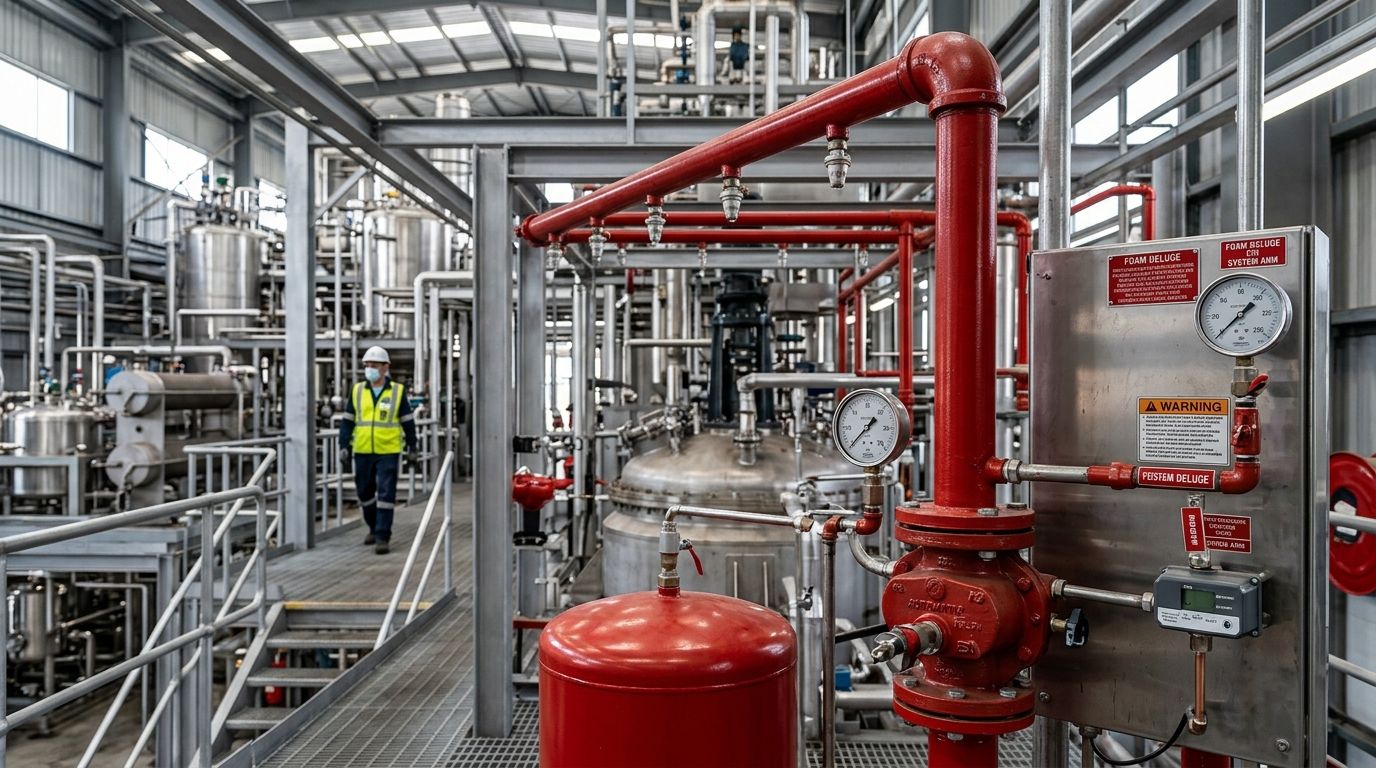
Chemical processing plants run multiple hazard classes under one roof — flammable liquids, reactive solvents, electrical control rooms, loading racks — and no single suppression agent covers all of them. This guide ranks the six suppression system types plants across Kentucky, Illinois, Indiana, Tennessee, Missouri and Alabama actually install in 2026, and tells you which hazard each one is built for.
- Clean agent (FM-200/Novec 1230) systems are the best overall fire suppression systems for chemical processing plants in 2026 for electrical and control rooms.
- Foam suppression wins for flammable liquid storage tanks and loading racks; CO2 flooding wins for enclosed process units.
- Dry chemical and dual-agent systems cover spray booths and multi-hazard yard areas where no single agent fits.
- Water mist is the pick for cable trays and turbine enclosures where cleanup and personnel exposure matter most.
- NFPA 2001, NFPA 11 and NFPA 17 govern design and discharge requirements — match the standard to the hazard before picking hardware.
Why this matters
A chemical plant fire doesn't behave like a warehouse fire. Reactive solvents, pressurized vessels and mixed occupancy areas mean a suppression system sized wrong for the hazard either fails to knock the fire down or damages equipment worse than the fire would have. Getting the agent-to-hazard match wrong in 2026 costs more in downtime than the system itself.
Insurance carriers and OSHA inspectors both check whether the installed system matches the process it protects — a dry chemical unit on a control room, or a clean agent system on an outdoor tank farm, gets flagged in every audit First-Line Fire Extinguisher Co. has walked through in industrial and industrial facilities settings across the six-state service area.
Best overall: Clean agent (FM-200/Novec 1230) systems. Best for flammable liquid storage: Foam suppression (AFFF/AR-AFFF) systems. Best for enclosed process areas: CO2 total flooding systems.
What makes the best fire suppression system for a chemical plant
- Agent compatibility — the agent can't react with the chemicals it's protecting
- NFPA compliance — design follows NFPA 2001 (clean agent), NFPA 12 (CO2), NFPA 11 (foam), or NFPA 17 (dry chemical)
- Discharge and hold time matched to the hazard's fire growth rate
- Cleanup and downtime after a discharge event
- Personnel safety in occupied or intermittently occupied spaces
- Integration with existing detection, alarm and shutdown controls
Fire suppression systems for chemical processing plants at a glance
| System | Best for | Standout feature | Key limitation |
|---|---|---|---|
| Clean agent (FM-200/Novec 1230) | Control rooms and electrical panels | No residue, safe for occupied spaces | Higher agent cost per cubic foot protected |
| CO2 total flooding | Enclosed process units | Total flooding knocks down deep-seated fires | Not safe for occupied spaces during discharge |
| Dry chemical (ANSUL-type) | Spray booths and process unit fires | Fast knockdown on Class B fires | Corrosive residue, long cleanup |
| Foam (AFFF/AR-AFFF) | Flammable liquid tank farms | Vapor suppression plus fire knockdown | Runoff containment required |
| Water mist | Cable trays and turbine enclosures | Low water volume, minimal collateral damage | Higher install complexity than sprinklers |
| Dual-agent (dry chemical + AFFF) | Multi-hazard loading racks | Covers Class B liquid and vapor fires together | Two agents to inspect and recharge |
1. Clean agent (FM-200/Novec 1230) systems: best for control rooms and electrical panels
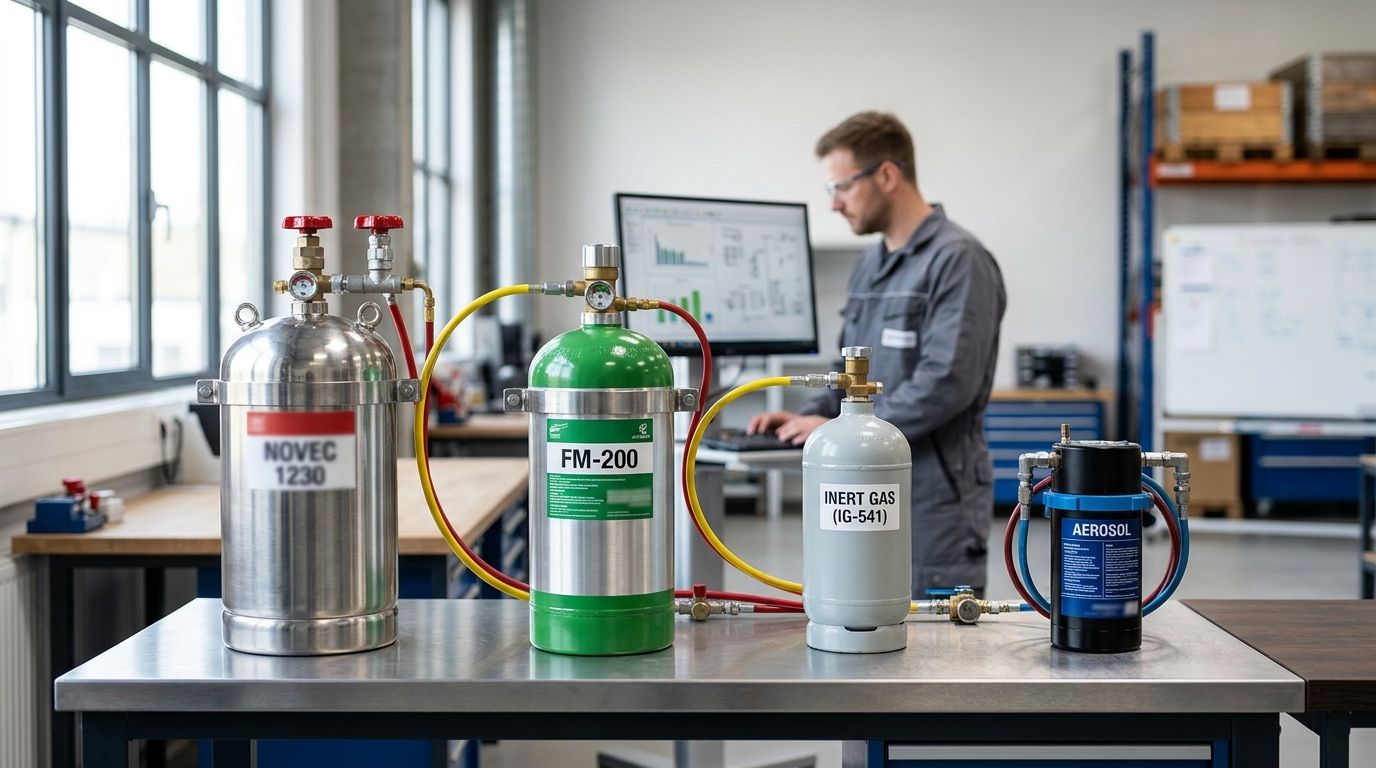
Clean agent systems discharge a gaseous agent that suppresses fire without leaving residue, which is why they protect fire suppression systems for server rooms and data centers and the equivalent control rooms and DCS panels inside a chemical plant. NFPA 2001 requires total flooding agents reach design concentration within 10 seconds for most hazard classes, which limits fire spread before it reaches adjacent instrumentation.
Clean agent pros:
- Leaves no residue on electronics or control panels
- Safe for brief occupancy during discharge
- Fast knockdown protects instrumentation from heat damage
Clean agent cons:
- Room integrity (door seals, penetrations) has to hold for the agent to work
- Not suited for large open process areas — agent volume gets impractical
- Requires periodic room integrity testing, not just cylinder inspection
Best for: Control rooms, MCC rooms, server closets tied to plant SCADA systems. Verdict: Buy for any occupied electrical space.
2. CO2 total flooding systems: best for enclosed process units
CO2 systems flood an enclosed space with carbon dioxide, displacing oxygen below combustion levels. Deep-seated fires in enclosed process equipment typically need a soak time in the range of 20 minutes to stay knocked down, which is why CO2 remains standard for enclosed reactors and process skids that can be evacuated before discharge.
CO2 pros:
- Effective on deep-seated Class B and C fires
- No cleanup — CO2 dissipates, no residue
- Works in enclosed spaces where foam runoff isn't practical
CO2 cons:
- Lethal in the discharge concentration — space must be cleared and locked out first
- Requires pre-discharge alarms and evacuation time built into the sequence
- Not effective in open or ventilated areas
Best for: Enclosed reactor rooms, process skids, and equipment that can be fully evacuated on alarm. Verdict: Buy where occupancy can be controlled; Hold if the space is continuously staffed.
3. Dry chemical (ANSUL-type) systems: best for spray booths and process unit fires
Dry chemical systems discharge a powder agent that interrupts the chemical chain reaction of a fire. NFPA 17 governs design for these systems, and they're common on spray booths, dip tanks and localized process equipment where a fast Class B knockdown matters more than cleanup.
Dry chemical pros:
- Fast knockdown on flammable liquid and gas fires
- Lower install cost than gaseous total-flooding systems
- Effective on both Class B and some Class A hazards
Dry chemical cons:
- Corrosive powder residue damages electronics and bearings
- Cleanup shuts the process line down longer than a clean agent discharge
- Not suited for occupied control spaces
Best for: Spray booths, dip tanks, localized process equipment away from sensitive electronics. Verdict: Buy for process-specific Class B hazards; Skip for any room with instrumentation.
4. Foam suppression (AFFF/AR-AFFF) systems: best for flammable liquid storage
Foam systems apply a concentrate — commonly mixed at 3% or 6% ratios — that blankets the liquid surface, cutting off vapor and knocking down the fire. NFPA 11 governs foam system design, and alcohol-resistant (AR-AFFF) formulations matter for plants storing polar solvents that break down standard AFFF.
The same vapor-suppression logic protects tank farms in fire suppression systems for marine vessels fuel storage, which run the same foam chemistry for shipboard flammable liquid protection.
Foam pros:
- Suppresses vapor release, not just visible flame
- AR-AFFF formulations handle polar solvent fires
- Proven standard for flammable liquid tank farms
Foam cons:
- Runoff needs containment — foam concentrate is an environmental discharge concern
- Requires matching the right foam chemistry to the stored chemical
- Concentrate has a shelf life and needs periodic testing
Best for: Flammable liquid storage tanks, loading racks, and diked containment areas. Verdict: Buy for any tank farm storing Class I or Class II liquids.
5. Water mist systems: best for cable trays and turbine enclosures
Water mist systems discharge fine water droplets at high pressure, cooling the fire and displacing oxygen locally without the water volume of a standard sprinkler system. They fit cable tray runs, turbine enclosures and equipment rooms where minimizing water damage matters as much as suppression.
Water mist pros:
- Uses a fraction of the water volume of standard sprinklers
- Effective on both Class A and some Class B hazards
- Minimal collateral water damage to adjacent equipment
Water mist cons:
- Higher install complexity — nozzle spacing and pump requirements are precise
- Less proven track record on large open process hazards than foam or CO2
- Requires a dedicated high-pressure pump skid
Best for: Cable trays, turbine enclosures, and equipment rooms with water-sensitive gear nearby. Verdict: Hold — solid option, but confirm design coverage against the specific hazard before committing.
6. Dual-agent (dry chemical + AFFF) systems: best for multi-hazard loading racks
Dual-agent systems combine a dry chemical knockdown with a foam vapor blanket in one skid, discharging both agents together. They're built for loading racks and multi-hazard yard areas where a fire involves both a flame front and a liquid pool at the same time.
Dual-agent pros:
- Attacks flame and vapor simultaneously — faster overall control
- Purpose-built for tanker truck and rail loading racks
- One control panel manages both agents
Dual-agent cons:
- Two agents to inspect, recharge and maintain on separate schedules
- Higher upfront design complexity than a single-agent system
- Overkill for a single, well-defined hazard
Best for: Truck and rail loading racks handling flammable liquids. Verdict: Buy for loading racks; Skip for a single contained hazard where one agent already does the job.
How we ranked these systems
Each system was scored against the six criteria above — agent compatibility, NFPA compliance, discharge/hold time, cleanup burden, personnel safety and detection integration — then matched to the specific hazard class it protects best in a chemical plant. No system ranks first for every hazard; the ranking reflects which system fits which zone of the plant in 2026.
“If the plant runs flammable liquids and reactive solvents under one roof, no single suppression agent covers every hazard in the building.”
Which fire suppression system should you choose?
For an undecided plant manager walking a facility with mixed hazards: protect control rooms and electrical panels with clean agent systems first — that's the equipment that can't survive a corrosive dry chemical discharge or a runoff cleanup. Then match foam to tank farms, CO2 to enclosed process units, and dry chemical to spray booths. Most chemical processing plants in 2026 end up running three or four of these systems side by side, not one system plant-wide.
Get a suppression system assessment
Site walk-through, hazard-by-hazard system recommendation, no guesswork.
FAQ
What is the best fire suppression system for a chemical processing plant?
There's no single best system for a whole plant in 2026 — clean agent systems win for control rooms and electrical panels, foam wins for flammable liquid storage, and CO2 wins for enclosed process units. Most plants run a combination.
Is clean agent better than CO2 for chemical plants?
Clean agent is safer for occupied spaces since it doesn't displace breathable oxygen, while CO2 is more effective on deep-seated fires in enclosed, evacuable areas. The choice depends on whether the space stays occupied during an incident.
Why do foam systems need alcohol-resistant formulations?
Standard AFFF foam breaks down when it contacts polar solvents like alcohols and ketones. AR-AFFF is formulated to resist that breakdown, which matters for any plant storing polar chemicals in 2026.
Can dry chemical systems damage electronics?
Yes — dry chemical powder is corrosive and leaves residue on circuit boards and bearings, which is why it's kept away from control rooms and instrumentation and reserved for spray booths and localized process equipment.
How often do fire suppression systems need inspection?
Suppression system inspection intervals follow the NFPA standard tied to the agent type — clean agent, CO2, foam and dry chemical systems each have their own inspection and recharge schedule under their governing NFPA standard.
Do chemical plants need multiple suppression system types?
Most do. A plant with control rooms, tank farms, loading racks and enclosed process units needs a different agent for each zone, since no single agent fits every hazard type at once.
What NFPA standard governs foam suppression systems?
NFPA 11 governs low-, medium- and high-expansion foam system design, covering everything from foam concentrate ratios to application rates for flammable liquid hazards.
One last thing
The hazard that gets missed most often in a plant walk-through isn't the tank farm — it's the loading rack, where a flame front and a liquid pool fire happen at the same time and a single-agent system only handles half the problem. That's the exact gap dual-agent systems were built to close.