
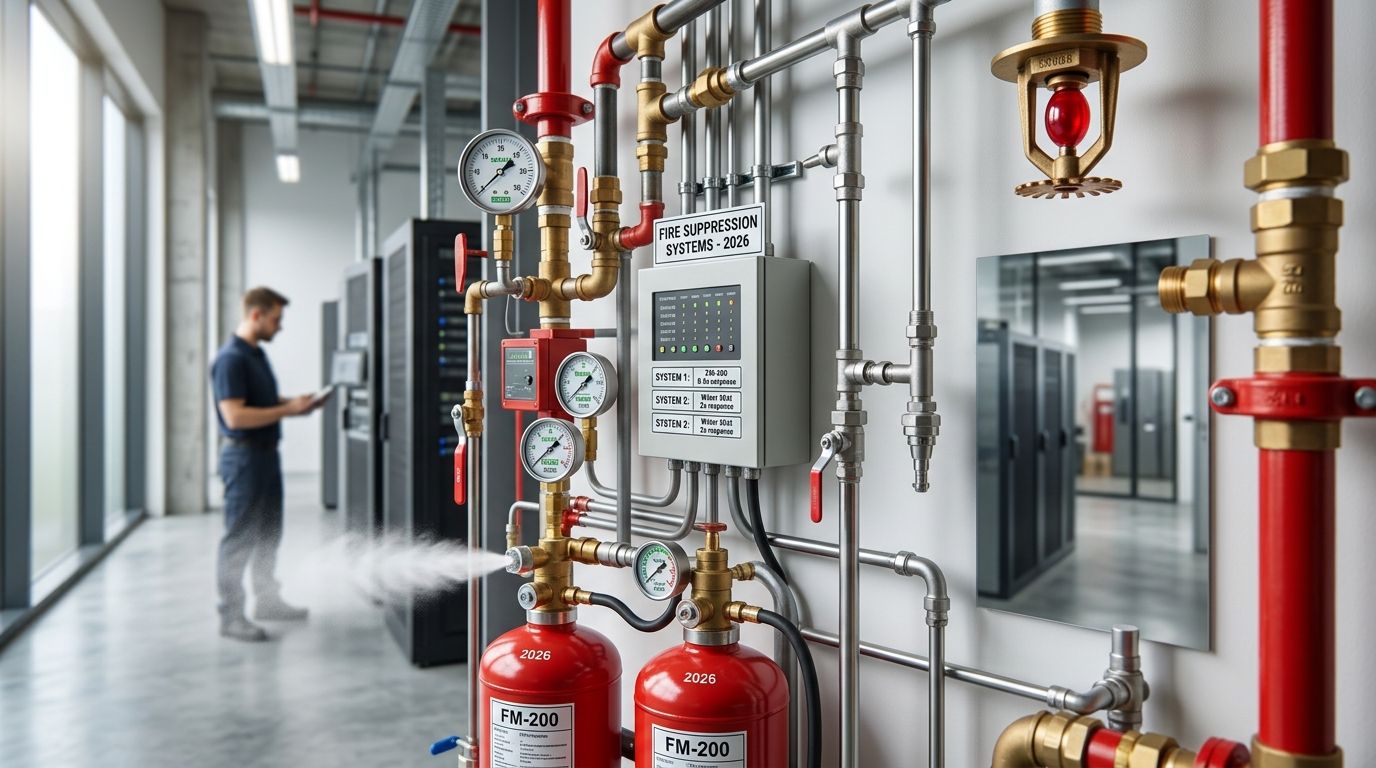
Fire suppression systems ranked by response time in 2026 come down to one variable: what triggers the agent and how fast it reaches the fuel. Clean agent systems discharge in seconds; wet pipe sprinklers wait for heat to build first. Here's how seven common system types stack up, and which one actually fits your hazard.
- Clean agent systems (FM-200, Novec 1230) discharge within 10 seconds under NFPA 2001 — fastest option for data centers.
- Wet chemical kitchen systems activate almost instantly via a fusible link and cut gas and power in the same motion.
- CO2 total flooding systems discharge within 60 seconds for surface fires per NFPA 12, longer for deep-seated fuel.
- Wet pipe sprinklers are the slowest system in this ranking — they wait for sustained heat to rupture the bulb.
- Speed alone doesn't decide the pick in 2026 — agent compatibility with the fuel type matters more than raw seconds.
Why this matters
A fire suppression system that discharges fast still has to hit the right fuel with the right agent, or the speed advantage does nothing. Grease fires need a chemical that saponifies fat; electrical rooms need an agent that won't short a rack on the way out. First-Line Fire sees the same mistake across Kentucky, Illinois, Indiana, Tennessee, Missouri and Alabama job sites in 2026: buildings with a fast system mismatched to the hazard it's supposed to protect.
Response time also drives insurance underwriting and code compliance in commercial and industrial buildings. Get the ranking wrong and you're either overpaying for speed you don't need or under-protecting a hazard that needed it.
The verdict
Fastest overall: clean agent systems. FM-200 and Novec 1230 discharge in 10 seconds or less and leave no residue, making them the pick for server rooms and switchgear. Fastest for commercial kitchens: wet chemical (UL 300) systems — the fusible link trips the moment grease hits ignition temperature and shuts gas and power in the same motion. Best baseline for general commercial and industrial buildings: wet pipe sprinkler systems — slower to trigger but the most common, most reliable option for broad-area coverage.
What determines response time
- Detection method — fusible link, rate-of-rise heat detector, smoke detector, or flame detector
- Discharge design — total flooding (clean agent, CO2) vs. localized application (wet chemical over a cook line, foam over a spill)
- Agent state — gas discharges near-instantly; foam and water need pressurized delivery through piping
- Hazard depth — surface fires extinguish fast; deep-seated Class A fires need soak time no matter the agent
- Governing standard — NFPA 2001 (clean agent), NFPA 12 (CO2), NFPA 17A (wet chemical), NFPA 13 (sprinkler)
- Life-safety compatibility — oxygen-displacing agents like CO2 require the space to clear before discharge
Fire suppression systems at a glance
| System Type | Trigger / Detection | Discharge Speed | Best For | Key Limitation |
|---|---|---|---|---|
| Clean Agent (FM-200, Novec 1230) | Smoke or flame detector | Within 10 seconds (NFPA 2001) | Data centers & server rooms | Higher cost per protected cubic foot |
| Wet Chemical (UL 300) | Fusible link over cook line | Near-instant, seconds | Commercial kitchens | Limited to kitchen hood equipment |
| CO2 Total Flooding | Heat or flame detector | Within 60 seconds, surface fires (NFPA 12) | Industrial equipment, oil & gas | Displaces oxygen, area must evacuate |
| Water Mist | Heat-activated head | Seconds to about a minute | Marine vessels & engine rooms | Needs pressurized water supply on board |
| Foam-Water | Heat detector + deluge valve | Moderate, valve-trip dependent | Chemical processing, flammable liquids | Slower on deep pools, needs foam stock |
| Dry Chemical | Manual pull or heat-activated | Fast knockdown, seconds | Auto shops & vehicle bays | No cooling effect, reignition risk |
| Wet Pipe Sprinkler | Heat-activated bulb (NFPA 13) | Slowest, needs sustained heat buildup | Warehouses & distribution centers | Water damage to contents |
1. Clean Agent Systems: fastest response for data centers and electrical rooms
Clean agent systems hold pressurized gas that floods a room the instant a detector confirms fire. NFPA 2001 caps discharge time at 10 seconds, and the agent leaves no residue behind, which matters when the alternative is a chemical or water agent totaling the same server rack the fire would have destroyed. The clean agent fire suppression systems compared guide breaks down FM-200 versus Novec 1230 for spec-level differences.
Clean agent pros:
- Discharges within 10 seconds of confirmed detection
- Non-conductive, leaves no residue on electronics
- Safe for occupied spaces at design concentration
Clean agent cons:
- Higher cost per cubic foot of protected space than water-based systems
- Requires a sealed room to hold concentration long enough to work
- Needs full recharge after any discharge, even a false alarm
Best for: data centers, server rooms, telecom switch rooms, control panels.
Verdict: install for any room where water or powder would finish the job the fire started.
2. Wet Chemical (UL 300) Systems: fastest response for commercial kitchens
Wet chemical systems sit above the cook line and trigger off a fusible link tuned to grease ignition temperature. The moment it trips, nozzles discharge a potassium-based agent that saponifies the fat into a foam blanket, and the same trigger cuts gas and electrical power to the appliance. That combination — near-instant agent plus automatic fuel shutoff — is why commercial kitchen suppression has held to this design since UL 300 replaced older dry chemical hood systems. The best fire suppression systems for commercial kitchens guide covers hood coverage and inspection intervals.
Wet chemical pros:
- Fusible link triggers in seconds, no waiting on smoke buildup
- Automatic gas and power shutoff on activation
- Agent is effective on grease fires specifically, not a general-purpose substitute
Wet chemical cons:
- Only protects the hood and cooking equipment it's mounted over
- Requires semiannual inspection per NFPA 17A to stay code-compliant
- Discharge means a full kitchen cleanup before service resumes
Best for: restaurants, cafeterias, any commercial kitchen with a grease-producing cookline.
Verdict: install — this is not optional equipment for a commercial hood, it's required by most local fire codes.
3. CO2 Total Flooding Systems: fastest response for industrial equipment and oil & gas
CO2 systems flood an enclosure with pressurized carbon dioxide that smothers oxygen supply to the fire. NFPA 12 sets a discharge window of 60 seconds for surface fires, though deep-seated Class A fires need a longer soak time to prevent reignition. That speed makes CO2 a fit for turbine enclosures, paint booths, and processing equipment where oxygen displacement doesn't put people at direct risk if evacuation happens first.
CO2 pros:
- Discharges within 60 seconds for surface fires
- Leaves zero residue, no cleanup on non-fire-related equipment
- Effective on flammable liquid and electrical fires
CO2 cons:
- Displaces oxygen, the space must be cleared before and during discharge
- Deep-seated fires need extended soak time beyond the initial discharge
- Requires pre-discharge alarms and evacuation procedures by code
Best for: industrial machinery enclosures, paint booths, oil and gas processing equipment.
Verdict: install where the hazard is enclosed equipment, not occupied work areas.
4. Water Mist Systems: fastest response for marine vessels
Water mist systems use fine droplets that cool the fire and displace oxygen at the same time, triggered by heat-activated heads similar to a sprinkler but at far lower water volume. On a vessel, that lower volume matters — less water means less risk of destabilizing the ship while still knocking down engine room or galley fires fast.
Water mist pros:
- Uses a fraction of the water volume of a standard sprinkler
- Cools the fire and the surrounding space simultaneously
- Works on Class A, B, and some electrical fires
Water mist cons:
- Requires a dedicated pressurized water supply and pump
- Coverage area per head is smaller than a standard sprinkler
- Less effective in open, ventilated spaces than enclosed compartments
Best for: marine vessels, engine rooms, enclosed mechanical spaces.
Verdict: install on vessels where standard sprinkler water volume isn't practical.
5. Foam-Water Systems: fastest response for chemical processing plants
Foam-water systems combine a heat detector with a deluge valve that releases a foam-water mixture across the hazard area. The response depends on how fast the deluge valve trips, which makes it slower to activate than a gas-based system but far more effective at smothering a flammable liquid vapor layer once it does.
Foam-water pros:
- Smothers flammable liquid vapor across a wide surface area
- Cools the fuel surface while blanketing it from reignition
- Scales to large tank farms and processing areas
Foam-water cons:
- Valve-trip dependent, slower activation than clean agent or CO2
- Requires foam concentrate stock and periodic replacement
- Cleanup after discharge is extensive across the flooded area
Best for: chemical processing plants, flammable liquid storage, tank farms.
Verdict: install where the hazard is a liquid fuel spread across a surface, not a contained enclosure.
6. Dry Chemical Systems: fastest response for auto shops and vehicle bays
Dry chemical systems, whether fixed or portable, discharge a powder agent that interrupts the chemical chain reaction of the fire within seconds of activation. In an auto shop, that speed matters against a fuel or electrical fire under a lift, where a water-based agent isn't an option.
Dry chemical pros:
- Fast knockdown on Class B and C fires
- Works on live electrical equipment without conductivity risk
- Portable units require no piping or fixed infrastructure
Dry chemical cons:
- No cooling effect, reignition risk if the fuel source stays hot
- Powder residue damages sensitive electronics and machinery
- Visibility drops to near zero during discharge
Best for: auto shops, vehicle bays, fuel-handling areas.
Verdict: install as a fast-response layer alongside a vehicle fire suppression system, not as the sole protection for a full bay.
7. Wet Pipe Sprinkler Systems: slowest but most common baseline for warehouses
Wet pipe sprinklers rely on a heat-sensitive bulb that has to reach a set temperature before it ruptures and releases water. That heat buildup is what makes this the slowest system in the 2026 ranking — but it's also the most widely deployed, lowest-complexity option for broad-area coverage in warehouses and distribution centers.
Wet pipe sprinkler pros:
- Simple, well-understood technology with a long service record
- Covers large open areas without per-hazard engineering
- Lowest ongoing complexity of any system on this list
Wet pipe sprinkler cons:
- Slowest response — needs sustained heat before it triggers
- Water damage to inventory and equipment on discharge
- Not suitable for electrical rooms or flammable liquid hazards
Best for: warehouses, distribution centers, general storage and office space.
Verdict: install as the code-required baseline, then layer a faster system over any hazard that needs it.
How this ranking was built
The order above follows published discharge-time standards for each agent type — NFPA 2001 for clean agent, NFPA 12 for CO2, NFPA 17A for wet chemical, NFPA 13 for sprinkler — not marketing claims from any single manufacturer. Detection method, discharge design, and hazard depth decide where a system lands, and none of that changes because a building sits in Kentucky versus Alabama in 2026.
“The fastest agent on paper still fails if it doesn't match the fuel it's supposed to put out.”
Which fire suppression system should you choose?
For a data center or electrical room, clean agent wins — nothing else discharges as fast without frying the equipment it's protecting. For a commercial kitchen, wet chemical is not optional, it's the code requirement. For everything else — general warehouse, office, retail floor — a wet pipe sprinkler system stays the correct baseline in 2026, with a faster secondary system layered over any specific hazard the sprinkler alone doesn't cover.
Get Your Hazard Assessed
First-Line Fire matches system type to hazard across KY, IL, IN, TN, MO and AL.
FAQ
What is the fastest fire suppression system in 2026?
Clean agent systems like FM-200 and Novec 1230 are the fastest, discharging within 10 seconds under NFPA 2001. They're the standard pick for data centers and electrical rooms where speed and no residue both matter.
How fast does a clean agent system discharge?
NFPA 2001 caps clean agent discharge at 10 seconds from confirmed detection. That speed, combined with zero residue, is why the agent is standard for server rooms and switchgear.
Is CO2 or wet chemical faster for kitchen fires?
Wet chemical is faster and correct for kitchen fires because the fusible link triggers directly off grease ignition and shuts down gas and power simultaneously. CO2 is not code-compliant for commercial kitchen hood protection.
How long does a wet pipe sprinkler take to activate?
Wet pipe sprinklers wait for a heat-sensitive bulb to reach its rated temperature before rupturing, making them the slowest system in this ranking. That tradeoff comes with the lowest complexity and broadest area coverage of any system type.
What's the fastest fire suppression system for a data center?
Clean agent systems are the fastest fit for a data center, discharging within 10 seconds and leaving equipment undamaged. Water or foam-based systems risk destroying the same servers the fire would have.
Do vehicle fire suppression systems respond faster than building systems?
Vehicle systems use dry chemical or clean agent triggered by heat sensors in the engine bay, discharging in seconds similar to a fixed dry chemical unit. Response speed depends on agent type, the same as any building system.
How often should a fire suppression system be inspected?
Wet chemical kitchen systems require semiannual inspection under NFPA 17A, and most fixed suppression systems follow a similar six-month cycle. Inspection intervals depend on the governing NFPA standard for that system type.
Which fire suppression system fits a coal mine?
Coal mining equipment typically uses dry chemical or foam-based systems matched to conveyor belts, crushers, and diesel equipment rather than clean agent, since the hazard is spread across open machinery, not an enclosed room.
One last thing
The fastest discharge time on this list, clean agent's 10 seconds, still isn't the whole story: a deep-seated Class A fire needs soak time regardless of how fast the agent hit the room. Speed wins the surface fire; it doesn't win a fire that's already burrowed into insulation or packed material. Match the agent to how the fuel actually burns, not just how fast the system reacts.


