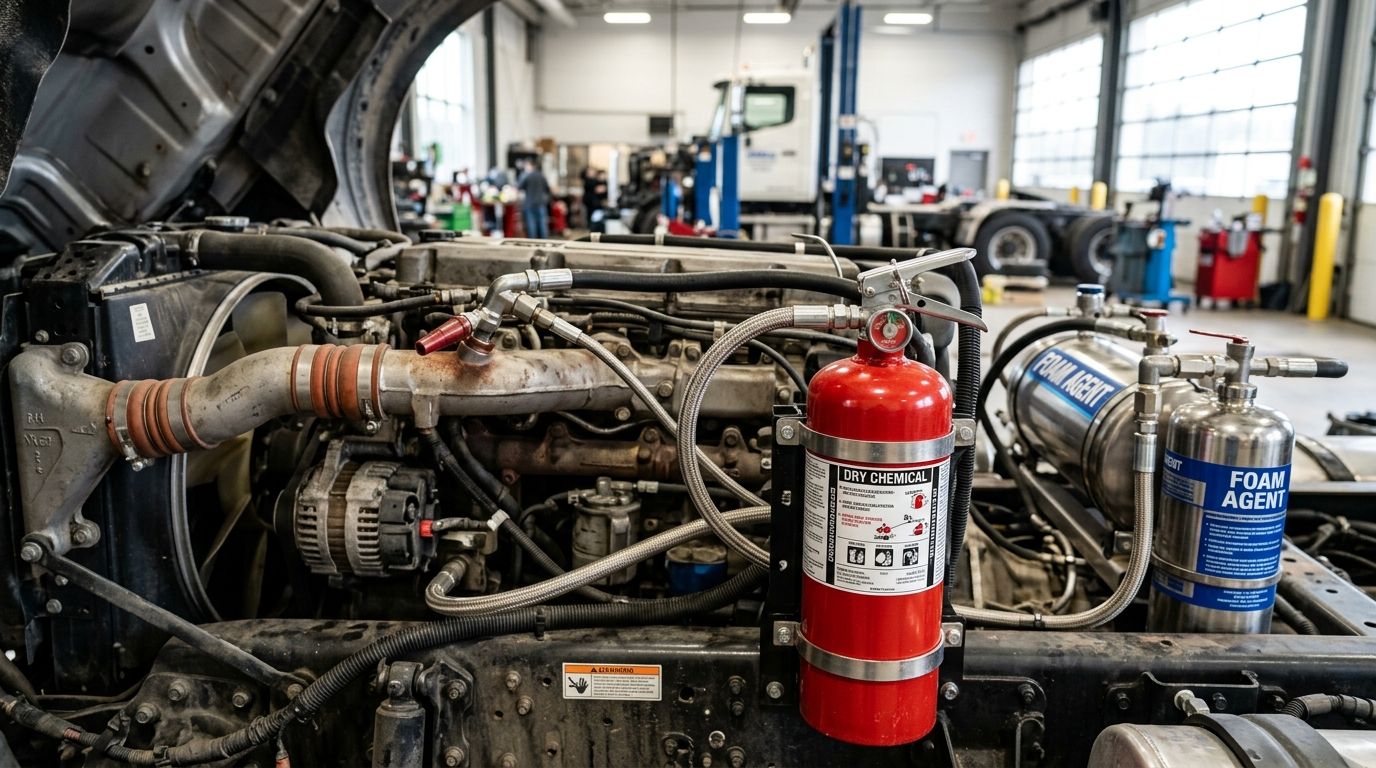
Vehicle fire suppression systems fall into five main agent categories, and picking the wrong one for the vehicle type costs more than the install job — it costs the truck. Best overall: automatic dry chemical (ABC) systems, best for diesel fleet trucks and engine compartment protection. Best for coal mining equipment: high-capacity mining-rated dry chemical systems. Best for cabs and electronics: clean agent (FK-5-1-12) systems. Best for fuel-fed risk: foam/wet agent systems. Best for marine vessel engine rooms: CO2 systems.
- Dry chemical (ABC) wins vehicle fire suppression systems ranked by agent type for diesel fleet trucks in 2026.
- Coal mining haul trucks need high-capacity dry chemical rated to 30 CFR Part 75/77, not standard truck kits.
- Clean agent (FK-5-1-12) is the only agent type here that won't corrode wiring or electronics after discharge.
- CO2 suppresses marine engine room fires cleanly but is unsafe in any space a person occupies.
- Foam/wet agent handles fuel-tanker pool fires but does nothing for a live electrical fault.
Why this matters
A vehicle fire suppression system that's rated for the wrong fire class doesn't slow a fire down — it just sits there while the truck burns. Fleet operators keep buying generic "engine fire" kits without checking what agent is inside, and by 2026 most of those kits are still built around chemistry designed for stationary equipment, not a vibrating, heat-cycling engine bay doing 60 mph.
Each agent type below behaves differently on Class B (fuel) and Class C (electrical) fires, leaves a different mess behind, and carries different code requirements depending on whether the vehicle is a fleet truck, a mining haul truck, or a vessel. Get the agent type right first — the tank size and detection setup are secondary decisions.
What makes the best vehicle fire suppression system
- Detection speed — linear heat detection or pneumatic tube response inside the engine bay, not just a cab warning light
- Fire class coverage — effectiveness on Class B fuel fires and Class C electrical fires simultaneously
- Residue and corrosion impact — what the agent does to wiring harnesses, sensors, and connectors after discharge
- Recharge turnaround — how long the truck sits down after a discharge before it's back on the road
- Code compliance — NFPA 17 for dry chemical, NFPA 2001 for clean agent, 30 CFR Part 75/77 for underground mining equipment
- Actuation reliability — automatic triggering that holds up under constant vibration and heat cycling
Vehicle fire suppression systems at a glance
| Agent Type | Best For | Standout Feature | Key Limitation |
|---|---|---|---|
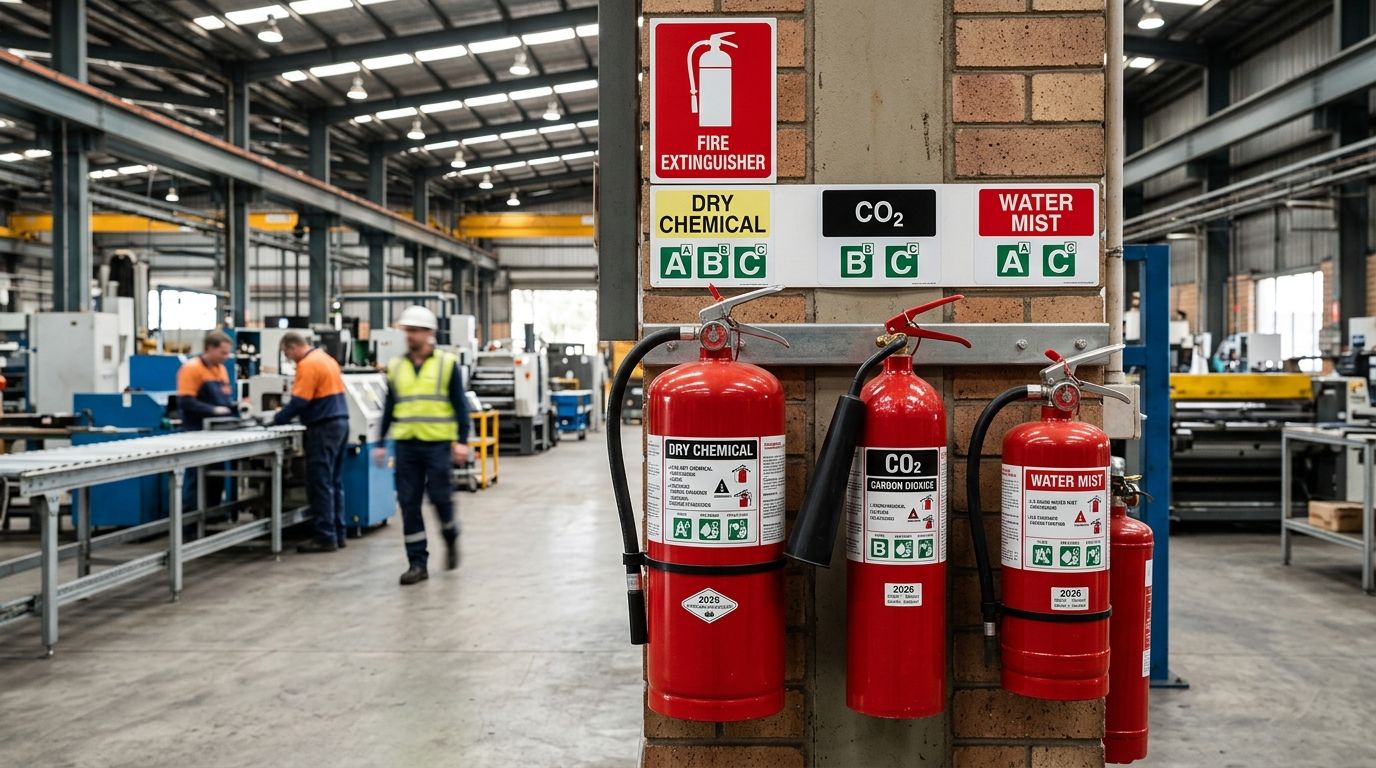
| Dry chemical (ABC) | Diesel fleet trucks, engine compartments | Fast knockdown on Class B/C fires, works in cold weather | Leaves corrosive powder residue on wiring |
| High-capacity dry chemical (mining-rated) | Coal mining haul trucks, underground equipment | Built to 30 CFR Part 75/77 discharge volume requirements | Larger tanks add weight and service points |
| Clean agent (FK-5-1-12) | Cabs, cargo areas, electronics-heavy trucks | Zero residue, safe around circuit boards | Higher agent cost per discharge cycle |
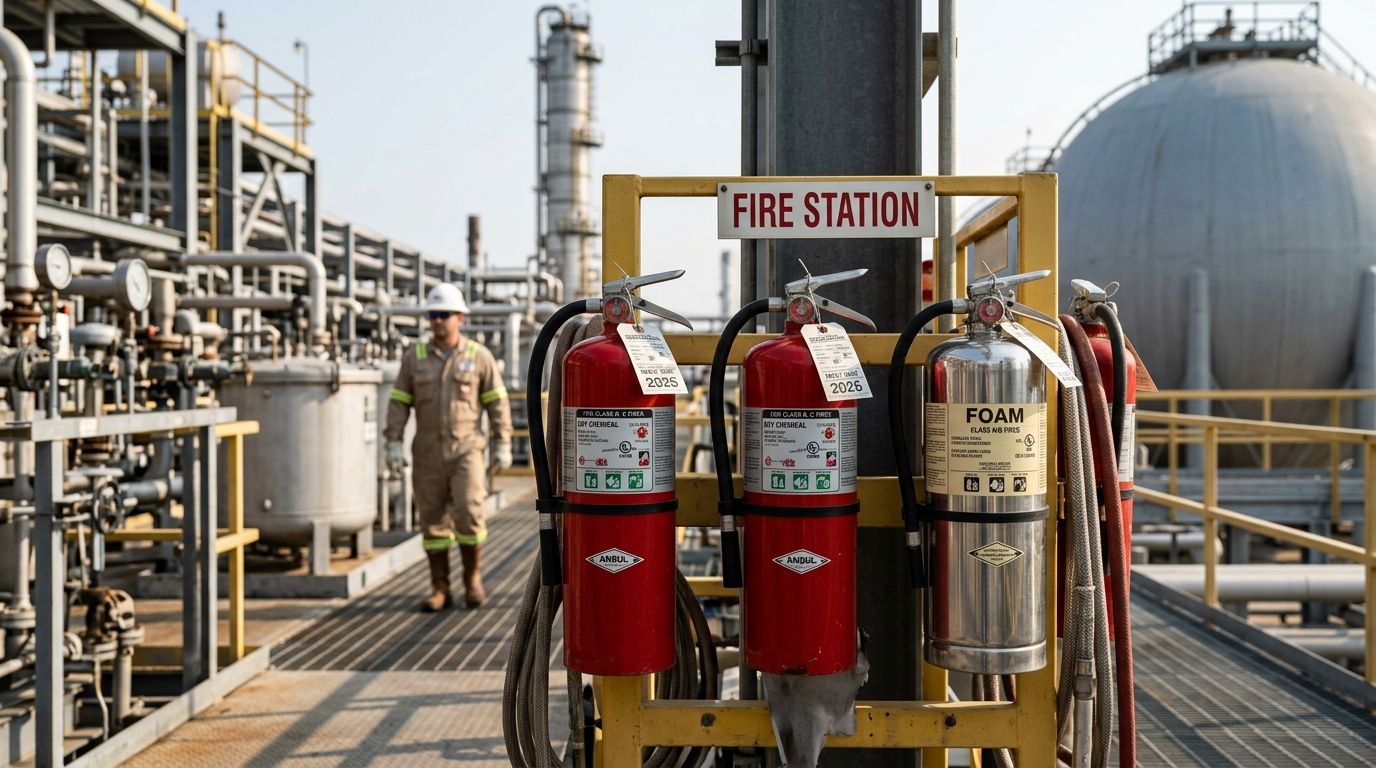
| Foam/wet agent | Fuel tankers, fueling trucks | Smothers flammable liquid pool fires and cools the surface | Ineffective on live electrical faults |
| CO2 | Marine vessel engine rooms | No residue, long track record in enclosed engine spaces | Displaces oxygen — hazard in occupied spaces |
1. Dry chemical (ABC) systems: best vehicle fire suppression for diesel fleet trucks
Dry chemical is the default agent for engine compartment protection on diesel fleet trucks because it hits both the fuel-fed flame and any electrical fault at the same time. Detection lines run along the engine bay and trigger an automatic discharge of monoammonium phosphate or sodium bicarbonate powder the moment heat crosses the set point. It's rated under NFPA 17 and it's been the standard for over-the-road and vocational trucks for decades.
Dry chemical pros:
- Knocks down Class B and Class C fires in the same discharge
- Rated to operate in a wide temperature range, roughly -40°F to 120°F, which covers most fleet operating regions
- Lower agent cost than clean agent alternatives
Dry chemical cons:
- Powder residue is corrosive and has to be cleaned off wiring and connectors fast after a discharge
- Visibility inside the engine bay drops to zero during discharge, which complicates driver response
Best for: diesel fleet trucks and standard commercial vehicle engine compartments.
Verdict: Buy if you're protecting a mixed fleet of over-the-road or vocational diesel trucks — it's the proven agent for fleet truck fire suppression systems in 2026.
2. High-capacity dry chemical (mining-rated): best for coal mining haul trucks
Underground and surface coal mining equipment runs bigger engine bays, more hydraulic lines, and higher fuel volumes than a highway truck, so the agent volume has to scale up. Mining-rated dry chemical systems are built to the discharge and coverage standards under 30 CFR Part 75 and Part 77, which govern fire suppression on underground mining machinery and surface haulage equipment respectively.
Mining-rated dry chemical pros:
- Discharge volume sized for haul truck and continuous miner engine bays, not passenger-vehicle-scale tanks
- Meets MSHA inspection and testing intervals required for coal operations
- Same fast Class B/C knockdown as standard dry chemical
Mining-rated dry chemical cons:
- Tanks and piping add weight and more service points to inspect
- Requires MSHA-specific documentation and testing that a standard fleet kit doesn't
Best for: underground and surface coal mining equipment including haul trucks and continuous miners.
Verdict: Buy for any coal mining operation running equipment subject to 30 CFR Part 75 or 77 — generic truck-rated kits don't clear inspection here.
3. Clean agent (FK-5-1-12) systems: best for cabs and electronics-heavy vehicles
Clean agent, sold under names like Novec 1230 and rated under NFPA 2001, discharges as a gas that evaporates without leaving residue. That makes it the pick when the fire risk sits close to sensitive electronics — telematics units, cab wiring, refrigerated cargo control boards — where dry chemical powder would do as much damage as the fire.
Clean agent pros:
- No residue means no post-discharge cleanup around circuit boards or connectors
- Safe to use in occupied spaces at design concentration, unlike CO2
- Doesn't conduct electricity, so it's a clean choice around live circuits
Clean agent cons:
- Costs more per discharge than dry chemical or CO2
- Needs a reasonably sealed enclosure to hold concentration long enough to work
Best for: cabs, refrigerated cargo units, and any vehicle fire suppression system protecting electronics rather than raw engine mass.
Verdict: Buy for specialty vehicles carrying expensive electronics; Hold on it for a standard diesel engine bay where dry chemical does the job for less.
4. Foam/wet agent systems: best for fuel tankers and fueling trucks
Foam-based wet agent systems are built for one job: smothering a pool fire on a flammable liquid surface and cooling the fuel below its ignition point. On a fuel tanker or fueling truck, that's exactly the failure mode that matters most — a ruptured line or spill igniting under the vehicle.
Foam/wet agent pros:
- Cools the fuel surface, which reduces reflash risk after initial knockdown
- Effective specifically on large-surface Class B liquid fires
- Lower agent cost than clean agent systems
Foam/wet agent cons:
- Does nothing for a Class C electrical fault — it's a single-purpose agent
- Cleanup after discharge is more involved than a gas-based agent
Best for: fuel tankers, fueling trucks, and vehicles where the dominant risk is a flammable liquid spill fire.
Verdict: Buy for dedicated fuel-hauling vehicles; Skip it as a general-purpose engine bay agent since it ignores electrical fires entirely.
5. CO2 systems: best for marine vessel engine rooms
CO2 has protected marine engine rooms for a long time because it leaves zero residue, doesn't damage machinery, and floods an enclosed space fast enough to starve a fire of oxygen. On a vessel, the engine room is typically unoccupied during operation, which is what makes CO2's biggest drawback tolerable there in a way it isn't on a road vehicle.
CO2 pros:
- No residue, no corrosion, no cleanup on machinery after discharge
- Long service history on enclosed marine engine compartments
- Effective on Class B and C fires in a sealed space
CO2 cons:
- Displaces oxygen, so it's an asphyxiation hazard in any space a person could be standing in
- Requires strict lockout procedures and audible pre-discharge alarms
Best for: enclosed marine vessel engine rooms that stay unoccupied during normal operation.
Verdict: Buy for marine engine rooms with proper lockout and warning systems in place; Wait on it for anything with regular foot traffic nearby.
Get the right agent for your fleet
Match agent type to vehicle risk before the next inspection cycle.
How this ranking works
Each agent type here is ranked against the criteria above: detection speed, fire class coverage, residue impact, recharge turnaround, and code compliance for the vehicle category it protects. Dry chemical tops the list because it's the only agent that balances all five criteria for the largest share of vehicles on the road in 2026 — general fleet diesel trucks. Specialty vehicles (mining equipment, fuel tankers, marine vessels) each pull a different agent to the top of their own category, which is why this reads as a decision by vehicle type rather than a single leaderboard.
“The agent that matches the fire class in front of it wins — everything else is a rounding error.”
Which vehicle fire suppression system should you choose?
For a standard diesel fleet truck, dry chemical (ABC) is the default answer in 2026 — it covers the fire classes that matter and it's been proven on this exact application for decades. Coal mining haul trucks and underground equipment need the mining-rated version built to 30 CFR Part 75/77, not a scaled-down highway kit. If the vehicle carries expensive electronics or refrigerated cargo controls, clean agent earns the higher cost. Fuel tankers get foam. Marine engine rooms get CO2, with lockout procedures non-negotiable.
Don't buy an agent type because it's what the last vehicle in the fleet had — match it to what's actually sitting in that engine bay.
FAQ
What's the best fire suppression agent for a diesel fleet truck engine fire?
Dry chemical (ABC) systems are the best fit for diesel fleet trucks in 2026 because they cover both fuel-fed and electrical fires in the engine bay in a single discharge. They're rated under NFPA 17 and have decades of use on this exact vehicle type.
Is clean agent suppression better than dry chemical for vehicle fires?
Clean agent isn't better overall, it's better for a specific job: protecting electronics and cabs without leaving corrosive residue. For a standard engine bay, dry chemical still wins on cost and proven performance.
How much does a vehicle fire suppression system cost in 2026?
Cost varies by agent type, tank size, and vehicle class, so check current pricing directly rather than relying on a flat figure. Mining-rated and clean agent systems generally run higher than standard dry chemical kits due to agent cost and compliance testing.
Are dry chemical systems required for coal mining haul trucks?
Coal mining equipment is subject to 30 CFR Part 75 for underground machinery and Part 77 for surface equipment, both of which set requirements that generic dry chemical kits usually don't meet. Mining-rated, higher-capacity dry chemical systems are built specifically to clear those requirements.
What agent works best for marine vessel engine room fires?
CO2 is the standard agent for enclosed marine engine rooms because it leaves no residue and doesn't damage machinery. It requires strict lockout and pre-discharge alarms since it displaces oxygen in the space.
Can CO2 systems be used in occupied vehicle cabs?
No. CO2 displaces oxygen and is an asphyxiation hazard in any occupied space, which is why it's used almost exclusively in unoccupied compartments like marine engine rooms, not cabs.
How often does a vehicle fire suppression system need to be serviced?
Service intervals depend on the agent type and the vehicle's operating environment, with mining and marine applications typically carrying stricter inspection schedules than standard fleet trucks. Check the system's rated inspection interval against the applicable code (NFPA 17, NFPA 2001, or 30 CFR Part 75/77).
What's the difference between wet chemical and dry chemical vehicle suppression?
Wet chemical (foam-based) agents are built for flammable liquid pool fires and work by cooling the fuel surface, while dry chemical covers both fuel and electrical fires with a powder discharge. Foam is the right call for fuel tankers; dry chemical is the broader-purpose choice for standard engine compartments.
One last thing
Most engine bay fires start at a fuel or hydraulic line leak hitting a hot surface, not at the battery or the cab — which is exactly why detection has to sit low in the engine compartment, not just on a dashboard warning light. A system with the right agent but detection mounted in the wrong spot still burns the truck down before the discharge ever triggers.