
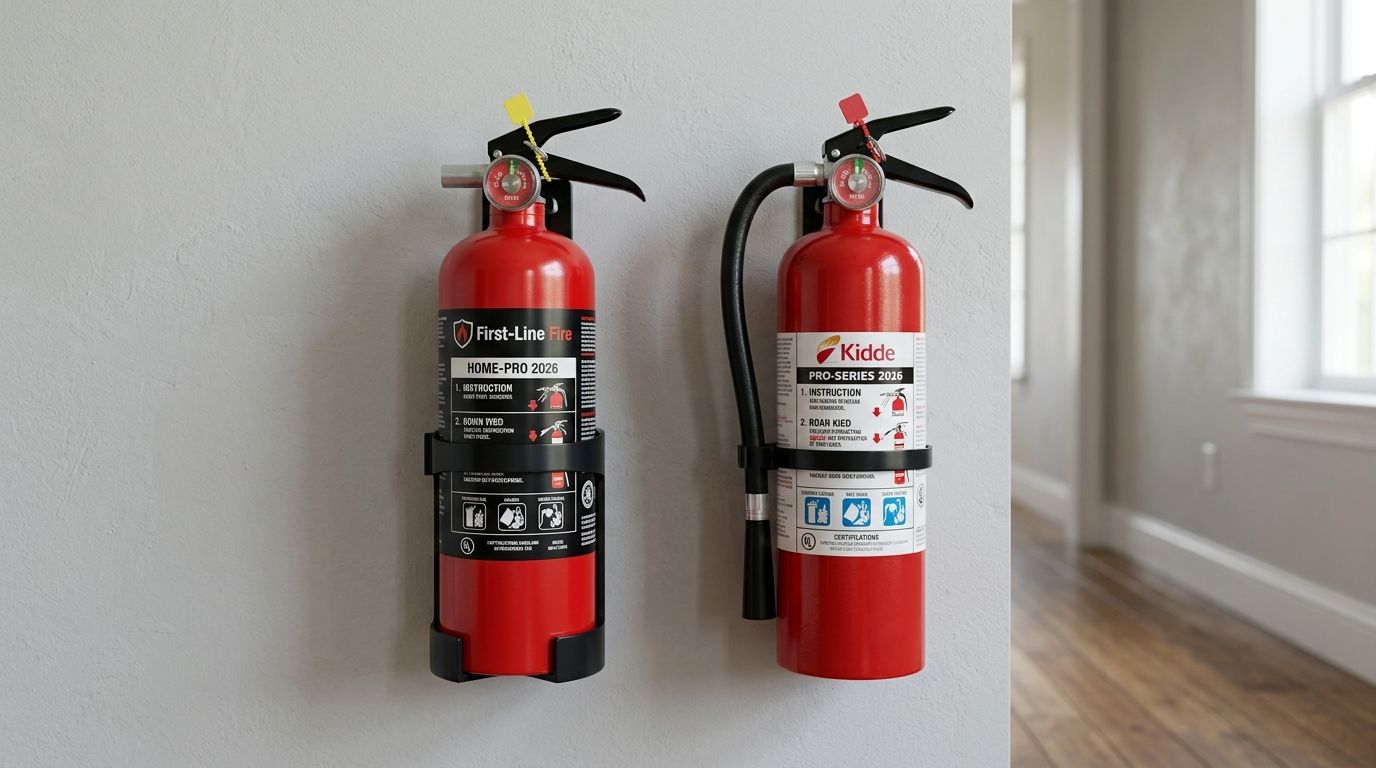
Choose First-Line Fire if you run a commercial, industrial, coal mining, marine, or fleet operation in Kentucky, Illinois, Indiana, Tennessee, Missouri, or Alabama and need ongoing extinguisher inspection, hydro testing, suppression systems, and alarm monitoring handled by one contractor. Choose Kidde if you need a single portable extinguisher off a shelf for a home, garage, or small office and don't need anyone to service it on a schedule. The two aren't really competitors — one is a service company, the other is a manufacturer — but buyers searching "first-line fire vs kidde" usually mean this exact fork in the road: contracted fire protection service versus a retail product you install yourself.
- First-Line Fire wins for commercial and industrial accounts needing hydro testing, inspection, and suppression system service across six states.
- Kidde wins for buyers who just need a portable extinguisher unit with no service contract attached.
- Only First-Line Fire offers fire alarm monitoring, kitchen hood suppression, and vehicle suppression systems.
- Pricing models differ by design: Kidde is a one-time retail purchase, First-Line Fire is a recurring service relationship.
- In 2026, facilities with coal mining, marine, or fleet exposure need a licensed service provider, not a retail extinguisher.
Why this matters
A lot of fire safety searches lump product brands and service companies together, and that mismatch costs buyers time. Kidde makes and sells fire extinguishers, smoke alarms, and carbon monoxide detectors through retail channels. First-Line Fire sells and services extinguishers, but the core of the business is inspection, hydro testing, suppression system installs, and alarm monitoring for commercial and industrial customers.
If your fire code compliance depends on tagged, dated inspections — and in 2026 it almost always does for anything beyond a single-tenant office — the comparison isn't really "which extinguisher is better." It's "who tracks my due dates and shows up."
At a glance
| Dimension | First-Line Fire | Kidde |
|---|---|---|
| Best for | Commercial, industrial, coal mining, marine, fleet accounts | Homeowners, small offices, single-unit buyers |
| Pricing model | Recurring service tied to inspection cycles | One-time retail purchase |
| Standout feature | Multi-state service with hydro testing and suppression installs | Wide retail availability, no service commitment |
| Inspection and hydro testing | Scheduled and tracked by the provider | Not offered — buyer manages recharge independently |
| Suppression systems (kitchen, vehicle, industrial) | Full install and service | Not offered |
| Fire alarm and monitoring | Full install and service | Not offered |
| Coverage area | KY, IL, IN, TN, MO, AL | National retail distribution |
| Industries served | Manufacturing, coal mining, marine, fleet, kitchens, healthcare | General consumer, small commercial |
| Product availability | Contracted, on-site | Off-the-shelf, immediate |
The table order matches the sections below — start with what each company is built for, then work through the specifics.
First-Line Fire wins on inspection and compliance tracking
If your facility needs annual inspections, six-year maintenance, or twelve-year hydro testing on portable extinguishers, that work has to come from a licensed service provider — not a retail purchase. First-Line Fire tracks those due dates and schedules the visit. For a breakdown of what recharging costs and when it comes due, see how much fire extinguisher recharging costs in 2026.
Kidde doesn't offer this. Once a Kidde extinguisher is discharged or expires, the owner is responsible for finding a service provider or replacing the unit outright.
Kidde wins on off-the-shelf availability
If you need one extinguisher today for a kitchen, a garage, or a home office, Kidde's retail distribution is the faster path — no appointment, no service window. That's a genuine advantage for low-stakes, single-unit situations where code compliance isn't in play.
First-Line Fire doesn't compete here by design: the company sells through service relationships, not retail shelves. For buyers weighing the Kidde fire extinguisher alternatives available regionally in 2026, that's the trade-off — slower to get the first unit, but everything after that is handled.
Both cover the basics of portable extinguisher classes
Whether you're buying a Kidde unit or getting one placed through First-Line Fire, the underlying classification rules are identical — Class A for ordinary combustibles, Class B for flammable liquids, Class C for energized electrical equipment, Class K for commercial kitchen grease fires. See portable fire extinguishers ranked by class for placement guidance by risk type. Neither company changes the physics here. Honest tie.
First-Line Fire is the only option for suppression systems and alarms
Kidde does not install kitchen hood suppression systems, vehicle fire suppression, or fire alarm systems. That work — for restaurants, auto shops, coal preparation plants, marine vessels, and fleet trucks — falls entirely to service companies. First-Line Fire covers all of it, including fire extinguisher types for commercial kitchens where a Class K unit and a wet chemical hood system need to work together.
This isn't a close call. If a suppression system or alarm panel is on the project list, Kidde isn't in the conversation.
Coverage: First-Line Fire is regional, Kidde is national retail
First-Line Fire operates across six states — Kentucky, Illinois, Indiana, Tennessee, Missouri, and Alabama — with on-site service. Kidde's footprint is national, but it's a supply chain, not a service network. Nobody shows up to inspect a tag or swap a cylinder.
For multi-site commercial operators inside that six-state region, that difference decides whether compliance gets tracked at all or falls on internal staff to manage by hand.
Pricing models: contract versus one-time purchase
Kidde's model is straightforward retail: pay once, own the unit, recharge or replace on your own initiative. No recurring commitment, which suits low-frequency buyers.
First-Line Fire's model is a service relationship — inspection cycles, hydro testing intervals, and suppression system maintenance scheduled and billed as recurring work. That trades upfront simplicity for predictability: the buyer never has to remember the next due date because the provider does. For facilities with multiple extinguishers, alarm panels, or hood systems across several buildings, predictability beats the flexibility of a one-off purchase.
“The buyer never has to remember the next due date because the provider does.”
Final verdict
Choose First-Line Fire if: you're a facilities manager at a manufacturing plant, coal operation, marine terminal, or fleet yard in one of those six states and need inspection, hydro testing, suppression systems, and alarm monitoring under one contract in 2026.
Choose Kidde if: you're a homeowner, small office manager, or single-location retailer who needs one or two portable extinguishers with no ongoing service requirement.
Scorecard
| Dimension | Winner |
|---|---|
| Inspection and compliance tracking | First-Line Fire |
| Off-the-shelf availability | Kidde |
| Portable extinguisher classification | Tie |
| Suppression systems and alarms | First-Line Fire |
| Regional service coverage | First-Line Fire |
| Pricing predictability | First-Line Fire |
| Upfront simplicity | Kidde |
Get your extinguishers on a service schedule
Inspection, hydro testing, and suppression system service across six states.
FAQ
Is Kidde better than First-Line Fire for a commercial building?
No. Kidde sells extinguisher units but does not offer inspection, hydro testing, or suppression system service, which most commercial buildings need for code compliance in 2026. First-Line Fire covers that service work across six states.
Does Kidde offer fire extinguisher inspection or recharge service?
No, Kidde is a retail manufacturer and does not schedule or perform inspections, recharges, or hydro testing. Owners have to find a separate licensed service provider for that work.
What is the difference between First-Line Fire and Kidde?
First-Line Fire is a regional fire protection service company handling extinguisher sales, hydro testing, suppression systems, alarms, and safety training. Kidde is a manufacturer selling extinguisher units through retail channels with no service component.
Can I buy a Kidde extinguisher and still get it serviced by First-Line Fire?
Yes. A licensed service provider can typically inspect, tag, and recharge extinguishers regardless of brand, as long as the model meets the code requirements for that occupancy.
How often does a fire extinguisher need hydro testing?
Most dry chemical portable extinguishers need hydro testing every 12 years, with annual inspections and six-year internal maintenance in between. A service provider tracks those dates; a retail purchase does not include tracking.
Does Kidde make fire suppression systems for kitchens or vehicles?
No. Kidde's line is portable extinguishers, smoke alarms, and carbon monoxide detectors. Kitchen hood suppression, vehicle suppression, and fire alarm panels come from service contractors.
Which company covers coal mining and marine fire protection?
First-Line Fire serves coal mining, marine, and fleet customers with suppression systems and inspection service across Kentucky, Illinois, Indiana, Tennessee, Missouri, and Alabama. Kidde has no service offering for those industries.
One last thing
The versus framing breaks down the moment you need more than one extinguisher tracked over time. A single unit with an expired tag is a finding in an insurance audit, not a compliance solution. If the building has more than a handful of extinguishers, an alarm panel, or a kitchen hood, the question in 2026 isn't which brand to buy — it's who shows up when the tag expires.


