
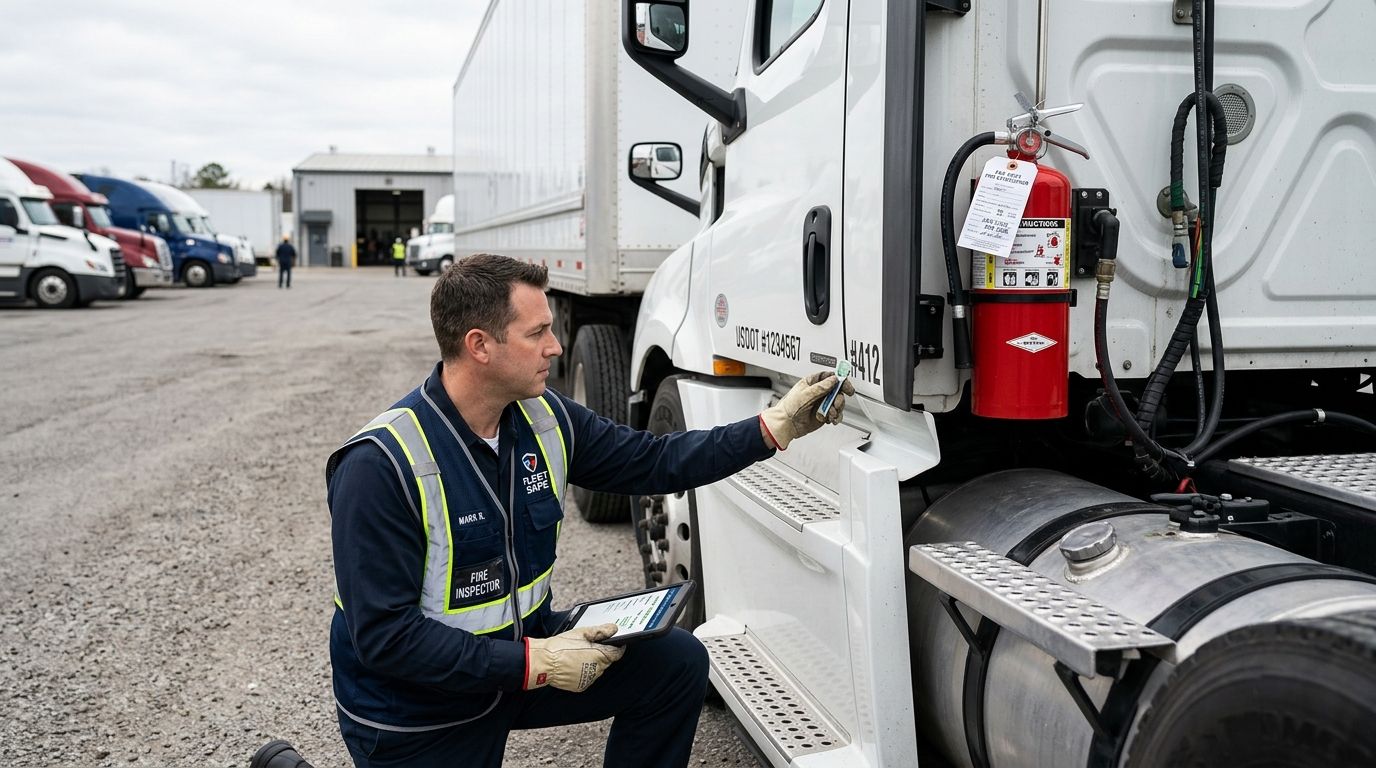
Trucking fleet fire extinguisher inspection is the recurring check of extinguisher pressure, mount security, and DOT compliance tags on every truck in a fleet, done to keep drivers legal at roadside stops and to keep a fire from shutting down a load. A dispatcher running 40 trucks across five states has different problems than a shop running three local delivery vans: multi-state DOT variance, driver turnover, and units that sit at a terminal for weeks between checks.
- FMCSA 393.95 sets minimum extinguisher size by cargo type — get this wrong and the truck is out of service.
- A fire extinguisher inspection service for trucking fleets should track every unit by VIN, not by terminal.
- Hydrostatic testing runs on a longer cycle than the monthly visual check — mixing the two schedules causes missed dates.
- First-Line Fire runs fleet inspection routes across Kentucky, Illinois, Indiana, Tennessee, Missouri and Alabama in 2026.
- Driver pre-trip checks catch dead gauges between scheduled service visits — they don't replace them.
Why fire extinguisher inspection matters for trucking fleets
A truck fire that starts in the cab or engine bay has minutes before it's unrecoverable, and a dead or missing extinguisher turns a $400 loss into a $150,000 truck plus the load. FMCSA rule 393.95 requires at least one 5-lb ABC-rated extinguisher (or two rated at 4 B:C each) on trucks not hauling placarded hazmat, and a 10-lb unit on anything that is. Roadside inspectors check this under the North American Standard Inspection, and an expired or missing extinguisher puts the vehicle out of service on the spot — the driver doesn't finish the route that day.
Fleets that operate across First-Line Fire's coverage area in Kentucky, Illinois, Indiana, Tennessee, Missouri and Alabama also deal with terminal-to-terminal variance: a truck serviced in Louisville might sit two weeks at a Memphis yard before its next scheduled check. The fix isn't more paperwork — it's a schedule tied to the unit, not the location.
Confirm the right extinguisher class for every unit
Start here before anything else. Mixed cargo fleets often run mismatched extinguisher sizes across the yard, and that's the first thing a DOT inspector flags.
- Check FMCSA 393.95 minimums against each truck's cargo classification
- Flag placarded hazmat units for the 10-lb requirement
- Confirm mount location is within reach of the driver's seat, not buried under gear
- Verify the gauge needle sits in the green zone, not just "present"
- Note extinguishers older than 12 years — many manufacturers stop servicing units past that age
Set an inspection cadence that matches DOT audit cycles
FMCSA 396.17 requires annual vehicle inspections, and the extinguisher check should ride on that same calendar so nothing falls through a gap between renewal cycles.
- Monthly visual check: gauge pressure, pin seal, mount tightness
- Annual certified inspection: tagged and dated by a licensed inspector
- Six-year internal maintenance for stored-pressure dry chemical units
- Twelve-year hydrostatic test for the cylinder itself
- Align the annual certified check with each unit's DOT annual inspection window, not a fleet-wide date
Track hydrostatic test dates by VIN, not by terminal
Hydrostatic testing pressure-tests the cylinder to confirm it can still hold service pressure safely, and it runs on a longer clock than the visual check — mixing the two is the single most common fleet mistake.
- Log the hydro test date on a tag attached to each cylinder
- Build a spreadsheet or fleet-maintenance system keyed to VIN, not depot
- Flag units approaching the 12-year mark six months out
- Pull a unit from service the moment a hydro tag is missing or unreadable
- Cross-reference hydro dates against DOT annual inspection dates so both land in the same service visit
More on the testing cycle itself is in the fire extinguisher recharging cost breakdown, which covers what triggers a recharge versus a full hydro test.
Document every inspection for roadside and DOT audits
A verbal "yeah, it's fine" doesn't hold up at a weigh station. Inspectors want a tag, a date, and a name.
- Keep a paper or digital tag on every unit showing last inspection date and inspector name
- Maintain a fleet-wide log a compliance officer can pull in under five minutes
- Photograph gauge readings during inspection for dispute backup
- Retain records for at least the length of one full DOT audit cycle
- Store copies off-truck in case the paper tag is lost or damaged
Train drivers to do a 30-second pre-trip check
Drivers aren't inspectors, but they're the last set of eyes before the truck leaves the yard. This step doesn't replace scheduled service — it catches what happens between visits.
- Confirm the gauge needle is in the green zone
- Check the pin and tamper seal are intact
- Confirm the mount bracket is locked and not rattling
- Wipe the extinguisher label so the class rating is legible
- Report any damage or discharge immediately, not at the next scheduled stop
Standardize extinguisher type across the fleet
A yard running three different extinguisher brands and two different agent types makes training harder and parts inventory a mess. Vehicle fires also behave differently than structure fires — engine bay and fuel-line fires call for specific agent types, covered in the vehicle fire suppression systems ranked by agent type guide.
- Pick one extinguisher class and stick to it across the fleet where cargo allows
- Standardize mount hardware so replacement units fit without retrofitting
- Keep a small stock of spares at each terminal for same-day swaps
- Train drivers on one unit type instead of three
Bring in a fleet inspection service once you're past a handful of trucks
Manual tracking works for three trucks running one route. It breaks down past a dozen units across multiple terminals in different states. A dedicated fire extinguisher inspection service for trucking fleets consolidates the schedule, the hydro dates, and the DOT paperwork into one system instead of a binder in the dispatcher's office.
- Route-based service visits that hit multiple terminals per trip
- Fleet-wide tagging so every unit's date lives in one record
- Multi-state coverage that accounts for state-specific fire marshal rules
- A single point of contact for DOT audit documentation requests
Fleets running cab suppression alongside portable extinguishers should also look at vehicle fire suppression systems for fleet trucks for engine-bay coverage that a portable unit alone doesn't handle.
Comparing inspection options for trucking fleets
| Option | Best for | Key limitation | Verdict |
|---|---|---|---|
| Driver self-check only | Owner-operators with 1-2 trucks | Misses hydrostatic and annual cert dates | Hold — pair with a scheduled service |
| DIY spreadsheet tracking | Small fleets under 10 units, one terminal | Breaks down once units span multiple states | Hold |
| Roadside-inspection reliance | Nobody as a primary plan | Catches problems only after DOT flags them | Skip |
| Scheduled fleet inspection service | Fleets of 10+ units across multiple terminals or states | Requires a signed service agreement and consistent scheduling | Buy |
A scheduled fleet inspection service wins for any operation running more than a handful of trucks across state lines — the paperwork alone justifies it once a compliance officer has to answer to a DOT audit.
Get your fleet on a fixed inspection schedule
Coverage across KY, IL, IN, TN, MO and AL for 2026.
Common mistakes trucking fleets make
- Tracking inspections by terminal instead of by VIN — a truck that moves between yards falls off the schedule when the record stays with the location.
- Confusing the annual certified inspection with the 12-year hydrostatic test — these are different intervals and missing the hydro date puts the cylinder itself out of spec.
- Letting drivers self-certify with no paper trail — a verbal confirmation doesn't survive a DOT audit or an insurance claim after a fire.
- Mixing extinguisher classes across the fleet — makes driver training inconsistent and slows down parts replacement at scale.
- Skipping engine-bay suppression coverage — a portable extinguisher handles a cab fire, not a fuel-line or engine-bay fire already spreading before the driver can act.
FAQ
How often does DOT require fire extinguisher inspection for trucking fleets?
FMCSA requires a monthly visual check plus an annual certified inspection tied to the vehicle's DOT annual inspection cycle. Cylinders also need a 6-year internal maintenance check and a 12-year hydrostatic test depending on the extinguisher type.
What size fire extinguisher does a semi-truck need under FMCSA rules?
FMCSA 393.95 requires at least one 5-lb ABC-rated extinguisher (or two rated 4 B:C) for trucks not hauling placarded hazmat, and a 10-lb unit for hazmat-placarded vehicles. Mount location has to stay within the driver's reach.
Is fire extinguisher inspection for trucking fleets different from a standard hydrostatic test?
Yes. The monthly and annual inspection checks pressure, mount, and tag condition, while the hydrostatic test pressure-tests the cylinder itself on a 12-year cycle. Fleets that confuse the two often miss the hydro date entirely.
How much does fleet fire extinguisher inspection cost in 2026?
Cost varies by fleet size, extinguisher class, and how many terminals a service route has to cover. Recharge and testing pricing specifics are covered in the fire extinguisher recharging cost guide rather than quoted as a flat number here.
Can a driver do the fire extinguisher inspection themselves?
A driver can and should run a 30-second pre-trip check on gauge pressure, pin seal, and mount security. That check doesn't replace the certified annual inspection or hydrostatic test, which require a licensed inspector's tag.
What happens if a DOT inspector finds an expired extinguisher?
The vehicle goes out of service immediately under the North American Standard Inspection, and the driver doesn't complete the route until it's corrected. This applies to missing, expired, or under-pressure units alike.
Do fleets crossing state lines need different extinguisher classes?
FMCSA sets the federal minimum that applies across state lines, but some states and local fire marshals add requirements on top of it. Fleets running Kentucky, Illinois, Indiana, Tennessee, Missouri, and Alabama routes in 2026 should confirm local variance with whoever services the fleet.
How long does a full fleet inspection take?
Time depends on fleet size and how many terminals a route has to hit, since a scheduled service visit checks gauge pressure, mount condition, and tag dates on every unit in one pass. A route-based service consolidates multiple terminals into a single trip instead of one truck at a time.
One last thing
The extinguisher that fails an inspection most often isn't the oldest one in the fleet — it's the one mounted where a driver's gear blocks access to it. Check clearance around the mount bracket at the same time as the gauge, because a DOT inspector checks both, and a blocked extinguisher fails the same as a missing one.


