
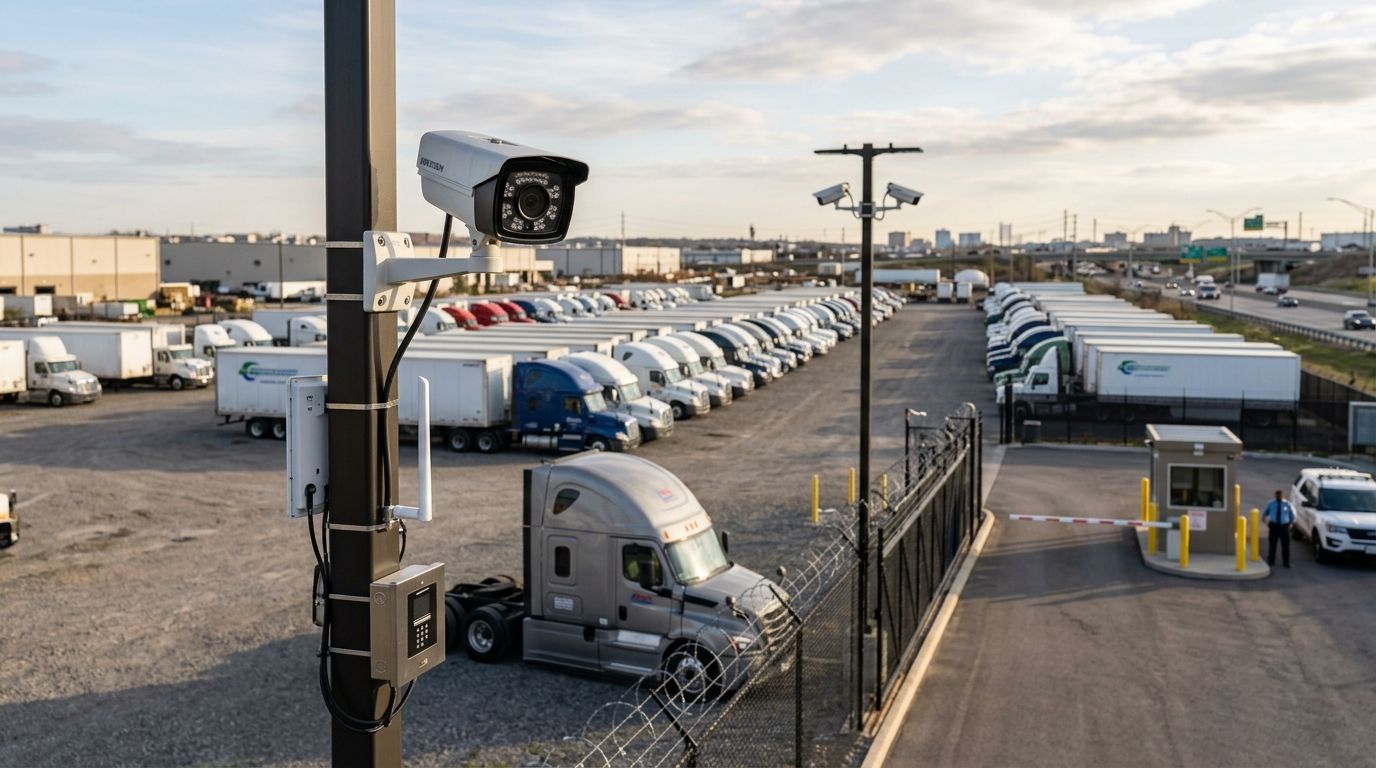
A commercial fleet yard sits at the intersection of two risks most owners underinvest in until something happens: theft and fire. The right security system for 2026 combines perimeter coverage, real-time alerts, and — for yards with fueled vehicles parked overnight — a link back to the same monitoring team watching your fire alarm panel.
Best overall for 2026: AI-powered video surveillance with real-time alerts. Best for controlling who drives on and off the property: license plate recognition (LPR) gate systems. Best for yards with more than one location: integrated alarm monitoring that ties security and fire into one contract.
- AI video surveillance wins as the best overall security system for commercial fleet yards in 2026 — it catches movement across the full lot, not just the gate.
- LPR gate systems are the right call when driver turnover or third-party haulers move through the yard daily.
- Motion-activated perimeter lighting is the cheapest deterrent to add on top of an existing camera system.
- GPS geofencing on trucks and trailers matters more than cameras once a vehicle actually leaves the lot.
- Multi-site fleets should pair security monitoring with the fire alarm panel so one dispatcher handles both alerts.
Why this matters
A fleet yard holds more exposed value overnight than almost any other commercial property type: idle trucks, loaded trailers, diesel and fuel storage, and often a maintenance bay with an open flame or welding torch during the day. Insurers and fleet managers across Kentucky, Illinois, Indiana, Tennessee, Missouri, and Alabama increasingly treat security and fire protection as one conversation, not two, because a break-in and a vehicle fire both start the same way — nobody was watching the yard at 2 a.m.
A security system that only records footage after a theft already happened isn't doing its job in 2026. The systems below are ranked by what they actually catch in real time, not by feature lists.
What makes the best security system for a commercial fleet yard
- Full perimeter coverage, not just the front gate and office door
- Weather-rated hardware that holds up through Midwest ice storms and Southern humidity without downtime
- Real-time push alerts to a phone or dispatch center, not footage reviewed the next morning
- Integration with existing fire alarm or monitoring panels so one team fields both alarm types
- Multi-site scalability for fleets running more than one yard across state lines
- Vendor coverage across your operating states, so you're not juggling separate contractors in each yard's home state
Security systems for fleet yards, at a glance
| System | Best for | Standout feature | Key limitation |
|---|---|---|---|
| AI-powered video surveillance | 24/7 perimeter monitoring | Flags a person or vehicle in real time, not just motion | Needs strong internet or cellular backhaul to push alerts fast |
| LPR gate systems | Controlling who enters and exits | Logs every plate automatically, no manual gate log | Doesn't help once a vehicle is already inside the fence |
| Motion-activated perimeter lighting | Deterring theft during off-hours | Cheapest add-on to an existing camera setup | Deters opportunists, won't stop a planned break-in alone |
| GPS asset tracking and geofencing | Recovering stolen trucks and trailers | Tracks the asset after it leaves the property | Useless for yard-perimeter theft that never moves the vehicle |
| Integrated alarm monitoring | Multi-site fleet operators | One monitoring center for security and fire alarms | Monthly monitoring cost stacks across every yard location |
| Access control (keycard/biometric) | Driver and staff accountability | Times and IDs every entry, no shared keys | Doesn't cover the outer perimeter or parked vehicles |
1. AI-powered video surveillance: best security system for 24/7 perimeter monitoring
AI-powered cameras don't just record — they flag a person, vehicle, or unexpected movement and push an alert before anything is stolen. For a fleet yard with rows of parked trucks and no staff on-site overnight, this is the difference between catching an intruder at the fence line and finding an empty trailer spot in the morning. First-Line Fire installs and services commercial security camera systems alongside fire alarm and suppression work across Kentucky, Illinois, Indiana, Tennessee, Missouri, and Alabama, so a fleet yard can add camera coverage without bringing in a second, unrelated contractor.
AI video surveillance pros:
- Real-time alerts instead of after-the-fact footage review
- Covers a full lot perimeter, not just gates and doors
- Footage doubles as evidence for insurance claims and law enforcement
- Can pair with the same service provider already handling fire alarm monitoring
AI video surveillance cons:
- Requires reliable internet or cellular data to push alerts in real time
- Camera placement across a large yard takes planning, not a single install visit
Best for: yards that need eyes on the entire lot around the clock. Verdict: Buy.
2. LPR gate systems: best security system for controlling entry and exit
License plate recognition reads every plate that crosses the gate, logs the time, and can flag a plate that isn't on an approved list. For yards with driver turnover, third-party haulers, or subcontracted trucks moving in and out daily, this replaces a manual sign-in sheet nobody actually checks.
LPR gate system pros:
- Automatic logging with zero staff time required
- Flags unauthorized or flagged plates instantly
- Creates a searchable record for every vehicle that entered the yard
LPR gate system cons:
- Only covers the gate — a fence breach elsewhere goes unnoticed
- Needs periodic database updates as drivers and haulers change
Best for: yards with heavy daily traffic from drivers and subcontractors. Verdict: Buy.
3. Motion-activated perimeter lighting: best security system for deterring off-hours theft
Lighting that only switches on when it detects movement does two things a static floodlight can't: it saves power all night, and it startles anyone approaching a dark row of trailers. Paired with cameras, it also makes footage sharper the moment it matters.
Motion-activated lighting pros:
- Low-cost addition to an already-installed camera system
- Deters casual theft before it starts
- Improves camera footage quality at night
Motion-activated lighting cons:
- Doesn't identify or record anything on its own
- A planned break-in with cut power can bypass it entirely
Best for: yards adding a cheap deterrent layer on top of cameras. Verdict: Buy.
4. GPS asset tracking and geofencing: best security system for recovering stolen vehicles
Once a truck or trailer actually leaves the yard, cameras and gate logs stop helping. GPS tracking with a geofence alert tells a fleet manager the instant a vehicle crosses a boundary it shouldn't, which is often the fastest path to recovering a stolen asset before it's stripped or resold.
GPS tracking pros:
- Tracks the asset after it leaves the property, unlike any camera system
- Geofence alerts fire in real time, not after a police report is filed
- Works across multiple yards and routes simultaneously
GPS tracking cons:
- Does nothing to prevent theft inside the yard itself
- Requires tracking hardware on every truck and trailer to be useful
Best for: fleets that need recovery, not just prevention. Verdict: Hold for yards without a theft history — prioritize perimeter coverage first.
5. Integrated alarm monitoring: best security system for multi-site fleet operators
A fleet running more than one yard across state lines can't staff every lot around the clock. Integrated alarm monitoring routes security alerts — and fire alarm signals, where that system already exists — to a single monitoring center, so one dispatcher covers a break-in at a yard in Illinois and a fire alarm trip at a yard in Kentucky without two separate phone trees.
Integrated alarm monitoring pros:
- One monitoring relationship across multiple yard locations
- Combines security and fire alerts into a single dispatch path
- Scales as a fleet adds new yards or terminals
Integrated alarm monitoring cons:
- Monthly monitoring fees add up across several sites
- Only as strong as the sensors and cameras feeding it
Best for: operators managing more than one yard. Verdict: Buy for multi-site fleets.
6. Access control (keycard or biometric): best security system for driver and staff accountability
Shared keys and unmonitored doors make it impossible to know who was on-site and when. Keycard or biometric access control timestamps every entry to an office, maintenance bay, or fenced sub-area, which matters for accountability and for insurance documentation after any incident.
Access control pros:
- Every entry is timed and tied to a specific person
- No shared keys that can be copied or lost
- Easy to revoke access for a terminated employee
Access control cons:
- Covers doors and gates only, not the open lot
- Biometric hardware costs more upfront than a keycard system
Best for: yards with a staffed office or maintenance building. Verdict: Buy if you have a building to secure; Skip for an open lot with no structure.
How we ranked these
Each system was weighed against the six criteria above: full-perimeter coverage, weather durability, real-time alerting, integration with fire monitoring, multi-site scalability, and consistent vendor coverage across operating states. AI video surveillance and LPR gates ranked highest because they act in real time; lighting and access control ranked lower because they support the primary systems rather than replace them.
Talk through your yard's security setup
Fire and security service across Kentucky, Illinois, Indiana, Tennessee, Missouri, and Alabama.
Which security system should you choose for your fleet yard?
For most fleet yards heading into 2026, AI-powered video surveillance is the default pick — it covers the widest range of threats with real-time alerts instead of after-the-fact footage. Add LPR at the gate if drivers and haulers rotate daily, and add GPS tracking once vehicles routinely leave the property unattended. Multi-site operators should push toward integrated monitoring so security and fire alarms share one dispatch path instead of two separate vendor relationships. Fleets running trucks with onboard fire risk should also look at vehicle fire suppression systems built for fleet trucks as a companion to whatever security system protects the yard itself.
“A camera system that only shows you the theft after it happened isn't security — it's a record.”
FAQ
What is the best security system for a commercial fleet yard in 2026?
AI-powered video surveillance with real-time alerts is the best overall system for a commercial fleet yard in 2026 because it covers the full perimeter and flags movement instantly, not just after footage is reviewed. Yards with heavy daily traffic should pair it with an LPR gate system.
Is LPR better than standard cameras for a fleet yard?
LPR and standard cameras solve different problems — LPR logs every vehicle entering or leaving the gate, while cameras cover the full lot. Most fleet yards in 2026 run both together rather than choosing one over the other.
Does GPS tracking replace the need for yard cameras?
No. GPS tracking only helps once a truck or trailer has already left the property, while cameras and lighting are what prevent or catch theft inside the yard itself.
How much does a security camera system cost for a fleet yard?
Cost depends on yard size, camera count, and whether monitoring is included, so get a site-specific quote rather than relying on a general estimate.
Can a fleet yard's security system connect to its fire alarm monitoring?
Yes, integrated alarm monitoring can route both security alerts and fire alarm signals to the same monitoring center, which is common for multi-site fleets across Kentucky, Illinois, Indiana, Tennessee, Missouri, and Alabama in 2026.
What security system works best for a yard with no staffed building?
AI video surveillance combined with motion-activated lighting is the strongest fit for an open lot with no office or maintenance building, since access control only secures doors that don't exist in that setup.
Do fleet yards need access control if they already have a gate?
A gate controls the perimeter, but access control still matters for any staffed office or maintenance bay on the property, tracking who entered a building separate from who entered the lot.
How many cameras does a typical fleet yard need?
Camera count depends on yard size, fence line length, and blind spots around parked trailers, so a walk-through is the only reliable way to size a system correctly.
One last thing
Most fleet yards buy security and fire protection from two unrelated vendors, then wonder why a 2 a.m. alert takes twenty minutes to get a real response. The fix isn't a bigger camera system — it's routing security alerts and fire alarm signals to the same monitoring center, so one dispatcher call covers a break-in and a fuel-tank alarm alike instead of two separate phone trees on two separate contracts.


