
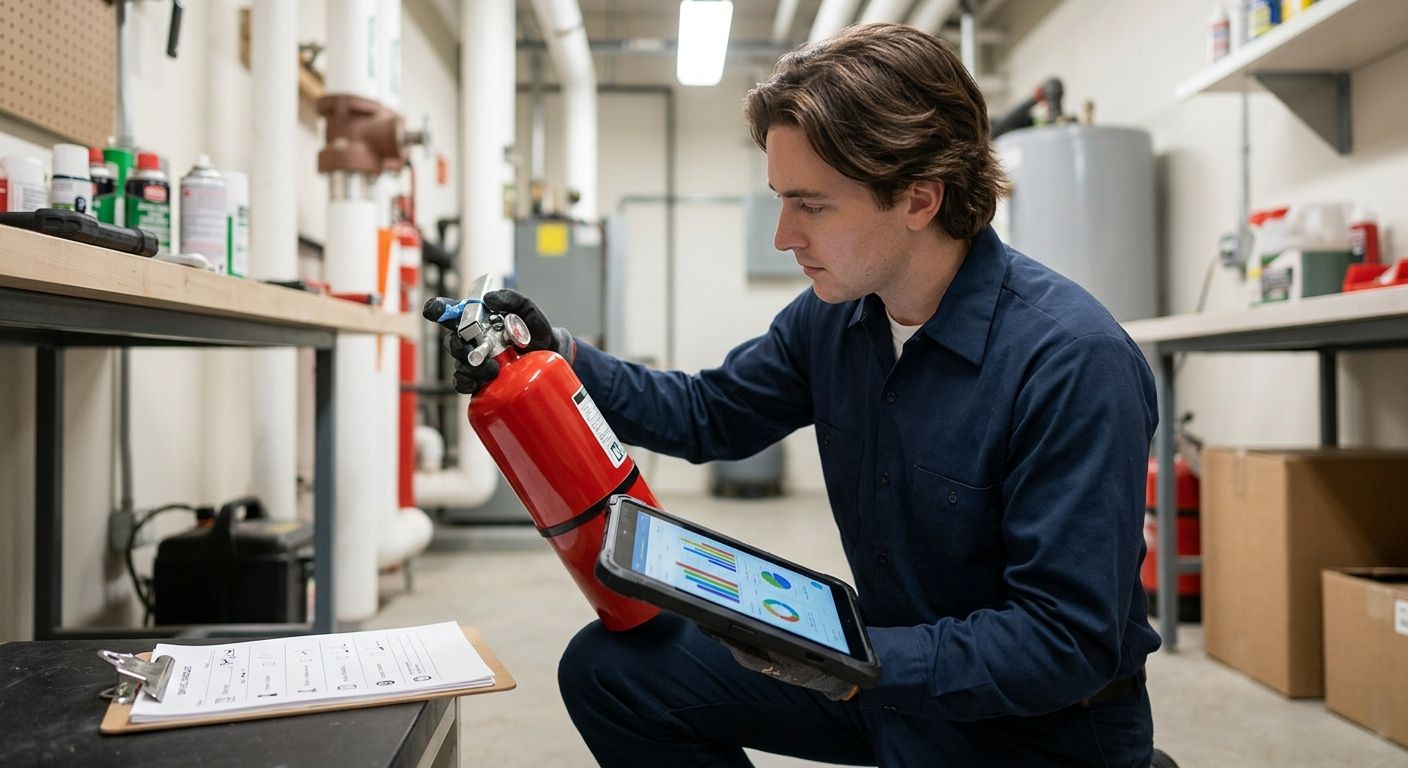
A fire extinguisher inspection service that hands you a paper tag and nothing else leaves you exposed the day an OSHA compliance officer asks for six years of maintenance history. Build a workflow that turns every service visit into a permanent, retrievable record and the inspection stops being a fire drill of its own.
- OSHA 1910.157(e)(3) requires an annual maintenance record retained for one year after the last entry, but auditors often ask further back.
- A fire extinguisher inspection service should log monthly visual checks, annual maintenance, 6-year internal maintenance, and 12-year hydrostatic tests separately.
- Paper tags alone fail audits when a unit is moved, replaced, or the tag is lost between visits.
- First-Line Fire converts on-site service data into a dated compliance log at the time of the visit, not after the fact.
- A central digital log across multiple locations cuts audit prep from days to minutes in 2026.
Why this matters
OSHA doesn't grade you on whether the extinguisher works. It grades you on whether you can prove, on paper, when it was last checked and by whom. NFPA 10 sets the technical intervals: monthly visual inspection, annual maintenance check, 6-year internal maintenance for rechargeable units, and 12-year hydrostatic testing for most steel and stainless models.
The gap that gets businesses cited isn't the inspection itself. It's the record. A fire extinguisher inspection service that just tags units and leaves doesn't solve that problem for you — you still have to build the log yourself, unit by unit, location by location.
Run this as a workflow instead of a once-a-year scramble and you get one file, one date system, and one answer ready any time an inspector, insurer, or fire marshal asks for it.
Before you start
- A complete extinguisher asset list — location, model, size, install or last-hydro date for every unit on the property, not just the ones you remember.
- A designated recordkeeping system — spreadsheet, shared drive folder, or digital log that stays accessible even if the person who set it up leaves.
- A named record owner at each site who signs off after every technician visit, so the log isn't dependent on one person's memory.
The gotcha: OSHA's retention rule only requires the annual maintenance record for one year after the last entry. Most auditors, insurers, and fire marshals want to see the full service history back to install or last hydro test — build the log to keep everything, not the legal minimum, or you'll be reconstructing history from memory during an audit.
Build your extinguisher asset log
- Walk every location and record each extinguisher's tag number, type (ABC, CO2, K-class, etc.), location description, and install date.
- Enter the last hydro test date and next due date for each unit — most dry chemical units run a 12-year hydrostatic cycle.
- Assign each unit a row ID that matches its physical tag number so field data and desk records never drift apart.
- Save the master list in the recordkeeping system you named in the pre-work step. This is your source of truth, not the technician's clipboard.
Expected result: every extinguisher on the property has one row, one ID, and one due date — no unit exists only on a paper tag.
Set up your service-record intake
- After each visit, log the service date, technician name, findings (pass, recharge needed, replace), and next due date against the matching row ID.
- Attach or reference the physical tag number stamped or punched during the visit, so field and desk records cross-check.
- Flag any unit marked failed or removed from service immediately — don't wait for the monthly review to catch it.
- Confirm the monthly visual inspection checkbox separately from the annual maintenance entry. OSHA treats these as two different obligations with two different intervals.
Expected result: every service visit produces one dated entry per unit, tied to a technician name and a pass/fail outcome.
Convert tags into a compliance log
- At month-end, pull every entry logged that period into a compliance summary — one line per unit, one column per required check type.
- Mark units approaching their annual maintenance, 6-year internal maintenance, or 12-year hydro test window at least 30 days out.
- Export or print the summary as a standing document you can hand over on request — this is the file an OSHA compliance officer or fire marshal actually wants to see.
- Archive the prior month's summary rather than overwriting it. The log's value is the trail, not just the current snapshot.
Expected result: a single document that answers "when was this extinguisher last serviced" for any unit, any date, without digging through a folder of technician tags.
Do this when a unit fails inspection or gets recharged
Run a shorter version of the same workflow whenever a technician flags a unit mid-cycle instead of waiting for the next scheduled visit.
- Log the failure or recharge event the same day it happens, tied to the unit's row ID.
- Update the next due date immediately — a recharge resets the service clock, and an old due date left in the log creates a false compliance record.
- Note whether the unit was replaced rather than recharged, since a replacement unit needs a new row, not an updated one.
Expected result: the log never shows a unit as "current" when it's actually been swapped or serviced off-cycle.
“A tag on the extinguisher proves the visit happened. A log proves you can find it again.”
Troubleshooting
- A tag is missing or illegible. Cross-check the row ID against your asset list and schedule an immediate re-tag visit — don't guess at the last service date.
- Monthly visual checks aren't getting logged. Assign the check to a named staff role, not "whoever's on shift," and require initials on the log entry.
- Multiple locations keep separate paper logs. Consolidate into one shared digital file before your next audit cycle — reconciling five site binders during an inspector visit is the single most common failure point.
- A unit's hydro test date is unknown. Treat it as overdue and schedule testing rather than assuming it passed on its original install date.
- An auditor asks for records older than one year. If you followed the one-year minimum literally, you may not have them — this is why the pre-work step above recommends keeping the full history, not the legal floor.
Customize your workflow
The base workflow above covers standard commercial extinguishers. Two adjustments are worth making depending on your property type.
If your extinguishers get tagged annually but you've never mapped that process against a compliance calendar, work through the extinguisher tagging to annual inspection workflow to close that gap before your next renewal cycle.
If hydro testing and recharge scheduling are still handled as two separate vendor calls, the hydro testing to recharge workflow shows how to fold both into one service visit and one log entry, which cuts the number of site trips your team has to coordinate in 2026.
Get your compliance log built right
First-Line Fire logs every visit at the time of service, not after.
FAQ
What's the best fire extinguisher inspection service for OSHA compliance?
The best fire extinguisher inspection service logs the visit date, technician name, and findings at the time of service rather than leaving you to reconstruct records later. First-Line Fire builds that log during the site visit across Kentucky, Illinois, Indiana, Tennessee, Missouri, and Alabama.
How often does OSHA require fire extinguisher inspections?
OSHA 1910.157 requires a monthly visual inspection and an annual maintenance check on every portable extinguisher. NFPA 10 adds a 6-year internal maintenance cycle and a 12-year hydrostatic test for most rechargeable models.
How long do you have to keep fire extinguisher inspection records?
OSHA's minimum is one year after the last annual maintenance entry, per 1910.157(e)(3). Most insurers and fire marshals expect the full service history back to install, so keeping records longer than the legal minimum avoids gaps during an audit.
What's the difference between a monthly visual check and an annual maintenance inspection?
A monthly visual check confirms the extinguisher is present, accessible, and charged, and can be done by staff. An annual maintenance inspection is a more detailed check performed by a certified technician and must be recorded with a date under OSHA rules.
Is a hydrostatic test the same as an annual inspection?
No. A hydrostatic test is a pressure test of the cylinder itself, required on a 12-year cycle for most steel units, while an annual inspection is a yearly maintenance check. They're separate obligations tracked on separate schedules.
What happens if an OSHA inspector asks for records you don't have?
Missing records during an inspection typically result in a citation for recordkeeping violations even if the extinguishers themselves are functional. A centralized compliance log prevents this by keeping every service date retrievable on request.
Do multi-location businesses need one central compliance log?
Yes. Separate paper logs per site create gaps and duplicate work during an audit. A single digital log with a location column lets you pull records for any site in minutes instead of collecting binders from each property.
How much does fire extinguisher recharging cost in 2026?
Recharge cost depends on extinguisher size and agent type, and varies by service provider and region. Check current recharge pricing directly with your fire extinguisher inspection service before budgeting for a multi-unit recharge cycle.
One last thing
The record that actually protects you in an audit isn't the current tag — it's the trail behind it. A unit serviced on schedule with three years of dated entries behind it reads as compliant at a glance; the same unit with only a current tag and no history reads as a question mark, even if nothing is wrong.


