
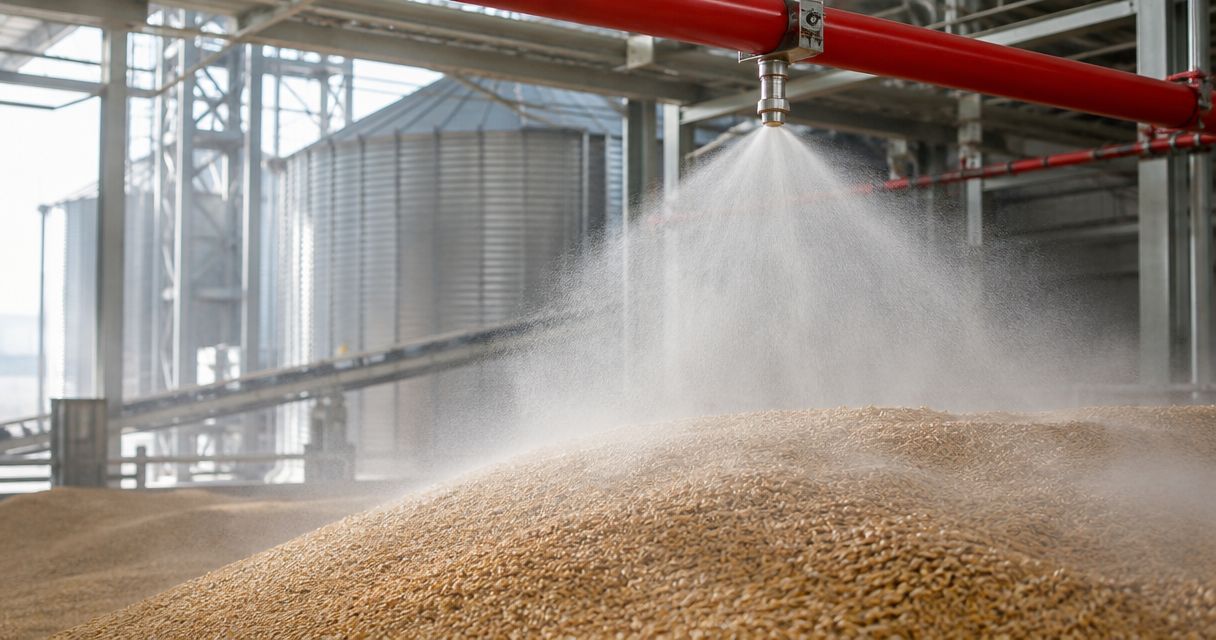
Fire suppression systems cannot prevent grain dust explosions on their own. Ordinary fire suppression controls fires, while engineered explosion suppression limits pressure after ignition inside protected equipment. You still need dust control, ignition prevention, and measures that stop an explosion from spreading.
- Can fire suppression systems prevent grain dust explosions? Not alone; ignition prevention and explosion protection serve different jobs.
- OSHA treats grain dust housekeeping, equipment maintenance, and worker training as essential controls at covered grain-handling facilities.
- Explosion suppression limits a developing explosion; isolation prevents propagation through connected equipment.
- Firstlinefire provides industrial fire-protection services; confirm grain-dust explosion engineering separately before selecting equipment.
Why this matters
A fire system and an explosion-protection system do not do the same job. Treating them as interchangeable leaves a gap between extinguishing burning material and controlling a pressure-producing event inside a dust collector, elevator, or other enclosure.
For your 2026 protection review, separate ordinary fire protection from combustible-dust protection before discussing equipment. Firstlinefire provides suppression systems, extinguishers, alarms, and safety training to industrial customers. Confirm the scope of any proposed service rather than assuming that fire suppression includes explosion suppression or isolation.
Can fire suppression systems prevent grain dust explosions?
Not by themselves. Explosion suppression acts after ignition; prevention removes conditions that allow ignition or an explosive dust cloud. A complete protection plan addresses both, then limits the consequences if prevention fails.
OSHA's Grain Handling Facilities standard, 29 CFR 1910.272, addresses housekeeping, training, preventive maintenance, hot work, and other controls at covered facilities. NFPA 69 addresses explosion-prevention systems, including explosion suppression and isolation. NFPA 68 addresses deflagration venting. Their scopes explain why a standard fire-system proposal is not a complete dust-explosion plan.
Use this comparison when reviewing a 2026 proposal. These are protection functions, not interchangeable purchase options.
| Protection function | Best for | What it does | Main limitation |
|---|---|---|---|
| Dust collection and housekeeping | Reducing combustible dust accumulations | Captures dust and removes deposits that can become airborne | Does not eliminate every ignition source or protect an unassessed enclosure |
| Ignition control | Reducing opportunities for ignition | Addresses sources such as overheating equipment, sparks, and hot work | Does not remove combustible dust already present |
| Ordinary fire suppression | Controlling the fire hazards covered by its design | Applies an extinguishing agent to a protected fire area or item | Is not automatically designed to control explosion pressure |
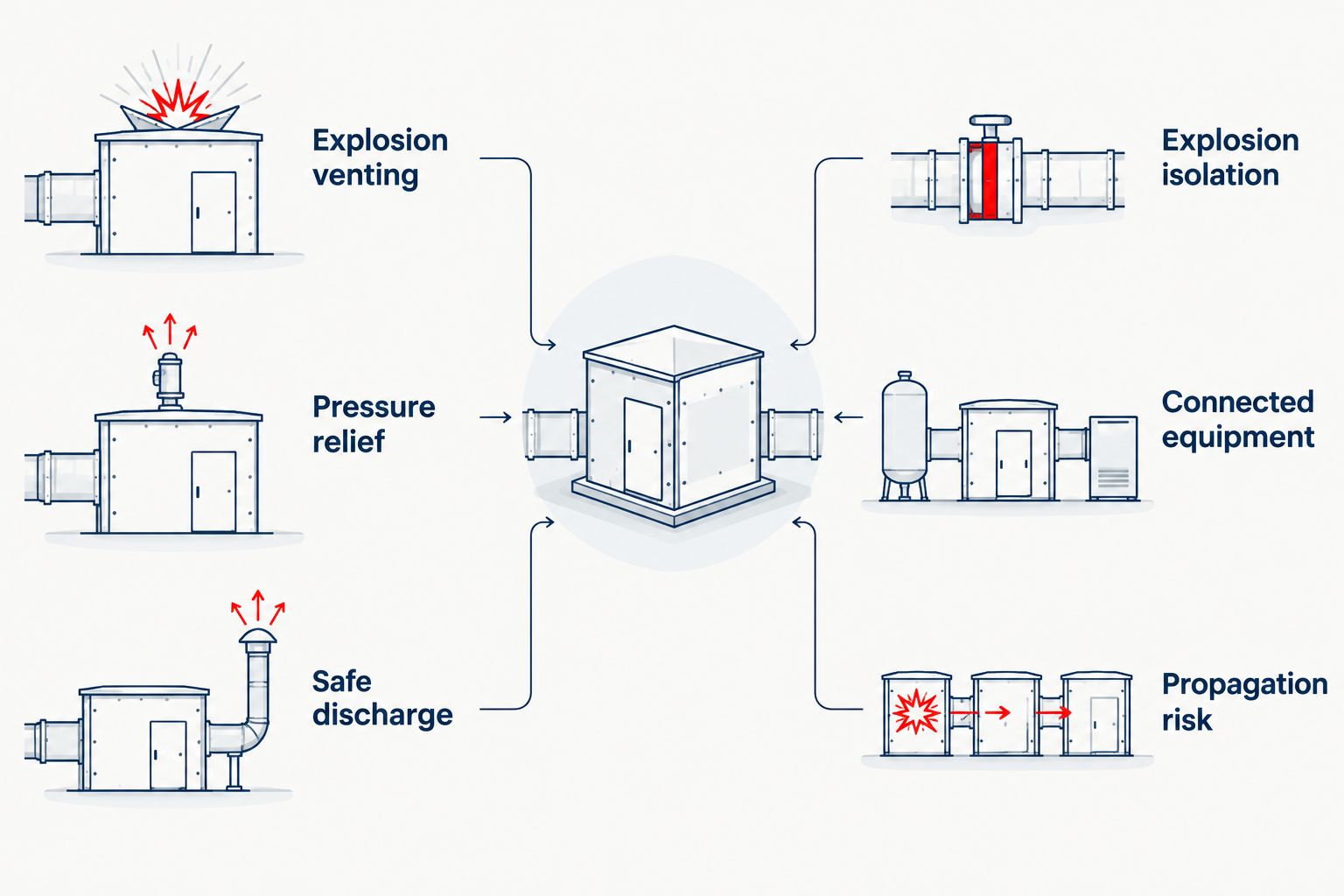
| Explosion suppression | Limiting a developing deflagration in a suitable enclosure | Detects the event and discharges suppressant as part of an engineered system | Acts after ignition and needs application-specific design |
| Explosion venting | Relieving deflagration pressure where discharge is safely managed | Opens a designed relief path | Does not prevent ignition or automatically stop propagation |
| Explosion isolation | Limiting propagation between connected equipment | Interrupts flame or pressure transmission through protected connections | Does not replace protection of the originating enclosure |
Do not select protection from the equipment name alone. A dust collector's location, construction, connections, and actual dust properties affect the design.
Ordinary fire suppression: useful, but not explosion protection
Sprinklers and other fire-suppression systems protect the hazards for which they are designed. Portable extinguishers support trained response to suitable incipient-stage fires. Those functions remain important at a grain facility.
The limitation is specific: a fire-suppression installation is not evidence that a dust enclosure has explosion protection. A building sprinkler system, for example, does not establish that a connected collector has suitable pressure protection or isolation.
Keep the fire-protection inspection records. Then ask for separate documentation identifying the combustible-dust hazards, protected equipment, and explosion-protection measures. An extinguisher tag cannot answer those questions.
Explosion suppression: pressure control after ignition
An engineered explosion-suppression system detects a developing deflagration and releases suppressant into the protected enclosure. Its purpose is to limit the event before pressure exceeds the system's design basis.
Best for: enclosed process equipment where a qualified design establishes that suppression is suitable. Its advantage is active protection inside the enclosure; its limitation is dependence on the correct detection, discharge arrangement, operating conditions, and maintenance.
Ask the designer to identify the dust-test information and enclosure details used in the design. Do not accept an agent name or cylinder size as proof of suitability. Protection must match the actual application, including connected equipment.
Explosion venting and isolation: different jobs
Explosion venting provides a designed route for pressure relief. The discharge creates its own hazard, so its destination matters. A vent is not simply an opening that can point toward a walkway or occupied work area.
Best for venting: equipment where a qualified design provides a suitable relief arrangement and safe discharge conditions. Its benefit is pressure relief; its limitation is that the vent discharge and any ducting need engineering consideration.
Explosion isolation addresses another route of harm: propagation through ducts, conveyors, or other connections. Best for isolation: connected equipment where the hazard assessment identifies a propagation risk. Isolation protects the connection, but the enclosure still needs its own appropriate protection.
Why grain dust explosion protection varies
There is no universal suppression arrangement for every grain operation. For a 2026 review, require the design to account for the equipment and material actually in service.
- Dust properties. Representative testing establishes characteristics used in explosion-protection design. Do not substitute assumptions based only on the grain's name.
- Enclosure construction. Volume, geometry, and pressure resistance affect the protection approach. Equipment that looks similar can have different design limits.
- Equipment connections. Ducts and transfer paths can carry an event beyond its starting point. Assess the connected process, not just the collector.
- Location and occupancy. Indoor placement, nearby work areas, and available discharge space affect whether a venting arrangement is suitable.
- Operating conditions. Process changes, dust loading, and airflow changes need review against the protection system's design basis.
- Maintenance condition. Disabled detection, obstructed equipment, and overdue service undermine the protection the design assumes.
Ask for these factors in writing. A proposal that lists hardware without explaining the protected hazard leaves you unable to judge its scope.
What should you check before choosing a system?
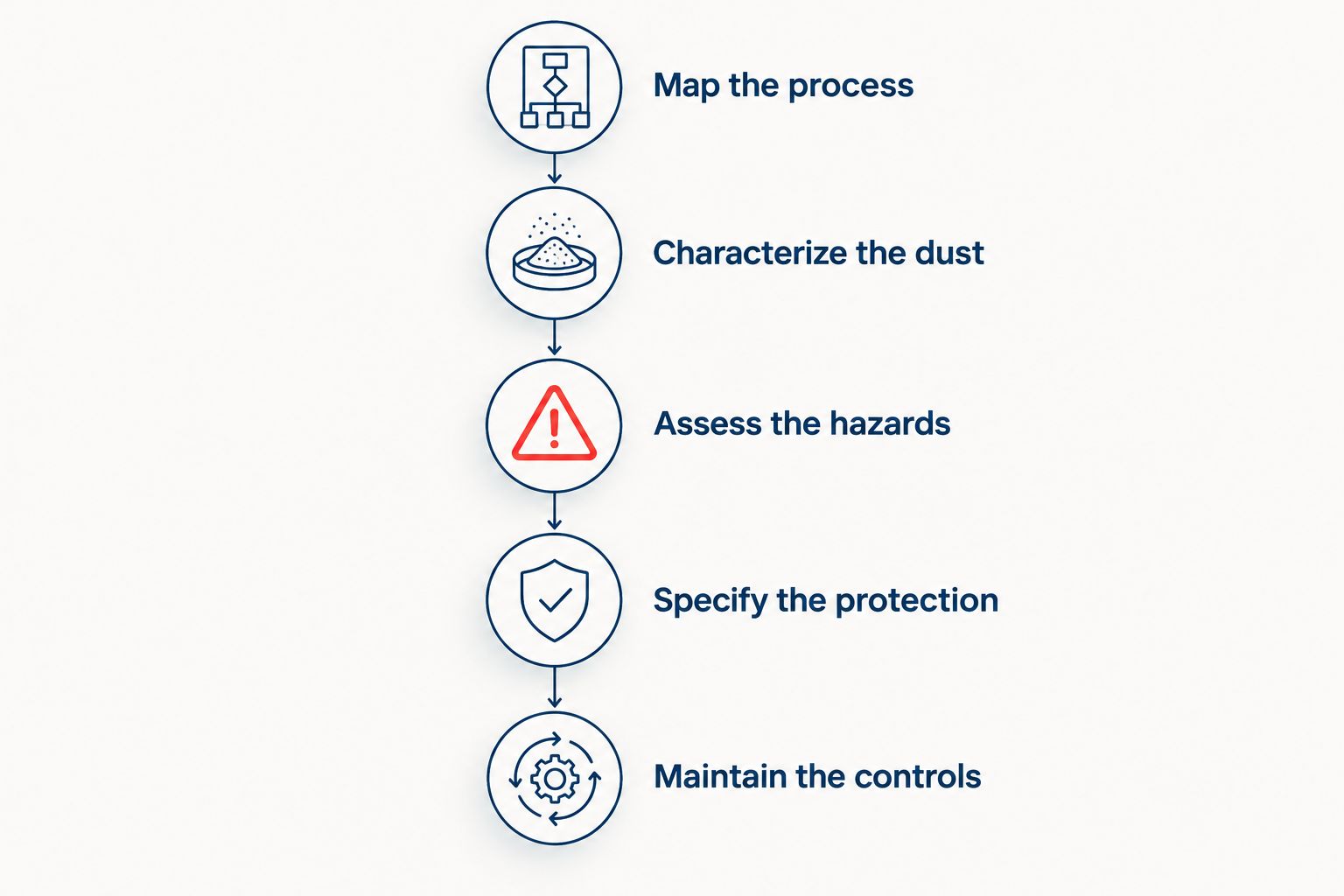
Start with the hazard, not the cylinder. Use this sequence to organize a qualified combustible-dust review and the work that follows.
- Map the process. Identify dust-producing equipment, collection points, transfer routes, and occupied areas. Include equipment that shares ducts or conveying connections.
- Characterize the dust. Obtain representative material information and testing through qualified specialists. Record where samples came from and which operating conditions they represent.
- Assess the hazards. Document credible ignition sources, dust-release points, accumulation areas, and propagation paths. Identify existing controls and the gaps between them.
- Specify the protection. Establish which equipment needs prevention, suppression, venting, isolation, or a combination. Record the design basis and applicable requirements.
- Maintain the controls. Assign responsibility for inspections, testing, housekeeping, training, and changes. Keep deficiencies open until the corrective work is documented.
The useful handoff is a defined scope, not a verbal assurance that the facility is protected. Operations, maintenance, the protection designer, and the authority having jurisdiction need a shared understanding of what each measure does.
Keep changes in that same process. Moving a collector, changing ductwork, or handling a different material is a reason to check the design basis—not merely update an equipment list.
What housekeeping numbers actually apply?
OSHA's 29 CFR 1910.272 requires a written housekeeping program for covered grain-handling facilities. Its grain-elevator provisions identify priority housekeeping areas and require immediate removal of fugitive grain dust accumulations exceeding 1/8 inch, approximately 3.2 millimeters, unless the employer demonstrates and maintains equivalent protection through the standard's alternative provisions.
Those priority areas include floors within 35 feet of inside bucket elevators. They also include floors in enclosed areas containing grinding equipment and floors in enclosed areas containing grain dryers located inside the facility.
These are specific housekeeping provisions, not a universal safe-dust allowance. Do not treat a thinner layer elsewhere as proof that an area is safe. Dust on elevated surfaces and dust released into the air still require assessment and control.
For your 2026 housekeeping review, identify the applicable areas, cleaning method, responsible person, and corrective-action process. OSHA restricts compressed-air cleaning under this standard; do not use it as a routine shortcut that disperses settled dust around operating equipment.
Can sprinklers stop an explosion inside a dust collector?
Sprinklers do not establish explosion protection inside a dust collector. Their presence does not prove that the collector can withstand a deflagration, safely relieve pressure, or stop propagation through connected ductwork.
Ask for the collector's protection design and isolation arrangements. Keep building fire protection and collector explosion protection as separate review items, even when the systems share alarm interfaces.
Does explosion suppression mean you can reduce housekeeping?
Explosion suppression does not replace housekeeping. Settled dust can become airborne during a disturbance and contribute to a secondary explosion outside the enclosure the system protects.
Keep the cleaning program tied to actual dust generation and accumulation. A protected collector does not make dusty beams, floors, or equipment surfaces acceptable.
Who should you call about the fire-protection work?
Firstlinefire is best for industrial operators needing the fire-suppression, extinguisher, alarm, and safety-training services it provides. Grain-dust explosion engineering is a separate scope to confirm before assigning the work.
Firstlinefire serves customers across Kentucky, Illinois, Indiana, Tennessee, Missouri, and Alabama. Discuss the existing fire-protection equipment, then identify who is responsible for the dust assessment, explosion-protection design, and coordination with the authority having jurisdiction.
Discuss your industrial fire-protection scope
Separate extinguisher, suppression, alarm, and training needs from grain-dust explosion engineering.
FAQ
Can fire suppression systems prevent grain dust explosions?
Fire suppression systems cannot prevent grain dust explosions on their own. Engineered explosion suppression limits a developing event after ignition, while dust control and ignition prevention reduce the conditions that allow it.
Is explosion suppression the same as a sprinkler system?
Explosion suppression is not the same as a sprinkler system. Explosion suppression is designed around a developing deflagration inside protected equipment; sprinklers address the fire hazards covered by their design.
Do grain dust collectors need explosion isolation?
A grain dust collector's connected process must be assessed for explosion propagation. Qualified design determines whether isolation is required and which arrangement suits the ducts, equipment, and operating conditions.
How much grain dust requires immediate cleanup under OSHA?
OSHA's grain-elevator provisions require immediate removal of accumulations exceeding 1/8 inch in designated priority housekeeping areas, unless the specified equivalent-protection alternative is demonstrated and maintained. That threshold is not a universal safe limit for other surfaces or airborne dust.
Can I use compressed air to clean grain dust?
Compressed-air cleaning is restricted under OSHA's Grain Handling Facilities standard. The standard allows it only when machinery presenting an ignition source is shut down and other known potential ignition sources in the area are removed or controlled.
Can an explosion vent discharge inside a building?
An ordinary explosion vent must not discharge a hazardous flame and pressure release into an occupied indoor area. Indoor applications require a specifically engineered protection arrangement, not an assumption that any vent panel is suitable.
What should I request during a 2026 grain facility protection review?
Request the documented dust-hazard assessment, explosion-protection design basis, inspection records, and unresolved corrective actions. Confirm which equipment is protected and how connected equipment is isolated where required.
One last thing
A small initial event can disturb settled dust and feed a larger secondary explosion. That is why protection cannot stop at the machine where ignition is most likely.
During your next walk-through, look above eye level as well as at the floor. Then compare the dust you find with the housekeeping plan and the equipment covered by the explosion-protection design. Make that comparison part of your 2026 review before treating a current service tag as proof that the whole hazard is controlled.


