
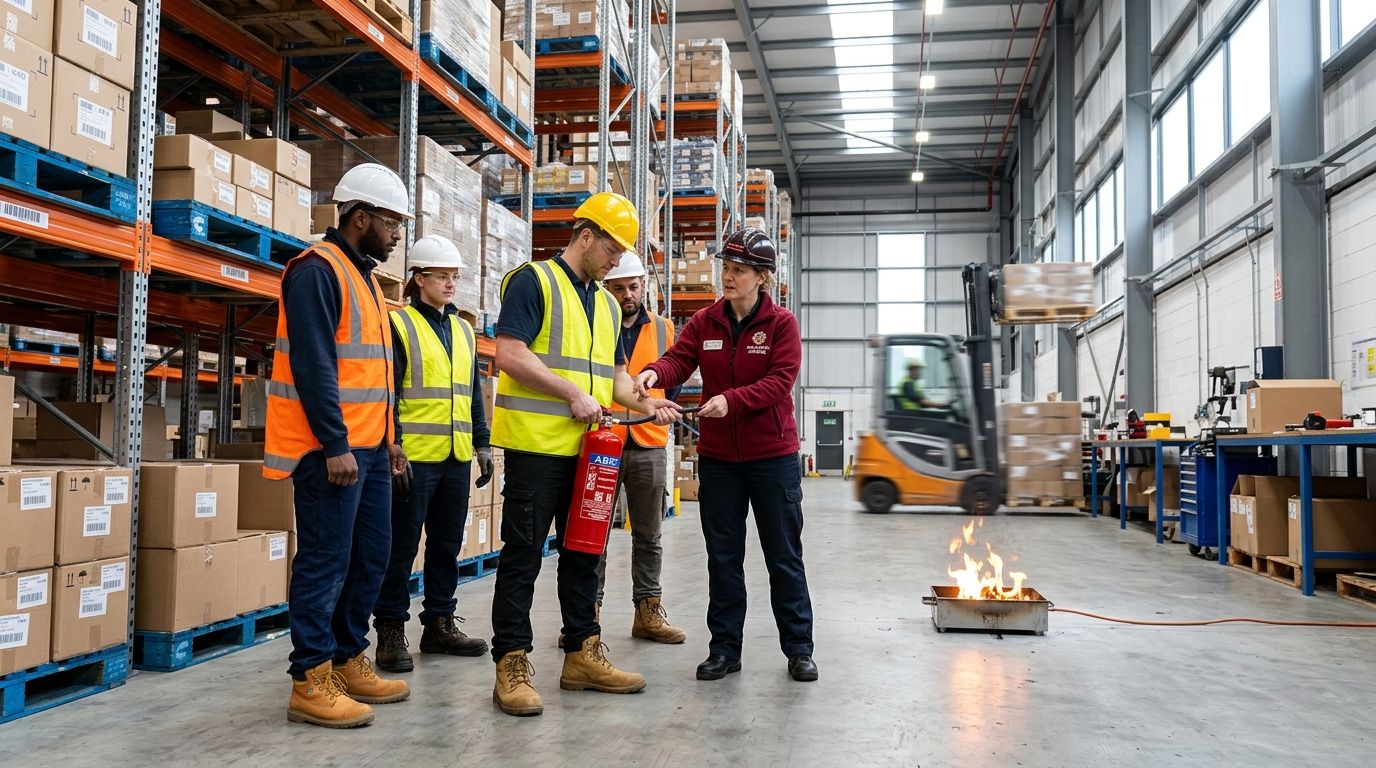
Fire safety training for warehouse staff is instruction that teaches employees how to spot fire hazards, operate a portable extinguisher, and clear a building safely, built around the OSHA training trigger and the layout risks unique to a distribution floor. A warehouse isn't an office: high-rack storage blocks sightlines, forklifts run on propane or lithium batteries, and a single aisle fire can cut off the only exit in under two minutes.
Here's the direct answer before the detail: warehouse staff who are expected to fight a fire need initial training plus refreshers at least once a year, under OSHA 29 CFR 1910.157(g)(1), and that training has to include hands-on extinguisher practice, not just a video. Everything below builds out how to run that program in 2026 without shutting down a shift.
- OSHA 1910.157(g)(1) requires initial training plus annual refreshers for staff expected to use extinguishers.
- Warehouses need Class A coverage plus Class B near solvents and Class C near chargers and panels.
- Live extinguisher discharge builds muscle memory that slideshow-only training never does.
- First-Line Fire runs on-site fire safety training for warehouse crews across KY, IL, IN, TN, MO and AL.
- NFPA 10 caps travel distance to a Class A extinguisher at 75 feet on most warehouse floors.
Why fire safety training matters for warehouse staff
Warehouse floors combine three things fire investigators flag every year: dense combustible loads (cardboard, shrink wrap, wood pallets), powered equipment with ignition sources (forklift chargers, conveyor motors), and long, obstructed egress paths. NFPA 10 sets a 75-foot maximum travel distance to a Class A extinguisher for light and ordinary hazard occupancies. In a 100,000-square-foot building, that spacing is the difference between a fast knockdown and a total loss.
OSHA does not require every employer to keep extinguishers on-site. But if you do keep them, and you expect staff to use them, training becomes mandatory: initial instruction, then annual refreshers, documented. Skip it and you have staff who freeze or grab the wrong class during the ninety seconds that actually matter.
For crews already running fire extinguishers for warehouses and distribution centers, training is the piece that turns hardware into a working safety program instead of a compliance checkbox nobody reads.
Build the program: seven steps
Map your hazards before you write a single slide
You cannot train staff on risks you have not identified. Walk the floor and mark every ignition source and every fuel load first.
- Battery charging stations and propane cage locations
- High-rack aisles with limited two-way clearance
- Loading dock doors that double as the nearest exit
- Shrink-wrap and cardboard staging zones
- Areas storing flammable liquids or aerosols
- Mezzanine or office pockets built inside the warehouse shell
Set a training cadence that meets OSHA's minimum
Annual is the floor, not a target. Build a 2026 calendar that never lets a shift run past twelve months without a refresher.
- Initial training for every new hire before they work the floor solo
- Annual refresher for all staff designated to use extinguishers
- An extra session after any layout change, such as new racking or a new charging area
- An extra round after any near-miss or actual incident
- Written sign-off logged for each employee, each session
Teach the extinguisher classes your team will actually reach for
Most warehouse fires are Class A, with pockets of Class B near maintenance bays and Class C near electrical panels. Staff need to tell the difference on sight, fast.
- Class A: ordinary combustibles such as cardboard, pallets and packaging
- Class B: flammable liquids such as solvents and fuel
- Class C: energized electrical equipment including panels, motors and chargers
- Which extinguisher is mounted where, and why that class was chosen
- What never to use water or a plain Class A unit on
A breakdown of portable extinguishers ranked by class works well as a posted reference near every charging station.
Run a hands-on discharge drill, not a slideshow
A classroom session teaches recognition. A live discharge teaches muscle memory. Do only the first half and you have done part of the job.
- PASS technique (pull, aim, squeeze, sweep) practiced on a live or training unit
- Safe approach distance and stance
- The decision point: fight it or evacuate
- Practice on the specific extinguisher model mounted in your facility
- A second attempt for anyone who fumbles the first
Plan evacuation around racking and dock doors
Warehouses fail evacuation drills more often than offices because racking blocks sightlines and dock doors get treated as informal exits nobody mapped.
- Marked primary and secondary routes from every rack aisle
- A rally point clear of dock traffic and delivery trucks
- Assigned headcount responsibility per shift supervisor
- A rule for forklift operators mid-load when the alarm sounds
- Signage that survives a power outage
Assign a trained fire warden to every shift
One person per shift owns the response: headcount, traffic direction, and confirming the 911 call actually happened.
- Warden trained on extinguisher use plus evacuation coordination
- Backup warden named for every shift, including vacation weeks
- Radio or phone contact confirmed before shift start
- Annual retraining alongside the general staff refresher
Document every session for your OSHA file
Training that is not logged does not exist during an inspection or after an incident. Build the paper trail as you go.
- Sign-in sheet with name, date and topics covered
- Trainer name and qualifications on file
- Extinguisher inspection tags cross-referenced to training dates
- Records retained per your state and OSHA jurisdiction
On-site training paired with an equipment service visit closes the gap between paperwork and a floor that is actually ready. First-Line Fire runs that combination for warehouse and industrial customers across Kentucky, Illinois, Indiana, Tennessee, Missouri and Alabama, so the training and the inspection happen on the same trip in 2026.
Comparing warehouse fire safety training options
| Option | Best for | Key limitation |
|---|---|---|
| Self-guided video plus quiz | Small crews needing initial documentation fast | No live discharge, weak muscle memory |
| On-site instructor-led with live discharge | Warehouses with mixed Class A, B and C hazards | Requires blocking out a shift window |
| Training bundled with extinguisher and alarm service | Facilities wanting compliance and equipment checked in one visit | Fewer providers offer both together |
| In-house safety officer program | Multi-site operators with a dedicated EHS lead | High ongoing staffing cost |
Verdict: on-site instructor-led training with a live extinguisher discharge is the only format that meets OSHA's hands-on expectation and builds real muscle memory. Video-only training checks a box; it does not prepare anyone for the ninety seconds that matter.
“A warehouse fire does not wait for someone to read the label on the extinguisher. Either the hands already know the drill, or they don't.”
Book warehouse fire safety training
On-site training paired with extinguisher and alarm service across six states.
Common mistakes warehouses make
- Training new hires once at onboarding and never again. OSHA's annual requirement does not stop after year one.
- Mounting extinguishers behind pallet racks or inside charging cages. Staff cannot reach what they cannot see.
- Skipping live discharge to avoid the mess. A slideshow-only session leaves a gap in any incident review.
- Letting the fire warden list go stale after turnover. A warden who left three months ago covers nobody.
- Leaving dock doors and mezzanine stairs off the evacuation map. Staff use them every shift; the official plan should say so.
FAQ
How often does OSHA require fire extinguisher training for warehouse employees?
OSHA 1910.157(g)(1) requires initial training when an employee is first designated to use an extinguisher, then a refresher at least annually. Layout changes or a near-miss are reasonable triggers for an extra session in 2026.
What class of fire extinguisher do warehouses need?
Most warehouses need Class A coverage for cardboard and pallet fuel loads, plus Class B near solvents or fuel storage and Class C near electrical panels and chargers. Coverage should match the facility's hazard map, not a generic default.
Is fire safety training required for all warehouse staff or only some?
OSHA mandates training for staff the employer expects to use a portable extinguisher during a fire. Employers who require immediate evacuation instead can train on evacuation procedures alone, though most warehouses designate several extinguisher-trained staff per shift.
How long does warehouse fire safety training take?
A combined classroom and live-discharge session typically runs one to two hours per group. Facilities scheduling training alongside an extinguisher inspection often cover both in a single visit.
Can warehouse staff complete fire extinguisher training online?
Online modules satisfy the instruction portion covering recognition and procedure, but the hands-on expectation is best met with a live or simulated discharge. Video-only training leaves a documentation gap if an incident review asks about practical practice.
What happens during a live fire extinguisher drill?
Staff practice the PASS technique, pull, aim, squeeze and sweep, on a live or training unit under supervision. The drill also covers safe approach distance and the decision point between fighting a fire and evacuating.
Who keeps fire safety training records at a warehouse?
Usually the facility safety officer or shift supervisor logs sign-in sheets, trainer credentials and inspection tag dates. Records should be retained for the period required by the employer's state and OSHA jurisdiction.
How much floor space does one portable extinguisher cover?
NFPA 10 sets a maximum 75-foot travel distance to a Class A extinguisher for light and ordinary hazard occupancies, which covers most warehouse floors. Higher-hazard areas near flammable liquids need shorter distances and added Class B units.
One last thing
The 75-foot NFPA 10 travel distance is the number most warehouse managers get wrong. They measure a straight line on a blueprint instead of the actual walking route around racking, which can easily run 120 feet or more in a deep-aisle layout. Walk it with a tape measure in 2026 before your next inspection, not after.


