
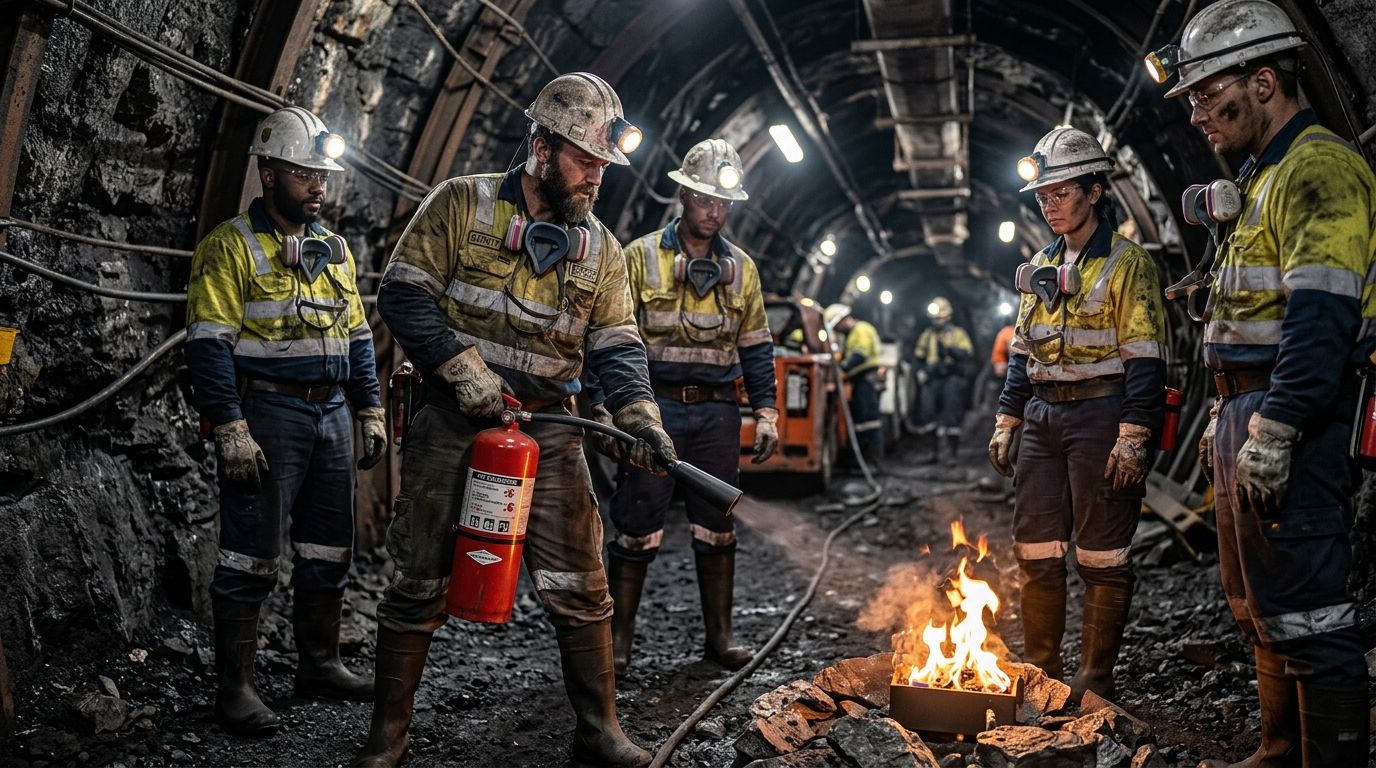
Fire safety training for coal mining crews is a structured program that teaches underground and surface miners how to spot ignition sources, discharge a portable extinguisher on a live equipment fire, and clear a section during an evacuation drill inside MSHA's Part 48 refresher window. Coal dust, diesel equipment, and conveyor friction points make mining crews a different training problem than an office or warehouse crew — the drills have to happen where the equipment actually lives.
- Fire safety training for coal mining crews must cover Class D metal fires and conveyor belt ignition points, not just generic extinguisher use.
- MSHA's 30 CFR Part 48 sets annual refresher training at 8 hours for both surface and underground crews in 2026.
- Hands-on extinguisher discharge beats video training — every crew member should pull the pin on a real unit at least once a year.
- First-Line Fire runs on-site fire safety training for coal mining crews across Kentucky, Illinois, Indiana, Tennessee, Missouri and Alabama.
- Log training dates 60 days before your Part 48 deadline — inspectors ask for signed sheets on-site, not filed paperwork.
Why fire safety training matters for coal mining crews
Coal preparation plants and underground sections put fire sources next to fuel sources in ways most industries don't: coal dust settles on hot conveyor bearings, diesel haulage equipment runs exhaust manifolds near hydraulic lines, and grinding or welding work throws sparks into confined air. A crew that only knows how to use an extinguisher in theory loses time it doesn't have when one of those points ignites.
MSHA's 30 CFR Part 48 sets the floor here, not the ceiling. New surface miners get 24 hours of training, new underground miners get 40 hours, and every crew member — surface or underground — needs an 8-hour annual refresher to stay current in 2026. None of that is optional, and a lapsed refresher shows up fast on an inspection. Fire safety training for coal mining crews has to sit inside that Part 48 cycle, not run as a separate box to check.
Getting training right also protects equipment. First-Line Fire works with coal mining operations on the extinguisher and suppression side of that same problem, which means the crews it trains are working with equipment that's already inspected and tagged, not guessing at what's behind the pin.
The training steps that hold up on inspection
Assess your mine's fire risk profile first
Walk the section before you build a training plan around it. A generic fire safety course misses the specific ignition points your crew actually works next to.
- Walk conveyor belts and transfer points for coal dust buildup and belt friction
- Check diesel equipment for fuel leaks, hot exhaust manifolds, and worn hydraulic lines
- Review electrical panels and cable splices for exposed wiring near coal dust
- Flag oil, grease, and solvent storage near any ignition source
- Note ventilation patterns that could spread smoke or feed a flame underground
Train crews on incipient-stage extinguisher use
A crew that's watched a video on extinguisher use hasn't been trained — they've been shown a video. Hands-on discharge is what sticks under stress.
- Teach the pull-aim-squeeze-sweep sequence on a live extinguisher, not a slide deck
- Match extinguisher class to fire type: Class D for metal fires from grinding and welding, Class C for energized electrical gear
- Drill specifically on conveyor belt fires — the most common ignition point in prep plants
- Require every crew member to discharge at least one unit during training, not just observe
- Bring in a certified trainer once your in-house units are out of usable discharge life — First-Line Fire schedules hands-on extinguisher training tied to your Part 48 hours so the paperwork and the practice happen on the same visit
Run evacuation and self-rescue drills
A fire safety course that skips evacuation timing isn't complete — it's a lecture.
- Time evacuation from the deepest working face to the surface or refuge chamber
- Test self-contained self-rescuer donning under blackout conditions
- Confirm mantrip and escapeway routes are marked and clear of debris
- Run drills on both day and night shifts — response times differ by crew
- Debrief every drill and log the time-to-clear number for the record
Certify equipment operators on suppression systems
A general fire card doesn't cover a haul truck's onboard suppression system. That's a separate certification tied to the machine, not the company.
- Confirm operators can manually trigger onboard suppression on haul trucks, shuttle cars, and continuous miners
- Train operators to tell a false discharge from a real one before they shut anything down
- Pair suppression activation with the correct equipment shutdown sequence
- Link certification to the specific suppression systems built for mining equipment your crew runs, not a generic company-wide card
- Bring in the equipment vendor's trainer for machines you didn't spec yourself
Document and track training compliance
An inspector doesn't want to hear that training happened — they want the sheet with the date and the signature.
- Log every crew member's training date, hours completed, and instructor name
- Track Part 48 hours separately from internal fire drills; they're not interchangeable
- Set a reminder 60 days ahead of every annual refresher deadline
- Keep signed sign-in sheets on-site, not filed at a home office
- Audit records quarterly against your active crew roster
Schedule refresher training and drills on a fixed cycle
One training session a year isn't a program — it's a one-time event with an expiration date.
- Run extinguisher refreshers at least once a year, tied to your Part 48 cycle
- Add a mid-year tabletop drill for supervisors and shift bosses
- Rotate drill scenarios so crews aren't just repeating a memorized script
- Retrain immediately after any near-miss or equipment change
- Pair refresher training with a hydro test check on your extinguisher types used across coal mining operations so units are current when crews train on them
“If your crew can't find the pin in the dark, the extinguisher is decoration.”
Training options for coal mining crews compared
| Training Option | Best For | Key Limitation |
|---|---|---|
| In-house toolbox talks | Weekly reinforcement between formal sessions | No certification, easy to skip under production pressure |
| MSHA Part 48 online modules | Meeting annual refresher paperwork | Doesn't cover hands-on extinguisher use or your specific equipment |
| Manufacturer equipment training | Crews running one specific suppression-equipped machine | Limited to that piece of equipment only |
| On-site certified trainer (First-Line Fire) | Crews needing live-fire extinguisher practice tied to Part 48 hours | Requires scheduling a site visit |
On-site hands-on training with a certified trainer wins for crews that need discharge practice, not just a signed form. Online modules alone satisfy the paperwork but leave the muscle memory gap that shows up when a belt actually catches.
Common mistakes coal mining crews make
- Treating the annual Part 48 refresher as complete fire training. The 8-hour refresher covers a lot of ground; extinguisher discharge and suppression system operation often get squeezed into a few minutes.
- Skipping Class D training for metal fires. Grinding and welding around mining equipment throws off metal fires that a Class A or B extinguisher won't touch.
- Ignoring how ventilation changes fire behavior underground. A training scenario built for a surface fire doesn't translate to a confined section with active airflow.
- No documented drill records for inspectors. A verbal confirmation that training happened doesn't hold up against a citation.
- Assuming portable extinguishers cover conveyor and belt fires. Belt fires often need a fixed suppression response, not a handheld unit, especially once they've spread past the first few feet.
Book on-site fire safety training
Hands-on extinguisher and suppression training for coal mining crews across KY, IL, IN, TN, MO and AL.
FAQ
How many hours of fire safety training does MSHA require for coal mining crews in 2026?
MSHA's 30 CFR Part 48 requires an 8-hour annual refresher for both surface and underground miners in 2026, on top of 24 hours of new miner training for surface crews and 40 hours for underground crews.
Is online fire safety training enough for coal mining crews?
No. Online modules satisfy the Part 48 paperwork requirement but don't give crews hands-on extinguisher discharge or suppression system operation practice, which is where most training gaps show up during an actual fire.
What extinguisher class do coal mining crews need for metal fires?
Class D extinguishers handle metal fires from grinding, cutting, and welding work common around mining equipment. Standard Class A or B units won't put out a metal fire and can make it worse.
How often should coal mining crews run evacuation drills?
At minimum once a year alongside the Part 48 refresher, though crews with active production changes or new escapeway routes should run drills more often and on both day and night shifts.
Do equipment operators need separate suppression system certification?
Yes. Manual suppression activation on a haul truck, shuttle car, or continuous miner is tied to that specific machine's system, not a general company-wide fire card.
What's the biggest gap in coal mining fire safety training?
Crews that discharge an extinguisher on video instead of in person. Muscle memory built from watching a demonstration doesn't hold up under the stress of an actual fire.
Can First-Line Fire run fire safety training for coal mining crews on-site?
Yes. First-Line Fire schedules on-site fire safety training for coal mining crews across Kentucky, Illinois, Indiana, Tennessee, Missouri and Alabama, tied to Part 48 refresher timing.
Should extinguisher hydro testing happen before or after training?
Before. Crews should train on units that are current on hydro testing so the equipment they practice on matches what's actually mounted on the section.
One last thing
Most crews find out their extinguisher training has a gap the same way: an inspector asks a shift boss to demonstrate a discharge and the pin doesn't come out clean. Fire safety training for coal mining crews isn't about the certificate on the wall — it's whether the person closest to the fire in 2026 can act on it in under a minute.


