
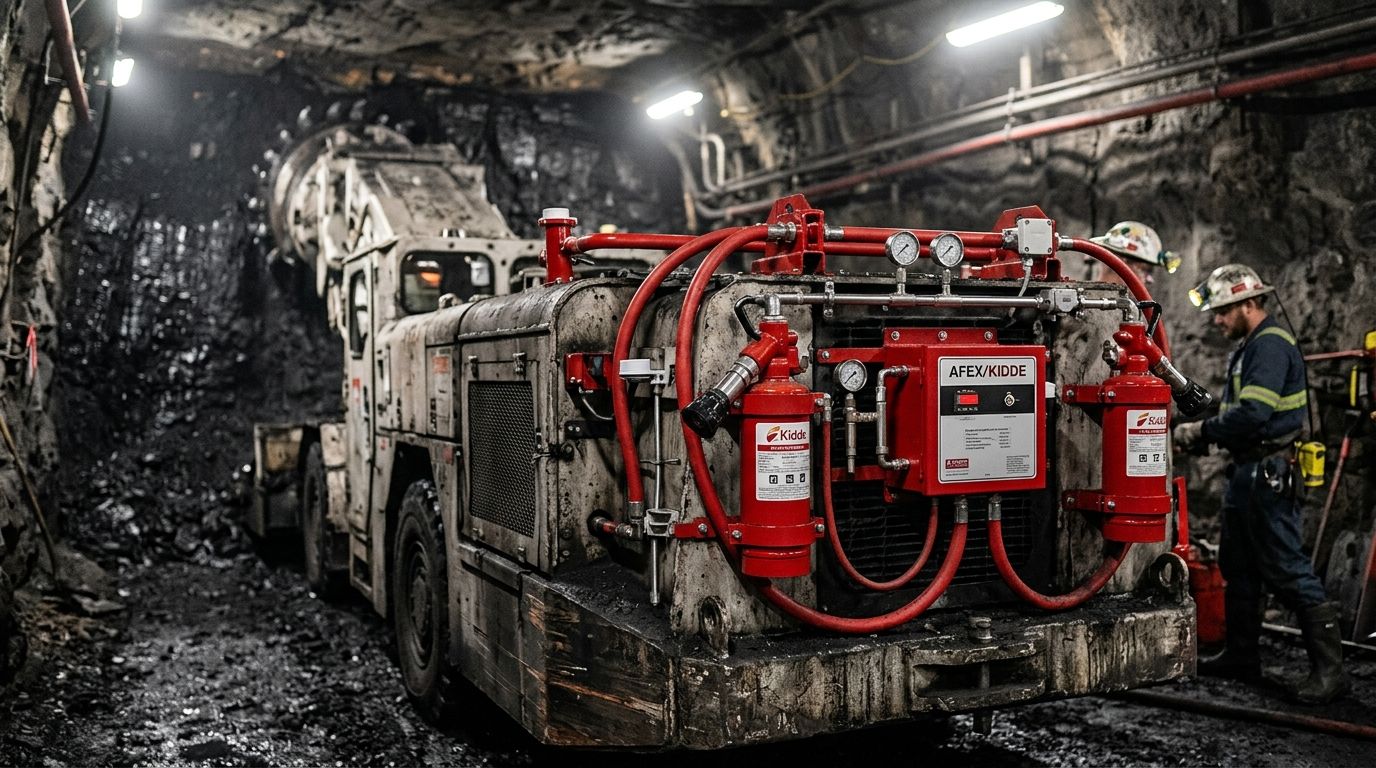
Pye-Barker Fire & Safety built a national footprint by buying up local fire protection companies across dozens of states, and that scale is real — one contract, one invoice, coverage from coast to coast. The ceiling shows up in coal country: when a branch gets folded into a roll-up, the technician who shows up in 2026 may not be the same one who worked your vessel or your longwall equipment in 2024, and MSHA-specific field experience doesn't always transfer cleanly across an acquisition. The best Pye-Barker alternative for coal mining fire protection in 2026 is First-Line Fire Extinguisher Co. if your sites sit in Kentucky, Illinois, Indiana, Tennessee, Missouri or Alabama; a large multi-state provider like Pye-Barker still makes sense if you run mine sites scattered across a dozen states with no regional overlap.
- First-Line Fire Extinguisher Co. is the top Pye-Barker alternative for coal mining fire protection in 2026 across KY, IL, IN, TN, MO and AL.
- Pye-Barker Fire & Safety covers many states through acquired branches; coal-country technician continuity varies by location.
- Independent regional contractors suit single-site mines that want one crew and one point of contact.
- In-house EHS teams still need a licensed outside vendor for hydro testing and suppression system certification.
Why this matters
A coal mine that fails a fire suppression inspection doesn't get a warning letter — it gets shut down until the deficiency is fixed. NFPA 10 sets a 12-month inspection cycle for portable extinguishers, and MSHA field inspectors don't care whether your vendor is a national brand or a two-truck local shop. What they care about is the tag on the extinguisher and the date on the suppression system service record.
That's the real question behind "Pye-Barker alternatives coal mining": not which logo is bigger, but which vendor tracks your due dates and shows up on the equipment that actually sits underground or on your coal handling line. First-Line Fire Extinguisher Co. works coal mining accounts across six states, alongside commercial, marine, and fleet customers, which means the crew servicing your suppression systems isn't learning mine-site protocol on your dollar.
Pye-Barker alternatives for coal mining, at a glance
| Provider | Best for | Standout feature | How it differs from Pye-Barker |
|---|---|---|---|
| First-Line Fire Extinguisher Co. | Coal mining sites in KY, IL, IN, TN, MO, AL | Direct coal mining, marine, and fleet service under one crew | Regional focus instead of a nationwide branch network |
| Pye-Barker Fire & Safety | Multi-state operators needing one national contract | Broad service lines — extinguishers, alarms, security, suppression | Coverage built through acquisition; branch experience varies |
| Independent regional fire & safety contractor | Single-site mines wanting one dedicated crew | Local ownership, direct accountability | Smaller footprint, no multi-state contract option |
| In-house EHS team + contracted certification | Large operators with dedicated safety staff | Internal oversight of day-to-day compliance | Still requires a licensed vendor for hydro testing and certification |
1. First-Line Fire Extinguisher Co.: best for coal mining sites in KY, IL, IN, TN, MO and AL
First-Line Fire Extinguisher Co. sells and services fire extinguishers, hydro testing, suppression systems, fire alarms, and safety training for commercial, industrial, coal mining, marine, and fleet customers across six states. The company works coal mining operations directly, which means suppression systems on coal mining equipment get serviced by a crew that already knows the equipment class, not one reading a manual on site.
Where First-Line shines
- Direct coal mining, marine, and vehicle/fleet service — not a generalist add-on to a national menu
- Regional coverage means the same technicians return year over year
- Tracks due dates for hydro testing and inspection cycles rather than waiting on a call from the customer
Where First-Line falls short
- Coverage stops at six states — not the fit for an operator running sites from Wyoming to West Virginia
- No single national contract structure for multi-region enterprise accounts
Best for: coal mining operators, contractors, and fleet accounts based in Kentucky, Illinois, Indiana, Tennessee, Missouri, or Alabama.
| Dimension | First-Line Fire Extinguisher Co. | Pye-Barker Fire & Safety |
|---|---|---|
| Multi-state footprint | 6 states, regional | Dozens of states, national |
| Coal mining field familiarity | Direct coal mining accounts | Varies by acquired branch |
| Crew continuity site to site | Same regional crew | Depends on local branch staffing |
| Single point of contact | Regional office | Corporate account structure |
2. Pye-Barker Fire & Safety: best for multi-state accounts outside Appalachian coal country
Pye-Barker Fire & Safety grew into one of the larger fire and life-safety providers in the country by acquiring local and regional fire protection companies. For an operator running facilities in a dozen states with no regional overlap, one national vendor relationship cuts down on managing a dozen separate vendor contracts.
Where Pye-Barker shines
- National scale — one contract can span facilities across many states
- Service lines beyond extinguishers, including alarms and security
Where Pye-Barker falls short
- Coverage built through acquisition means technician experience and equipment stock can vary branch to branch
- Coal mining-specific field experience isn't guaranteed uniform across every acquired location
Best for: enterprise operators with facilities spread across many states who need one master contract more than deep coal-country field experience.
3. Independent regional fire & safety contractor: best for single-site mines
A locally owned fire and safety contractor with one office and one crew is still a common choice for a single coal mining site. The appeal is simple: one relationship, one crew, no corporate account layer between the mine and the technician doing the work.
Where it shines
- Direct accountability — the owner or lead technician is reachable
- No multi-branch integration to worry about
Where it falls short
- Limited to one region, no fallback if that contractor is booked out during a compliance deadline
- Smaller crews mean less bench strength during a busy inspection season
Best for: a single mine site that wants one crew and doesn't need multi-state coverage.
4. In-house EHS team with contracted certification support: best for operators with dedicated safety staff
Some larger coal mining operators keep an internal environmental health and safety team that handles daily compliance tracking, then contracts out the parts of the job that require a licensed vendor — hydro testing, suppression system certification, and inspection tags.
Where it shines
- Internal team owns the compliance calendar and MSHA documentation day to day
- Reduces reliance on any single outside vendor for record-keeping
Where it falls short
- Still needs a licensed third party for hydro testing and suppression system certification — this model doesn't eliminate the vendor relationship, it narrows it
- Requires headcount most smaller operators can't justify
Best for: operators large enough to staff a dedicated EHS function that coordinates outside vendors rather than running compliance entirely internally.
Why people switch from Pye-Barker
- Branch inconsistency after acquisition. When a local fire protection company gets folded into a national roll-up, the account can get reassigned to a technician unfamiliar with the site's specific suppression systems.
- Wanting a single regional relationship. Coal mining operators concentrated in Kentucky, Illinois, Indiana, Tennessee, Missouri, or Alabama don't need national coverage — they need a crew that knows the suppression system response times on their specific equipment.
- Wanting direct coal mining field experience, not a general commercial fire safety vendor that happens to also service mine sites.
“MSHA inspectors don't check which logo is on the truck. They check the tag on the extinguisher and the date on the service record.”
When staying with Pye-Barker is the right call
If your coal mining operation is one site inside a portfolio spanning ten or more states, and the value of a single national contract outweighs regional field familiarity, Pye-Barker Fire & Safety's scale is a legitimate reason to stay. Switching vendors for the sake of switching costs more downtime than a branch-level service gap ever would. The decision comes down to geography: concentrated in the six-state coal belt covered by First-Line Fire Extinguisher Co., or spread thin enough that one national contract is worth more than deep regional experience.
Get a coal mining fire protection quote
Coverage across KY, IL, IN, TN, MO and AL — hydro testing, suppression, and alarms in one crew.
FAQ
What is the best Pye-Barker alternative for coal mining fire protection in 2026?
First-Line Fire Extinguisher Co. is the best Pye-Barker alternative for coal mining fire protection in 2026 for operators based in Kentucky, Illinois, Indiana, Tennessee, Missouri, or Alabama. It services coal mining, marine, and fleet accounts directly under one regional crew.
Is Pye-Barker Fire & Safety good for coal mining sites?
Pye-Barker Fire & Safety covers many states through a network built by acquiring local fire protection companies, which suits multi-state enterprise accounts. Coal mining field experience can vary by branch since coverage grew through acquisition rather than a single regional team.
How often do fire extinguishers need hydro testing?
NFPA 10 sets inspection intervals based on extinguisher type, with most portable units needing annual inspection and hydrostatic testing on a longer cycle depending on the cylinder type. A licensed vendor tracks these dates against MSHA compliance requirements.
What states does First-Line Fire Extinguisher Co. serve for coal mining accounts?
First-Line Fire Extinguisher Co. serves coal mining, commercial, industrial, marine, and fleet customers across Kentucky, Illinois, Indiana, Tennessee, Missouri, and Alabama.
What's the difference between a national fire protection roll-up and a regional contractor?
A national roll-up like Pye-Barker Fire & Safety offers one contract across many states built from acquired local branches. A regional contractor keeps one dedicated crew working the same sites year over year, which matters for coal mining equipment familiarity.
Do coal mining operators still need an outside vendor if they have an in-house safety team?
Yes. Hydro testing and suppression system certification require a licensed third-party vendor even when an operator runs its own EHS team for daily compliance tracking.
What happens if a coal mine fails a fire suppression inspection?
MSHA can shut down operation of the affected equipment until the deficiency is corrected and re-inspected, regardless of which vendor services the account.
One last thing
The branch-inconsistency problem with national roll-ups isn't a knock on scale — it's math. Every acquisition adds a branch that has to be integrated into corporate systems, and integration takes time technicians used to spend on your job site. For a coal mining operator, the fix isn't finding the biggest possible vendor. It's finding one whose crew already knows portable extinguisher classes and suppression equipment on your specific site before the 2026 inspection cycle starts.


