
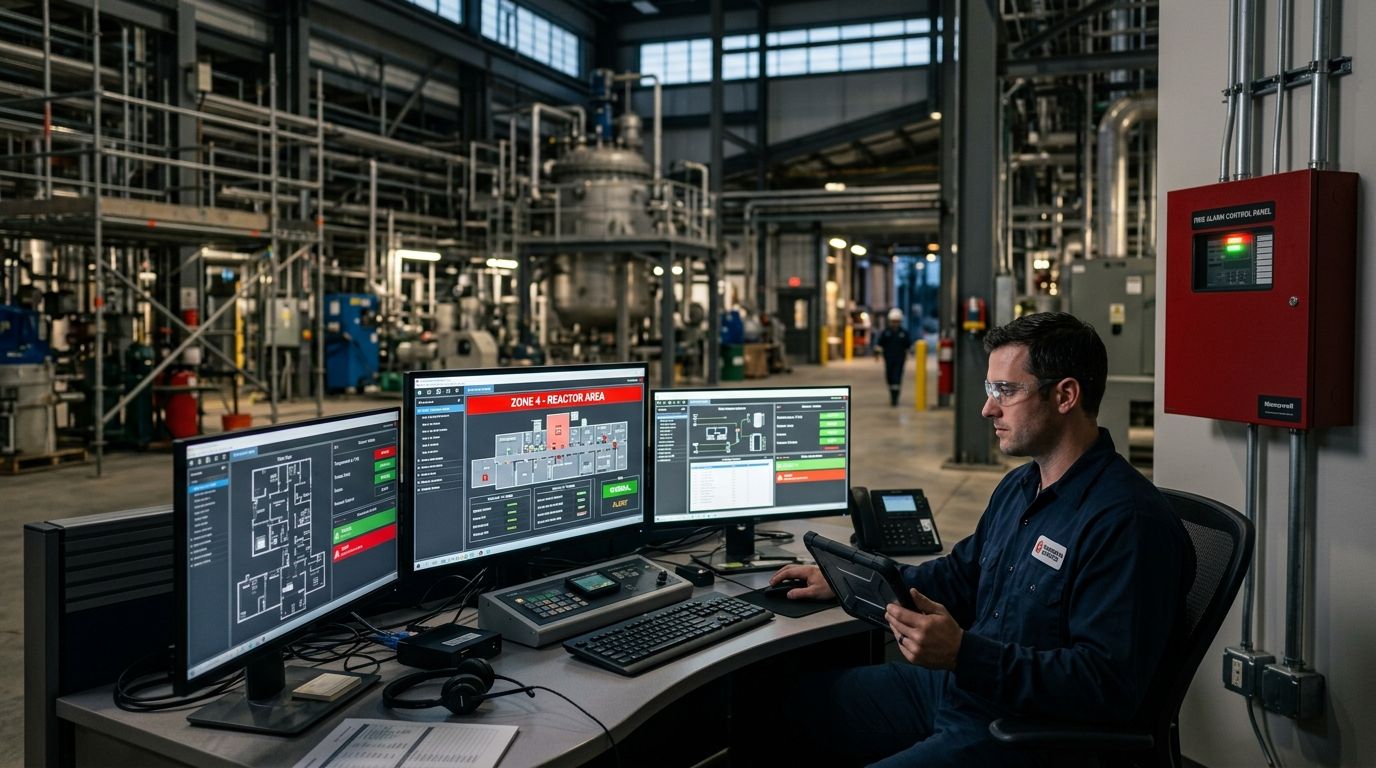
Industrial facilities in Kentucky, Illinois, Indiana, Tennessee, Missouri and Alabama don't all need the same fire alarm monitoring setup — a coal mining operation with no cell signal needs something different than a warehouse near the interstate. Best overall for 2026: UL 864 central station monitoring with dual-path cellular and IP backup. Best for active hot-work periods: hybrid monitoring paired with an on-site fire watch. Best for remote sites with weak cellular coverage: long-range radio monitoring.
- UL 864 dual-path cellular/IP central station monitoring is the best fire alarm monitoring service for industrial facilities in 2026 — buy it as your baseline.
- Hybrid monitoring plus an on-site fire watch covers hot work and turnarounds at chemical and processing plants.
- Remote sites like coal mines and rural plants need long-range radio monitoring when cellular signal is unreliable.
- Self-monitored local alarms with no central station are the weakest option for industrial compliance — skip for anything beyond a small standalone building.
- Operators running facilities across several states benefit from networked multi-site monitoring with one reporting dashboard.
Why this matters
A fire alarm that rings a bell on the wall and nothing else does not meet most industrial insurance or fire code requirements in 2026. Monitoring is what turns a detected fire into a dispatched fire department. Get the monitoring method wrong and you either overpay for redundancy a small facility doesn't need, or you underpay and end up with a signal that never reaches anyone at 2 a.m. on a night shift.
First-Line Fire installs and services fire alarm monitoring across commercial, industrial, coal mining, marine and fleet accounts, so the ranking below reflects what actually holds up on real job sites — not spec-sheet comparisons.
What makes the best fire alarm monitoring service
- UL 864 listing — the monitoring service and the receiving central station carry a current UL 864 listing, which most AHJs and insurers require for commercial fire alarm systems.
- Signal path redundancy — at least two independent paths (cellular plus IP, or cellular plus radio) so a cut phone line or a downed cell tower doesn't leave the building blind.
- Coverage in low-signal areas — cellular monitoring is only as good as the carrier's signal at that specific site; remote and underground facilities need a different path entirely.
- Response protocol — how fast the central station calls the fire department versus calling a facility contact first, and whether that protocol matches your risk level.
- Integration with suppression and inspection schedules — monitoring that ties back to hydro testing dates, extinguisher recharge cycles and suppression system inspections instead of running as an island.
- Multi-site reporting — for operators with more than one facility, one dashboard beats five separate vendor logins.
Fire alarm monitoring services at a glance
| Monitoring type | Best for | Standout feature | Key limitation |
|---|---|---|---|
| UL 864 dual-path central station | General industrial facilities | Cellular + IP redundancy | Still needs cellular signal at the site |
| Hybrid + on-site fire watch | Hot work and turnarounds | Human eyes plus electronic signal | Labor cost of a physical fire watch |
| Long-range radio (RF) | Remote or underground sites | Works without cell towers | Line-of-sight and terrain limits range |
| Networked multi-site monitoring | Multi-state operators | One dashboard, one alert stream | Needs standardized panels across sites |
| Self-monitored local alarm | Very small standalone buildings only | Lowest complexity | No automatic dispatch to the fire department |
1. UL 864 dual-path central station monitoring: best for general industrial facilities
This is the baseline setup for a manufacturing plant, distribution center or processing facility that has reliable cellular coverage. The panel reports to a UL 864-listed central station over cellular as the primary path and IP as backup, so a cut line doesn't kill the signal.
UL 864 dual-path pros:
- Meets the monitoring requirement most industrial insurers and local fire codes expect in 2026
- Two independent signal paths instead of relying on a single phone line
- Works alongside existing suppression and sprinkler systems without extra hardware in most retrofits
UL 864 dual-path cons:
- Doesn't help if the entire site has poor cellular reception to begin with
- Requires periodic testing and a monitoring account that needs to stay current, not a set-it-and-forget-it install
Best for: industrial facilities in cities and towns with normal cellular coverage. Verdict: Buy.
2. Hybrid monitoring plus on-site fire watch: best for hot work and turnarounds
Chemical processing plants and facilities running welding, cutting or other hot work during a shutdown often can't rely on electronic monitoring alone — a suppression system being serviced or bypassed needs a human watching. Hybrid monitoring keeps the electronic signal running while a staffed fire watch covers the gap.
Hybrid + fire watch pros:
- Covers the window when a suppression system is offline or bypassed for service
- A person on-site can spot a problem before a sensor does
- Common requirement during permitted hot work at chemical processing plants
Hybrid + fire watch cons:
- Adds labor cost for the duration of the watch
- Only makes sense as a temporary layer, not a full-time replacement for electronic monitoring
Best for: facilities mid-turnaround, doing hot work, or running a suppression system with an active impairment. Verdict: Buy for the specific window, then drop back to standard monitoring.
3. Long-range radio (RF) monitoring: best for remote and underground sites
Coal mining operations and rural industrial sites frequently sit in dead zones where cellular monitoring simply doesn't work. Radio monitoring uses a dedicated RF network instead of a cell tower, which is why it shows up so often at coal mining equipment sites across Kentucky and Illinois.
Long-range radio pros:
- Doesn't depend on cellular carrier signal strength
- Holds up in terrain and underground conditions that defeat cellular
- Pairs well with suppression systems already in place on mining equipment
Long-range radio cons:
- Range is limited by line-of-sight and terrain, so site surveys matter before install
- Fewer vendors service RF monitoring compared to cellular, which narrows your options
Best for: coal mining, quarries and rural industrial sites with weak or no cellular signal. Verdict: Buy if a site survey confirms coverage; Wait if the survey comes back marginal.
4. Networked multi-site monitoring: best for multi-state operators
An operator running facilities in Kentucky, Tennessee and Alabama at the same time doesn't want three separate monitoring vendors and three separate login portals. Networked monitoring standardizes the panel type and routes every site's alerts to one reporting stream.
Networked multi-site pros:
- One point of contact for alerts across every facility instead of juggling regional vendors
- Easier to track inspection and testing due dates across a portfolio of buildings
- Simplifies compliance reporting when an insurer or auditor asks for records across multiple sites
Networked multi-site cons:
- Works best when panel hardware is reasonably standardized across sites, which can mean upgrading older equipment first
- Onboarding takes longer up front than a single-site install
Best for: operators with facilities in more than one state or region. Verdict: Buy if you're managing three or more sites; Hold at one or two.
5. Self-monitored local alarm: best for very small standalone buildings
A local alarm sounds a horn and strobe on-site with no automatic call to a central station or the fire department. It's the cheapest path to a working alarm system, but it depends entirely on someone being present to hear it and call for help.
Self-monitored local alarm pros:
- Simplest install with no ongoing monitoring account
- Can work as a stopgap while a full monitoring service gets set up
Self-monitored local alarm cons:
- No automatic dispatch — a fire after hours or on an unstaffed shift may go unreported
- Doesn't satisfy most industrial insurance or fire code monitoring requirements in 2026
- Not a real fit for anything with meaningful occupancy or inventory value
Best for: a small standalone outbuilding with no overnight occupancy. Verdict: Skip for any facility with regular staff, inventory, or insurance requirements.
How we ranked these
The order above tracks the criteria list: UL 864 listing status, signal path redundancy, whether the method actually works at the site's location, and how well it ties into existing suppression and inspection schedules. Central station monitoring with dual-path signaling sits at the top because it's the only option that satisfies both code requirements and real-world reliability for most industrial sites in 2026. Radio and hybrid options move up the list specifically for the sites where cellular-only monitoring fails.
Get your facility's monitoring evaluated
Site survey confirms which monitoring method actually works at your location.
Which fire alarm monitoring service should you choose?
If your facility has normal cellular coverage and no special hazard conditions, UL 864 dual-path central station monitoring is the default answer for 2026. Layer in a fire watch only during hot work or system impairments. Move to radio monitoring if a site survey shows cellular reception is weak or nonexistent — this is common enough at mining and rural sites that it shouldn't be treated as an edge case. Operators spanning multiple states should push for networked reporting so due dates and alerts don't live in five different systems.
FAQ
What's the best fire alarm monitoring service for industrial facilities in 2026?
UL 864 dual-path central station monitoring, using cellular as the primary signal path and IP as backup, is the best fit for most industrial facilities in 2026. It's the only option that satisfies both code and insurer requirements while holding up if one signal path goes down.
Is central station monitoring required for industrial fire alarms?
Most local fire codes and commercial insurers require monitored fire alarm systems for industrial occupancies, not just a local horn and strobe. Requirements vary by jurisdiction and occupancy type, so check with your local fire marshal for your specific facility.
How much does fire alarm monitoring cost for a facility?
Cost depends on facility size, number of monitored devices, and which signal path the site needs, so there's no single flat number. A site visit is the only way to get an accurate figure for your building.
Is cellular monitoring better than landline for industrial sites?
Cellular monitoring is generally preferred over landline because a cut phone line can't take down the signal path. Dual-path setups that combine cellular with IP or radio add a second layer of redundancy on top of that.
What's the difference between central station monitoring and a fire watch?
Central station monitoring is an automated electronic signal that reaches a monitoring company and then the fire department. A fire watch is a staffed person physically walking the site, typically used temporarily during hot work or when a suppression system is impaired.
Do coal mining or remote industrial sites need special monitoring?
Yes — sites with weak or no cellular signal, including underground mining operations and rural industrial sites, typically need long-range radio monitoring instead of standard cellular monitoring. A site survey confirms which option actually has coverage.
Can one company monitor multiple facilities across different states?
Yes, networked multi-site monitoring routes alerts from facilities in different states to a single reporting dashboard. It works best when panel hardware is reasonably standardized across the portfolio.
Does fire alarm monitoring replace fire extinguisher inspections?
No. Fire alarm monitoring covers detection and dispatch, while extinguisher inspections, hydro testing and suppression system checks are separate, code-required services that run on their own schedules.
One last thing
The most common gap isn't the monitoring method — it's a monitoring account that got set up correctly in 2020 and never got re-checked after a panel upgrade or a change in carrier coverage. Confirm the signal path actually tests successfully at least once a year, not just at initial install.


