

Yes. A fire watch can keep a business open after a failed alarm test when the fire code official accepts it as temporary protection and permits continued occupancy. A fire watch does not override an evacuation order, fix the alarm, or guarantee permission to operate; your next move is to report the impairment, confirm the occupancy instructions, and arrange repairs.
- Can a fire watch keep a business open after a failed alarm test? Yes, when the fire code official permits it.
- Firstlinefire provides commercial fire alarm services; the fire code official controls occupancy decisions.
- An approved fire watch needs assigned personnel, coverage instructions, emergency communication, and records.
- Keep temporary protection in place until restoration is verified and required release instructions are satisfied.
Why this matters
A failed test tells you something needs attention. It does not, by itself, tell you whether the entire building must close or whether a temporary measure is acceptable. The missing information is which protection failed, what area it affects, and what the fire code official requires.
For your 2026 operating plan, treat an alarm impairment as an active safety problem, not a paperwork deadline. The fire alarm impairment to fire watch coverage workflow covers the handoff from identifying lost protection to arranging temporary coverage.
Can a fire watch keep a business open after a failed alarm test?
Yes, but only within the conditions accepted by the authority having jurisdiction, often called the AHJ. For building fire safety, that authority is commonly the local fire code official or fire marshal. A service contractor documents and repairs the problem; the contractor does not replace the official's occupancy decision.
The International Fire Code addresses out-of-service fire protection systems in Section 901.7. Its framework includes notifying the fire department and fire code official and using evacuation or an approved fire watch when required. Your jurisdiction's adopted code and amendments control the actual requirements.
Use this comparison to understand the possible responses. None is a choice you make independently of the official's instructions.
| Temporary response | Best for | What it accomplishes | Limitation |
|---|---|---|---|
| Approved fire watch | Occupied areas where the official accepts temporary human surveillance | Provides observation and a way to report a fire while repairs proceed | Does not restore automatic detection, notification, or signal transmission |
| Restricted occupancy or partial closure | Affected areas that the official permits you to isolate | Removes occupants from specified areas while authorized operations continue elsewhere | Requires clear boundaries and does not establish that other areas are safe |
| Evacuation or closure | Conditions where continued occupancy is not permitted | Removes occupants from the affected premises | Interrupts operations and requires authorization before reoccupancy where directed |
A fire watch is a temporary safeguard, not a substitute alarm system. Its usefulness depends on people following an approved assignment without gaps.
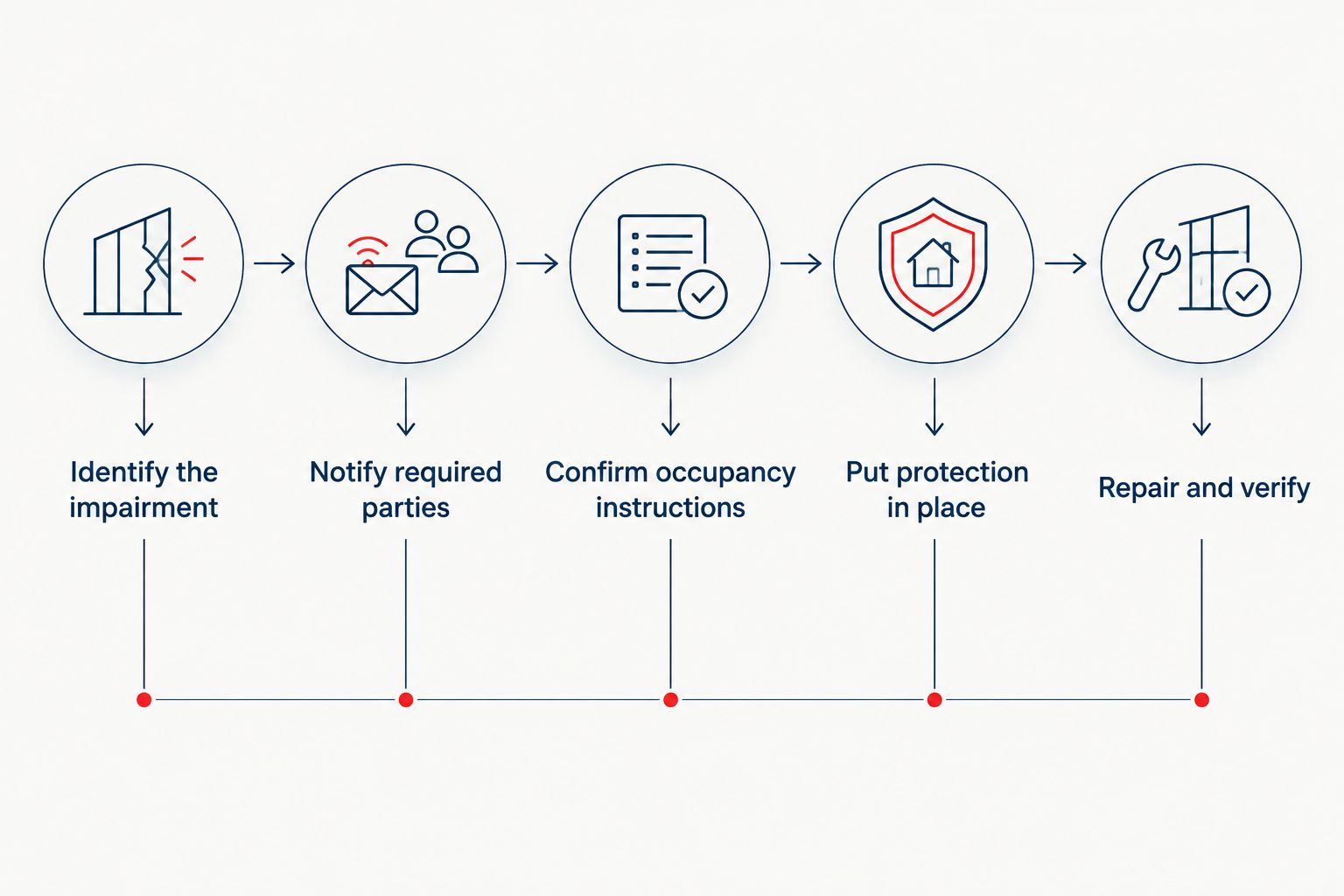
Follow this sequence after the failed test
- Identify the impairment. Get the failed device, circuit, communication function, or other condition into the test report. Ask which protective functions remain operational.
- Notify the required parties. Follow the adopted code, site procedures, and official's directions. Coordinate with the alarm service provider and monitoring station where applicable.
- Confirm occupancy instructions. Ask whether the building must be evacuated, whether an affected area must close, or whether an approved fire watch permits continued use.
- Put accepted protection in place. Assign the personnel, route, communication method, and documentation the official requires. Do not count an unstaffed plan as coverage.
- Repair and verify restoration. Have qualified personnel correct the failure and test the affected functions. Complete the required notifications before ending temporary protection.
What must an approved fire watch actually do?
An approved fire watch needs a workable assignment, not just a name on a schedule. Ask the fire code official to confirm the coverage area, personnel qualifications, patrol instructions, recordkeeping, and conditions for ending the watch.
For a 2026 site procedure, put those instructions where the assigned personnel and shift supervisor can find them. A verbal handoff is not a dependable record of what the official required.
Assign personnel
Identify who will perform the watch and who will relieve them. Do not assume a receptionist, security officer, maintenance employee, or outside guard qualifies simply because that person is already on-site.
Ask whether employees are acceptable and what training or credentials are required locally. If a person has other duties, confirm those duties do not conflict with the required watch assignment.
Cover the affected area
The route must match the impairment. A failure affecting one part of the premises needs a different assessment from a failure affecting notification throughout the building.
Provide access to the required spaces and explain any restricted areas. Do not send watch personnel into hazardous locations without the training and authorization those locations require.
Report a fire
Personnel need a reliable way to contact the fire department and initiate the site's emergency procedures. In the United States, call 911 for an emergency; confirm the site address and access information before a watch begins.
Explain how occupants will be warned if the normal notification equipment is impaired. A phone call to the fire department and an instruction to evacuate serve different purposes; the plan must address both.
Record the watch
Use the documentation format required by the official. A practical log identifies the person on duty, patrol times, areas covered, observations, corrective actions, and relief handoff.
Record actual activity. Pre-filled entries do not show that anyone checked the building, and an unsigned schedule does not establish continuous coverage.
Maintain relief coverage
Account for breaks, shift changes, and unexpected absences. If the approved coverage cannot continue, contact the responsible site manager and follow the official's instructions for the loss of that safeguard.
An approved plan stops protecting occupants when the assigned coverage stops. Keep the staffing arrangement tied to the actual impairment, not just the original repair appointment.
Why permission to stay open varies
There is no single answer for every failed alarm test. These are the facts to bring to the fire code official, not grounds for granting yourself permission to operate:
- The failed function. Detection, occupant notification, and transmission to a monitoring station perform different jobs. Identify the function rather than reporting only that the panel failed.
- The affected area. Establish whether the impairment concerns a device, a zone, a tenant space, or a broader portion of the building.
- The occupants. Explain who uses the premises and whether occupants need assistance receiving a warning or leaving the building.
- The work taking place. Describe operations and hazards in the affected area, including any proposed restrictions during repairs.
- The remaining protection. Report what testing confirms is operational. Do not assume sprinklers or portable extinguishers replace a required alarm function.
- The proposed coverage. Present the personnel, communication method, route, and repair plan for the official's review.
Use the actual conditions at your site in 2026. Approval for a different building, an earlier incident, or another location does not establish approval for this impairment.
Does every failed alarm test require a fire watch?
No. The response depends on the deficiency, whether required protection is impaired, and the applicable instructions. Have the service provider identify what failed, then confirm the required response with the fire code official.
A test report marked deficient is not enough information to design temporary protection. Request a plain-language explanation of the lost function, affected area, and repair scope.
Can employees perform the fire watch?
Employees can perform a fire watch only when the applicable requirements and approving official allow it. Confirm qualifications, training, assigned duties, and coverage before putting an employee on the roster.
Being present in the building is not the same as performing a fire watch. Give each assigned person the approved instructions and a clear relief arrangement.
Can the business stay open if only alarm monitoring fails?
A monitoring failure does not automatically permit continued occupancy, even when local horns and strobes still work. Confirm the lost communication function, remaining protection, and required temporary measures with the fire code official.
Do not treat local notification and off-site reporting as interchangeable. Ask the monitoring station and service provider to explain the actual condition rather than relying on a panel message alone.
What should you send the official and repair contractor?
Build a short incident packet. The goal is to give everyone the same facts without making the official reconstruct the failure from separate phone calls.
Include:
- Site information: address, responsible manager, contact details, and affected areas.
- Test findings: report, failed functions, relevant panel indications, and confirmed remaining protection.
- Occupancy information: current use, operating hours, and any proposed restrictions.
- Temporary plan: proposed watch personnel, coverage instructions, communication method, and log.
- Repair information: contractor contact, identified work, and the current repair status.
- Official instructions: occupancy conditions, required notifications, and release requirements.
Keep the packet current as conditions change. If a broader failure is found during repairs, the original temporary arrangement needs review against that new condition.
Firstlinefire is a fit for commercial operators seeking fire alarm service alongside extinguisher and suppression services. Firstlinefire serves commercial and industrial customers across Kentucky, Illinois, Indiana, Tennessee, Missouri, and Alabama. That service scope does not establish fire-watch staffing availability or permission to remain open; confirm the work needed and keep the occupancy decision with the official.
When can you end the fire watch?
End the fire watch only after restoration is verified and the applicable release instructions are satisfied. A technician arriving, a replacement part being installed, or a panel appearing normal does not by itself establish that every affected function works.
Have the service provider document the correction and required testing. Where monitoring was affected, coordinate verification of signal receipt with the monitoring station and follow its testing procedures.
For your 2026 records, retain the failed test report, official's instructions, watch logs, repair documentation, and restoration notices together. The record should show why temporary protection began and what justified ending it.
Use a clear handoff between the technician, site manager, watch supervisor, and any required outside parties. Do not release the watch because someone assumes another person has already cleared it.
FAQ
Can a fire marshal still close my business if I hire a fire watch?
Yes. Hiring personnel does not override the fire code official's evacuation or closure instructions. The official must accept the temporary arrangement for the proposed occupancy.
How often does a fire watch need to patrol?
Follow the patrol interval and coverage instructions required by the approving official. Do not borrow an interval from another jurisdiction or treat routine security rounds as approved coverage.
Does a fire watch replace a broken fire alarm?
No. A fire watch provides temporary observation and reporting under approved conditions; it does not restore the alarm's automatic functions. Repairs and verification are still required.
Can I use security cameras instead of fire-watch personnel?
Do not substitute security cameras for an approved fire watch without express acceptance from the fire code official. Camera coverage does not establish that the required observation, reporting, and occupant-warning duties are being performed.
Does Firstlinefire decide whether my business can remain open?
No. Firstlinefire provides fire alarm and other fire-protection services; the responsible authority determines whether continued occupancy is permitted. Keep the service findings and occupancy instructions together.
What happens if the fire-watch employee leaves early?
Replace the person without a coverage gap under the approved plan. If required coverage cannot continue, follow the official's instructions and notify the responsible site manager immediately.
Can I stop the fire watch when the alarm panel clears?
A cleared panel alone is not enough to end an approved fire watch. Verify restoration of the affected functions and satisfy the required notifications and release conditions first.
One last thing
A quiet panel and a working alarm system are not the same finding. Ask the technician to state which failed functions were restored and tested, not merely whether the trouble indication disappeared.
Before the next shift starts in 2026, give the supervisor a direct instruction: either the approved watch remains active, or restoration and the required release have been confirmed. Leave no gap between those states.


