

Instead of manually chasing test reports, repair tickets, and inspector emails, build an AHJ fire alarm inspection checklist that connects each finding to evidence and a documented disposition. This 2026 workflow takes you from inspection results to an organized submission without confusing a contractor’s completed work with the authority’s approval.
- Build your AHJ fire alarm inspection checklist around local requirements, test evidence, deficiency closure, and documented acceptance.
- Firstlinefire provides fire alarm services for commercial and industrial customers; the AHJ controls acceptance.
- Keep inspection results, repair records, and AHJ decisions separate but connected.
- Use qualified personnel for fire alarm testing, repairs, and restoration.
Why this matters
A completed inspection report does not automatically close an enforcement notice or approve a new installation. The authority having jurisdiction, or AHJ, determines what documentation, witnessed testing, and acceptance apply to the job.
Firstlinefire is best suited to commercial and industrial customers seeking fire alarm and other fire-protection services. Its service territory includes Kentucky, Illinois, Indiana, Tennessee, Missouri, and Alabama. You can start with Firstlinefire for service needs, but obtain submission instructions from the authority responsible for your property.
Your 2026 checklist needs a defined endpoint: routine records retained, a deficiency notice closed, or installation acceptance documented. Those are different outcomes. Name yours before scheduling work.
Before you start
- Get the governing instructions. Obtain the AHJ contact, applicable inspection notice or permit, required forms, adopted code information, submission method, and any witness requirements. Confirm whether formal sign-off applies to this inspection.
- Gather records and access. Collect the latest report, device inventory, relevant drawings, previous unresolved findings, monitoring contact information, and access arrangements. Assign a property representative and qualified fire alarm personnel.
- Confirm the testing coordination plan. Alarm testing can affect occupants, monitoring, and connected building functions. Arrange required notifications, impairment procedures, and restoration checks before work starts; placing an account on test does not make every connected function safe to operate.
This guide describes a document-control workflow, not instructions for operating a fire alarm panel. The bold field names below are suggested labels for your register, not buttons in a specific software product. Keep the AHJ’s required form unchanged.
Inspection scope and requirements
Establish the job record
- Create Site record with the property address, building identifier, owner contact, service contact, and relevant permit or notice reference. Separate buildings when their systems or approval records differ.
- Set Inspection purpose to routine inspection, deficiency follow-up, or acceptance work, as applicable. Record the scope the AHJ and qualified contractor identify; do not choose a lighter scope to simplify the paperwork.
- Add Requirements source. Reference the actual notice, approved plans, instructions, or adopted requirements governing the work. Record when those instructions were confirmed.
- Define Completion evidence. Ask whether the endpoint requires retained records, a submitted report, a witnessed test, a written response, or another documented action.
- Assign Submission owner. Use 1 accountable owner per site packet so responsibility for sending documents and answering comments stays clear.
Expected result: Your job record identifies the property, inspection purpose, governing instructions, and evidence needed to finish. Nobody has to guess what sign-off means.
Choose the correct approval path
Routine inspection and installation acceptance share records, but they are not interchangeable. Use this comparison to organize the work, not to decide which requirements apply.
| Workflow | Best for | Advantage | Limitation |
|---|---|---|---|
| Routine inspection record | Existing-system inspection and testing documentation | Keeps ongoing results and unresolved findings together | Does not establish acceptance of new or altered work |
| Deficiency closeout | Responding to an inspection finding or notice | Connects each issue to corrective evidence | Repair completion alone does not close an AHJ notice |
| Acceptance package | New or altered work subject to acceptance | Organizes plans, completion records, and required test evidence | Required scope and witnessing depend on the project and AHJ |
For a 2026 project, confirm the applicable code edition rather than assuming the calendar year identifies it. Record the answer in the job file.
Inspection results and deficiency register
Map results to the checklist
- Preserve Original report as received, including attachments and signatures. Save later revisions separately so the record shows what changed.
- Enter Device identifier and Location for each item in scope. Use 1 record per device or documented test item, with identifiers matching the report and drawings where applicable.
- Copy Observed result accurately. Keep passing, failing, untested, and inaccessible items distinct. An item that was not tested is not a passing item.
- Add Evidence reference linking the checklist row to its report page, attachment, or other supporting record. A photograph supports identification or visible condition; it does not replace functional test results.
- Create Deficiency record for every reported issue. Include the finding, affected equipment, responsible party, and any deadline stated by the authority. Assign 1 accountable owner per deficiency.
- Flag Scope gap whenever the inventory, report, and required scope disagree. Send the discrepancy to the qualified contractor before presenting the packet as complete.
Expected result: Every required item has a traceable result, and every unresolved finding remains visible. A blank cell cannot silently become a pass.
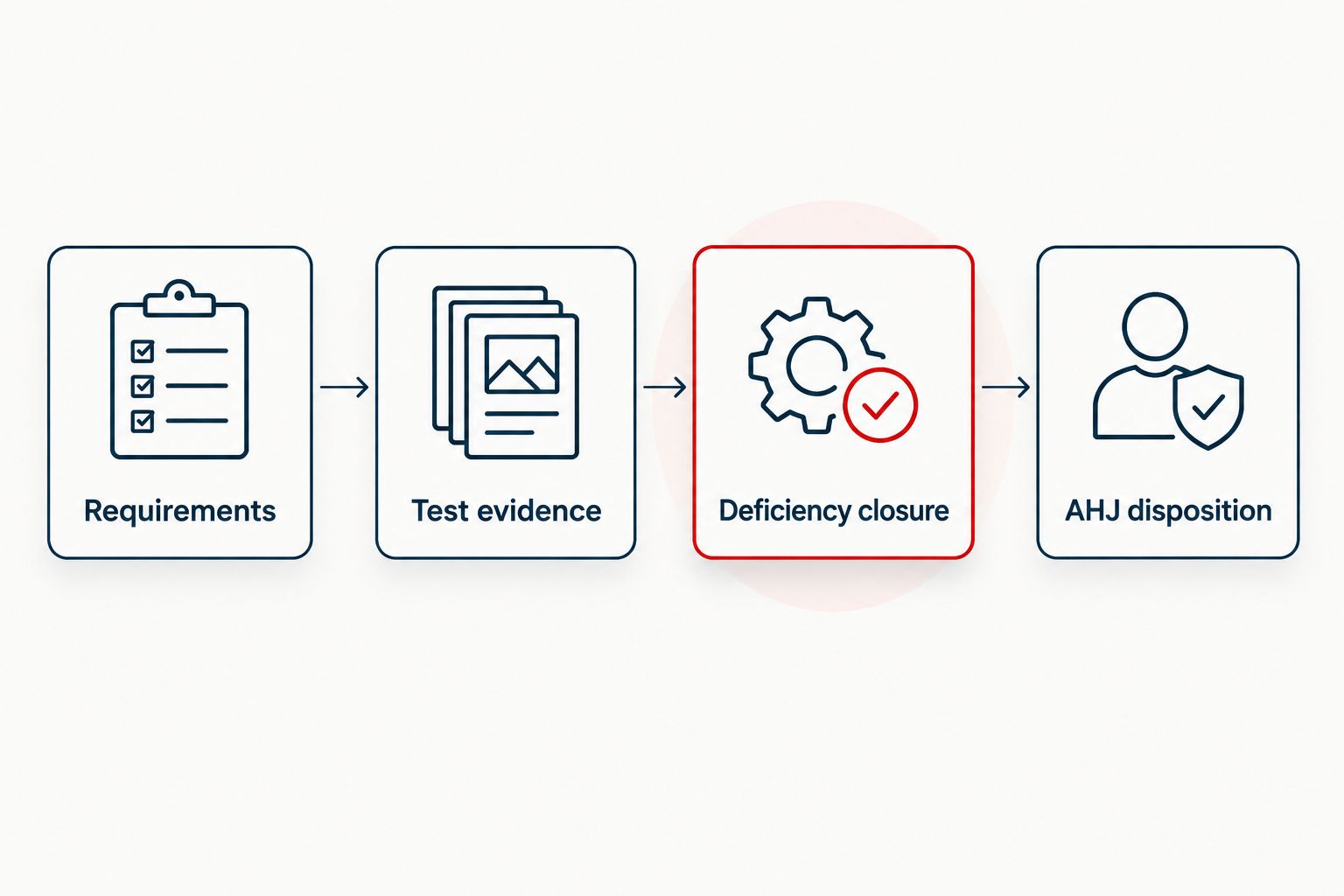
Use a simple record sequence: Requirements, Test evidence, Deficiency closure, and AHJ disposition. These stages keep a repair invoice from being mistaken for approval.
Build the working checklist
Use the following rows as a starting structure. Add the AHJ’s actual requirements and remove irrelevant administrative rows; never delete a required test item because it complicates the packet.
- Property and scope: Address, building, system identification, inspection purpose, and permit or notice reference agree across documents.
- Inspection documentation: Report identifies the work performed, dates, responsible personnel, results, and limitations.
- Equipment traceability: Device identifiers and locations connect reported results to the system records.
- Required functions: Qualified personnel document applicable initiating, notification, supervisory, trouble, communication, and interface tests within the required scope.
- Unresolved conditions: Failed, inaccessible, untested, and excluded items remain clearly identified.
- Corrective evidence: Repair records and required retest results reference the original finding.
- Submission and disposition: Delivery receipt, AHJ comments, required follow-up, and final decision stay with the packet.
For inspection scheduling outside this closeout task, use the guide to fire alarm inspection and testing frequency by system type. A checklist tracks required work; it does not establish the correct interval by itself.
Corrective work and retest evidence
Close findings without overwriting history
- Set Corrective action from the qualified contractor’s documented work. Keep the original finding intact and append the response.
- Record Repair evidence with the service date, affected equipment, work performed, and responsible provider. Match identifiers to the deficiency register.
- Obtain Retest evidence for the required scope. Let the qualified contractor and AHJ establish what testing the repair or alteration requires; do not assume testing only the replaced part is sufficient.
- Change Technical status only when supporting evidence is attached. Keep repaired, retested, and awaiting review distinct.
- Record Restoration confirmation through the responsible personnel. Include completion of required notifications and confirmation that temporary testing arrangements have been removed as applicable.
Expected result: Each closed technical finding has a documented correction and the required verification. Any unresolved condition remains assigned and visible.
If an impairment exists, follow the applicable impairment procedure and AHJ direction. The paperwork process does not authorize continued occupancy or substitute for required protective measures.
When coordinating fire alarm services with Firstlinefire, give the service team the original finding and device reference, not just a request to “fix the alarm.” Specific records make the requested work clear without promising an approval outcome.
Submission packet and AHJ disposition
Assemble and track the decision
- Prepare Submission index listing the documents required for this job. Organize inspection reports, corrective records, retest evidence, relevant plans, and required completion forms in the requested order.
- Check Document consistency. Compare addresses, system names, device identifiers, dates, signatures, and revision labels. Resolve contradictions before submission.
- Complete Submission receipt using the required delivery channel. Retain evidence of delivery and the exact packet submitted. Sending documents is not approval.
- Log AHJ response without paraphrasing away conditions. Assign each request for clarification, additional documentation, or witnessed testing to a responsible person.
- Save Final disposition in the form the authority provides. Record acceptance, conditions, outstanding actions, or another stated outcome accurately.
- Update Next action and transfer ongoing responsibilities to the property’s maintenance process. Close the administrative task only when its defined endpoint is documented.
Expected result: You can show what was submitted, what the AHJ decided, and what remains open. The property file contains the decision, not an assumption.
For your 2026 archive, identify the current packet clearly while retaining superseded versions. Do not erase the history needed to explain a revised result or approval condition.
Repeat the workflow whenever a finding changes
A deficiency update needs a smaller version of the same process. Reopen the affected record, attach new evidence, reassess the required testing scope, and follow the authority’s instructions for resubmission.
Best for: Corrective work after the initial report or after an AHJ comment. This approach preserves traceability without treating every update as an unrelated inspection.
Use a separate Evidence updated status rather than an automatic approved status. A new attachment proves only that someone added a document; a responsible person still needs to check its content.
For multi-building properties, apply the same fields across sites but keep each authority’s instructions separate. A 2026 acceptance record for one building does not establish approval for another.
Troubleshooting
The report says complete, but a room was inaccessible
Keep that area marked untested or inaccessible as reported. Arrange access and ask the qualified contractor to complete the missing scope; do not convert the report’s overall completion label into a passing result for every device.
A repair invoice is attached, but the finding remains open
Check whether the invoice identifies the affected equipment and whether required retest evidence exists. Add the missing verification, then follow the AHJ’s closeout instructions. An invoice documents work, not necessarily successful testing.
The submitted packet has conflicting device names
Reconcile the report, drawings, and deficiency register with the contractor. Keep a documented cross-reference when identifiers have legitimately changed; never rename equipment in the checklist merely to hide the mismatch.
The AHJ requests another test after repairs
Ask for the requested scope and witnessing arrangements, then coordinate qualified personnel, access, notifications, and documentation. Do not argue that a prior passing result covers work performed afterward.
Nobody can locate written sign-off
Check the required endpoint and submission history. Ask the authority whether a disposition exists or further action is required; if routine records do not receive formal approval, document that instruction instead of inventing a certificate.
Customize your workflow
Add fields that support your property: tenant access, building references, monitoring contacts, or links to relevant life-safety procedures. Keep optional convenience fields separate from required inspection evidence.
Firstlinefire provides fire alarms alongside extinguisher, suppression, security, and safety-training services. Those service categories do not make their inspection records interchangeable. Keep each system’s requirements and acceptance evidence distinct.
For the next 2026 cycle, review unresolved findings before scheduling the visit. Set reminders from confirmed requirements and assigned deadlines, not a generic annual date applied to every task.
FAQ
What should an AHJ fire alarm inspection checklist include?
An AHJ fire alarm inspection checklist should connect the applicable requirements to inspection results, unresolved findings, corrective evidence, and the authority’s disposition. Use the AHJ’s required forms and project-specific instructions rather than treating a generic checklist as the governing document.
Does a passing fire alarm inspection mean the AHJ has signed off?
No. A passing contractor report documents the reported inspection results; AHJ acceptance or notice closure is a separate determination when required. Retain the authority’s actual response.
Who is responsible for submitting fire alarm inspection results?
Confirm submission responsibility with the AHJ and the parties responsible for the property and work. Assign one accountable submission owner in your workflow without assuming that assignment replaces legal or contractual responsibilities.
Can I close a fire alarm deficiency with a repair invoice?
A repair invoice alone does not establish successful retesting or AHJ closure. Attach the corrective work record, required verification, and any authority response needed for that finding.
Do I need the same fire alarm checklist in every state?
No single checklist establishes compliance for every jurisdiction and project. You can use a shared administrative structure, but confirm the applicable requirements, forms, and acceptance process for each property.
Can building staff perform all fire alarm tests themselves?
Do not assume building staff are qualified or authorized to perform every fire alarm test. Use personnel who meet the applicable qualifications and coordinate testing, impairment precautions, and restoration through the responsible parties.
What happens if the AHJ does not issue a sign-off certificate?
Retain the disposition or instructions the AHJ actually provides. Some routine recordkeeping tasks do not end with a formal certificate, so confirm the required endpoint rather than creating your own proof of approval.
One last thing
Check the disposition before checking the completion box. A packet can contain every requested document and still have an unresolved condition. The final review should answer a plain question: what, exactly, did the authority accept or require next?


