
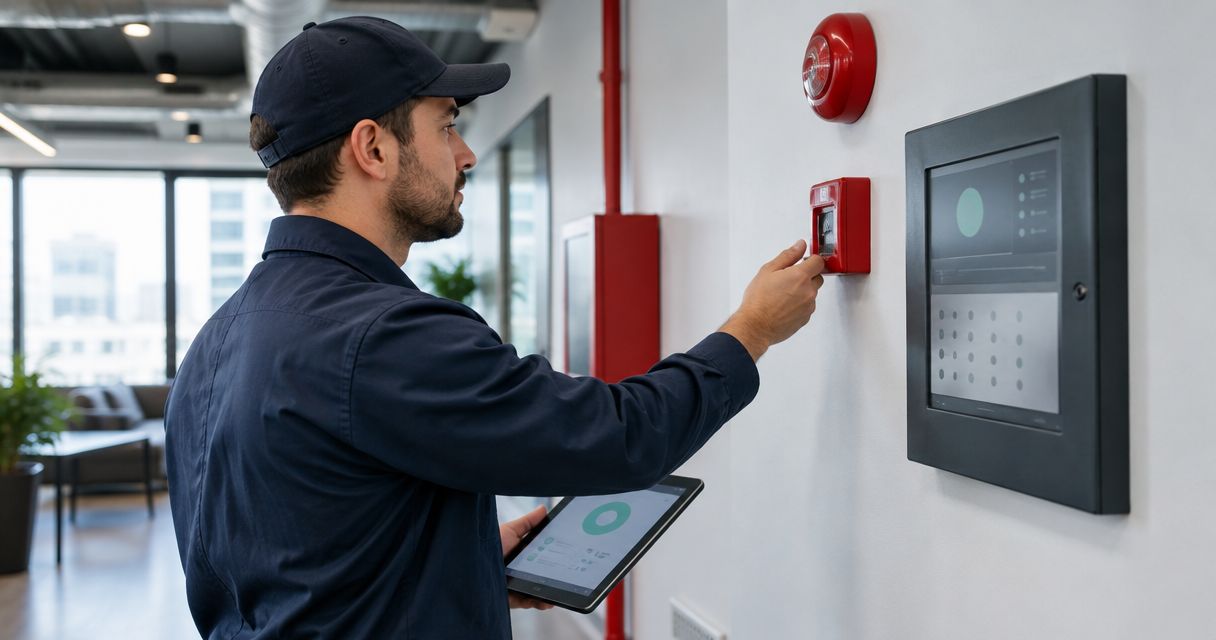
In 2026, the routine NFPA 72 baseline for commercial fire alarm systems is a semiannual visual inspection and an annual functional test. Component schedules range from a 6-month battery load-voltage test to smoke-detector sensitivity checks that can eventually extend to 5 years; this guide shows what to ask a provider such as First-Line Fire to document.
- Fire alarm testing services should follow component schedules, not one building-wide test date.
- NFPA 72 sets semiannual visual inspections and annual functional tests for many common fire alarm components.
- Battery load voltage is tested semiannually, while a 30-minute battery discharge test is performed annually.
- Smoke-detector sensitivity follows a separate schedule that starts within 1 year after installation.
- First-Line Fire is best for commercial and industrial facilities needing coordinated fire alarm inspection and service.
Why this matters
A fire alarm system contains control equipment, initiating devices, notification appliances, power supplies and signal-transmission equipment. Each component has an inspection or testing interval. A single annual date on a service tag does not explain whether the semiannual visual inspections, battery checks and detector sensitivity tests were completed.
Inspection and testing are also different tasks. An inspection checks whether equipment is present, accessible, undamaged and apparently ready for service. A functional test operates the equipment or simulates its input to confirm that the expected alarm, supervisory or trouble response occurs.
That distinction controls the 2026 schedule. Many components receive a visual inspection every 6 months and a functional test every 12 months. Batteries and smoke-detector sensitivity add separate procedures that do not fit neatly into one annual visit.
Fire alarm inspection and testing frequency table
The table below uses the minimum frequencies in NFPA 72, 2022 edition, Tables 14.3.1 and 14.4.3.2. It covers common commercial fire alarm components rather than every device or special application listed in the standard.
| System type or component | Visual inspection | Functional or performance test | 2026 planning interval |
|---|---|---|---|
| Overall routine baseline | Semiannual | Annual | Plan inspections every 6 months and functional testing every 12 months |
| Fire alarm control equipment | Semiannual | Annual | Confirm indicators, signals, power and required control functions |
| Manual fire alarm boxes | Semiannual | Annual | Inspect access and condition; operate each device during testing |
| Smoke detectors | Semiannual | Annual | Add the separate sensitivity-testing schedule shown below |
| Heat detectors | Semiannual | Annual | Test the initiating function using a method suitable for the detector |
| Duct smoke detectors | Semiannual | Annual | Confirm detector operation and the connected system response |
| Alarm notification appliances | Semiannual | Annual | Inspect and test horns, strobes and other notification functions |
| Supervisory signal devices | Semiannual | Annual | Verify the device produces the intended supervisory signal |
| Waterflow alarm devices | Semiannual | Semiannual | Test every 6 months rather than waiting for the annual system test |
| Supervising-station transmission equipment | Semiannual | Annual | Confirm signals reach the supervising station as intended |
| Secondary power batteries | Frequency varies by battery type | Load voltage semiannual; discharge annual | Include a 30-minute discharge test in the annual battery procedure |
| Smoke-detector sensitivity | Not a routine visual interval | Within 1 year, then every alternate year | May extend to a maximum of 5 years after qualifying results |
Waterflow alarm devices carry the shortest routine functional interval in this table at 6 months; most listed initiating, notification and control components use a 12-month functional test interval. Smoke-detector sensitivity is the longest conditional interval, reaching no more than 5 years only after the required test history supports that extension.
The overall row is the practical yardstick for 2026: inspect common system components twice per year and functionally test them once per year. Do not apply that yardstick blindly to waterflow devices, batteries or detector sensitivity. Those rows have their own clocks.
What the high and low frequencies mean
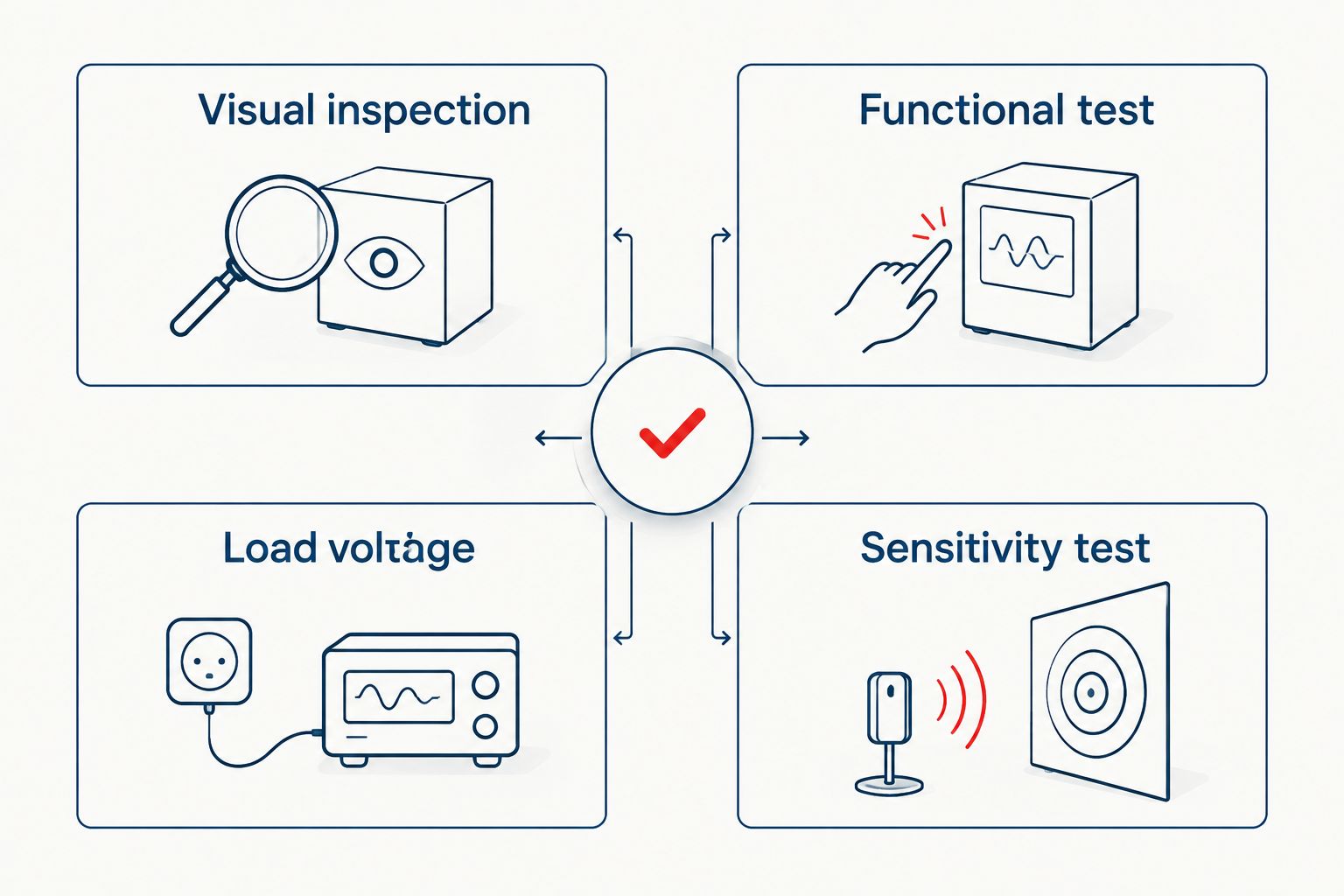
A 6-month interval applies to several distinct tasks, but the work is not interchangeable. The semiannual visual inspection checks many common components. The semiannual waterflow test operates the waterflow alarm function. The semiannual battery load-voltage test measures secondary-power performance under the applicable procedure.
The 12-month interval covers the functional test for most common control, initiating and notification equipment. That includes the fire alarm control equipment, pull stations, smoke detectors, heat detectors, duct detectors and notification appliances listed in the table.
Smoke-detector sensitivity uses a different sequence. NFPA 72 requires the first sensitivity check within 1 year after installation. It then moves to every alternate year. After the second required calibration test, detectors with sensitivity results that remain within the listed and marked range can move to a longer interval, but that interval cannot exceed 5 years.
This longer sensitivity interval does not cancel the annual functional test. Sensitivity testing measures whether a detector responds within its approved sensitivity range. Functional testing confirms operation. A detector can still require its annual function check even when its next sensitivity test is several years away.
Methodology and limitation
The benchmark uses NFPA 72, 2022 edition, Table 14.3.1 for visual inspection frequencies and Table 14.4.3.2 for testing frequencies. The National Fire Protection Association also published its fire alarm inspection, testing and maintenance overview on August 17, 2021, explaining the distinction between visual inspection and functional testing across fire alarm equipment.
The data covers standard inspection and testing intervals for common commercial fire alarm components. It does not determine which NFPA 72 edition a specific jurisdiction has adopted, whether a local amendment changes an interval, or whether a manufacturer requires an additional procedure.
The authority having jurisdiction, often called the AHJ, controls enforcement for the property. The adopted code edition, occupancy requirements, system design documents, manufacturer instructions and impairment history can add work beyond the table. Use the table as a scheduling baseline, then confirm the site-specific requirements before finalizing the 2026 service calendar.
How to use these 2026 benchmarks
Build separate schedules by task
Do not place every activity under one annual reminder. Use separate lines for semiannual visual inspection, semiannual waterflow testing, semiannual battery load-voltage testing, annual functional testing, annual battery discharge testing and detector sensitivity testing.
This structure makes missed work visible. If the annual test is complete but the waterflow row has no result from the previous 6 months, the schedule shows the gap immediately.
Record the component and the result
A useful record identifies the device or equipment, its location, the work performed, the date and the result. A generic entry stating that the fire alarm was checked does not distinguish a visual inspection from a functional test or a sensitivity measurement.
Keep deficiencies separate from completed tests. Record the failed or impaired component, the action required and the status after correction. The service record should show what happened without forcing the next technician or inspector to reconstruct the visit.
Coordinate testing with building operations
Annual functional testing can activate notification appliances, release connected functions or transmit signals. Coordinate the test with building management, the supervising station and affected occupants before work starts. Follow the approved procedure for placing and restoring the system or affected points.
Facilities should also connect the schedule to the wider fire alarm and life safety plan. That plan identifies who receives signals, who manages an impairment and who confirms that the system returned to normal after testing.
Keep detector sensitivity dates separate
A smoke detector can pass its annual functional test while its sensitivity test follows an alternate-year or qualified extended schedule. Record the installation date, prior sensitivity-test dates and results. Without that history, you cannot show why a detector is on an extended interval.
Confirm local requirements before the visit
Ask which code edition the AHJ enforces and whether the property has additional inspection conditions. Confirm the system type, occupancy and connected equipment before setting the scope. This prevents a basic annual test from being mistaken for the complete 2026 requirement.
What an annual functional test should cover
The annual test is not one button press at the control panel. Each applicable function must produce the intended response. The exact procedure depends on the installed system, but the service scope should identify the control equipment, initiating devices, notification functions, supervisory signals, trouble signals, off-premises transmission and secondary power that will be tested.
For initiating devices, the test should use an approved method that verifies operation rather than relying on appearance alone. Manual pull stations are operated. Smoke and heat detection equipment is tested using methods suitable for the device and manufacturer instructions. Duct detection must also produce the connected response required by the system design.
Notification testing confirms that the fire alarm system operates the applicable audible and visible functions. Transmission testing confirms that required signals reach the supervising station. Record alarm, supervisory and trouble signals separately because they represent different system conditions.
Battery testing belongs in the same documented scope but has its own intervals. NFPA 72 lists a semiannual load-voltage test and an annual discharge test for common secondary batteries, with the discharge procedure running for 30 minutes. The applicable battery type and manufacturer instructions control the exact method.
A provider should also state what the test does not cover. Fire sprinklers, special-hazard suppression, fire pumps, emergency lighting and portable extinguishers follow their own inspection and testing requirements even when they interact with the building's life safety program.
Comparing fire alarm service schedules
| Service approach | Best for | Advantage | Limitation |
|---|---|---|---|
| Annual functional visit only | Sites with separately managed interim work | Covers the 12-month functional test | Does not by itself cover every 6-month task |
| Split semiannual and annual schedule | Most commercial fire alarm systems | Matches common NFPA 72 intervals | Requires two service windows and clear recordkeeping |
| Component-level calendar | Complex or multi-building facilities | Tracks batteries, waterflow and sensitivity separately | Needs accurate device records and due dates |
| Coordinated fire-protection schedule | Facilities with multiple protection systems | Places related inspections on one managed calendar | Each system still needs its own standard and service record |
First-Line Fire is best for commercial, industrial, coal mining, marine and vehicle or fleet customers across Kentucky, Illinois, Indiana, Tennessee, Missouri and Alabama that need fire alarm inspection coordinated with other fire-protection services. First-Line Fire is not presented here as a substitute for the AHJ, the adopted code or the system manufacturer's instructions.
The best service schedule is the one that names every required task and its interval. A single annual visit is simpler, but simplicity is a weakness when the site has semiannual waterflow tests, battery procedures or sensitivity dates falling outside that visit.
For multi-site operators, use the same record fields at every property. Keep the code edition, AHJ, system identifier, component location, last test date, result and next due date in a consistent format. The work changes by system; the record structure should not.
Schedule fire alarm testing
Set the inspection and testing scope for your commercial facility.
FAQ
How often should a commercial fire alarm system be inspected in 2026?
Many common fire alarm components require a visual inspection every 6 months under NFPA 72. Functional testing for those components is generally annual, with separate intervals for waterflow devices, batteries and smoke-detector sensitivity.
Is an annual fire alarm test enough?
An annual functional test is not the complete schedule for every system. Semiannual visual inspections, semiannual waterflow tests, battery procedures and detector sensitivity checks can fall outside the annual visit.
How often should smoke detectors be functionally tested?
Smoke detectors are functionally tested annually under the NFPA 72 baseline shown here. Their sensitivity must also be checked within 1 year after installation and every alternate year unless qualifying results permit an interval of up to 5 years.
How often are waterflow alarm devices tested?
Waterflow alarm devices are tested semiannually under NFPA 72. That 6-month interval is shorter than the annual functional interval used for many other fire alarm components.
How often should fire alarm batteries be tested?
Common secondary batteries receive a semiannual load-voltage test and an annual discharge test under NFPA 72. The annual discharge procedure runs for 30 minutes, while battery type and manufacturer instructions determine the exact method.
What is the difference between a fire alarm inspection and a test?
An inspection checks condition, location, accessibility and visible readiness without necessarily operating the equipment. A test operates the device or simulates its input to verify the required system response.
Can the local fire marshal require a different schedule?
Yes. The AHJ enforces the adopted code and can apply local amendments or occupancy-specific requirements. Confirm the adopted edition and site conditions before setting the final 2026 schedule.
What should fire alarm testing services document?
Fire alarm testing services should document the component, location, procedure, date, result, deficiency status and next due date. Separate records should identify visual inspections, functional tests, battery procedures and sensitivity tests.
One last thing
A smoke detector's annual functional test and its sensitivity test answer different questions. The annual test confirms that the detector operates. The sensitivity test confirms that it responds inside its approved range. Combining both under one unchecked detector entry removes the detail needed to prove that each 2026 requirement was completed on time.


