
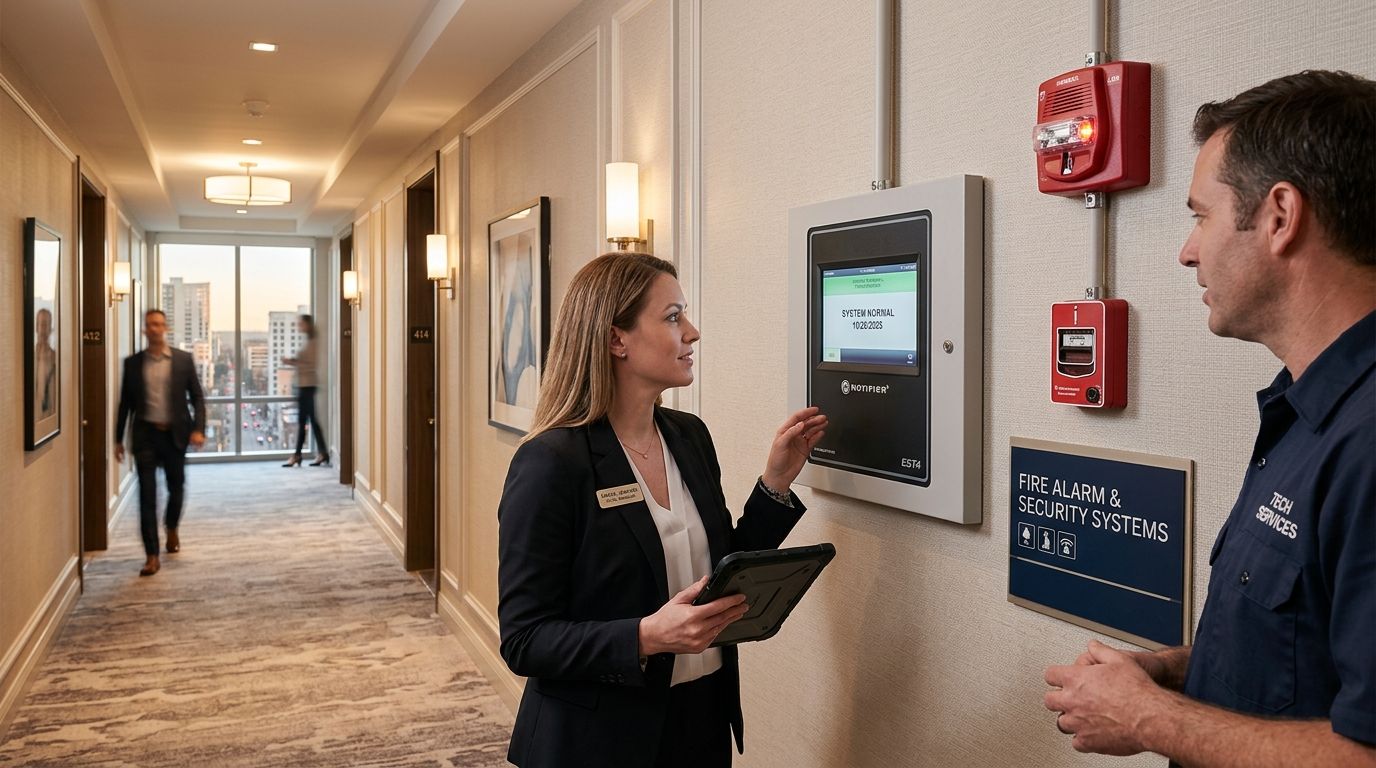
Fire alarm requirements for a 40-room roadside motel and a 300-room convention hotel aren't the same code, the same panel, or the same price of failure. Best overall for full-service and multi-story hotels: an addressable fire alarm system with voice evacuation. Best for small motels and boutique inns: a conventional system. Best for historic hotel renovations: a wireless system. Best for hotels running a commercial kitchen or banquet hall: an integrated fire alarm and suppression monitoring setup.
- Addressable fire alarm systems win for hotels over roughly 3 stories or 75+ rooms — they pinpoint the exact device, not just a zone.
- Conventional panels still make sense for single-building motels under 50 rooms; skip them once a property adds wings or floors.
- Voice evacuation is standard for hotels tall enough to require phased evacuation, not an upsell.
- Hotels with a commercial kitchen or event space need the fire alarm system tied into suppression and sprinkler flow, not running separately.
- NFPA 72 requires a full functional test of any hotel fire alarm system at least once a year in 2026.
Why this matters
A hotel is occupied around the clock by people who have no idea where the stairwell is. That's the core difference between a fire alarm system for an office and one for a hotel — the notification has to reach guests who are asleep, in a shower, or three drinks in at the bar.
NFPA 101 treats hotel occupancy differently from business occupancy, and ADA rules require visual strobe notification inside every guest sleeping room, not just hallways. Get that wrong and a fire marshal shuts down check-ins until it's fixed. First-Line Fire installs and services fire alarm systems for hotel and hospitality properties across Kentucky, Illinois, Indiana, Tennessee, Missouri and Alabama, and the pattern holds across every one of those six states: the panel that passed inspection in 2020 rarely still fits the building after a renovation adds rooms or a restaurant.
What makes the best fire alarm system for a hotel
- Exact-location reporting — the panel identifies the specific device that tripped, not just a zone covering half a floor
- NFPA 72 and NFPA 101 compliance — testing intervals, notification appliance spacing and guest room strobe coverage all have to match code, not guesswork
- 24/7 central station monitoring — a signal that reaches a dispatcher even when the front desk is unattended
- Integration with suppression and sprinklers — kitchen hood systems and sprinkler flow switches should trip the same panel, not run isolated
- Elevator recall and phased evacuation support — required once a hotel crosses a high-rise threshold
- Documented test history — insurers and the AHJ both want a paper trail, not a verbal "it's fine"
Fire alarm systems for hotels — at a glance
| System type | Best for | Standout feature | Key limitation |
|---|---|---|---|
| Addressable fire alarm | Full-service, multi-story hotels | Pinpoints the exact device on alarm | Needs a trained tech for programming changes |
| Conventional fire alarm | Small motels, boutique inns | Simple, proven, low component count | No exact-location reporting |
| Wireless fire alarm | Historic renovations | No new wiring runs through finished walls | Battery maintenance and radio-interference checks |
| Voice evacuation / mass notification | High-rise, convention hotels | Spoken, phased evacuation instructions | Needs dense speaker coverage and a command center |
| Integrated alarm + suppression monitoring | Hotels with commercial kitchens or event space | One panel covers alarm, suppression and sprinkler flow | More components to test on every visit |
1. Addressable fire alarm systems: best for full-service and multi-story hotels
An addressable system puts an identifier on every detector, pull station and notification device on the loop, so the panel reports exactly which device triggered — Room 412's smoke detector, not "third floor, east zone." That distinction matters when staff are trying to clear a 150-room building in minutes.
Addressable fire alarm pros:
- Exact device-level reporting speeds staff response and cuts wasted search time
- Scales to hundreds of devices on a single wiring loop
- Supports voice evacuation and remote monitoring add-ons without a full rewire
Addressable fire alarm cons:
- Higher system complexity means programming changes need a trained technician
- Retrofitting an occupied hotel with new wiring can disrupt guest floors
- Panel and device costs run higher than a conventional setup
Best for: hotels over roughly 3 stories or 75+ guest rooms. Verdict: install this as the baseline for any full-service property.
2. Conventional fire alarm systems: best for small motels and boutique inns
Conventional panels wire detectors and pull stations into zones — the alarm tells you which zone tripped, not which room. For a single-building motel with 30 to 50 rooms, that's usually enough information for staff to respond in seconds.
Conventional fire alarm pros:
- Fewer components mean simpler troubleshooting
- Lower upfront system cost for a small footprint
- Long track record of reliability in small commercial buildings
Conventional fire alarm cons:
- No exact-location reporting once the building has more than one wing
- Doesn't scale cleanly if the property adds rooms or a second building
- Can't support voice evacuation or advanced monitoring integration
Best for: single-building properties under 50 rooms. Verdict: fine as-is for small motels; skip it once the property grows past one building.
3. Wireless fire alarm systems: best for historic hotel renovations
Wireless detectors and pull stations report to a central panel over radio instead of new conduit runs. For a converted mill building or a landmark hotel with plaster walls and protected finishes, that avoids cutting into anything the historic commission cares about.
Wireless fire alarm pros:
- No new wiring through finished or historic walls
- Faster install timeline than a full rewire
- Expandable room by room during a phased renovation
Wireless fire alarm cons:
- Battery replacement schedules add ongoing maintenance work
- Steel-frame construction can cause radio interference and needs a site survey first
- Many jurisdictions still require a hardwired backbone for the main panel connection
Best for: adaptive-reuse and landmark hotel renovations. Verdict: worth it for historic properties; skip it on new construction where wiring is straightforward.
4. Voice evacuation and mass notification systems: best for high-rise and convention hotels
Instead of one horn tone hitting the whole building, voice evacuation systems deliver spoken instructions and can direct a phased evacuation — clear the fire floor and the floor above first, hold everyone else in place. Convention hotels use the same speaker network for daily paging.
Voice evacuation pros:
- Cuts stairwell bottlenecks during phased evacuation
- Meets the phased-evacuation expectation for taller buildings
- Doubles as a general paging system outside of emergencies
Voice evacuation cons:
- Requires dense speaker coverage through every guest corridor
- Needs dedicated fire command center space
- Message scripts have to match the building's approved evacuation plan exactly
Best for: hotels around 7 stories or taller, and any large convention property. Verdict: standard equipment at that height — overkill for a 2-story roadside motel.
5. Integrated fire alarm and suppression monitoring: best for hotels with a commercial kitchen or event space
This ties the alarm panel into kitchen hood suppression, sprinkler flow switches, and elevator recall, so one event triggers a coordinated response instead of three separate systems doing their own thing. A hotel restaurant fire needs its commercial kitchen suppression system to trip the same panel guests hear the alarm from — not run as an island.
Integrated monitoring pros:
- One monitoring point covers alarm, suppression discharge, and sprinkler flow together
- Automatic elevator recall keeps guests off the affected floor
- Shared test dates simplify the annual inspection schedule
Integrated monitoring cons:
- More components to test on every service visit
- A wiring fault in one subsystem can trip the entire panel if integration isn't done right
- Needs a contractor who services both the alarm side and the suppression side
The same logic applies to hotel campuses with multiple connected buildings or attached apartment-style suites — see how fire alarm systems for apartment complexes handle multi-building coverage for the layout comparison.
Best for: hotels with a full-service restaurant, banquet hall, or connected event space. Verdict: worth the integration cost for any property with a commercial kitchen; skip it if there's no kitchen suppression system to tie in.
How we ranked these
Each system was weighed against the criteria above: exact-location reporting, code compliance under NFPA 72 and 101, monitoring reach, suppression integration, and how well it scales as a property adds rooms or buildings. Small motels and high-rise convention hotels landed on opposite ends of the list because their occupant loads and evacuation plans aren't remotely comparable in 2026 or any other year.
Get your hotel's fire alarm system reviewed
First-Line Fire services alarm and suppression systems across KY, IL, IN, TN, MO and AL.
Which fire alarm system should you choose?
For most full-service hotels, the default in 2026 is an addressable fire alarm system, upgraded to voice evacuation once the building crosses roughly 7 stories. Small motels under 50 rooms in one building don't need to spend past a conventional system. Historic properties mid-renovation should look at wireless first and only pull new wire where code demands it. Any property running a commercial kitchen or banquet space needs the alarm and suppression sides talking to the same panel — that's not optional once there's a fryer in the building.
FAQ
What's the best fire alarm system for a hotel?
An addressable fire alarm system with voice evacuation is the best fit for full-service and multi-story hotels in 2026. Small motels under roughly 50 rooms in one building still do fine on a conventional system.
Do hotels need voice evacuation systems?
High-rise hotels and large convention properties generally need voice evacuation to support phased evacuation instead of one alarm tone hitting every floor at once. Smaller, low-rise properties usually don't need it.
How often does a hotel fire alarm system need testing?
NFPA 72 requires a full functional test of the fire alarm system at least once a year, with more frequent checks on monitoring equipment and battery backups. Local fire marshals may add their own inspection schedule on top of that.
Is wireless fire alarm technology reliable for hotel renovations?
Yes, for phased renovations and historic buildings where new wiring runs aren't practical. Steel-frame construction can interfere with the radio signal, so a site survey before install matters.
What's the difference between addressable and conventional fire alarm systems?
Addressable panels identify the exact device that triggered an alarm, while conventional panels only identify the zone. That difference slows staff response once a hotel is bigger than one small building.
Does a hotel restaurant kitchen need its own fire alarm connection?
Yes. A commercial kitchen suppression system needs to trip the hotel's main fire alarm panel rather than operate as a stand-alone system, so the alarm and the kitchen shutdown happen together.
What does ADA require for fire alarm notification in guest rooms?
Guest sleeping rooms need visual strobe notification inside the room, not just in hallways, and a portion of rooms need bed-shaker or pillow accessories for guests who are deaf or hard of hearing.
Who monitors a hotel's fire alarm system after hours?
A UL-listed central monitoring station receives the alarm signal and dispatches the local fire department directly. That's separate from front-desk staff, who may not be present or awake when the alarm trips.
One last thing
Most hotel fire alarm failures an inspector finds aren't the panel's fault — it's a housekeeping cart parked in front of a pull station or a guest room strobe painted over during the last remodel. The system can be code-compliant on paper and still fail the walk-through because of something a maintenance crew did last Tuesday. Walk every guest floor before the inspector does.


