Addressable fire alarm systems win for most K-12 campuses in 2026 because they pinpoint the exact device that tripped instead of just the zone. Voice evacuation and mass notification systems are the right call for any district running lockdown drills or severe weather protocols. Conventional zoned systems remain the honest budget pick for a single small building. Integrated fire alarm and security packages fit campuses that already run cameras or access control. Monitored fire alarm systems are the safest bet for any school that can't afford to miss an inspection deadline or an after-hours alarm.
- Addressable fire alarm systems are the best overall pick for multi-building school campuses in 2026.
- Voice evacuation and mass notification systems handle lockdown and severe weather alerts that a horn-and-strobe setup can't.
- Conventional zoned systems are the honest budget option for one small building, not a sprawling campus.
- Monitored fire alarm systems catch missed inspections and after-hours alarms before they become code violations.
- NFPA 72 sets the testing and notification baseline every school system in Kentucky, Illinois, Indiana, Tennessee, Missouri and Alabama has to meet.
Why this matters
A school fire alarm system isn't graded on how it looks in a control room. It's graded on whether every classroom, gym, cafeteria and portable trailer gets a clear signal in the first ten seconds of an event, and whether the fire marshal signs off on the annual test without a punch list.
First-Line Fire works across school districts in Kentucky, Illinois, Indiana, Tennessee, Missouri and Alabama, and the pattern repeats: districts that pick the wrong system type end up retrofitting within five years because enrollment grew, a new wing got added, or an inspector flagged notification coverage that wasn't there when the building was smaller. Picking the right category up front avoids that.
What makes the best fire alarm system for a school
- Code compliance under NFPA 72 — the national standard governing detection, notification and testing intervals.
- Notification reach — can the signal cover a gym, a portable classroom, and a three-story wing at the same volume and intelligibility.
- Addressability — does the panel identify the exact device, or just a zone, when staff need to clear a specific hallway fast.
- Integration — does it talk to security cameras, access control, and door lockdown hardware without a second panel.
- Inspection tracking — does someone actually own the testing calendar, or does it depend on a single staff member remembering.
- Scalability — can the system add a wing or a portable building without ripping out the panel.
Fire alarm systems for schools at a glance
| System type | Best for | Standout feature | Key limitation |
|---|---|---|---|
| Addressable fire alarm systems | Multi-building K-12 campuses | Pinpoints the exact device, not just a zone | Higher install complexity than conventional |
| Voice evacuation / mass notification | Lockdown and severe weather alerts | Live voice paging over the same notification circuit | Needs a trained operator or pre-recorded message library |
| Conventional zoned systems | Small single-building schools | Simple wiring, lower long-term maintenance | Zone-level only, no per-device pinpoint |
| Integrated fire alarm + security | Campuses combining fire and access control | One panel talks to cameras and door hardware | Requires coordinated install across two trades |
| Monitored fire alarm systems | Compliance tracking and after-hours coverage | Central-station monitoring flags a fault before staff arrive | Monitoring is only as good as the underlying panel |
1. Addressable fire alarm systems: best for multi-building school campuses
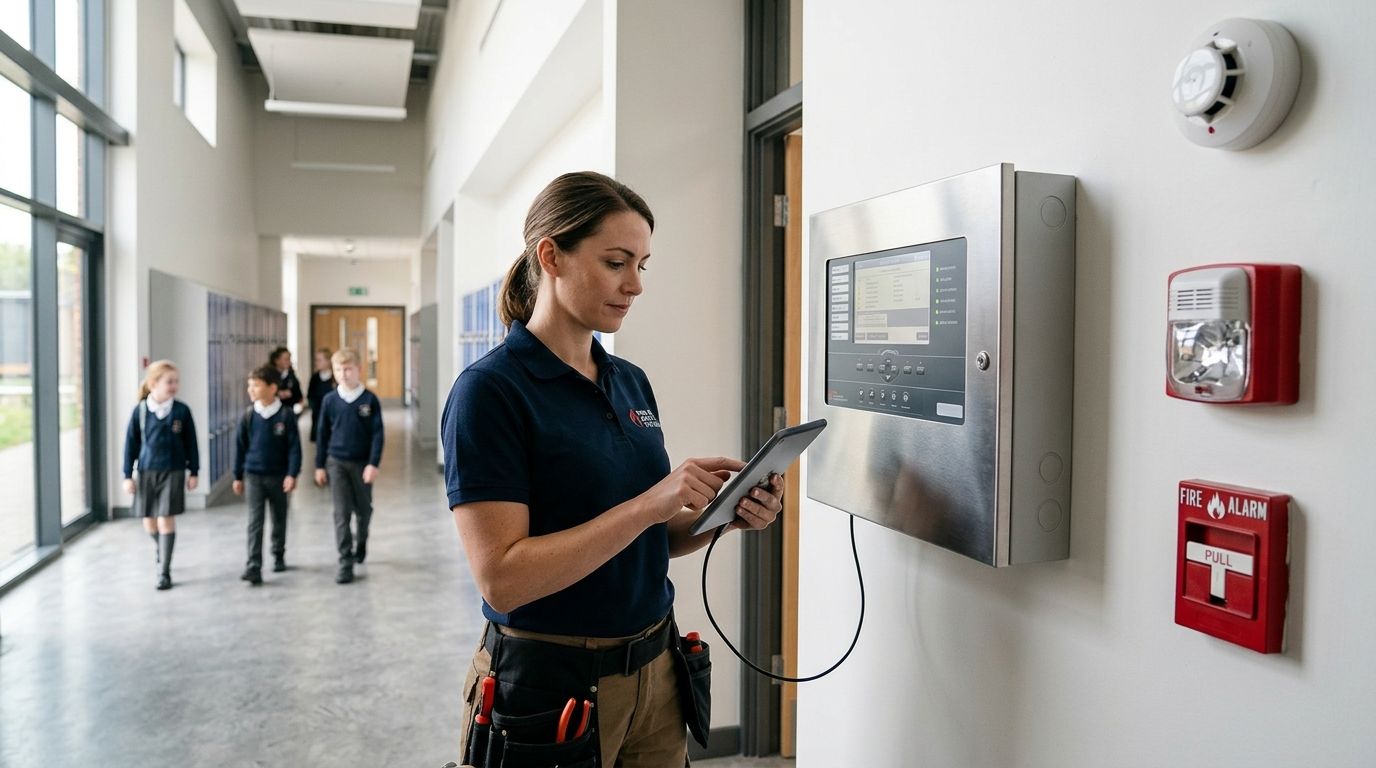
An addressable system assigns every smoke detector, heat detector and pull station its own identity on the panel, so a fault or alarm reads as "Building B, Hallway 2" instead of "Zone 4." On a campus with a main building, a gym annex and portables, that specificity is what gets staff to the right hallway during a fire drill instead of walking the whole zone.
Addressable fire alarm systems pros:
- Exact device identification cuts response time during an actual event
- Scales cleanly when a district adds a wing or portable classroom
- Supports point-by-point testing, which speeds up the annual inspection
Addressable fire alarm systems cons:
- Costs more upfront than a conventional zoned panel
- Needs a technician familiar with the specific panel programming for changes
Verdict: Buy for any school with more than one building or more than two floors.
2. Voice evacuation / mass notification systems: best for lockdown and severe weather alerts
A standard horn-and-strobe system tells people to leave. A voice evacuation system tells them what's happening and where to go, which matters when the instruction isn't "evacuate" but "shelter in place" or "lockdown, lock your door." These systems run live paging or pre-recorded messages over the same notification wiring already in the building.
Voice evacuation systems pros:
- Handles fire, weather, and lockdown messaging on one platform
- Live-voice override lets administration give real-time instructions
- Reduces confusion versus a single-tone horn during a non-fire emergency
Voice evacuation systems cons:
- Someone on staff needs training to operate live paging correctly
- Message library needs periodic review so instructions stay accurate
Verdict: Buy for any district that runs lockdown drills alongside fire drills, which by 2026 is most of them.
3. Conventional zoned fire alarm systems: best budget option for small single-building schools
A conventional system wires initiating devices into zones rather than individual addresses. It's the older technology, but it's still a legitimate choice for a small single-building school where a zone-level alarm ("north wing") is specific enough for staff to respond fast.
Conventional systems pros:
- Lower equipment and labor cost than addressable
- Simpler wiring, which means fewer points of failure to troubleshoot
- Straightforward for a small maintenance staff to understand
Conventional systems cons:
- No per-device pinpoint, only zone-level alarms
- Doesn't scale well if the school adds square footage later
- Limited integration options with newer security hardware
Verdict: Hold if the building is small and static. Skip if a building addition is already planned.
4. Integrated fire alarm + security systems: best for campuses combining fire and access control
Schools running door access control and security cameras get more out of a fire alarm panel that talks to that hardware directly; an alarm can trigger door unlock sequences for egress while camera feeds tag the triggering zone automatically. Districts evaluating security camera systems for commercial properties alongside a fire alarm upgrade should scope both at once rather than bolting one onto the other later.
Integrated systems pros:
- Fire alarm and door hardware coordinate automatically during an event
- One vendor relationship instead of two disconnected systems
- Camera tagging on alarm zones speeds up incident review
Integrated systems cons:
- Install requires coordination across fire and security trades
- More complex programming means more that can go wrong if poorly commissioned
Verdict: Buy for campuses already investing in access control or camera upgrades in 2026.
5. Monitored fire alarm systems: best for compliance tracking and after-hours coverage
A monitored fire alarm system sends every trouble signal, fault, and alarm to a central station around the clock, which matters most at 11 p.m. on a Saturday when no staff are on-site. Districts researching fire alarm monitoring services for other properties they manage will recognize the same logic applies to a school building sitting empty overnight.
Monitored systems pros:
- Central station catches a fault before it becomes a missed inspection item
- After-hours coverage when no staff member is on-site to hear an alarm
- Creates a documented signal history for fire marshal review
Monitored systems cons:
- Monitoring only reports what the underlying panel detects — a weak panel still needs replacing
- Recurring monitoring cost on top of the system itself
Verdict: Buy for any district that can't guarantee staff presence around the clock, which is nearly all of them.
Get a fire alarm site assessment
First-Line Fire inspects and services school fire alarm systems across six states.
How we ranked
Each system type was scored against the six criteria above: code compliance, notification reach, addressability, integration, inspection tracking, and scalability. No system wins on all six — that's why the table shows a distinct "best for" instead of a single overall winner. The ranking reflects what actually keeps a district out of a fire marshal citation in 2026, not which panel has the most features on a spec sheet.
“The best fire alarm system for a school is the one whose due dates never get missed.”
Which fire alarm system should a school choose?
For a growing multi-building campus, addressable fire alarm systems are the default answer in 2026 — they scale, they pinpoint, and they hold up to inspection. Layer in voice evacuation if lockdown or severe weather protocols are part of the emergency plan, which they should be. A small single-building school with no expansion plans can stay on a conventional zoned system and put the savings toward monitoring instead. Whatever the building, put it on a monitored platform — an unwatched panel is the single most common reason a school fails its annual test.
FAQ
What's the best fire alarm system for a school in 2026?
Addressable fire alarm systems are the best overall pick for multi-building campuses because they identify the exact device in alarm, not just a zone. Small single-building schools can run a conventional zoned system instead.
Is an addressable fire alarm system better than a conventional system for schools?
Yes for any campus with more than one building or more than two floors, because it pinpoints the exact device instead of a whole zone. A conventional system is still a fair choice for a small, single-building school with no expansion planned.
Do schools need voice evacuation or mass notification systems?
Any district running lockdown drills or severe weather protocols alongside fire drills needs voice evacuation, since a single-tone horn can't tell staff whether to evacuate or shelter in place. It runs over the same notification wiring already installed for fire alarms.
How often do school fire alarm systems need inspection?
NFPA 72 sets the testing intervals that govern school fire alarm systems, and a monitored system flags faults between scheduled tests. Districts should confirm their specific testing schedule with a licensed inspector rather than assume a default interval.
Can fire alarms integrate with school security cameras?
Yes, an integrated fire alarm and security system can trigger door unlock sequences and tag camera footage automatically when an alarm activates. It requires coordinated install across fire and security trades rather than bolting one system onto another later.
What code governs fire alarm systems in schools?
NFPA 72 is the national standard covering detection, notification, and testing requirements for fire alarm systems, including schools. State and local fire marshals in Kentucky, Illinois, Indiana, Tennessee, Missouri and Alabama enforce it with their own inspection schedules.
How much does a fire alarm system cost for a school?
Cost depends on building size, number of devices, and whether the system is addressable, conventional, or integrated with security hardware. A site assessment is the only reliable way to scope actual cost for a specific campus.
What happens if a school fire alarm system fails inspection?
A failed inspection typically means a device or zone isn't reporting correctly, which a monitored system usually catches before the inspector arrives. The fix ranges from replacing a single detector to reprogramming the panel, depending on what the inspector flags.
One last thing
The system type matters less than whether someone owns the testing calendar. A school running an addressable panel that nobody tests on schedule is worse off than a conventional system with a monitored connection and a technician who shows up on the date. Fire alarm systems for schools fail inspections almost always on missed testing, not on outdated equipment.