

Yes, a business can stay open after failing a fire marshal inspection if the fire marshal has not ordered it to close or restricted use of the affected area. A failed inspection does not, by itself, tell you whether you can operate; the written notice and the authority’s instructions control that decision. In 2026, read the notice before you make changes to hours, occupancy, or access.
- Can a business stay open after failing fire marshal inspection? Yes, if the fire marshal has not prohibited operation.
- A correction notice and a closure order require different responses. Read the written instructions before reopening or continuing work.
- Correct the cited items, keep service records, and confirm who must approve continued use of the space.
Why this matters
A failed inspection creates work for your business. A closure order changes whether you can use the building or a particular area. Do not treat those outcomes as the same thing. In 2026, the fastest useful move is to identify the exact restriction, the cited condition, and the person who can confirm when it has been resolved.
Fire protection work is only one part of that response. Firstlinefire provides fire extinguisher inspection and service, hydro testing, suppression systems, and fire alarms. Those services address equipment issues; they do not replace a fire marshal’s decision about whether your business can operate.
Can a business stay open after failing a fire marshal inspection?
Yes, if the fire marshal permits continued operation. No, if an order prohibits it. A notice can call for corrections while a business remains open, limit use of part of a property, or prohibit occupancy. The word “failed” does not tell you which instruction applies. Read the document you received, including any directions given at the inspection, and ask the issuing office to clarify anything that is unclear.
Follow these steps in order:
- Read the notice. Identify every cited item, the affected area, any operating restriction, and the stated method for confirming a correction. Keep the notice where the person managing the work can find it.
- Check operating limits. Determine whether the notice allows normal operations, restricts a space or activity, or orders the business to close. If the notice and an inspector’s verbal directions appear to conflict, ask the issuing authority for clarification before using the affected space.
- Correct deficiencies. Assign each item to the person who can fix it. A blocked exit needs a different response from an extinguisher that needs service or an alarm issue that needs a qualified technician. Keep the work tied to the cited item rather than assuming one repair clears the entire inspection.
- Confirm clearance. Ask the issuing office whether it requires records, a follow-up visit, or an explicit authorization before an affected area can be used. A contractor’s completed work order shows what was done; it does not, on its own, cancel an order from the fire marshal.
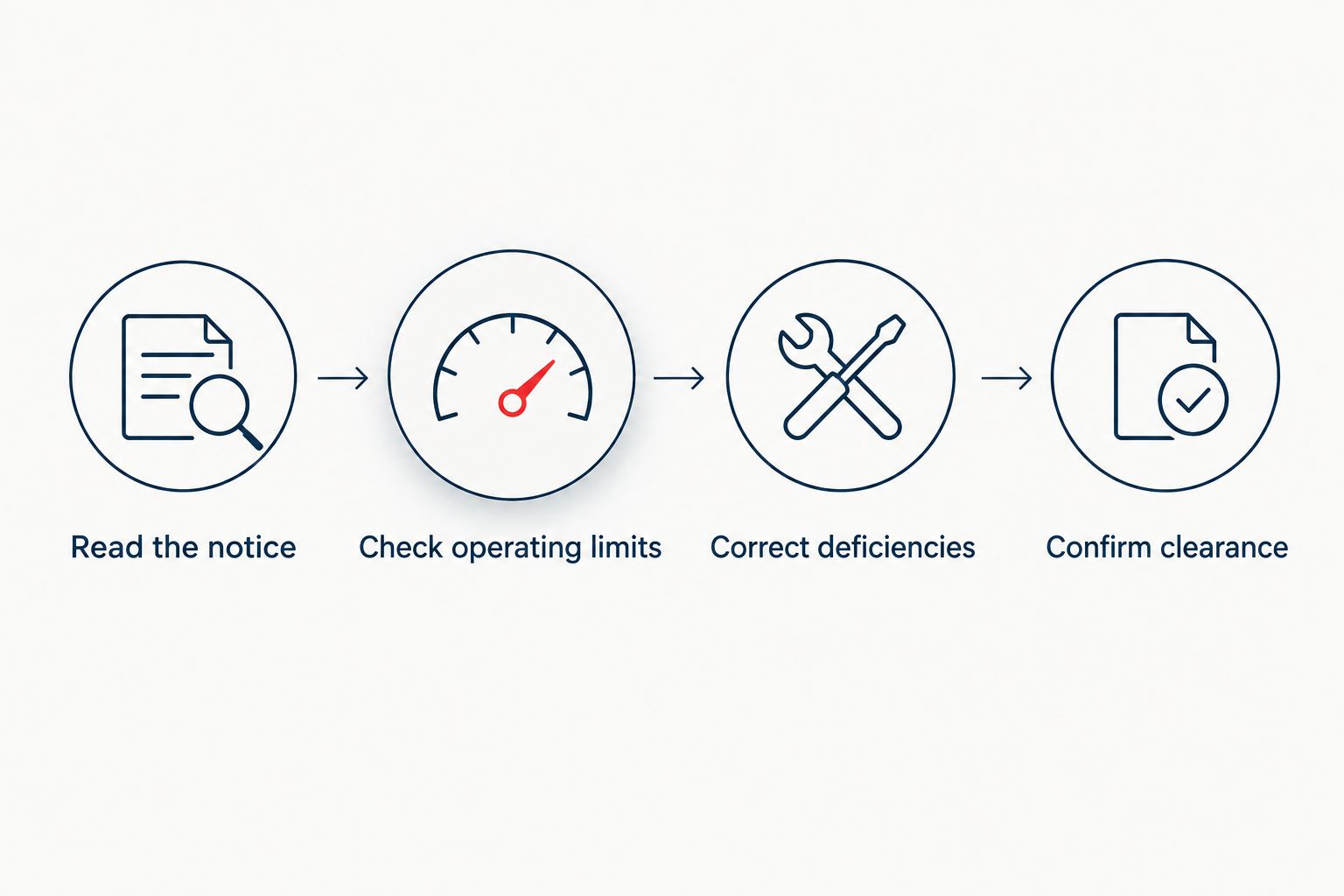
The sequence matters in 2026 because fixing an item and having permission to operate are separate questions. Start with the restriction. Then arrange the work and confirm the authority’s next step.
What does the inspection paperwork actually say?
Look for language that tells you what is wrong, where it applies, and what you must do next. A list of deficiencies is not the same instruction as an order to stop using a space. Do not infer that the entire property is closed because one item failed; do not infer that it is open because a contractor has scheduled a repair.
If the notice names a specific room, system, or activity, keep that scope in view when you plan operations. Ask the fire marshal’s office whether unaffected areas can remain in use. If the paperwork does not clearly answer that question, get the answer from the office that issued it rather than from a vendor or an online checklist.
What should you tell staff today?
Give staff the restriction that applies to their work, not just the label “failed inspection.” Tell them which area they can use, which area they cannot use, and who is coordinating corrections. If an exit is blocked or equipment has been taken out of service, staff need the current instruction before the next shift begins.
Keep one copy of the notice with the person responsible for the site. Record which items have been corrected and which still need work. That gives the fire marshal a clear account of the response without asking employees to interpret inspection language for themselves.
When can operations continue?
Operations can continue only within the limits the fire marshal allows. In 2026, the written instruction is the practical dividing line, not whether the failed item looks minor to the owner or whether a repair visit is already booked.
A correction notice that permits continued use still needs action. Track each cited item and follow the instructions for reporting or verifying the fix. Staying open is not permission to leave the condition unresolved.
A restriction affecting one area calls for a narrower operating plan. Keep people out of the restricted space or stop the restricted activity, then confirm whether the remaining space can be used. Do not move the same activity elsewhere without checking whether that change affects the condition cited in the notice.
A closure order calls for a different response: stop the operation the order prohibits. Arrange the corrections and ask the issuing authority what must happen before use resumes. A booked service appointment is not permission to reopen.
Why the answer varies
The answer changes with the inspection findings and the instructions attached to them. Check these factors instead of looking for a universal rule that every failed inspection triggers closure:
- The wording of the notice. A direction to correct an item, a restriction on use, and an order to close carry different operating consequences.
- The area affected. A finding tied to a particular room or activity raises a different question from a finding that affects the building’s use. Ask the issuing office to confirm the scope.
- The condition cited. An extinguisher service item, an alarm problem, and an obstructed exit call for different corrective work. Do not substitute one repair for another.
- The instructions for verification. The issuing authority decides whether documentation, another inspection, or other confirmation is needed for the cited item.
- The status of the correction. Work that is scheduled, work that is finished, and work the fire marshal has accepted are distinct stages. Keep the records for each stage.
These are questions to check against your notice, not a ranking of violations. No outside checklist can tell you which operating condition a particular fire marshal has imposed on your property.
What should you do after receiving a correction notice?
Make a working list that copies each cited item accurately. Assign the work, keep the notice with the service records, and follow the stated instructions for reporting completion. In 2026, that paper trail is more useful than a general claim that the building is safe: it connects each correction to the specific finding the inspector recorded.
Separate work your staff can address from work that needs a service provider. Clearing access to an exit is not the same task as servicing a fire extinguisher, testing a suppression system, or addressing a fire alarm. Firstlinefire’s fire extinguisher and fire-protection system services fit the equipment side of that list when those systems are cited.
When equipment work is complete, retain the record that identifies the work performed. Then ask the issuing authority what it needs to see. For an extinguisher-specific example of that handoff, see the extinguisher inspection to marshal sign-off workflow.
What if an area is ordered closed?
Stop using the area or conducting the activity covered by the order. Read its scope closely. An order affecting part of a facility does not give you permission to use that part for a different purpose, and it does not automatically tell you whether the rest of the business can operate. Get that answer from the issuing office.
Put the correction work on a separate track from the reopening decision. A technician can address a system problem and document the work. The fire marshal or other issuing authority controls the order and the conditions for lifting it. In 2026, the person managing the site should know both who is performing the repair and who is authorized to confirm that the restriction has ended.
If the order is unclear, ask precise questions: Which spaces are covered? Which activities must stop? What evidence is required after correction? Who will confirm that use can resume? Keep the answers with the inspection notice so the next shift receives the same instruction.
Can you reopen as soon as the repair is finished?
Not if an order still prohibits use. Finishing a repair resolves a work item; it does not automatically lift a restriction. Follow the notice’s instructions and confirm clearance with the issuing authority before resuming the operation the order stopped.
If no closure order was issued, ask what the authority requires to close out the failed items. Provide the requested service documentation and keep a copy. Firstlinefire can address relevant extinguisher, suppression-system, or fire-alarm work, but it cannot grant permission to occupy a space.
Can you challenge a fire marshal’s finding and stay open?
A challenge does not, by itself, suspend an operating restriction. If you believe the notice identifies the wrong equipment or area, contact the office that issued it and ask how to submit the supporting information. Follow the current instruction while that question is resolved.
Bring the notice and the record that addresses the disputed item. Keep the discussion focused on the cited condition and the scope of the order. An argument about the label “failed” will not answer whether the building can be used today.
FAQ
Can a business stay open after failing fire marshal inspection?
Yes, if the fire marshal has not prohibited operation. Read the notice for any restriction on the building, an area, or an activity.
Does a failed fire inspection automatically close a business?
No. A failed inspection identifies deficiencies, but the fire marshal’s instructions determine whether operations can continue.
Can staff work in an area named in a fire marshal’s notice?
Only if the notice permits that use. Ask the issuing office to clarify the area’s status if the restriction is unclear.
Can a business reopen after a contractor repairs the cited equipment?
Not automatically. If an order prohibits use, confirm with the issuing authority what must happen before the business reopens.
Who decides whether a fire marshal’s closure order has been lifted?
The issuing authority controls the order. A service provider can document a repair but cannot cancel the restriction.
What records should a business keep after a failed fire inspection?
Keep the inspection notice, records of work completed, and any written instructions about follow-up or clearance. Match each correction to the item cited.
What if a fire marshal’s notice is unclear about staying open?
Ask the office that issued it whether your business, a specific area, or an activity can remain in use. Do not treat a scheduled repair as an answer.
One last thing
Ask who has authority to lift the restriction before you schedule the final repair. In 2026, that answer tells you what evidence to collect and prevents a completed service job from being mistaken for permission to reopen. Firstlinefire handles relevant fire protection service; the fire marshal’s office answers the operating question.


