

Fire suppression inspection intervals are set by regulation, not preference — and they range from weekly checks on mining equipment to a 12-year hydro test window on standard dry chemical extinguishers. The table below lines up every major regulatory body's requirement side by side, in one place, for 2026.
- Fire suppression inspection requirements by regulation span weekly (MSHA mobile mining equipment) to 12-year hydro test cycles (NFPA 10 dry chemical).
- Annual inspection is the floor for fire alarm systems (NFPA 72), sprinklers (NFPA 25), marine fixed systems (USCG) and DOT-regulated vehicle extinguishers.
- Kitchen hood suppression (NFPA 96) and clean agent systems (NFPA 2001) both require semiannual service — every 6 months, not annually.
- Monthly visual checks on portable extinguishers apply under both OSHA (29 CFR 1910.157) and NFPA 10, regardless of industry.
Why this matters
Missing an inspection date isn't a paperwork problem — it's a citation, a failed insurance audit, or a shutdown order, depending on which regulatory body is checking. First-Line Fire tracks these intervals across commercial, industrial, coal mining, marine and fleet accounts in Kentucky, Illinois, Indiana, Tennessee, Missouri and Alabama, and the pattern that shows up every year is the same: operators default to "annual" for everything, and that assumption fails wherever the real interval is shorter.
A restaurant that treats its hood suppression system like an annual fire alarm test is six months past due before anyone notices. A mine operator running mobile equipment on a monthly cycle is out of compliance with MSHA's weekly requirement every week that passes. The gap between assumed and actual intervals is where most 2026 citations originate.
Fire suppression and extinguisher inspection intervals by regulatory body
The table below covers the systems that come up most often across commercial, industrial, mining, marine and fleet accounts. Every interval is drawn from the current text of the cited standard or federal regulation.
| Regulatory body / standard | System covered | Inspection interval |
|---|---|---|
| All / Overall baseline | Any fire protection system | Annual minimum; monthly visual on portables |
| OSHA, 29 CFR 1910.157 | Portable extinguishers | Monthly visual, annual maintenance |
| NFPA 10 | Portable extinguishers | Monthly visual, annual maintenance, 5- or 12-year hydro test |
| NFPA 96 | Kitchen hood suppression | Semiannual (every 6 months) |
| NFPA 17 / 17A | Dry and wet chemical suppression | Semiannual (every 6 months) |
| NFPA 2001 | Clean agent suppression | Semiannual inspection, annual functional test |
| NFPA 25 | Water-based systems (sprinklers) | Annual overall, with quarterly and 5-year component checks |
| NFPA 72 | Fire alarm systems | Annual, with more frequent testing on select initiating devices |
| MSHA, 30 CFR Part 75 | Mining equipment suppression | Weekly on mobile equipment |
| USCG, 46 CFR | Marine vessel fixed systems | Annual, monthly visual on portables |
| FMCSA / DOT, 49 CFR 393 | Vehicle and fleet extinguishers | Annual inspection cycle, monthly visual recommended |
MSHA sets the tightest interval on this list at weekly for suppression equipment mounted on mobile mining equipment underground — no other regulatory body covered here requires anything close to that frequency. NFPA 10's 12-year hydro test window for standard dry chemical extinguishers is the longest single interval in the table, six times the length of the 2-year cycle some operators assume applies.
The numbers are pulled from the current published text of each standard and regulation: OSHA's 29 CFR 1910.157, NFPA 10, 17, 17A, 25, 72 and 2001, MSHA's 30 CFR Part 75, USCG's 46 CFR, and FMCSA's 49 CFR 393. One limitation worth naming: this table shows the federal or national floor. A state fire marshal, an insurance carrier, or a local AHJ can require shorter intervals, and in coal mining and marine operations, they often do.
Portable fire extinguisher intervals within NFPA 10
NFPA 10 isn't one interval — it's three, stacked on top of each other, and mixing them up is the most common compliance mistake operators make.
| Requirement | Interval | Applies to |
|---|---|---|
| Visual inspection | Monthly | All portable extinguishers |
| Maintenance check | Annual | All portable extinguishers |
| Hydrostatic test — CO2, water, wet chemical, AFFF | Every 5 years | Stored-pressure water/wet chemical and CO2 cylinders |
| Hydrostatic test — dry chemical, stored-pressure steel | Every 12 years | Standard dry chemical extinguishers |
| Hydrostatic test — Halon 1211, dry powder (Class D) | Every 12 years | Halon and Class D units |
Monthly visual checks apply to the widest population of extinguishers of any requirement in NFPA 10 — every unit, every month, regardless of agent type. The 12-year hydro test interval is the longest gap NFPA 10 allows anywhere — and it only applies to a narrower slice of stored-pressure steel units, not the fleet as a whole.
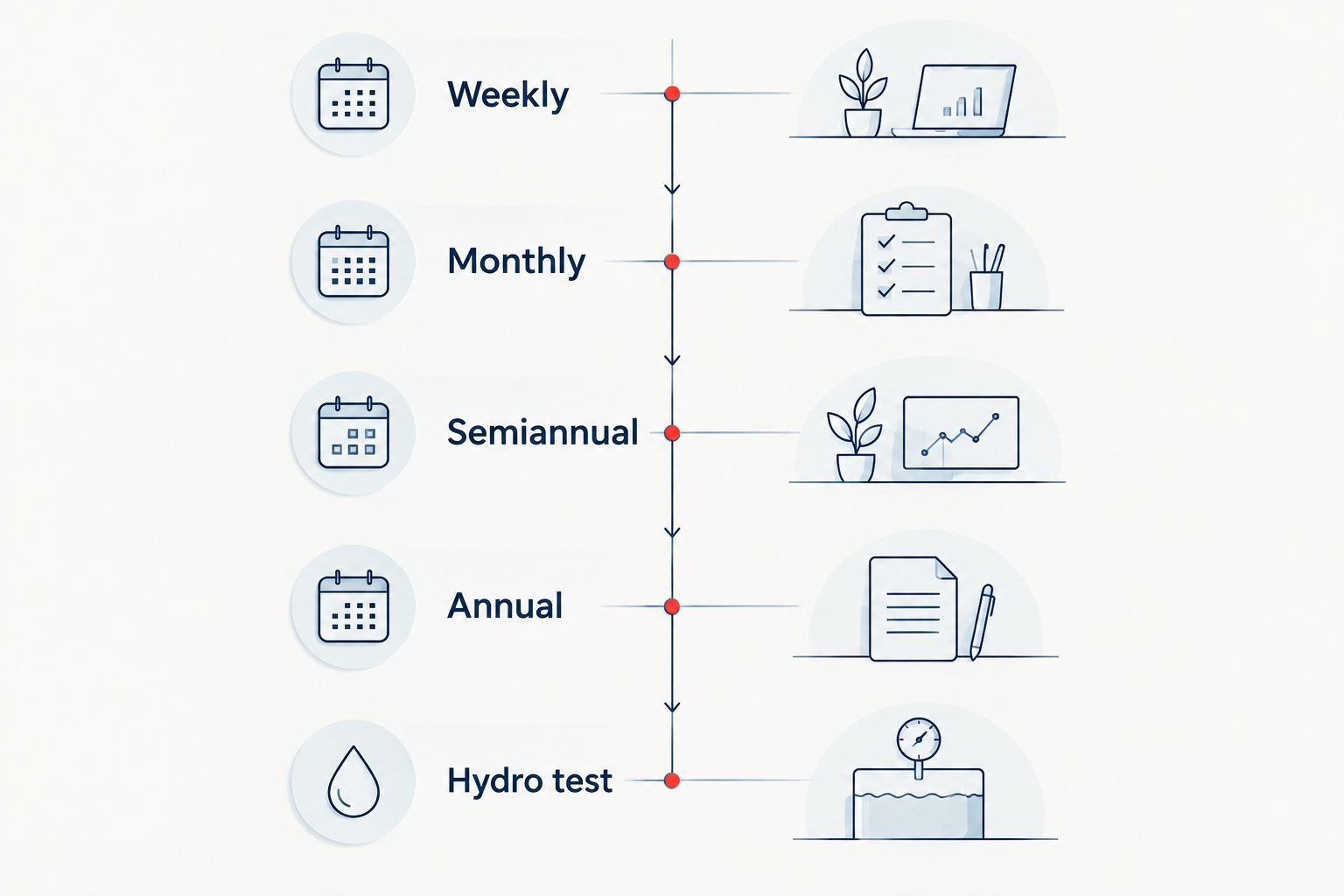
Getting a tag current on a fixed schedule matters more than the specific interval — an annual inspection compliance workflow keeps the monthly, annual and hydro-test clocks running independently instead of collapsing into one due date.
Where the intervals diverge by industry
Coal mining and marine operations carry the tightest requirements on this list, and that's not incidental — both sectors combine confined spaces, flammable materials and federal oversight bodies (MSHA and USCG) that write their own inspection schedules on top of NFPA baselines.
- Coal mining: MSHA's weekly mobile-equipment check under 30 CFR Part 75 sits on top of whatever NFPA 10 or suppression-system schedule already applies to the same equipment. Documentation has to satisfy both. The MSHA reporting workflow covers how those two schedules get logged without duplicating paperwork.
- Marine and towboat operations: USCG inspection of fixed suppression systems runs annually under 46 CFR, but portable extinguishers on the same vessel still follow NFPA 10's monthly visual and annual maintenance cycle. The Coast Guard inspection workflow walks through how the two overlap on a single vessel.
- Commercial kitchens: NFPA 96's semiannual interval catches operators who assume kitchen suppression follows the same annual clock as their fire alarm panel. It doesn't — six months, not twelve.
- Fleet and vehicle operations: DOT-regulated fleets under 49 CFR 393 run on an annual inspection cycle tied to the vehicle inspection itself, but a monthly visual check on the extinguisher mount catches the failures that happen between annual inspections.
Get your inspection schedule mapped
See which intervals apply to your systems and locations across KY, IL, IN, TN, MO and AL.
How to use these benchmarks
- Don't default to annual. Kitchen suppression, dry/wet chemical systems and clean agent systems all run on a 6-month clock — check the standard before setting the reminder.
- Track hydro test intervals separately from monthly and annual checks. A 2026 extinguisher tag can show current monthly and annual sign-off while still being years away from — or overdue for — hydro testing.
- Stack federal requirements where they overlap. Coal mining and marine accounts answer to MSHA or USCG on top of NFPA baselines — one schedule that only covers the NFPA side leaves a gap.
- Treat the state or local AHJ as the real floor, not the federal standard. These intervals are the national minimum; several states and insurance carriers set shorter cycles.
FAQ
What is the standard fire extinguisher inspection interval under NFPA 10?
NFPA 10 requires a monthly visual inspection and an annual maintenance check on every portable extinguisher, separate from hydrostatic testing. Hydro test intervals run 5 or 12 years depending on the agent and cylinder type.
How often does OSHA require fire extinguisher inspections?
OSHA's 29 CFR 1910.157 requires a monthly visual inspection and an annual maintenance check, mirroring NFPA 10's schedule. The two standards are enforced together in most commercial and industrial facilities.
How often must commercial kitchen suppression systems be inspected?
NFPA 96 requires semiannual inspection of kitchen hood suppression systems — every 6 months, not annually. This applies regardless of how often the hood and duct itself gets cleaned.
What is the MSHA inspection interval for coal mining fire suppression equipment?
MSHA's 30 CFR Part 75 requires weekly checks of fire suppression equipment on mobile mining equipment underground. It's the shortest interval among the regulatory bodies covered in this table.
How often do marine vessel fire suppression systems need Coast Guard inspection?
USCG requires annual inspection of fixed fire suppression systems under 46 CFR. Portable extinguishers aboard the same vessel still follow NFPA 10's monthly visual and annual maintenance cycle.
What's the DOT inspection requirement for vehicle fire extinguishers?
FMCSA regulation 49 CFR 393 ties fire extinguisher inspection to the annual vehicle inspection cycle for DOT-regulated fleets. A monthly visual check is recommended to catch issues between annual inspections.
How often should clean agent suppression systems in server rooms be tested?
NFPA 2001 requires semiannual inspection with an annual full functional test for clean agent suppression systems, the standard used in data centers and server rooms.
Is a 5-year or 12-year hydro test required for my extinguisher?
It depends on the agent: CO2, water, wet chemical and AFFF units test every 5 years under NFPA 10, while standard dry chemical stored-pressure steel cylinders and Halon 1211 units test every 12 years.
One last thing
The interval most operators get wrong isn't the extinguisher — it's the kitchen suppression system, because NFPA 96's semiannual schedule looks identical to an annual fire alarm test on a maintenance calendar until someone lines the two standards up side by side. If your kitchen system's last service tag says more than 6 months ago, it's overdue in 2026, even if the fire alarm panel next to it is current.


