
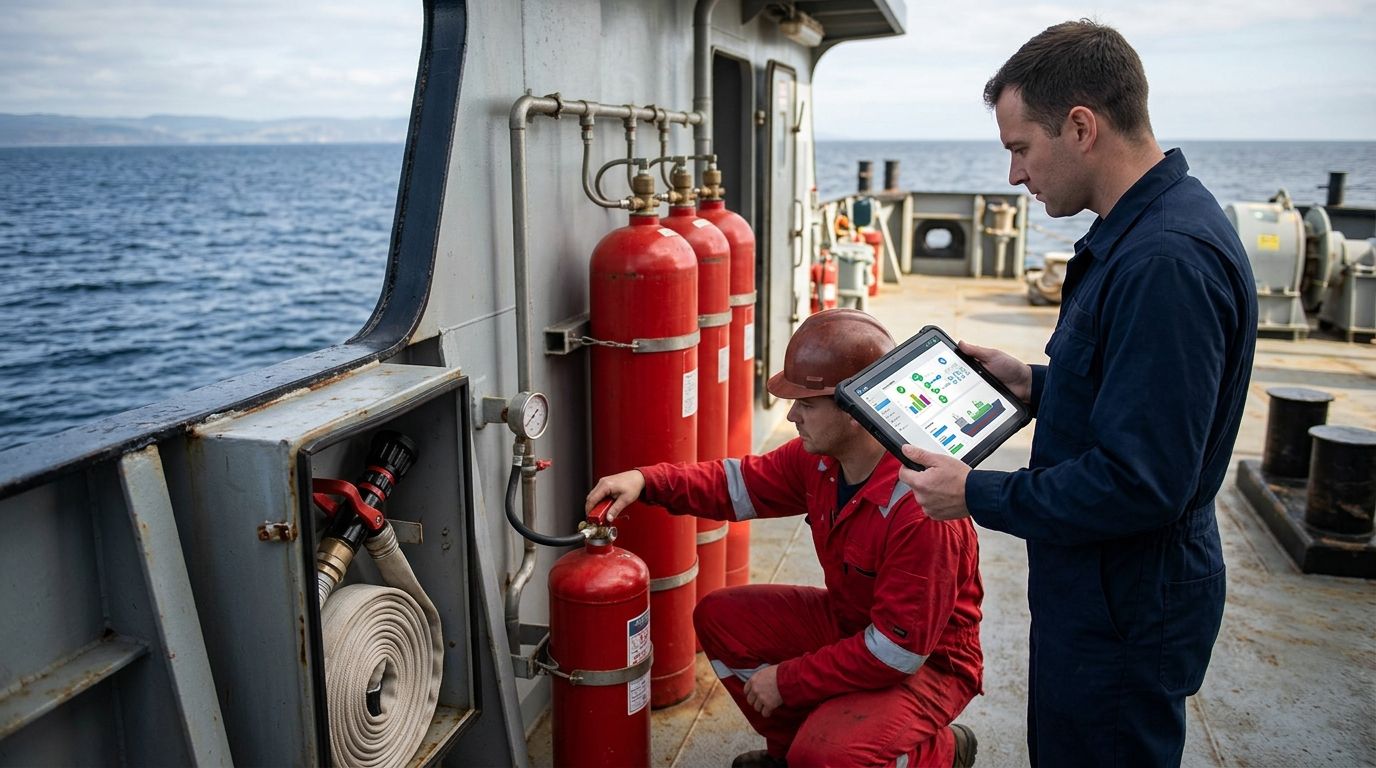
Manually tracking hydro test dates, CO2 cylinder weights, and annual survey deadlines across a fleet means someone eventually misses a tag renewal and the vessel sits at the dock. Build a repeatable workflow that ties suppression system service to your Coast Guard inspection calendar and the paperwork takes care of itself.
This guide walks through setting up marine vessel fire suppression maintenance so it feeds directly into your annual Coast Guard inspection, not a separate scramble the week before the inspector shows up.
- Marine vessel fire suppression maintenance should run on the same calendar as your Coast Guard inspection cycle, not a separate schedule.
- Fixed CO2 and clean agent systems on inspected vessels need annual servicing under 46 CFR before the Coast Guard will sign off.
- Portable extinguisher hydrostatic testing intervals run 5 to 12 years depending on agent type per NFPA 10 - track by cylinder, not by fleet.
- Schedule hydro test renewal at least 30 days before the inspection window so tags are current, not expiring, on inspection day.
- First Line Fire builds the maintenance record that walks straight into a Coast Guard inspection without a paperwork chase.
Why this matters
A vessel that fails a Coast Guard inspection over an expired hydro tag or an underweight CO2 cylinder doesn't get a warning - it gets held. That's lost charter days, delayed cargo runs, or a towboat sitting idle while paperwork gets sorted.
Most of these holds are avoidable. The failure isn't usually equipment condition - it's that hydro test dates, system inspection records, and the Coast Guard's inspection window were never tracked against each other. Marine vessel fire suppression systems and portable extinguishers both carry hard service intervals, and once you map those dates against your inspection cycle, the workflow runs itself instead of running you.
Before you start
- Vessel documentation on hand: Certificate of Inspection (COI), current fire control plan, and the machinery space cubic footage for any fixed CO2 or clean agent system - inspectors and service techs both need these numbers to verify agent concentration.
- Access to protected spaces: engine rooms, paint lockers, and any space with a fixed system need to be reachable during the service window, not mid-voyage.
- The gotcha: don't schedule your Coast Guard inspection the same week a hydro test tag expires. If the tag lapses even a day before the inspector checks it, that extinguisher gets rejected on the spot - build a 30-day buffer between hydro renewal and inspection date, every time.
For extinguishers specifically rated for towboats and barges, the fire extinguisher types built for towboats and barges differ from pleasure craft requirements - confirm class and size before you build the schedule.
Map your vessel's protected spaces
- List every space requiring fixed suppression - engine rooms, generator spaces, paint lockers - and note the system type installed (CO2, clean agent, or dry chemical).
- Record the machinery space cubic footage against the system's design concentration. This number is what a Coast Guard marine inspector checks first.
- Cross-reference against your current fire control plan. Any space added or modified since the last inspection needs the plan updated before the inspection date, not during it.
Expected result: a single list matching each protected space to its system type, agent quantity, and last service date.
Set up your fixed system inspection
- Confirm the last annual service date for each fixed CO2 or clean agent system. Under 46 CFR, inspected vessels need these systems serviced and weighed annually - a cylinder below its reject weight fails inspection outright.
- Book the annual service at least 30-45 days ahead of the Coast Guard inspection window so any flagged cylinder has time to get recharged or replaced before the inspector arrives.
- Get the service tag and weight-check documentation in writing, dated, and filed with the vessel's records - not just left on the cylinder.
Expected result: every fixed system on board carries a current annual service tag with matching weight documentation on file.
Schedule portable extinguisher hydro testing
- Pull the manufacture date and last hydro test date stamped on every portable extinguisher aboard.
- Sort by agent type - dry chemical and CO2 cylinders typically test on a 5-year cycle, while some steel cylinders run to 12 years under NFPA 10. Don't assume one interval covers the whole fleet.
- Flag anything due within the next 12 months and schedule hydro testing now, not when the tag actually expires.
- Verify class and placement still match the space - an engine room retrofit or new paint locker sometimes outgrows the extinguisher class already on board.
Expected result: a hydro test schedule sorted by cylinder, with none due to expire inside your Coast Guard inspection window. Marinas managing multiple vessels can lean on the hydro testing workflow for marinas to keep a whole fleet's cylinders on one calendar instead of tracking each hull separately.
Coordinate the Coast Guard inspection date
- Confirm your vessel's inspection cycle - most inspected vessels run on an annual or 5-year Certificate of Inspection renewal cycle, depending on vessel class.
- Lock the inspection date only after fixed system service and hydro testing are both confirmed current for at least 30 days past the inspection date.
- Bring the full documentation set to the inspection: COI, fire control plan, fixed system service tags, and hydro test certificates for every portable extinguisher aboard.
Expected result: the inspector reviews current paperwork on the first pass, no held vessel, no re-inspection trip.
Annual servicing vs. Certificate of Inspection renewal
These are two different clocks and conflating them is where most vessels get caught out. Annual servicing of fixed systems and portable extinguisher condition checks happen every year regardless of inspection cycle. Certificate of Inspection renewal is a separate, less frequent event tied to vessel class - and it's the renewal cycle where hydro-due cylinders most often get missed because nobody checked the interval against the renewal date months in advance.
Run both on the same tracking sheet. When annual servicing is current and hydro test dates are checked against the COI renewal date at least a quarter out, the renewal inspection becomes a formality instead of a fire drill.
Get your fleet inspection-ready
Marine suppression service and hydro testing scheduled around your Coast Guard inspection date.
Troubleshooting
- Hydro tag expires between scheduling and inspection day: build the 30-day buffer described above - if you're already past it, expedite the test rather than risk the hold.
- CO2 cylinder weighs in under reject point: don't attempt a partial recharge fix on inspection day - swap the cylinder and document the replacement immediately.
- Fire control plan doesn't match current space layout: any machinery space modification since the last inspection needs the plan revised and filed before the inspector reviews it, not explained verbally on the day.
- Wrong extinguisher class for a converted space: engine room retrofits and new fuel storage areas sometimes need a different class than what's currently mounted - check class against space use during the annual mapping step, not at inspection.
- Multiple vessels, inconsistent hydro dates: without a single tracking sheet across the fleet, cylinders drift onto different renewal cycles and someone always misses one. Centralize the schedule per vessel, not per cylinder batch.
Customize your workflow
Barge terminals and towboat operators running fleet-wide suppression programs can extend this same annual-plus-renewal structure across dock-side systems too - the fire suppression workflow for barge terminals covers how terminal fixed systems fit the same inspection calendar. If you're evaluating providers for marine and fleet coverage across multiple states, the comparison in Koorsen alternatives for marine and fleet fire suppression breaks down what to look for beyond price. And for the system selection itself, the ranked options in fire suppression systems for marine vessels cover CO2, clean agent, and dry chemical tradeoffs by vessel type.
The bottom line for 2026: marine vessel fire suppression maintenance works when it's tracked against the inspection date, not against the calendar year. First Line Fire services fixed suppression systems and portable extinguishers across Kentucky, Illinois, Indiana, Tennessee, Missouri, and Alabama on the same schedule your Coast Guard inspection runs on.
FAQ
What is marine vessel fire suppression?
Marine vessel fire suppression covers fixed systems - CO2, clean agent, or dry chemical - installed in engine rooms and machinery spaces, plus portable extinguishers throughout the vessel. Both are subject to Coast Guard inspection under 46 CFR for inspected vessels.
How often does a Coast Guard inspection require fixed system servicing?
Fixed CO2 and clean agent systems on inspected vessels need annual servicing and cylinder weight verification under 46 CFR. A cylinder below its reject weight fails inspection regardless of the system's age.
How often do portable fire extinguishers on boats need hydro testing?
Hydrostatic test intervals run 5 to 12 years depending on agent type and cylinder material under NFPA 10. Dry chemical and CO2 cylinders typically fall on the shorter end of that range.
What happens if a hydro tag expires before a Coast Guard inspection?
The extinguisher gets rejected on the spot during inspection, which can hold the vessel until it's replaced or retested. Schedule hydro renewal at least 30 days ahead of the inspection date to avoid this.
Is a Certificate of Inspection the same as annual fire system servicing?
No. Annual servicing happens every year regardless of vessel class, while Certificate of Inspection renewal runs on a separate cycle tied to vessel type. Both need to be tracked against each other, not treated as one event.
What size fire extinguisher does a towboat need?
Extinguisher class and size for towboats depend on vessel length and engine room configuration, not a single fleet-wide standard. Confirm current class against machinery space use before scheduling service.
Can one provider handle both marine hydro testing and fixed system service?
Yes - coordinating hydro testing and fixed system servicing through one provider keeps both clocks on a single schedule instead of two separate vendor calendars. That's the setup most fleets running multiple vessels rely on for 2026 inspection cycles.
What documentation does a Coast Guard inspector check first?
Inspectors typically start with the Certificate of Inspection and fire control plan, then verify fixed system service tags and portable extinguisher hydro dates against them. Current, dated paperwork on every system speeds the inspection considerably.
One last thing
The fire control plan is the document most fleets forget to update - a machinery space gets modified, a paint locker gets added, and nobody revises the plan until the inspector asks for it on inspection day in 2026. Update it the same day you complete the annual mapping step, not the week before your Coast Guard inspection.


