
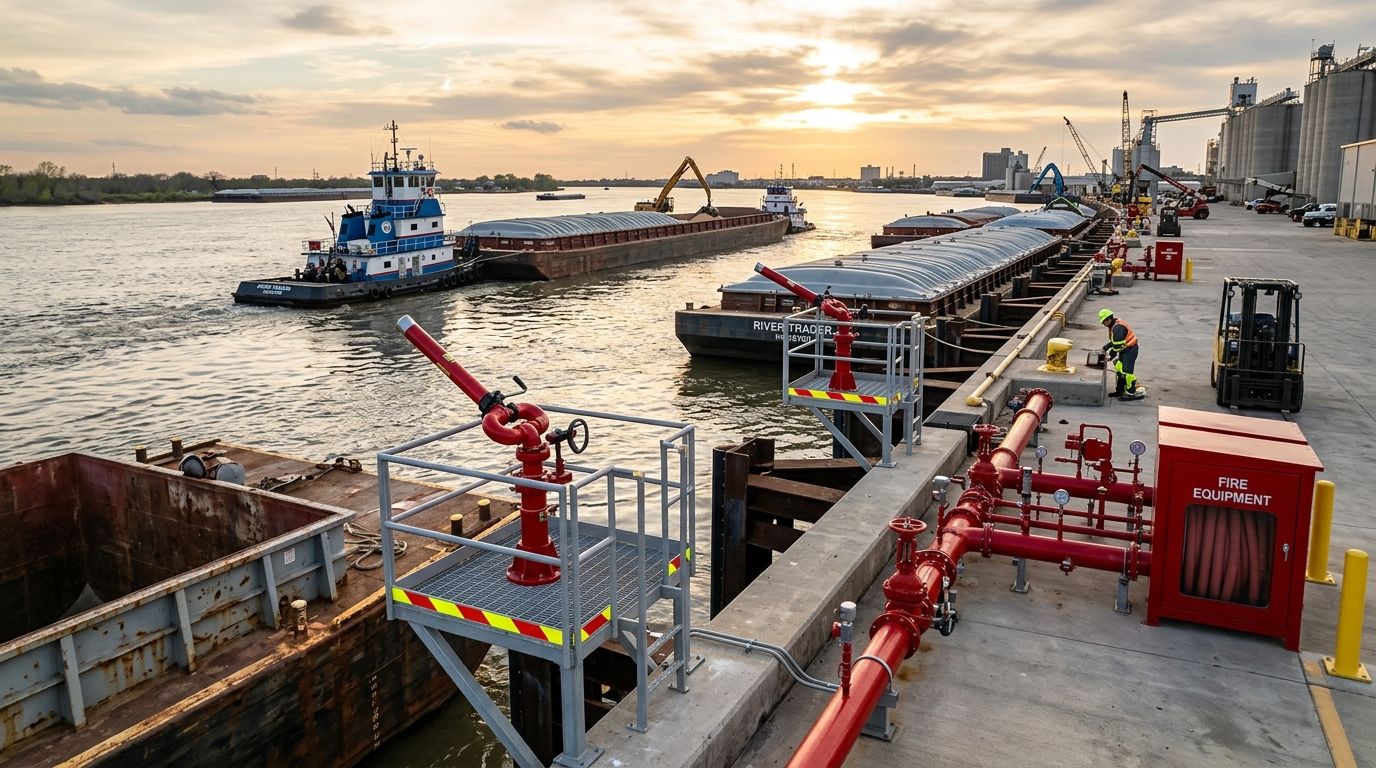
Fire suppression systems for barge terminals protect loading docks, transfer conveyors, and moored vessels from ignition sources that dry-land facilities rarely deal with at the same scale — diesel spillage on water, coal or grain dust in enclosed holds, and vapor buildup in confined transfer spaces. A terminal moving petroleum, coal, or grain faces a different fire load than a warehouse, and the suppression plan has to match the hazard at each specific point on the property, not a single generic system for the whole site.
TL;DR
- Fire suppression systems for barge terminals need separate coverage for docks, conveyors, and moored vessels — one system rarely fits all three.
- NFPA 307 and NFPA 10 set the baseline for marine terminal fire protection and portable extinguisher inspection in 2026.
- Dry chemical cylinders require hydrostatic testing every 12 years; CO2 cylinders every 5 years — miss the interval and the unit fails inspection.
- Clean agent and wet chemical systems suit enclosed electrical and control rooms; dry chemical and foam handle open dock and conveyor fires better.
- First-Line Fire services terminals across Kentucky, Illinois, Indiana, Tennessee, Missouri, and Alabama with on-site inspection and hydro testing.
Why fire suppression matters for barge terminals
A barge terminal combines three fire risks in one footprint: petroleum or chemical transfer, coal or grain dust, and diesel-powered equipment running continuously near open water. Standard commercial fire codes were not written with a loading arm or a conveyor gallery in mind — NFPA 307 covers marine terminals, piers, and wharves specifically because a fire at the water's edge behaves differently than one inside a building.
Dock crews work around fuel transfer lines and diesel-powered winches at the same time cargo is loaded or unloaded. A fire that starts at a transfer point can spread to a moored vessel in minutes, and a fire on a moored barge can spread back to the dock. That's why terminal operators plan suppression coverage as three linked zones — shore infrastructure, transfer equipment, and the vessels themselves — instead of one blanket system.
Map ignition sources and fuel loads across the terminal
Start with a walk of the site and list every point where fuel, dust, or electrical load concentrates. This step costs nothing but time and it's the foundation every other decision rests on.
- Fuel transfer points: loading arms, hoses, pump stations
- Dust-generating equipment: conveyors, elevators, screening plants handling coal or grain
- Electrical rooms and control panels near the water
- Diesel generators, compressors, and mobile equipment fueling stations
- Moored vessel engine rooms and galley areas
- Confined spaces with limited ventilation
Match suppression agent to hazard class
Once you know where the fuel loads sit, match the agent to the hazard instead of installing one system type across the whole terminal. This is where a walk-through inspection turns into a real spec.
- Class B (flammable liquid) zones need dry chemical or foam, not water
- Electrical rooms and control panels call for clean agent systems that leave no residue
- Dust-heavy conveyor galleries often need dry chemical with linear heat detection
- Confined engine spaces on vessels typically use CO2 or clean agent, sized for the enclosed volume
- A licensed contractor can size the system to the actual cubic footage and hazard class rather than a stock package
First-Line Fire designs suppression layouts hazard-by-hazard rather than selling one system across an entire site — a terminal with a pump house, a conveyor line, and three moored boats gets three different specs, not one.
Protect transfer points, conveyors, and loading arms
Transfer equipment runs constantly and takes the most wear. It also sits closest to open fuel and open water, so detection speed matters as much as the agent itself.
- Linear heat detection cable along conveyor runs, not just spot detectors
- Automatic shutoff tied to the suppression release at loading arms
- Dry chemical or foam nozzles positioned at pump seals and hose connections
- Manual pull stations at every operator station on the dock
- Regular clearing of dust buildup around detection cable — dust insulates the cable and delays activation
For terminals also running coal or grain handling equipment, the same dust-control logic applies to coal preparation plant suppression systems, where conveyor fires are the most common loss event.
Cover moored vessels and fleet boats as a separate system
A barge or towboat tied to the dock is not covered by the terminal's fixed suppression system. Vessel engine rooms, galleys, and fuel storage need their own equipment, sized for a moving asset that leaves the property.
- Fixed CO2 or clean agent systems in engine rooms, sized to enclosed volume
- Portable extinguishers rated for the vessel's specific hazard classes, mounted per Coast Guard guidance
- Automatic detection tied to an audible alarm on the bridge or wheelhouse
- Annual inspection scheduled around the vessel's actual dock rotation, not a fixed calendar date
- Records kept aboard the vessel, not just at the terminal office, since Coast Guard inspectors check the boat directly
Towboats and barges have their own extinguisher requirements separate from the terminal's fixed systems — see fire extinguisher types for towboats and barges for the class breakdown by vessel area.
Set inspection, testing, and hydro test intervals
Inspection intervals aren't optional and they aren't the same across equipment types. NFPA 10 sets a 12-month inspection cycle for portable extinguishers; hydrostatic testing runs on a longer clock tied to cylinder type.
- Dry chemical stored-pressure cylinders: hydrostatic test every 12 years
- CO2 cylinders: hydrostatic test every 5 years
- Fixed suppression systems: semiannual inspection minimum, more often in high-dust environments
- Detection cable and nozzles: visual check every inspection cycle for dust or corrosion buildup
- Tag every unit with the test date on-site so an OSHA or Coast Guard inspector can verify compliance without a records search
Miss a hydro test date and the cylinder fails inspection outright, regardless of how well the system otherwise performs. Terminal operators who track this manually on a spreadsheet lose the date more often than a service provider running it as a route.
Train crews and document for compliance
A suppression system that dock crews don't know how to activate is a system that doesn't work in the moment it's needed. Training closes that gap.
- Annual walk-through of pull station locations and manual activation procedure
- Evacuation route review specific to dock and vessel egress, not a generic office drill
- Documentation kept both on-site and off-site in case a fire damages the terminal office
- A single point of contact responsible for tracking every due date across extinguishers, alarms, and suppression systems
The terminals that pass inspection without a scramble are the ones that treat the due-date list as a schedule, not a memory.
Comparison: suppression options for barge terminal zones
| Option | Best for | Key limitation |
|---|---|---|
| Dry chemical | Open dock and transfer point fires, Class B fuel spills | Leaves residue, requires cleanup before restart |
| Wet chemical | Small galley or cooking areas on vessels | Limited to Class K, not suited to fuel fires |
| Clean agent (e.g. FM-200, Novec) | Electrical rooms, control panels, enclosed engine spaces | Higher install cost, needs sealed enclosure to work |
| CO2 | Confined engine rooms, generator enclosures | Displaces oxygen — requires evacuation before discharge |
| Foam-water | Large fuel storage and transfer areas | Needs a water supply and foam concentrate resupply |
Verdict: no single system covers a barge terminal end to end — pair dry chemical or foam at transfer points with clean agent or CO2 in enclosed electrical and engine spaces.
Get a terminal fire protection assessment
On-site review of dock, conveyor, and vessel suppression coverage.
Common mistakes barge terminals make
- Treating vessel and terminal systems as one plan. A fixed dock system doesn't protect an engine room on a moored barge — they need separate specs and separate inspection schedules.
- Letting dust bury detection cable. Coal and grain dust insulates linear heat cable over months, delaying activation until the fire is already established.
- Skipping the hydro test date because the extinguisher "still looks fine." A dry chemical cylinder past its 12-year hydro test interval fails inspection regardless of visual condition.
- Training crews once at hire and never again. Dock turnover is high in this industry; a pull station nobody remembers how to reach is a pull station that doesn't get used.
- Keeping all fire safety records in one office. If that office is damaged in the incident that triggers an inspection, there's no backup copy to show a Coast Guard or OSHA inspector.
FAQ
What suppression system works best for barge terminals?
No single system covers a whole terminal. Dry chemical or foam handles open dock and transfer-point fires, while clean agent or CO2 protects enclosed electrical rooms and vessel engine spaces. Match the agent to each zone's hazard class rather than installing one system site-wide.
How often do fire extinguishers need hydro testing on a barge terminal?
Dry chemical stored-pressure cylinders need hydrostatic testing every 12 years, and CO2 cylinders every 5 years. Annual visual inspection under NFPA 10 is required every 12 months regardless of hydro test status.
Do moored vessels need their own fire suppression separate from the terminal?
Yes. A barge or towboat's engine room, galley, and fuel storage aren't covered by the terminal's fixed dock system. Vessels need their own fixed suppression and portable extinguishers sized to their specific hazard areas.
Is dry chemical or clean agent better for a terminal control room?
Clean agent is better for enclosed electrical and control rooms because it leaves no residue and doesn't damage sensitive equipment. Dry chemical is better suited to open dock areas and transfer points where cleanup isn't a concern.
What standard governs fire protection at marine terminals?
NFPA 307, the Standard for the Construction and Fire Protection of Marine Terminals, Piers, and Wharves, sets the baseline requirements. NFPA 10 governs portable extinguisher inspection and testing on top of that.
How much does fire suppression system installation cost for a terminal?
Cost varies by zone count, agent type, and cubic footage covered — a terminal with multiple transfer points and vessel berths needs a site-specific quote rather than a flat estimate.
Can coal dust affect fire detection equipment at a terminal?
Yes. Coal and grain dust builds up on linear heat detection cable over time and insulates it, which delays activation. Regular cleaning during inspection cycles is required to keep detection response times accurate.
Who inspects fire suppression systems at barge terminals in 2026?
A licensed fire protection contractor handles inspection, testing, and hydrostatic testing on the schedule set by NFPA 10 and the equipment manufacturer, with records kept on-site and available for Coast Guard or OSHA review.
One last thing
The detail most terminals miss isn't the suppression system itself — it's the dust on the detection cable. A conveyor gallery running coal or grain dust for six months without a cleaning cycle can bury a linear heat detector enough to delay a fire signal by minutes, and minutes matter when the same fire has a fuel transfer point twenty feet away. Build cable cleaning into the same schedule as the 12-month extinguisher inspection instead of treating it as a separate task, and the whole system stays as fast as it was designed to be.


