
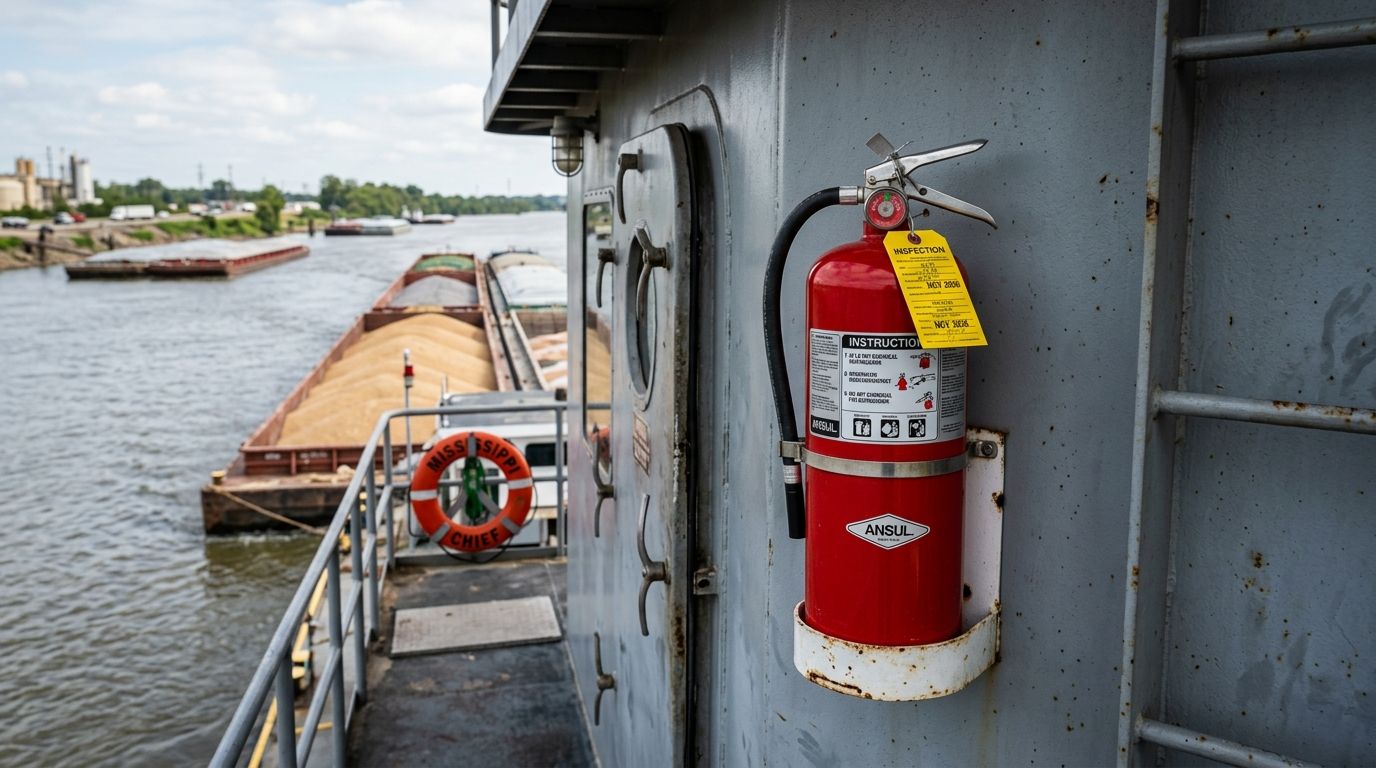
Towboats and barges run engine rooms, fuel systems, and living quarters within a few hundred feet of each other, and no single fire extinguisher type covers all three. Dry chemical B-I/B-II units win for fleet-wide Coast Guard compliance, CO2 wins for engine room electrical panels, and fixed CO2 flooding wins for unmanned engine spaces on larger tows. This guide ranks the fire extinguisher types that matter on inland and coastal towing vessels in 2026, by where each one actually earns its spot on board.
- Dry chemical B-I/B-II extinguishers are the best fire extinguisher types for towboats and barges for baseline Coast Guard compliance across the vessel.
- CO2 units are the right call for engine room electrical panels; dry chemical covers fuel and deck fires.
- Fixed CO2 flooding systems make sense for unmanned or remote engine spaces on bigger tows.
- Clean agent extinguishers protect wheelhouse electronics without leaving corrosive residue behind.
- Cylinder condition and hydrostatic test dates matter as much as agent type on inland waterway runs.
Why this matters
A towboat pushing barges on the Ohio or Tennessee River isn't docked next to a fire department. If the wrong extinguisher type is mounted in the engine room, the crew is fighting a Class B fuel fire with a Class A tool, or discharging dry chemical into avionics-grade wheelhouse electronics that now need full replacement.
Inspected towing vessels fall under 46 CFR Subchapter M, and the extinguisher type, rating, and count required depend on vessel length, engine horsepower, and whether the engine room already has a fixed suppression system installed. Getting the type wrong doesn't just fail an inspection — it leaves a fire class uncovered on a vessel that can't call for backup for an hour or more.
For a broader look at marine-rated extinguishers across recreational and commercial hulls, see fire extinguishers for boats and marinas.
What makes the best fire extinguisher type for towboats and barges
- Coast Guard-approved marine type rating — B-I or B-II classification matched to engine room size and vessel tonnage
- Agent match to the actual fire class on board — fuel and lubricant fires (Class B), electrical panels (Class C), living quarters (Class A)
- Corrosion resistance — river humidity and barge deck exposure degrade unprotected cylinders faster than land-based units
- Crew reach time — mounting location has to put the extinguisher within seconds of the engine room hatch, not buried behind gear
- Compatibility with fixed systems — portable units need to back up, not duplicate, any installed engine room suppression
- Hydrostatic test interval — NFPA 10 sets a 5-year retest cycle for CO2 cylinders and a 12-year cycle for stored-pressure dry chemical units
Fire extinguisher types for towboats and barges: at a glance
| Type | Best for | Standout feature | Key limitation |
|---|---|---|---|
| Dry chemical ABC (B-I/B-II) portable | Fleet-wide compliance baseline | Rated for Class A, B, and C fires in one unit | Corrosive residue, hard to clean off electronics |
| CO2 portable | Engine room electrical panels | No residue, safe on live electrical gear | Short discharge range, weak against wind or open deck fires |
| Dry chemical B-II wheeled | Large engine rooms and fuel-handling areas | Higher agent capacity for bigger Class B fires | Bulky, needs dedicated mounting space |
| Clean agent (Halotron/FE-36) | Wheelhouse and navigation electronics | Agent evaporates clean, no residue on instruments | Costs more per unit, shorter range than dry chemical |
| Fixed CO2 flooding system | Unmanned or remote engine rooms | Activates automatically without crew intervention | Requires engineered install and professional service |
| Water-mist / foam | Crew quarters and galley | Safe for occupied living spaces, no toxic agent | Not rated for fuel or electrical fires |
1. Dry chemical ABC portable: best for fleet-wide compliance
Dry chemical B-I/B-II extinguishers are the default marine type because one unit covers wood, fuel, and electrical fire classes at once. That versatility is why they're the minimum Coast Guard-approved type carried across crew quarters, deck lockers, and engine room approaches on most towboats.
Dry chemical pros:
- Rated for Class A, B, and C fires in a single unit
- Widely stocked, straightforward for crew to inspect and swap
- Meets baseline marine type requirements on most inspected tows
Dry chemical cons:
- Powder residue corrodes exposed electronics and instrumentation
- Doesn't cool a fire the way water-based agents do, so reignition is possible
Dry chemical pricing: varies by cylinder size and rating; confirm current options directly.
Best for: the extinguisher every towboat and barge needs somewhere on board, regardless of what else gets added. Verdict: Buy.
2. CO2 portable: best for engine room electrical panels
CO2 extinguishers displace oxygen without leaving residue, which is exactly what an engine room switchgear panel or generator control box needs. On a towboat, that means CO2 sits closest to the electrical distribution panel, not the fuel manifold.
CO2 pros:
- Leaves no cleanup on electronics or wiring
- Safe to discharge on energized equipment
- Doesn't damage sensitive control systems
CO2 cons:
- Discharge range is short, so it's a close-quarters tool only
- Loses effectiveness outdoors or in any draft
Best for: engine room electrical panels and generator compartments. Verdict: Buy.
3. Dry chemical B-II wheeled: best for large engine rooms and fuel areas
On bigger tows with more horsepower and larger fuel-handling zones, a handheld unit doesn't carry enough agent. A wheeled B-II dry chemical unit gives the crew a longer discharge time and more agent volume for a spreading Class B fire.
B-II wheeled pros:
- Higher agent capacity than handheld units
- Longer discharge time for a fuel-fed fire
- Rated for the larger engine room classification some vessels require
B-II wheeled cons:
- Takes up floor space and needs a fixed mounting point
- Heavier to maneuver in a tight engine room during an actual emergency
Best for: larger tows with bigger engine rooms and dedicated fuel-handling areas. Verdict: Buy if vessel size calls for B-II classification; otherwise B-I portable covers it.
4. Clean agent (Halotron/FE-36): best for wheelhouse electronics
The wheelhouse holds the radar, radios, and navigation electronics that keep the tow moving safely. Dry chemical residue in that space means replacing instruments after a fire that otherwise would have been contained. Clean agent extinguishers solve that by evaporating without leaving a trace.
Clean agent pros:
- No residue on navigation and communication equipment
- Effective on Class B and C fires without corrosive powder
- Compact enough for tight wheelhouse mounting
Clean agent cons:
- Costs more per unit than dry chemical or CO2
- Shorter effective range than a comparable dry chemical unit
Best for: wheelhouse, control rooms, and any space with electronics you can't afford to coat in powder. Verdict: Buy for the wheelhouse specifically.
5. Fixed CO2 flooding system: best for unmanned engine rooms
Some towboats run engine rooms that aren't continuously staffed, especially on longer river routes. A fixed CO2 flooding system detects and discharges automatically, covering the gap between ignition and a crew member reaching a portable unit.
Fixed CO2 pros:
- Activates without waiting on crew response
- Floods the full engine room volume, not just a point source
- Backs up whatever portable units are already mounted nearby
Fixed CO2 cons:
- Requires an engineered install matched to the compartment's volume
- Needs professional inspection and service on a set schedule, not a DIY recharge
See how fixed marine suppression compares by vessel type in fire suppression systems for marine vessels.
Best for: unmanned or remote engine compartments on larger tows. Verdict: Buy if the engine room runs unstaffed for stretches of the route.
6. Water-mist / foam: best for crew quarters and galley
Crew quarters and the galley carry a different fire risk than the engine room — cooking fires and ordinary combustibles, not fuel or live current. Water-mist and foam units handle Class A fires without introducing a toxic agent into occupied living space.
Water-mist / foam pros:
- Safe to use in spaces where crew sleep and eat
- No toxic residue or displaced-oxygen risk in occupied rooms
Water-mist / foam cons:
- Not rated for fuel or electrical fires, so it can't replace CO2 or dry chemical elsewhere on the vessel
- Least versatile type on this list if it's the only unit aboard
Best for: galley and crew quarters, as a supplement, not a substitute for engine room coverage. Verdict: Buy as a supplement.
How we ranked these
Each type was weighted against the criteria above: Coast Guard marine type rating, fire class match to where it's mounted, corrosion resistance, crew reach time, fixed-system compatibility, and hydrostatic test interval. No single type scored well across every criterion — that's the point. A towboat needs at least two or three of these types working together, not one unit doing every job.
“If the extinguisher matches the wrong fire class, it doesn't matter how fast the crew reaches it.”
For a full classification breakdown of what each portable rating actually covers, check portable fire extinguishers ranked by class.
Which fire extinguisher type should you choose?
Start with dry chemical B-I/B-II units for baseline coverage across the vessel — that's the type that satisfies most Coast Guard inspections in 2026. Add CO2 at the engine room electrical panel, clean agent in the wheelhouse, and a fixed CO2 system if the engine room runs unmanned on any part of the route. Skip water-mist as a standalone unit; it only works as a supplement in crew quarters.
Whichever mix you land on, cylinder condition matters as much as agent type. A dry chemical unit past its 12-year hydrostatic test date, or a CO2 cylinder past its 5-year cycle, fails inspection regardless of how well it's positioned. Check current recharge timing and cost in fire extinguisher recharging cost before the next inspection window.
Get your fleet inspected before your next tow
Marine extinguisher inspection, hydro testing, and recharge across KY, IL, IN, TN, MO, and AL.
FAQ
What's the best fire extinguisher type for towboats and barges?
Dry chemical B-I/B-II portable units cover the widest range of fire classes and satisfy baseline Coast Guard requirements for inspected towing vessels in 2026. CO2 and clean agent units supplement dry chemical near electrical panels and wheelhouse electronics.
Do towboats need Coast Guard-approved extinguishers?
Yes. Inspected towing vessels fall under 46 CFR Subchapter M, and extinguishers must carry a Coast Guard-approved marine type rating matched to vessel size and engine room configuration.
Is CO2 or dry chemical better for engine rooms?
CO2 is better for electrical panels because it leaves no residue and is safe on live equipment. Dry chemical is better for larger fuel-fed fires because it carries more agent volume and covers a broader area.
How often do marine fire extinguishers need hydrostatic testing?
NFPA 10 sets a 5-year hydrostatic test interval for CO2 cylinders and a 12-year interval for stored-pressure dry chemical units. River humidity and deck exposure can push visual inspections more frequent than that baseline.
Can one extinguisher type cover the whole vessel?
No. A single type leaves a fire class or a location uncovered on most towboats. Engine rooms, wheelhouse electronics, and crew quarters each call for a different agent.
What fire extinguisher type works best in a wheelhouse?
Clean agent extinguishers like Halotron or FE-36 work best in the wheelhouse because they evaporate without leaving residue on navigation and communication electronics.
Do barges need fixed suppression systems?
Barges with unmanned or remote engine compartments benefit most from a fixed CO2 flooding system, since it activates automatically without waiting on crew response. Manned engine rooms can often rely on portable units backed by regular inspection.
How much does fire extinguisher recharging cost for marine fleets?
Recharge cost depends on cylinder size, agent type, and whether hydrostatic testing is due at the same service visit. Check current pricing directly rather than budgeting off a fleet average.
One last thing
River humidity and barge deck exposure corrode extinguisher cylinders faster than the same units mounted in a dry warehouse, which means a visual check between scheduled inspections catches rust and pressure gauge drift before it becomes a failed inspection tag in 2026. Crews that build a monthly walk-check into the wheelhouse log routine catch that early far more often than crews relying on the annual service date alone.


