
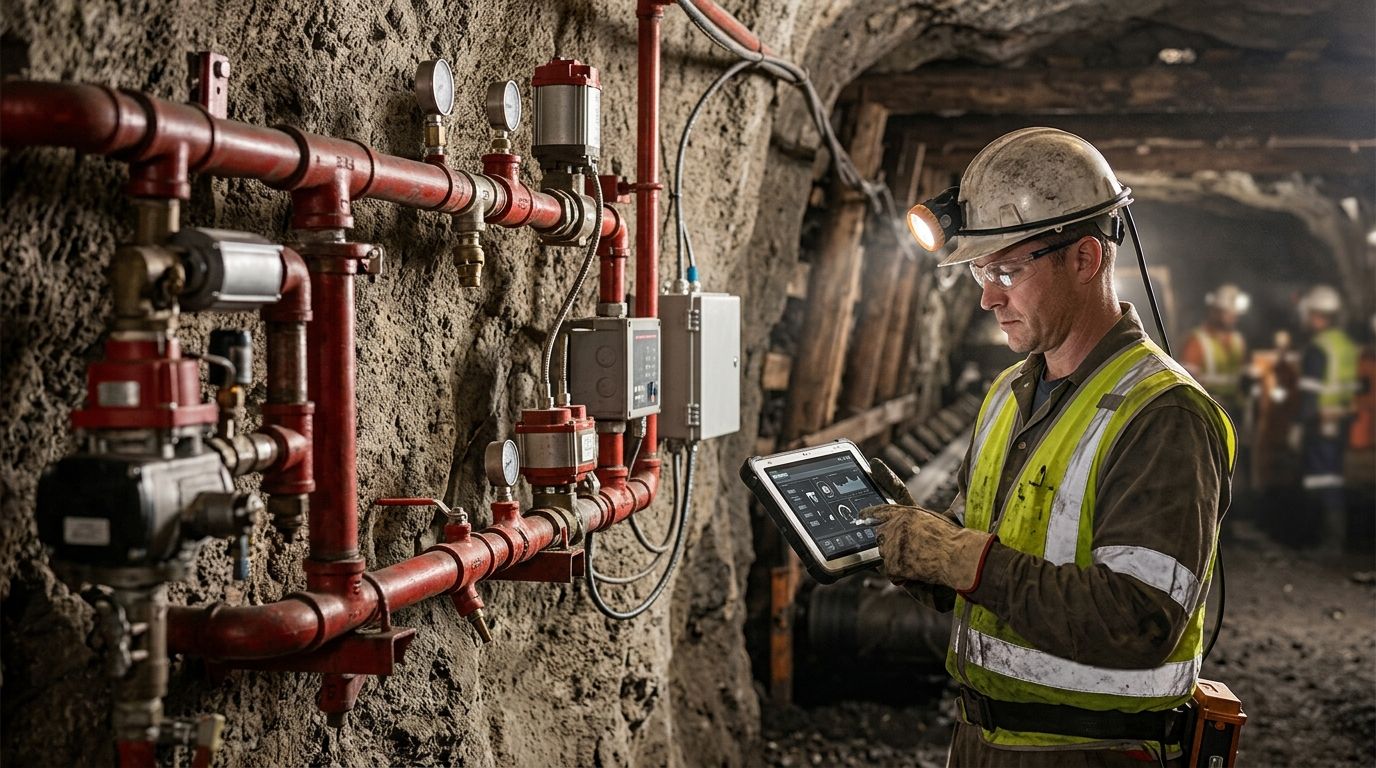
You've got a suppression system watching the belt line, but a discharge doesn't file the MSHA paperwork for you — someone has to connect the two, on the clock, or the mine eats a citation on top of the incident. Instead of scrambling to remember reporting windows after a discharge, build the notification workflow now so the clock starts correctly and Form 7000-1 gets filed clean.
- An unplanned mine fire not extinguished within 10 minutes of discovery is immediately reportable to MSHA under 30 CFR Part 50.10.
- The 15-minute notification clock starts at discovery, not at suppression system activation or extinguishment.
- Coal mining fire suppression systems on belt conveyors fall under 30 CFR 75.1103 and need documented activation logs, not just working sensors.
- Accidental discharges with no fire don't trigger MSHA reporting but still need an internal log for insurance and citation defense.
- Form 7000-1 is due within 10 working days for reportable injuries, illnesses, and fires — separate from the 15-minute call.
Why this matters
MSHA doesn't care how good your coal mining fire suppression systems are if the reporting workflow around them falls apart. A missed 15-minute window on a belt fire turns a contained incident into a separate citation, and inspectors will ask for the activation log before they ask about the fire itself.
Most coal operations in Kentucky, Illinois, and the surrounding mining states already have suppression hardware installed correctly. What's missing is the procedural bridge — who calls MSHA, what gets logged, and how the suppression system's own activation record ends up in the mine's federal file. That gap is what gets flagged in 2026 inspections more often than the hardware itself.
Before you start
- Confirm your suppression system type and its trigger point — deluge systems, dry chemical belt sensors, and foam systems each report activation differently, and you need to know which sensor fired before you can log a discovery time.
- Post the MSHA hotline (1-800-746-1553) and your mine ID number at every surface phone and mine office, not just the safety office — during an actual fire, whoever's closest to a phone makes the call.
- The gotcha: the 15-minute reporting clock starts at discovery, not at suppression activation and not at extinguishment. Crews commonly wait to see if the fire's out before calling, which burns the window. Train the rule as "call at discovery, update later," not "call once it's handled."
Map your suppression triggers to reportable events
- List every suppression zone on the mine — belt lines, transfer points, electrical rooms — and note the sensor or manual pull station tied to each.
- For each zone, write down what "discovery" means in practice: sensor alarm, smoke detected by a crew member, or automatic deluge activation.
- Flag any fire not extinguished within 10 minutes of discovery as immediately reportable under 30 CFR §50.10. This is the trigger that starts the 15-minute clock, regardless of whether suppression knocked it down.
- Confirm this list with your MSHA district office contact so there's no dispute later about what counts.
Expected result: a one-page zone map showing suppression type, sensor location, and reportability threshold for every fire-prone area underground and on the surface.
Set up your on-site notification workflow
- Name a primary and backup responsible person per shift whose job is making the MSHA call — not whoever happens to answer the phone.
- Post a discovery-time log sheet at the surface phone and in the mine office. The first entry on any suppression activation is the time it was discovered, written down before anyone calls anyone.
- Dial 1-800-746-1553 within 15 minutes of a reportable discovery. Give the mine ID, location, and a one-line description — details can follow, the call can't wait.
- Log the call time itself next to the discovery time. Inspectors compare these two numbers first.
Expected result: every shift has a named caller, a posted number, and a paper trail showing discovery time and call time within 15 minutes of each other.
Document the incident for Form 7000-1
- Record the suppression system that activated (belt sensor, deluge, portable extinguisher) and whether it fully extinguished the fire or just knocked it down before crews finished it.
- Note extinguishment time separately from discovery time — MSHA wants both, and they're not the same field.
- Attach the suppression system's own activation printout or panel log if the system generates one. This corroborates your written log instead of relying on memory.
- File Form 7000-1 within 10 working days. This deadline is separate from the 15-minute call and applies even if the fire was minor.
Expected result: a completed 7000-1 packet with discovery time, call time, extinguishment time, and suppression hardware ID all cross-referenced.
Tie inspection records into your MSHA file
Suppression systems that haven't been inspected on schedule create a second problem during an MSHA review: the citation isn't just about the fire, it's about whether the system was compliant when it activated. Keep hydro testing and inspection sign-offs filed alongside incident reports, not in a separate binder nobody checks. The extinguisher inspection to marshal sign-off workflow covers how to structure that recordkeeping so it's ready before an inspector asks for it.
Logging accidental discharges (no fire present)
Suppression systems trip without a fire more often than mines like to admit — a bad sensor, a maintenance error, static discharge near a dry chemical system. These events don't meet the 30 CFR §50.10 threshold and don't require the 15-minute MSHA call.
Still log them the same way:
- Record discovery time, system involved, and cause if known.
- Note downtime while the system resets or gets recharged.
- Keep this log separate from reportable-fire logs, but in the same file structure, so a pattern of false activations is visible before it becomes a real incident.
Expected result: a clean separation between reportable fires and false activations, both time-stamped and both retrievable in seconds during an inspection.
Get your suppression system inspection-ready
On-site review of coal mining fire suppression systems before your next MSHA inspection.
Troubleshooting
- Discovery time and call time don't match up on the log. Assign the log sheet to a fixed physical location (the surface phone), not a clipboard that moves around — inconsistent locations are the top cause of missing timestamps.
- Crew waited to see if the fire was out before calling. Retrain on the rule explicitly: call at discovery, not at resolution. A follow-up call updating status is fine; a late first call is a citation.
- Suppression panel log doesn't match the written discovery time. Panel clocks drift. Check and sync suppression system clocks against the mine office clock monthly, not just after an incident forces the comparison.
- 7000-1 filed late because nobody owned the paperwork. Assign Form 7000-1 completion to the same responsible person who makes the 15-minute call, so the whole incident stays with one owner from discovery to filing.
- False activations aren't tracked, so a failing sensor keeps tripping the system. Log every discharge, reportable or not — a sensor tripping three times in a month is a maintenance problem, not three separate incidents.
Customize your workflow
Once the notification and documentation steps are running, extend the same structure to crew training and equipment selection. If your crews aren't drilled on discovery-time logging, the workflow breaks at the first real fire regardless of how good the paperwork template is — the fire safety training for coal mining crews guide covers how to build that drill into a regular schedule.
Mines running multiple suppression types across belt lines, prep plants, and surface facilities should also standardize the zone map format across all sites so a district-wide MSHA review doesn't turn up three different logging systems in three different formats.
Verdict: build the notification workflow around discovery time, not activation or extinguishment, and coal mining fire suppression systems stop being a paperwork liability during MSHA inspections in 2026.
FAQ
When does a coal mine fire have to be reported to MSHA?
An unplanned mine fire not extinguished within 10 minutes of discovery must be reported to MSHA within 15 minutes under 30 CFR Part 50.10. The clock starts at discovery, not at suppression system activation.
Does a suppression system activation count as MSHA reporting?
No. A suppression system knocking down a fire doesn't file anything with MSHA — a person has to call 1-800-746-1553 within 15 minutes of discovery if the fire meets the reportable threshold.
How long do you have to file Form 7000-1 after a fire?
Form 7000-1 is due within 10 working days of a reportable fire, injury, or illness. This is separate from the 15-minute phone notification and applies even after suppression handled the incident.
Do accidental suppression discharges need to be reported to MSHA?
An accidental discharge with no actual fire generally doesn't meet the 30 CFR Part 50.10 threshold, so it doesn't require the 15-minute call. It should still be logged internally for maintenance tracking and insurance purposes.
What triggers the 30 CFR 75.1103 requirements for belt conveyors?
30 CFR 75.1103 covers automatic fire sensor and warning device systems on underground coal mine belt conveyors. Mines running belt lines need documented, working sensor systems tied to an alarm, not just suppression hardware.
Who should make the MSHA notification call at a coal mine?
A named responsible person per shift, with a backup, should own the call. Posting the MSHA hotline at every surface phone and mine office removes the delay of finding the right person during an actual fire.
What's the difference between discovery time and extinguishment time on an MSHA report?
Discovery time is when the fire was first detected, and it starts the 15-minute reporting clock. Extinguishment time is when the fire was fully out, and both need separate entries on Form 7000-1.
One last thing
The single most common reason mines get cited after a fire that was actually handled correctly is a discovery-time log that doesn't exist — the suppression system worked, the fire went out in under 10 minutes, and nobody wrote down when it started. Log the discovery time even on fires that self-extinguish fast, because that timestamp is the only thing that proves you didn't need to make the 15-minute call in the first place.


