
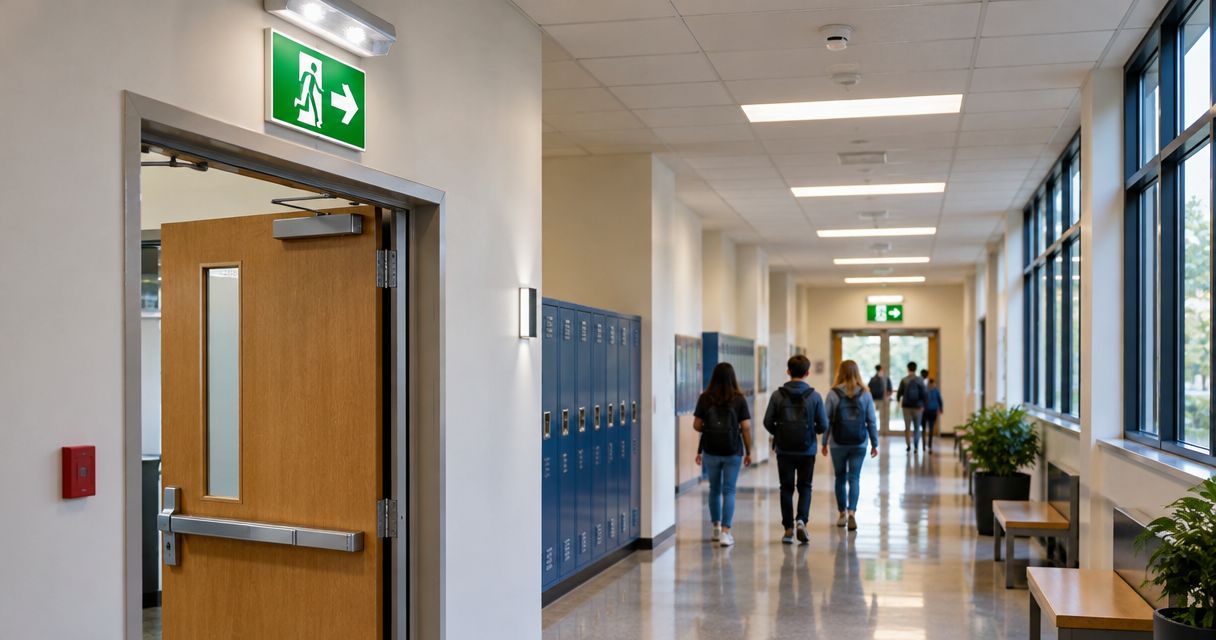
Best overall: self-testing LED exit signs with dedicated battery-backed emergency lights. Best for compact retrofits: exit-sign and light combination units. Best for larger school buildings: a central emergency inverter serving approved lighting circuits. This 2026 guide compares system types by coverage, testing, and maintenance—not by fixture brand.
- The best exit and emergency lighting for schools pairs visible exit signs with verified escape-route illumination.
- Self-testing LED exit signs and dedicated emergency lights are the default choice for conventional school retrofits.
- Central emergency inverters suit larger buildings with an engineered lighting plan and qualified maintenance support.
- Firstlinefire provides fire alarms and safety training; confirm emergency-lighting scope before assigning the work.
Why this matters
An exit sign identifies the way out. Emergency lighting lets students and staff see the route when normal power fails. You need both functions, and one does not prove the other works.
A glowing sign above a door says nothing about a dark stair landing. A bright corridor says nothing about whether the next exit is marked correctly. Start your 2026 project with the approved escape routes, not a fixture catalog.
Firstlinefire provides fire alarms, suppression systems, extinguisher services, security, and safety training across Kentucky, Illinois, Indiana, Tennessee, Missouri, and Alabama. Confirm the emergency-lighting work included in any proposal; a fire-alarm scope does not establish a lighting-installation scope.
What makes the best exit and emergency lighting for schools
Judge each system against these criteria before choosing equipment:
- Route coverage: Light the required walking surfaces, turns, stairs, and discharge areas—not just the door underneath an exit sign.
- Sign visibility: Select the correct sign faces, directional indicators, and mounting positions for the approved route.
- Power-loss response: Confirm the emergency lights respond to the required loss-of-power conditions, including relevant local lighting-circuit failures.
- Testability: Choose equipment that your maintenance team can test, identify, and record without guesswork.
- Environment fit: Match the equipment listing to moisture, temperature, physical exposure, and the actual mounting location.
- Service access: Put batteries, test controls, and central equipment where qualified staff can reach them safely.
For a 2026 specification, check the locally adopted code and the authority having jurisdiction—the official responsible for enforcing it. NFPA 101, the Life Safety Code, provides widely used emergency-lighting requirements, but local adoption determines the applicable edition and provisions.
Under NFPA 101's conventional emergency-lighting provisions, required illumination lasts 90 minutes. Initial illumination along the egress path averages at least 1 foot-candle, with a minimum of 0.1 foot-candle at any point, measured at floor level. Those are design criteria, not a promise that any particular fixture placement complies.
School emergency-lighting systems at a glance
These options are not all substitutes. A school can use self-testing units indoors, wet-location equipment outside, and emergency drivers in selected rooms.
| Rank and system | Best for | Standout feature | Key limitation |
|---|---|---|---|
| 1. Self-testing LED exit signs and dedicated battery-backed lights | Conventional school retrofits | Separate sign placement and route-lighting placement | Distributed batteries still need service |
| 2. Exit-sign and emergency-light combination units | Compact exit-door retrofits | Sign and adjustable light heads in one assembly | Door location can limit useful light coverage |
| 3. Central emergency inverter with compatible LED fixtures | Larger buildings with engineered circuits | Centralized backup for selected lighting loads | Requires circuit design and central equipment maintenance |
| 4. Wet-location-rated exit and emergency fixtures | Exposed exits and outdoor discharge routes | Equipment suited to the specified environment | Indoor-rated equipment cannot substitute |
| 5. Emergency LED drivers in compatible luminaires | Finished interiors using existing ceiling-light locations | Emergency illumination through selected normal fixtures | Compatibility and emergency output need verification |
1. Self-testing LED systems: best for conventional school retrofits
Self-testing LED exit signs and dedicated battery-backed emergency lights separate two jobs. You place signs where people need direction and emergency lights where the walking surface needs illumination. Each battery-backed unit supplies its own emergency power.
Self-testing equipment runs diagnostic routines according to its design. That reduces reliance on manually initiating every test, but it does not eliminate inspections, records, or failed-battery replacement.
Self-testing LED systems pros:
- Separate fixtures give you more freedom to cover stairs, turns, and corridors.
- Local battery backup avoids relying on one central battery source.
- Diagnostic indicators help staff identify equipment needing attention.
- Individual units can be serviced without replacing the whole lighting arrangement.
Self-testing LED systems cons:
- Batteries and service points are spread throughout the building.
- A passing diagnostic does not prove floor-level coverage or unobstructed signs.
- Indicator lights still need an assigned person to review them.
Best for: Existing schools upgrading corridor and stair lighting without replacing the entire emergency-power arrangement.
Before approving a 2026 retrofit, require fixture locations, emergency-mode coverage calculations, and a clear explanation of what each diagnostic actually checks. Ask how failed tests become repair orders. A warning light that nobody reads is not a maintenance system.
Verdict: Buy self-testing LED systems for conventional retrofits when the layout verifies both sign visibility and route illumination.
2. Combination units: best for compact exit-door retrofits
Exit-sign and emergency-light combination units put an illuminated sign and emergency light heads in one assembly. They suit locations where the sign position also gives the heads a useful view of the required walking surface.
The assembly simplifies the arrangement at a door. It does not solve lighting coverage elsewhere in a corridor or stairwell.
Combination units pros:
- One assembly provides exit identification and emergency illumination.
- Adjustable heads let qualified installers aim light toward the required path.
- Fewer separate housings simplify identification during inspections.
Combination units cons:
- The correct sign location is not always the correct lighting location.
- One damaged assembly can affect both the sign and its emergency lights.
- Separate fixtures remain necessary where corners or stairs block coverage.
Best for: Compact exit approaches where a verified design supports both functions from the same mounting position.
Check head aiming, obstructions, and illumination beyond the threshold. Do not accept a combination unit merely because it fits the existing electrical box. In a 2026 replacement project, the old mounting position still needs review.
Verdict: Buy combination units for verified door-area coverage; skip them as a blanket solution for every school exit.
3. Central emergency inverters: best for larger engineered buildings
A central emergency inverter uses a central battery source to supply compatible lighting loads when normal power fails. Selected normal fixtures can provide emergency illumination through an appropriately designed emergency circuit arrangement.
This option changes more than the fixture choice. The designer must establish supported loads, circuit behavior, equipment compatibility, and the required emergency operation.
Central emergency inverter systems pros:
- Central equipment concentrates battery service in a designated location.
- Selected ceiling fixtures can distribute light through larger spaces.
- An engineered circuit schedule identifies the supported emergency loads.
- Central status information supports an organized maintenance program.
Central emergency inverter systems cons:
- A central equipment fault can affect multiple connected areas.
- Changes to connected loads require review against system capacity.
- Installation and troubleshooting demand qualified electrical support.
Best for: Larger school buildings undergoing substantial electrical work, with an engineered lighting plan and an assigned maintenance owner.
Require the proposal to explain how local circuit failures activate the necessary lighting. A system that responds to a building-wide outage still needs the correct response to other required failure conditions.
For a 2026 project, require an updated circuit schedule at handover. Renovations must not quietly remove emergency-supported fixtures or add unreviewed loads.
Verdict: Buy a central emergency inverter when the building design and maintenance plan justify centralized backup; hold until the engineering is complete.
4. Wet-location-rated systems: best for exposed discharge routes
Wet-location-rated exit and emergency fixtures address areas exposed to water under the equipment's listing. Outdoor discharge paths also require attention to temperature ratings, mounting, and the location's actual conditions.
A sheltered doorway and an exposed exterior stair are different environments. Choose the rating from the site conditions, not from how weather-resistant a housing looks.
Wet-location-rated systems pros:
- Listed equipment addresses the specified moisture exposure.
- Suitable fixtures extend emergency illumination beyond interior doors.
- A separate environmental review catches locations overlooked by an indoor-only plan.
Wet-location-rated systems cons:
- Moisture suitability does not automatically establish cold-temperature suitability.
- Outdoor placement still needs coverage calculations and obstruction checks.
- Seals, housings, and mounting conditions require inspection.
Best for: Required exterior exit-discharge lighting and other locations with exposure matching the equipment listing.
Check the full route to the required discharge destination. A bright doorway with an unlit exterior walking path is not a completed design. Have the designer identify which exterior portions require emergency illumination under the adopted code.
Verdict: Buy properly rated equipment for exposed locations; skip indoor-only fixtures wherever the listing does not match the environment.
5. Emergency LED drivers: best for finished interior spaces
An emergency LED driver allows a compatible luminaire to produce emergency illumination from battery power. It uses the normal fixture's location rather than adding a separate wall-mounted lighting unit.
Emergency output differs from normal output. A bright ceiling fixture during class does not prove that the same fixture provides adequate emergency illumination.
Emergency LED drivers pros:
- Selected existing luminaire locations can support emergency lighting.
- Ceiling-light distribution can serve open interior spaces.
- The arrangement avoids adding a separate lighting housing at each selected position.
Emergency LED drivers cons:
- Driver, LED load, and luminaire compatibility require verification.
- Ceiling access can complicate battery service and testing.
- Fixture replacement can disrupt the approved emergency arrangement.
Best for: Finished corridors or shared spaces where compatible luminaires and calculated emergency output support the required coverage.
Specify the emergency operating output, not just the normal fixture wattage. Record which luminaires contain emergency equipment so future maintenance does not replace them with ordinary fixtures.
Verdict: Buy emergency LED drivers for verified compatible luminaires; skip unreviewed field modifications.
How the systems rank
The ranking favors route coverage, testability, and practical service access. Self-testing distributed systems take the default position because sign and light placement remain separate. Central inverters take the larger-building slot because they require a coordinated electrical design.
Combination units, wet-location fixtures, and emergency drivers win narrower applications. No ranking replaces a site-specific lighting design. Firstlinefire's fire-alarm and safety-training services address related fire-protection needs; confirm the contractor responsible for lighting design, installation, testing, and repairs separately.
Turn the choice into a workable school plan
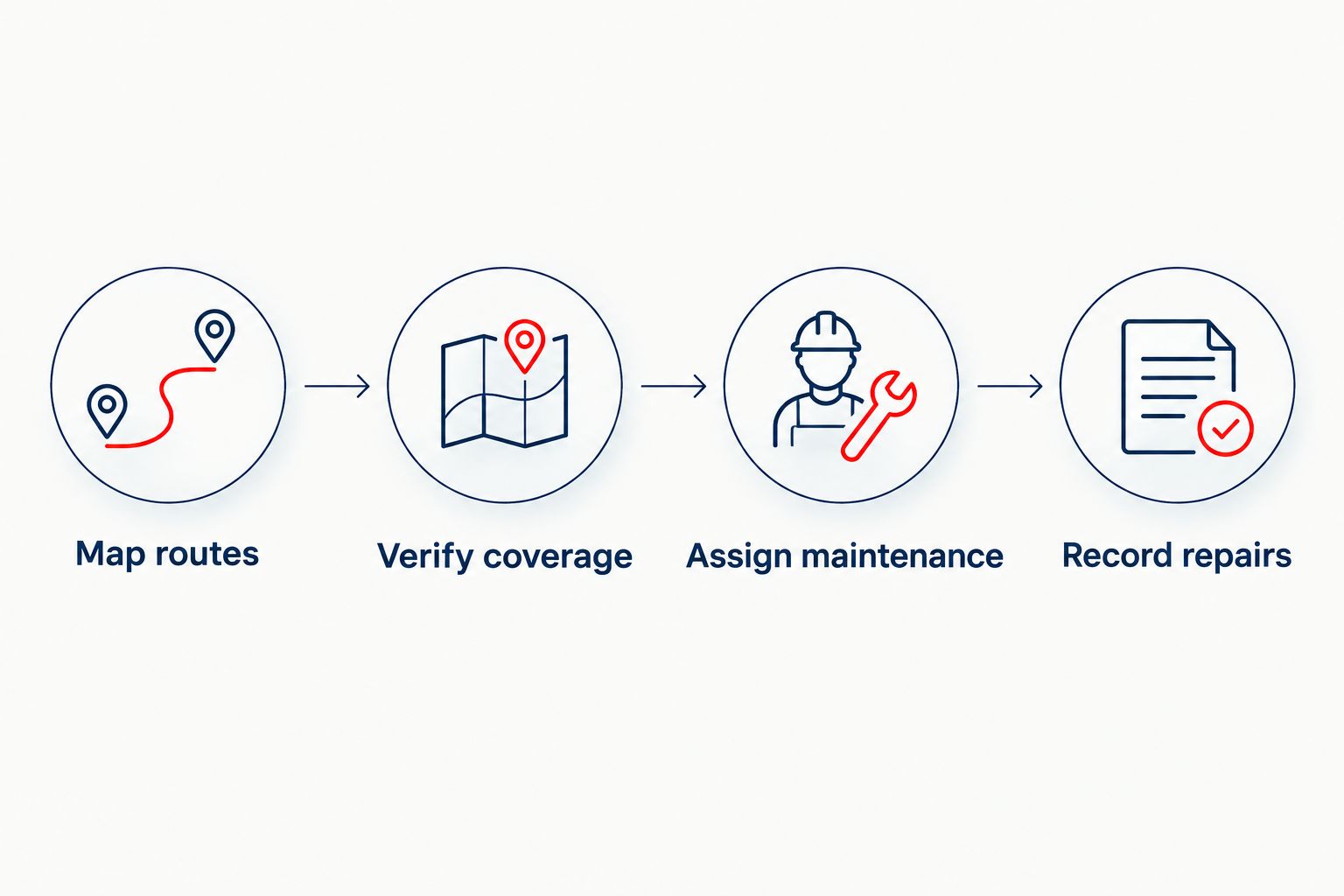
Use this sequence before approving equipment. Keep the records in the school's facilities file, not only in a contractor's inbox.
Map routes
Walk the approved paths from occupied spaces through corridors, stairs, exits, and required discharge areas. Mark signs, turns, obstructions, and changes in level. Include evening activities when daylight cannot help illuminate the route.
Verify coverage
Have the qualified designer confirm emergency-mode illumination and sign visibility. Check performance with the relevant normal lighting unavailable, using a controlled test plan. Do not ask school staff to disconnect live equipment.
Assign maintenance
Identify who reviews diagnostics, performs required tests, arranges repairs, and keeps records. Under NFPA 101's conventional battery-lighting test approach, functional testing occurs monthly for at least 30 seconds, with an annual 90-minute test. Approved self-testing arrangements have their own applicable provisions and record requirements.
Record repairs
Use a unique location identifier for each unit or supported circuit. Record failures, corrective work, and successful retests. Close the work order only after verifying restored operation.
Coordinate lighting work with the broader safety schedule without treating separate systems as interchangeable. The guide to connecting exit-lighting checks to fire-alarm testing addresses that scheduling connection.
Which school emergency-lighting system should you choose?
Choose self-testing LED exit signs with dedicated battery-backed lights as the default for a conventional retrofit. Switch to a central inverter when an engineered project supports it. Use combination units, outdoor-rated fixtures, and emergency drivers where their distinct applications fit.
The best exit and emergency lighting for schools is the arrangement that marks the approved exits, illuminates the required route, and has a documented test-and-repair owner. Specify those outcomes before approving the equipment schedule.
FAQ
What's the best exit and emergency lighting for schools in 2026?
Self-testing LED exit signs with dedicated battery-backed emergency lights are the default recommendation for conventional school retrofits. A site-specific design must verify sign visibility, emergency illumination, and the required power-loss response.
Are exit signs enough to light a school escape route?
No. Exit signs identify exits, while emergency lights illuminate the walking surface. A combination fixture provides both functions only where its placement and output satisfy the design.
How long must school emergency lighting operate?
NFPA 101's conventional emergency-lighting provisions require 90 minutes of operation. The school must follow the locally adopted code and the requirements of the authority having jurisdiction.
Do self-testing emergency lights eliminate manual checks?
No. Self-testing equipment still needs review of its status, applicable records, physical inspections, and corrective maintenance. Follow the adopted code and the manufacturer's instructions for the approved testing arrangement.
Is a central emergency inverter better than individual batteries?
A central emergency inverter fits larger buildings with engineered circuits and qualified maintenance support. Individual battery-backed units fit distributed retrofits, but neither approach is universally better.
Can a school use indoor emergency lights outside?
Only if the equipment's listing covers the actual outdoor conditions. Check moisture exposure, temperature, mounting instructions, and required illumination rather than judging the housing by appearance.
Does Firstlinefire provide school emergency-lighting installation?
Confirm emergency-lighting installation directly with Firstlinefire before assigning that scope. Its stated services include fire alarms, suppression systems, extinguisher services, security, and safety training.
One last thing
Test the failure condition, not just the test button. A fixture's local test proves only the functions covered by that test. Require qualified personnel to verify the designed response to loss of the relevant normal lighting supply, then document the result.


