
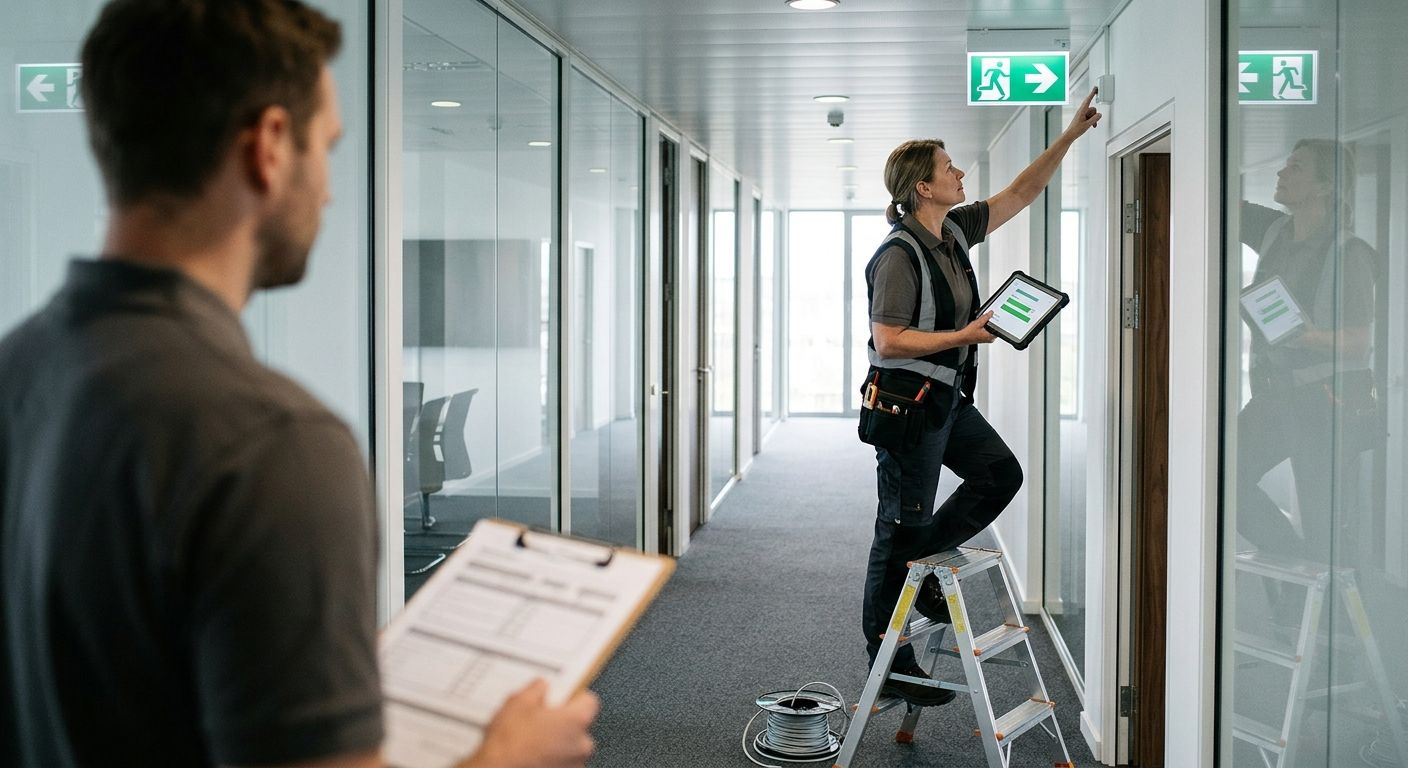
Exit lighting testing takes 90 minutes minimum for the annual full-duration test — the fixed discharge period required under NFPA 101 — stretching to several hours in buildings with dozens of fixtures spread across multiple floors, plus a quick 30-second-per-fixture check every month, in 2026. The number that catches most building owners off guard isn't the test itself — it's the documentation. Every fixture result has to be logged for the fire marshal or insurance auditor, and that paperwork adds real time on top of the testing.
- Monthly exit lighting function test takes 30 seconds minimum per fixture under NFPA 101.
- Annual full-duration test runs 90 minutes minimum per fixture, longer for buildings with many exit signs.
- Exit lighting testing time scales with fixture count, floor layout, and whether it's combined with fire alarm testing.
- First-Line Fire documents every result on-site so the log is ready before the inspector asks for it.
Why this matters
Exit lighting is one of the few life-safety systems tested on two separate schedules — monthly and annually — and each one checks something different. A building manager who assumes the quick monthly push-test covers the code requirement will fail an inspection when the annual 90-minute discharge test never happened. First-Line Fire's technicians run both on the schedule the code demands, and connecting exit lighting checks to fire alarm testing on one visit is the fastest way to keep both current without doubling site visits.
How long does exit lighting testing take per building?
The two tests aren't interchangeable, and the time commitment for each is different by design.
| Test type | Duration per fixture | Frequency | What it checks |
|---|---|---|---|
| Function test | 30 seconds minimum | Monthly | Lamp illuminates and battery briefly holds charge |
| Full-duration test | 90 minutes minimum | Annually | Battery holds full rated output under load for the entire period |
A building with 10 exit and emergency fixtures moves through the monthly check fast — each fixture only needs the 30-second minimum before moving to the next. The annual test is a different animal: the 90 minutes is a fixed discharge period, not a per-fixture stopwatch that can be rushed, which is why buildings with fixtures on separate circuits or spread across several floors take longer to clear entirely.
Monthly function test: 30 seconds per fixture
The monthly test confirms the lamp lights and the battery holds a charge for the short window NFPA 101 requires. It's a push-button or self-test-triggered check, fixture by fixture, and most buildings clear it inside a single visit.
- Confirms the lamp illuminates on battery power
- Confirms the battery holds charge for the 30-second minimum
- Gets logged fixture-by-fixture for the compliance record
- Self-diagnostic fixtures can run this automatically, cutting hands-on time
Buildings with self-testing exit signs still need someone reviewing the diagnostic logs and correcting any fixture flagged with a fault code — the test runs itself, but the paperwork doesn't.
Annual full-duration test: 90 minutes minimum
This is the test that actually determines exit lighting testing time for a building. NFPA 101 requires the battery to power the fixture at full output for a minimum of 90 minutes straight, simulating a real evacuation where power stays out. That 90 minutes doesn't compress — it's the same whether a building has 5 fixtures or 50.
What changes with fixture count is how many discharge cycles run in parallel versus back-to-back. A small office with fixtures on one circuit clears the annual test close to the 90-minute mark. A multi-floor warehouse or a facility with fixtures split across separate emergency circuits often needs multiple discharge cycles staggered through the day, which is why larger buildings report site visits running well past the 90-minute minimum.
Buildings due for fixture upgrades alongside their testing schedule can check exit and emergency lighting installation cost before the next annual cycle, since replacing an aging fixture during testing is faster than scheduling a second visit later.
Why exit lighting testing time varies
- Fixture count — more exit and emergency lights means more discharge cycles to run through the full 90 minutes.
- Self-testing vs. manual push-button units — self-diagnostic fixtures cut hands-on monthly time but still need log review.
- Battery type and age — older nickel-cadmium batteries sometimes fail mid-discharge, forcing a retest.
- Building layout — fixtures split across floors or separate electrical circuits add setup time between discharge cycles.
- Combined inspection scheduling — pairing exit lighting testing with fire alarm inspection saves a separate site visit but adds coordination time upfront.
- Documentation requirements — AHJs and insurers with stricter logging standards add paperwork time per fixture.
Schedule your exit lighting test
First-Line Fire runs monthly and annual testing across KY, IL, IN, TN, MO and AL.
How often does exit lighting need to be tested?
Exit lighting needs a 30-second function test monthly and a 90-minute full-duration test annually under NFPA 101. Both tests are mandatory regardless of building size, and skipping either one is one of the most common findings in a fire marshal inspection.
Can exit lighting testing be combined with fire alarm testing?
Yes — pairing exit lighting checks with fire alarm inspection on the same visit is standard practice for buildings already on an annual alarm testing cycle. Connecting exit lighting checks to fire alarm testing cuts down on separate site visits and keeps both logs dated the same day for the compliance file.
What happens if exit lighting fails the 90-minute test?
A fixture that fails the 90-minute test needs battery replacement or fixture repair before it passes, and the failure gets logged with a retest date. Buildings can't leave a failed exit fixture in service — it has to be corrected and retested before the annual cycle closes out.
FAQ
How long does exit lighting testing take per building?
The monthly function test takes 30 seconds minimum per fixture, and the annual full-duration test takes 90 minutes minimum per fixture in 2026. Total site time depends on how many fixtures a building has and whether they're split across separate circuits.
Is the 90-minute exit lighting test required every year?
Yes, NFPA 101 requires a 90-minute full-duration test annually for every exit and emergency lighting fixture. Skipping it is a common fire marshal citation.
Do self-testing exit signs still need manual testing?
Self-testing exit signs automate the monthly 30-second check and often the annual 90-minute test, but someone still needs to review the diagnostic logs and correct flagged fixtures. The hardware runs the test; a person still owns the compliance record.
How much does exit and emergency lighting testing cost?
Cost depends on fixture count and whether testing is bundled with fire alarm inspection. Check current options on the site for a building-specific estimate.
What's the difference between exit lighting and emergency lighting?
Exit lighting marks the path to an exit with an illuminated sign, while emergency lighting floods the surrounding area with light when power fails. Both are tested on the same monthly and annual NFPA 101 schedule.
Can one company handle both exit lighting and fire alarm testing?
Yes, First-Line Fire runs exit lighting testing alongside fire alarm inspection for commercial buildings across Kentucky, Illinois, Indiana, Tennessee, Missouri and Alabama on a single scheduled visit.
What happens if a building skips the annual exit lighting test?
A skipped annual test is a standard fire marshal citation and can affect insurance standing. Fixtures found non-compliant during a walk-through need immediate retesting and documentation.
One last thing
The 90-minute discharge test is the one building owners underestimate — it's not 90 minutes of a technician standing there, it's 90 minutes the battery has to hold output before the fixture passes, and rushing it voids the result. Buildings that fail the annual test almost always have batteries past their rated service life, not a wiring problem. First-Line Fire flags aging batteries during the monthly check specifically so the annual 90-minute test doesn't turn into a failed inspection and a second site visit.


