
Exit and emergency lighting installation cost isn't one number — it moves with fixture count, wiring condition, and whether the building is a retrofit or new construction. Facilities across Kentucky, Illinois, Indiana, Tennessee, Missouri, and Alabama see the same swings, and the line item that moves price most is almost always the electrical work behind the walls, not the fixtures themselves.
- Exit and emergency lighting installation cost depends on fixture count, wiring condition, and retrofit vs. new-construction scope — no flat number applies to every building in 2026.
- Hardwired combo units cost more upfront than battery-powered exit signs but need less battery replacement over the life of the system.
- NFPA 101 requires a 30-second monthly test and a 90-minute annual test on every emergency lighting unit, regardless of how it was installed.
- First-Line Fire installs and services exit and emergency lighting for commercial, industrial, and marine facilities across six states — get a site-specific quote instead of guessing from a national average.
Why this matters
Building owners budget for the fixtures and get surprised by everything around them: conduit runs, panel capacity, permit fees, and the testing schedule that starts the day the units go live. First-Line Fire quotes exit and emergency lighting jobs based on the actual site — panel condition, ceiling height, exit path count — because a national average number doesn't tell you what your building needs.
The fixtures themselves are a small piece of the bill on most jobs. The labor to get power to each fixture location, especially in an older building with a panel that's already near capacity, is where installation cost separates from the sticker price of the unit.
How much does exit and emergency lighting installation cost?
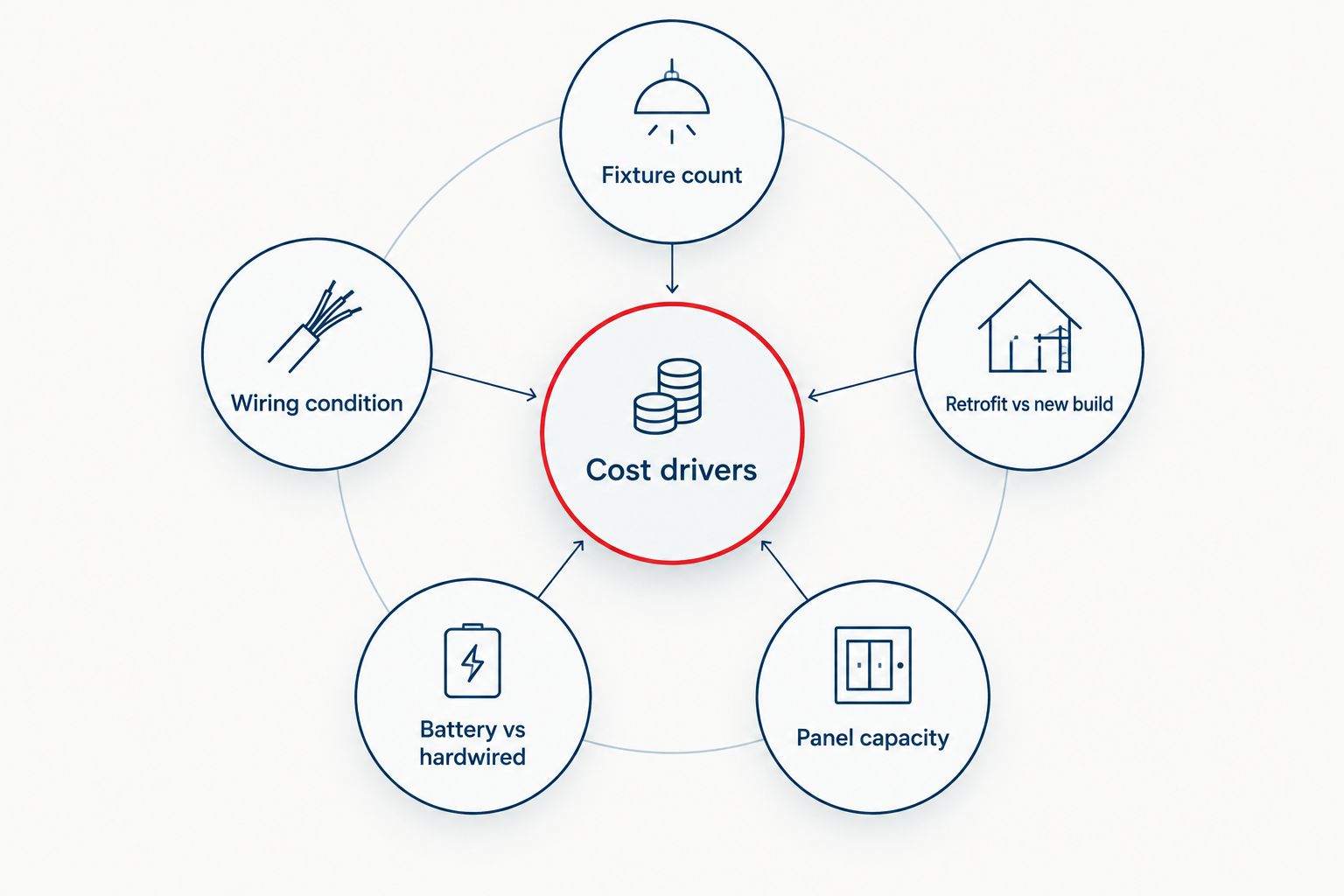
There's no single figure that fits every building, because the cost is built from several independent variables. Here's what actually drives the number up or down:
| Cost factor | Impact on installation cost |
|---|---|
| Number of exit/emergency fixtures needed | High |
| Existing electrical infrastructure (panel capacity, wiring age) | High |
| Retrofit vs. new construction | High |
| Battery-powered vs. hardwired with battery backup | Medium |
| Building size and number of exit paths | Medium |
| Permit and inspection requirements | Low to Medium |
A single-tenant office with a handful of exits and a modern panel is a different job than a multi-level warehouse retrofit where conduit has to run through finished ceilings. Get the specific factors for your building assessed before comparing any quote to a number you saw online.
Why exit and emergency lighting installation cost varies
- Fixture count — more exits and hallways mean more units, and code sets minimum spacing so you can't skip locations to save money.
- Wiring condition — an older building often needs new circuits run before a single fixture goes up, which is labor, not hardware.
- Retrofit vs. new construction — running conduit through finished walls and ceilings costs more than wiring an open frame before drywall goes up.
- Battery-powered vs. hardwired — battery units skip the electrical run but need scheduled battery replacement; hardwired units cost more to install and less to maintain.
- Panel capacity — if the electrical panel is already full, adding a circuit for emergency lighting means panel work before the lighting job even starts.
- Permit and inspection timing — jobs that need a local permit and a fire marshal sign-off add time and a line item most owners don't budget for.
Battery-powered exit signs vs. hardwired combo units
Battery-powered exit signs plug into an existing outlet or run on a self-contained battery pack, which keeps the electrical work minimal. Best for: small offices and retail spaces with simple exit paths and no plans for major remodeling. The tradeoff is scheduled battery swaps and shorter unit life compared to hardwired systems.
Hardwired combo units — a single fixture that handles both the exit sign and the emergency light — tie into the building's electrical system with battery backup for outages. Best for: warehouses, industrial facilities, and multi-tenant buildings where consistent output and less field maintenance outweigh the higher install labor. First-Line Fire's guide to emergency lighting systems for offices breaks down which unit type fits which building type in more detail.
Verdict: battery-powered signs win on simplicity and lower upfront labor. Hardwired combo units win on reliability and lower long-term maintenance. Pick based on how much the building will change over the next five to ten years, not just the install day cost.
New construction vs. retrofit installation
New construction lets an electrician run conduit before walls close up, which keeps labor predictable and lowers the electrical portion of the job. Retrofit work means opening finished surfaces, working around existing HVAC and plumbing runs, and often patching drywall or ceiling tile after the fixture goes in.
Verdict: new construction installation is the cheaper path when the timing lines up with a build-out. Retrofit costs more per fixture but is unavoidable for occupied buildings bringing exit lighting up to current code.
Get a site-specific lighting quote
Fixture count and wiring condition change the number — see what your building actually needs.
Related questions
Is exit and emergency lighting required by law in 2026?
Yes, NFPA 101 (the Life Safety Code) requires emergency lighting along exit paths in commercial and industrial buildings, and most states enforce it through the local fire marshal's office. Requirements apply regardless of building size, though the number of required fixtures scales with the number and length of exit paths.
How often does emergency lighting need testing?
NFPA 101 requires a 30-second functional test monthly and a 90-minute full-discharge test annually on every emergency lighting unit. Skipping either test is one of the most common findings during a fire marshal inspection, and it applies whether the unit is battery-powered or hardwired.
Can exit signs and emergency lights be combined into one unit?
Yes — combo units handle both functions in a single fixture, which is common in warehouses and industrial buildings to reduce the number of fixtures and wiring runs. Standalone exit signs and separate emergency lights are still used where code or layout calls for them individually.
FAQ
What's the difference between an exit sign and emergency lighting?
An exit sign marks the direction to the nearest exit, while emergency lighting illuminates the path itself when power fails. Most modern buildings use combo units that do both from a single fixture.
Do I need a licensed electrician for emergency lighting installation?
Yes, any hardwired exit or emergency lighting installation needs a licensed electrician, and most jurisdictions require a permit and inspection before sign-off. Battery-powered plug-in units have lighter requirements but still need to meet NFPA 101 placement rules.
How much does exit and emergency lighting installation cost for a small office?
Cost for a small office depends on how many exits the space has and whether the existing wiring can support new fixtures without panel work. Get a site walkthrough rather than pricing off a national figure, since a two-exit office and a ten-exit floor plan aren't comparable jobs.
Is LED emergency lighting cheaper to run than older bulb types?
LED emergency lighting draws less power and lasts longer than incandescent or fluorescent options, which lowers the maintenance burden over the life of the unit. Most new installations in 2026 use LED fixtures by default.
Does emergency lighting installation require a permit?
Most jurisdictions require a permit for hardwired emergency lighting work tied into a building's electrical panel. Battery-powered plug-in units generally don't need a permit but still have to meet NFPA 101 spacing and coverage rules.
How long do emergency lighting batteries last before replacement?
Battery life varies by unit and usage, but batteries in both self-contained and hardwired backup units need periodic replacement as part of routine maintenance. The monthly and annual NFPA 101 tests are what catch a battery that's failing before it becomes a code violation.
One last thing
The most common finding during a fire marshal inspection isn't a dead battery — it's a fixture that got painted over, boxed in during a remodel, or blocked by a shelving reset and never restored to code. Exit and emergency lighting checks tied to your regular fire alarm testing schedule catch that kind of drift before an inspector does, which is cheaper than a failed inspection in 2026.


