
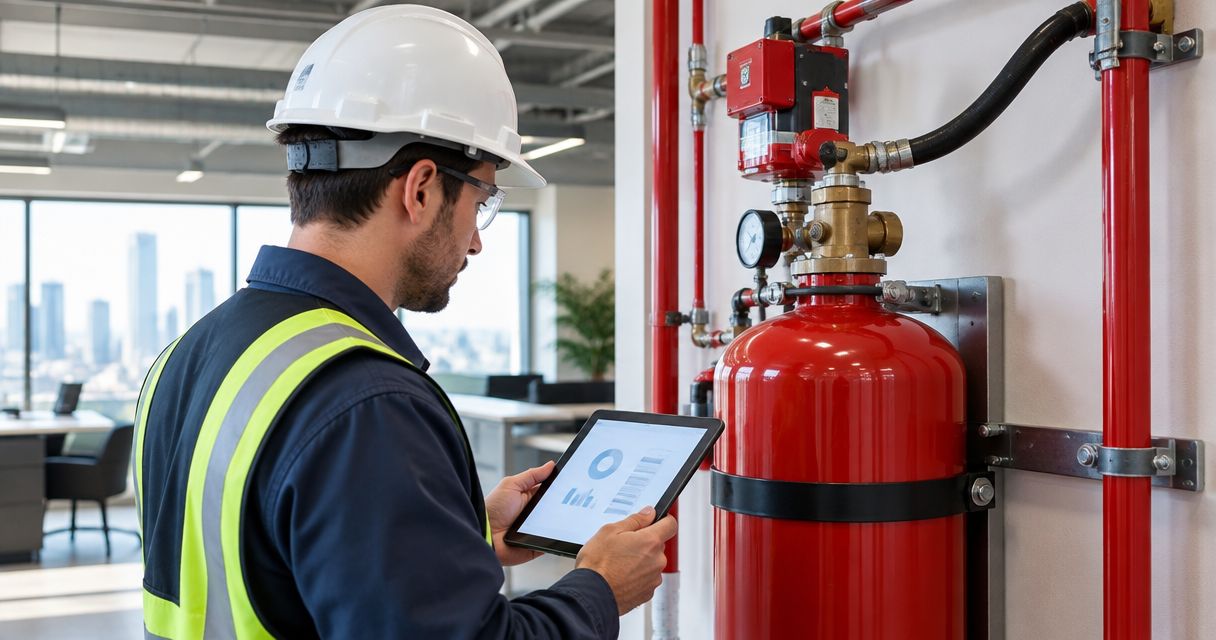
A commercial fire suppression system installation cost in 2026 depends on hazard class, agent type and the square footage or room volume being protected — a kitchen hood job and a server room job aren't priced off the same scale. The number that actually applies to your building only comes out of a site survey, but the factors that move that number are the same everywhere in the country.
- Commercial fire suppression system installation cost in 2026 tracks hazard class, agent type and square footage, not a flat rate.
- Kitchen hood systems follow NFPA 17A and need inspection twice a year; clean agent systems follow NFPA 2001.
- Cost drivers include agent type, room volume, alarm tie-in, and local permitting requirements.
- A site survey from a licensed contractor is the only accurate way to price a specific building.
- First-Line Fire Extinguisher Co. installs and services suppression systems across Kentucky, Illinois, Indiana, Tennessee, Missouri and Alabama.
Why this matters
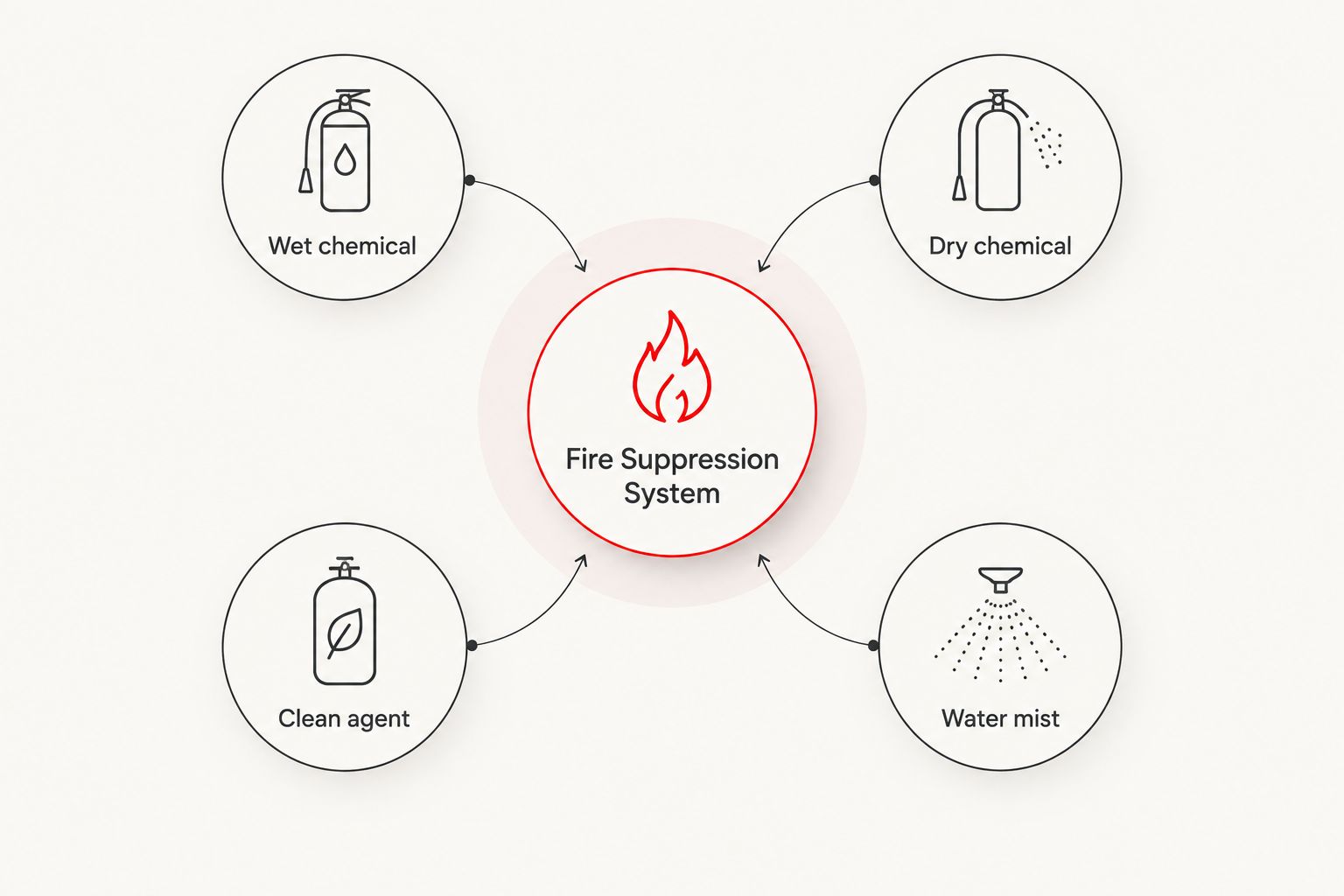
Building owners get quoted wildly different numbers for what sounds like the same job, and it's because "fire suppression system" covers at least five distinct technologies with different governing standards, different agent costs and different labor requirements. A restaurant owner comparing a hood system quote to a friend's data center quote is comparing two different categories of equipment.
Getting the category right before you shop quotes saves time and stops you from underbuilding a system that fails inspection or overbuilding one that costs more than the hazard requires. First-Line Fire Extinguisher Co. handles suppression system installation and service for commercial kitchen fire suppression systems, industrial hazards, marine vessels and fleet vehicles across Kentucky, Illinois, Indiana, Tennessee, Missouri and Alabama, and the pricing conversation always starts with the same question: what's the hazard class?
How much does a commercial fire suppression system cost to install in 2026?
There isn't one number, because the systems aren't the same product. A wet chemical system over a three-basket fryer line has a different nozzle count, piping run and agent cost than a clean agent system protecting a server room, and a dry chemical system in a paint booth is priced off a hazard classification neither of the other two uses. In 2026, the drivers that move the final number are consistent even when the dollar figure isn't: agent type, square footage or room volume, existing infrastructure, and local permitting.
The honest answer to "how much" is: get a site survey. A contractor needs to measure the space, classify the hazard, and check what's already in place (existing alarm panel, sprinkler main, electrical capacity) before a real number exists. Anyone quoting a number sight unseen is guessing.
| System Type | Governing Standard | Typical Application | Best For |
|---|---|---|---|
| Wet chemical | NFPA 17A | Kitchen hoods, fryers, griddles | Restaurants, commercial kitchens |
| Dry chemical | NFPA 17 | Paint booths, flammable liquid storage | Manufacturing, auto shops |
| Clean agent (FM-200, Novec) | NFPA 2001 | Server rooms, electrical rooms, archives | Data centers, offices with sensitive equipment |
| CO2 | NFPA 12 | Engine rooms, generator enclosures | Marine vessels, industrial equipment rooms |
| Water mist | NFPA 750 | Machine rooms, turbine enclosures | Facilities where clean agent isn't practical |
Kitchen hood systems: wet chemical, NFPA 17A
A wet chemical system installed over a cooking line covers the hoods, ducts and each appliance underneath them with a network of nozzles tied to a single pull station. Cost swings on the number of hoods, the length of duct run, and how many appliances need individual nozzle coverage — a single-hood taco counter and a six-hood hotel kitchen aren't the same install even though both fall under NFPA 17A.
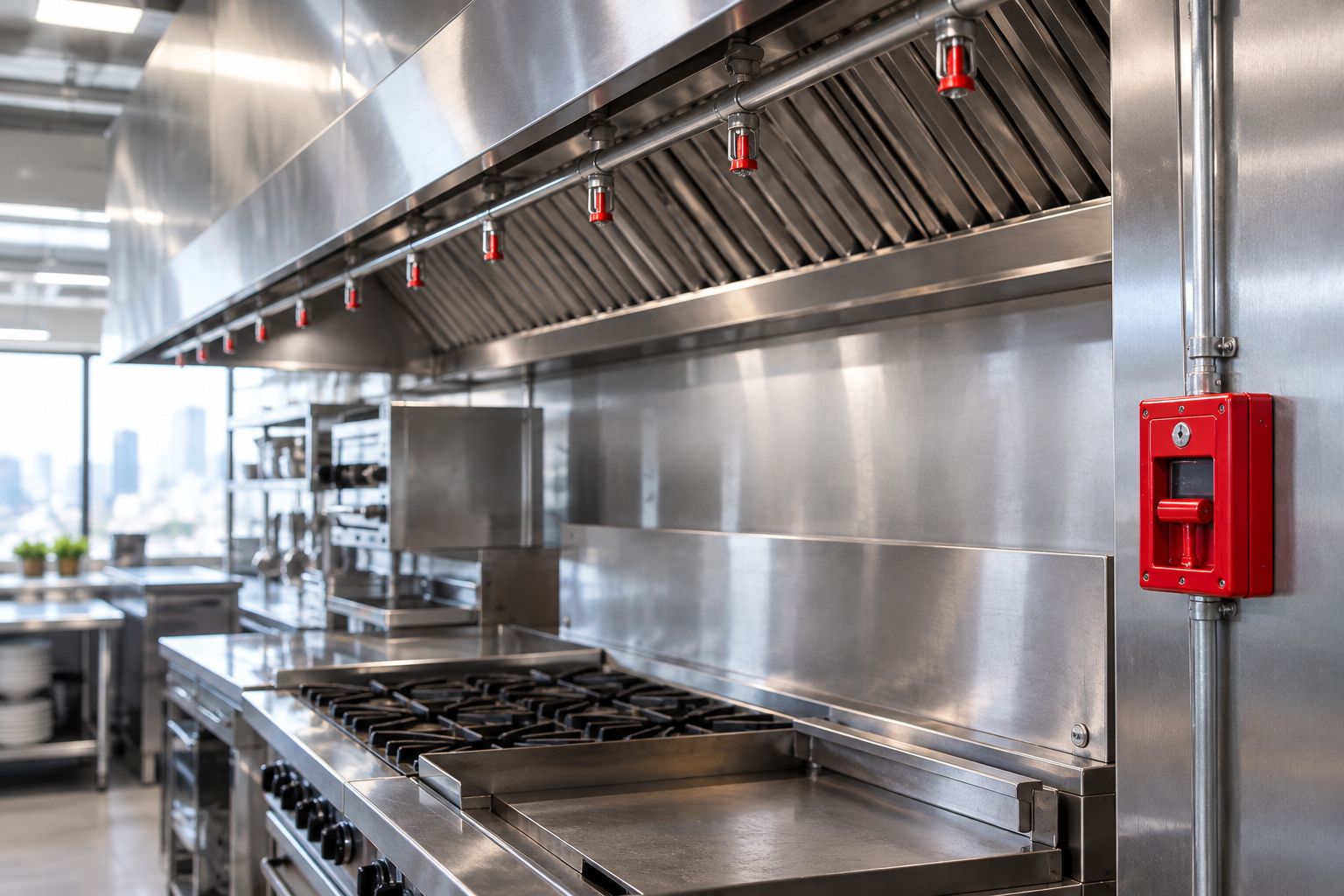
These systems require inspection twice a year under NFPA 96, so the installation quote should already assume a service contract on the back end — a system with no inspection plan is a compliance problem waiting to surface at renewal.
Clean agent systems for server rooms and electronics
A clean agent system discharges a gas — not a liquid or powder — so it protects equipment without leaving residue. Pricing here runs off room volume, because the agent concentration has to fill the enclosed space to the design concentration under NFPA 2001, and enclosure integrity (sealed doors, capped conduit penetrations) affects how much agent the room actually needs.
A data center or a records archive typically wants clean agent fire suppression systems over a water-based option specifically because the equipment inside can't take a soaking during a discharge test or a real event.
Dry chemical systems for industrial hazards
Dry chemical systems under NFPA 17 cover paint booths, flammable liquid storage and similar industrial hazard classes. Cost drivers include the number of nozzles required to cover the hazard area, cross-zoned detection if the space needs two independent triggers before discharge, and piping runs through what's often a retrofit into an existing building.
Auto shops, body shops and manufacturing floors with spray booths fall into this category more often than any other commercial occupancy.
Water-based and mist systems
Water mist systems under NFPA 750 fit spaces where a clean agent isn't practical and a full sprinkler retrofit is overkill — machine rooms, turbine enclosures, some marine engine spaces. Installation cost here depends heavily on whether water supply already exists at the site and whether the region requires freeze protection, which matters across the winter months in Kentucky, Illinois, Indiana and Missouri.
Why fire suppression system installation cost varies
- Hazard class — a Class B flammable liquid hazard needs different agent and coverage than a Class K cooking hazard.
- Square footage or room volume — clean agent and mist systems price off cubic volume, not floor space alone.
- Agent type — wet chemical, dry chemical, clean agent and CO2 all have different unit costs and different piping requirements.
- Existing infrastructure — a building with an existing fire alarm panel or water main costs less to integrate than one starting from nothing.
- Alarm and monitoring tie-in — a system that needs to report to central dispatch adds labor beyond the suppression hardware itself.
- Permitting and local code adoption — fire marshal review timelines and local amendments to NFPA standards vary by jurisdiction across Kentucky, Illinois, Indiana, Tennessee, Missouri and Alabama.
“The system sized to the hazard class costs less to maintain over time than the system that just barely meets code.”
Get a site survey before you budget
Hazard class and square footage decide the real number, not a phone quote.
Do I need a fire suppression system by law?
Most commercial kitchens with a hood need one under NFPA 96, and industrial hazard occupancies fall under whatever version of NFPA 17, 17A or 2001 the local fire code has adopted. Whether your specific building needs one depends on occupancy type and hazard classification, which a fire marshal or licensed contractor determines during plan review — not a generic yes-or-no.
How often does a fire suppression system need inspection?
Kitchen hood systems need inspection twice a year under NFPA 96 and NFPA 17A, while most other pre-engineered systems — dry chemical, clean agent, CO2 — need inspection once a year under their respective NFPA standards. Miss the interval and the system typically fails its next certification on the paperwork gap, not the hardware.
What's the difference between a wet chemical and a clean agent system?
A wet chemical system discharges a liquid that cools and saponifies burning cooking grease, which is why it's built for kitchen hoods and nowhere else. A clean agent system discharges a gas that suppresses fire without leaving residue or moisture behind, which is why it protects electronics instead of a fryer line.
FAQ
What's the best fire suppression system for a commercial kitchen?
A wet chemical system built to NFPA 17A is the standard for commercial kitchen hoods in 2026. It's built specifically to cool and suppress grease fires over fryers, griddles and ranges.
Is a clean agent system better than a sprinkler for a server room?
For equipment-heavy spaces, a clean agent system under NFPA 2001 is generally preferred over a water sprinkler because it doesn't damage electronics on discharge. Sprinklers remain standard for general building fire protection outside sensitive equipment rooms.
How much does a commercial fire suppression system cost to install in 2026?
Cost depends on hazard class, agent type and square footage or room volume, so no single figure applies across kitchen, industrial and data center installs. A site survey from a licensed contractor is the only way to get an accurate number for a specific building.
Do restaurants need a fire suppression system?
Restaurants with a cooking hood almost always need a wet chemical suppression system under NFPA 96 and NFPA 17A. The requirement applies regardless of restaurant size once a hood covers commercial cooking equipment.
What's the difference between dry chemical and CO2 suppression?
Dry chemical systems under NFPA 17 use a powder agent for flammable liquid and industrial hazards like paint booths. CO2 systems under NFPA 12 use gas and fit enclosed equipment spaces like engine rooms and generator enclosures.
How often do fire suppression systems need inspection?
Kitchen hood systems need inspection twice a year under NFPA 96. Most other pre-engineered systems need inspection once a year under their governing NFPA standard.
Can a fire suppression system be added to an existing building?
Yes, most commercial fire suppression systems are retrofit installs into existing kitchens, paint booths or equipment rooms. Existing water supply, electrical capacity and alarm infrastructure affect how much retrofit work is needed.
Does a fire suppression system replace a fire extinguisher?
No, a fire suppression system doesn't replace portable fire extinguishers required in the same space. Most occupancies need both under local fire code, covering different stages and types of fire response.
One last thing
The suppression system install is only half the compliance picture — the inspection schedule that follows it is what actually gets checked at renewal. A kitchen hood system and its portable extinguishers running on two different inspection calendars is the single most common paperwork gap that trips up an otherwise sound install in 2026, and it's avoidable by putting both on the same service schedule from day one.


