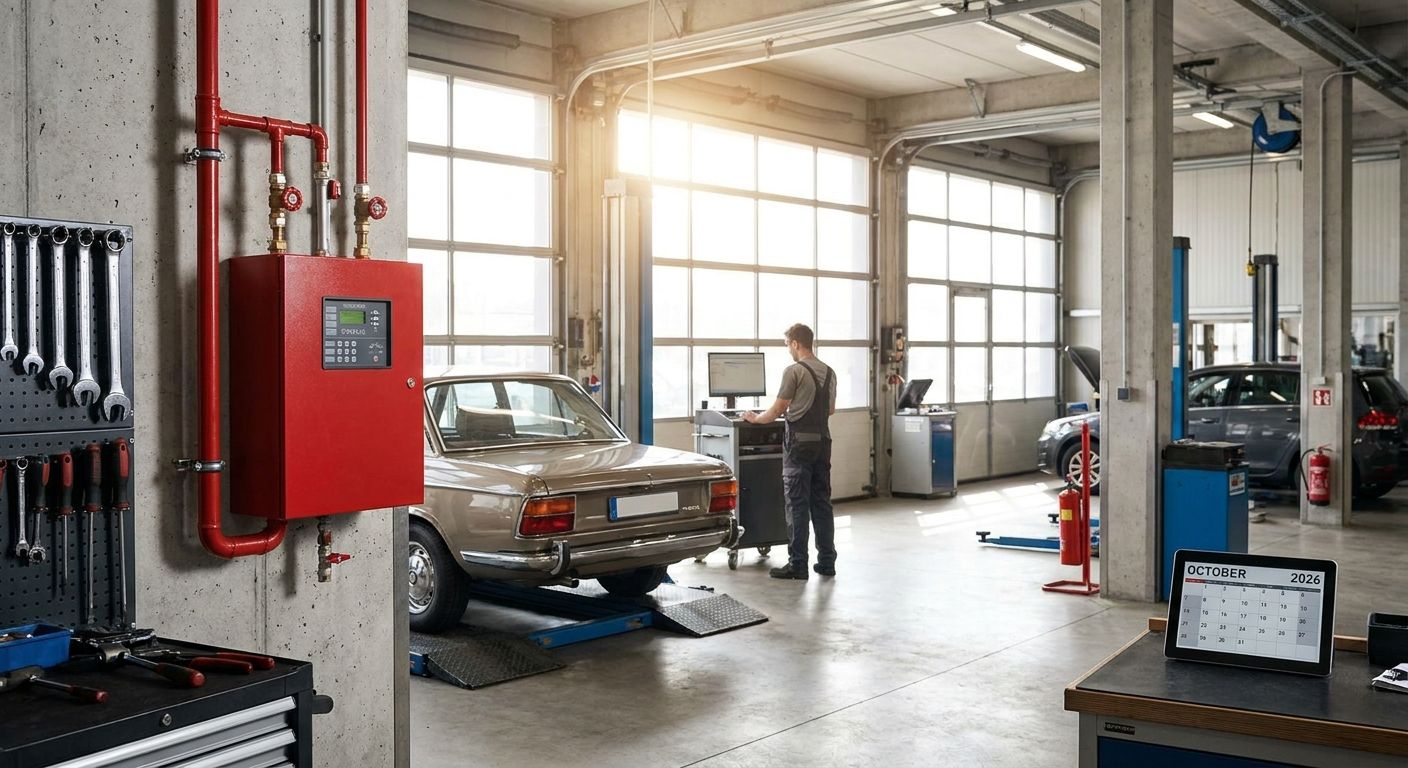
Auto shops carry fire risk that a wall-mounted extinguisher alone can't cover — paint booth flash fires, engine compartment flare-ups, flammable liquid spills near the lift. Picking the best fire suppression systems for auto shops and garages in 2026 means matching the system type to the hazard in each bay, not buying whatever the catalog pushes hardest.
- The best fire suppression systems for auto shops and garages in 2026 start with dry chemical automatic units for paint booths.
- CO2 systems suit engine compartments and enclosed equipment without leaving corrosive residue behind.
- Clean agent systems protect diagnostic bays and dyno cells without damaging wiring or sensors.
- Portable ABC and Class B extinguisher stations remain the budget baseline for general shop-floor coverage.
- First-Line Fire Extinguisher Co. installs and services all of these systems across six states.
Why this matters
A body shop stacks open-flame welding, flammable solvents, and an enclosed spray booth under one roof, and each hazard calls for a different suppression response. NFPA 33 requires an automatic fire-extinguishing system inside spray booths and spray rooms — a portable extinguisher hanging on the wall doesn't satisfy that code, and a fire marshal will flag it on inspection.
Get the system type wrong and the cost shows up twice: once in a failed inspection, and again if an insurer denies a claim because the wrong agent was protecting the wrong hazard. First-Line Fire Extinguisher Co. installs and services suppression systems for shops running everything from a single-bay garage to a multi-lift collision center across Kentucky, Illinois, Indiana, Tennessee, Missouri and Alabama, and the pattern holds across all of them in 2026: booths need automatic systems, engines need clean agents, and the shop floor still needs portable coverage regardless of what fixed system sits in the booth.
What makes the best fire suppression system for an auto shop
Rank a system against these six points before an installer ever quotes it:
- NFPA compliance for the specific bay — spray booths and spray rooms fall under NFPA 33; general work areas fall under NFPA 10 for portable extinguishers.
- Automatic activation — a system that trips on heat or flame without waiting for someone to spot the fire and pull a pin.
- Residue and cleanup after discharge — some agents shut a shop down for hours of cleanup; others leave nothing behind.
- Hazard match — flammable liquid fires (Class B), electrical fires (Class C), and ordinary combustibles (Class A) each need a compatible agent.
- Inspection and recharge cycle — a system only protects the shop if it gets serviced on schedule, not just installed once and forgotten.
- Local install and service coverage — a system with no nearby contractor for annual testing turns into deferred maintenance fast.
Fire suppression systems for auto shops at a glance
| System | Best for | Standout feature | Key limitation |
|---|---|---|---|
| Dry chemical automatic suppression | Paint and spray booths | Trips automatically via heat detection and cuts fuel/electrical to the booth | Leaves corrosive residue that requires cleanup after discharge |
| CO2 suppression systems | Engine compartments and enclosed equipment | Leaves no residue and won't damage sensitive electronics | Displaces oxygen, so occupied spaces need pre-discharge alarms |
| Clean agent systems (FM-200/Novec 1230 type) | Diagnostic bays and electronics-heavy control rooms | Extinguishes without damaging wiring harnesses or diagnostic gear | Costs more to install than dry chemical systems |
| Foam suppression systems | Flammable liquid storage and fuel dispensing | Blankets the fuel surface to stop vapor release and reignition | Not effective on electrical fires; needs concentrate replenishment |
| Portable ABC/Class B extinguisher stations | General shop floor coverage | Gives technicians an immediate first-response tool | Depends on a trained person being present to use it |
1. Dry chemical automatic suppression systems: best for paint and spray booths
A dry chemical automatic system mounts inside the spray booth or spray room and trips on its own when a fusible link or heat detector senses fire, dumping a smothering dry chemical agent onto the hazard and cutting power and fuel to the booth in the same motion. This is the system NFPA 33 has in mind when it requires automatic extinguishing protection for spray booths, spray rooms, and open spray areas — a hand-pull extinguisher on the wall doesn't meet that standard, and most fire marshals know the difference on sight.
Dry chemical automatic suppression pros:
- Activates automatically on heat detection, without waiting for a technician to spot the fire
- Satisfies NFPA 33's automatic extinguishing requirement for spray booths and spray rooms
- Shuts off electrical and fuel/air supply to the booth the instant it discharges
- Handles Class B flammable liquid fires, the dominant hazard in a paint operation
Dry chemical automatic suppression cons:
- Discharge coats the booth interior and overspray filters, meaning cleanup before the booth runs another job
- Only covers the booth footprint — it does nothing for an engine fire two bays over
Best for: paint booths, spray booths, and mixing rooms. Verdict: Buy — if the shop runs a spray booth, this system isn't optional, it's code.
2. CO2 fire suppression systems: best for engine compartments and enclosed equipment
A CO2 system floods an enclosed space — an engine compartment, an enclosure around diagnostic equipment, a generator housing — with carbon dioxide gas that displaces the oxygen a fire needs to keep burning. It leaves nothing behind on the engine block, the wiring harness, or the electronics, which matters when the alternative agent would mean replacing sensors after every discharge.
Shops that also run a fleet of service trucks or tow vehicles apply the same logic to those vehicles; see vehicle fire suppression systems for fleet trucks for how that coverage extends past the shop floor and onto the road.
CO2 suppression pros:
- Leaves no residue on engine components, sensors, or wiring
- Effective on Class B and Class C (electrical) fires
- Works in enclosed compartments where a dry agent can't reach every surface
CO2 suppression cons:
- Displaces oxygen, so occupied spaces need pre-discharge alarms and evacuation time before release
- Not a fit for open, ventilated areas where the gas disperses before it can smother anything
Best for: engine compartments, dyno rooms, and enclosed equipment housings. Verdict: Buy for shops doing heavy engine or electrical diagnostic work; Hold if the shop's engine work is limited to routine service.
3. Clean agent systems (FM-200/Novec 1230 type): best for diagnostic bays and electronics
Clean agent systems discharge a gaseous agent that extinguishes fire without leaving powder, foam, or moisture behind — the reason data centers and control rooms use them, and the reason a shop with a high-value diagnostic bay or an electronics-heavy dyno cell should consider the same protection. The agent won't short a circuit board or corrode a wiring harness the way dry chemical residue can, which matters once the equipment in the bay costs more than the car on the lift.
Clean agent suppression pros:
- No residue, so sensitive electronics and diagnostic tools survive a discharge undamaged
- Discharges fast enough to suppress a fire before it spreads past the source
- Safe for occupied spaces at design concentration, unlike CO2
Clean agent suppression cons:
- Costs more to install than a comparable dry chemical system
- Overkill for a bay that only holds hand tools and a lift, with nothing electronic worth protecting
Best for: diagnostic bays, dyno cells, and control rooms with sensitive electronics. Verdict: Buy for shops with real equipment investment on the line; Skip for a basic service bay.
4. Foam suppression systems: best for flammable liquid storage and fuel dispensing
Foam systems blanket the surface of a flammable liquid spill or storage area, cutting off the vapor that feeds the fire and keeping it from reigniting once knocked down. That makes them the right call for a bulk solvent room, a fuel dispensing island, or a waste-oil storage area — anywhere a pooled liquid, not an enclosed compartment, is the hazard sitting on the floor.
Foam suppression pros:
- Blankets the fuel surface, stopping vapor release and reignition
- Handles large-surface flammable liquid fires better than a gaseous agent can
- Works well paired with a containment berm around bulk storage
Foam suppression cons:
- Not effective on electrical fires — foam conducts and can spread the hazard
- Needs foam concentrate replenished and tested after any discharge or drill
Best for: flammable liquid storage rooms and fuel dispensing areas. Verdict: Buy for shops storing bulk solvent or fuel on-site; Skip if all liquids stay in small, closed containers.
5. Portable ABC/Class B extinguisher stations: best for general shop floor coverage
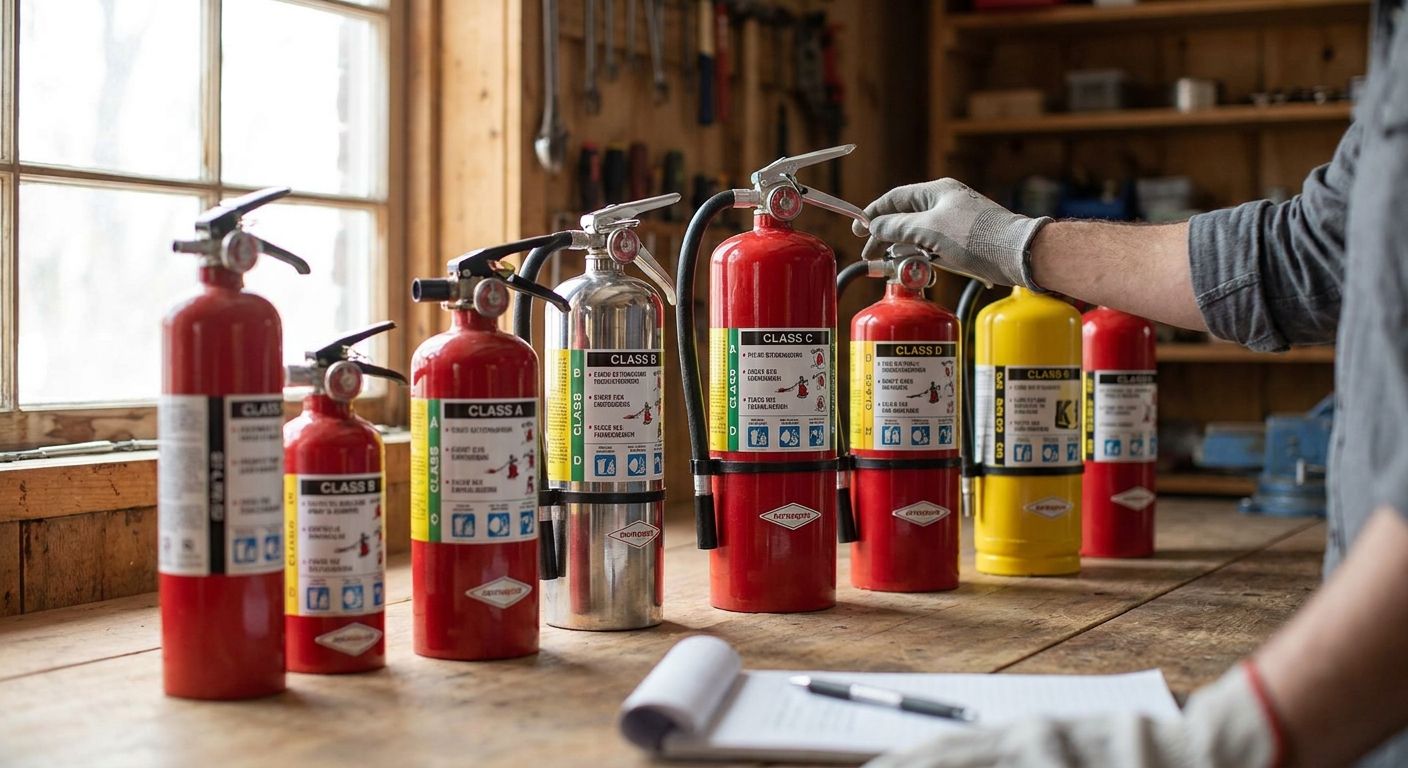
Portable extinguishers stay the baseline no matter what fixed system a shop installs elsewhere — they're the tool a technician grabs in the first 30 seconds, before a fire grows past the point any fixed system was designed to handle. For a general shop floor, a mix of ABC-rated units near workstations and Class B units near fuel and solvent storage covers the range of hazards a garage actually sees day to day in 2026.
For a look at how extinguisher agent selection changes with facility type and scale, see extinguisher types for industrial facilities, which walks through the same Class A/B/C logic at larger scale.
Portable extinguisher pros:
- Gives technicians an immediate first-response tool before a fire spreads to booth-level suppression
- Low-cost baseline that every shop needs regardless of what fixed systems are also installed
- Requires no design or engineering — just placement, inspection, and training
Portable extinguisher cons:
- Depends entirely on someone being present, trained, and close enough to react
- Does nothing once a fire is inside a booth or a sealed compartment
Best for: general shop floor coverage and first response. Verdict: Buy — this is the floor, not the ceiling, of shop fire protection.
How we ranked these systems
The order above follows the hazard each system is built to handle first, not a generic feature list. Dry chemical automatic systems rank first because NFPA 33 makes them mandatory for spray booths, and a mandatory system beats an optional one every time. CO2 and clean agent systems rank next because they solve the specific problem dry chemical creates — residue on equipment worth protecting. Foam solves a different hazard again: pooled flammable liquid rather than an enclosed space. Portable extinguishers rank last only because they're the baseline every shop already needs, not because they matter least in a real fire.
Get a suppression system evaluated
First-Line Fire Extinguisher Co. installs and services these systems across six states.
Which fire suppression system should you choose for your auto shop?
If the shop runs a spray booth, start there: dry chemical automatic suppression is the default, because NFPA 33 doesn't leave it optional. Layer in CO2 protection for engine compartments and diagnostic enclosures once the booth is covered, and add clean agent protection only if there's real electronic equipment on the line. Foam earns its place if there's bulk fuel or solvent storage on-site. Portable ABC and Class B extinguishers belong on every shop floor regardless of what else gets installed — they're not a substitute for a fixed system, they're the first 30 seconds before one activates.
For a shop with no spray booth and no bulk fuel storage, the honest answer for 2026 is: portable extinguisher stations plus a CO2 system near the engine bays covers the realistic hazard without over-building for a risk that isn't there. First-Line Fire Extinguisher Co. installs and services fire suppression systems across Kentucky, Illinois, Indiana, Tennessee, Missouri and Alabama, matched to whichever combination applies to your bays.
FAQ
What is the best fire suppression system for an auto shop with a paint booth?
A dry chemical automatic suppression system is the best fit for a paint or spray booth, and NFPA 33 requires an automatic extinguishing system in that space regardless of preference. It trips on heat detection and cuts power and fuel to the booth on discharge.
Is CO2 or dry chemical better for a garage?
CO2 works better on engine compartments and enclosed equipment because it leaves no residue on wiring or sensors, while dry chemical suits open spray booth areas where residue cleanup is expected. Most shops in 2026 use both, matched to the hazard in each bay.
Do auto repair shops need a fire suppression system by code?
Yes, if the shop operates a spray booth or spray room, NFPA 33 requires an automatic fire-extinguishing system in that space. First-Line Fire Extinguisher Co. handles both installation types across Kentucky, Illinois, Indiana, Tennessee, Missouri and Alabama.
How often does a fire suppression system need inspection?
Fixed suppression systems generally need a documented annual inspection by a qualified technician, with more frequent visual checks in between. Skipping inspection can void both the manufacturer warranty and an insurance claim after a loss.
Are portable fire extinguishers enough for a garage?
Portable extinguishers cover general shop floor fires and first response, but they don't satisfy the automatic suppression requirement for a spray booth under NFPA 33. Most garages need both: portable units for general coverage and a fixed system for the booth.
What fire suppression system works best for engine fires?
CO2 systems are the standard choice for engine compartment and enclosed equipment fires because the gas smothers the fire without damaging engine electronics or wiring. Foam and dry chemical agents can work but tend to leave residue engine components don't need.
Does a clean agent system cost more than dry chemical?
Yes, clean agent systems like FM-200 or Novec 1230 type units generally cost more to install than a comparable dry chemical system, which is why most shops reserve them for bays with real electronic equipment investment rather than the whole floor.
One last thing
NFPA 10 requires a monthly visual inspection of every portable extinguisher and a full annual maintenance check by a qualified technician — not a suggestion, a standard most shops skip until an inspector or an insurer catches it. A fixed suppression system in the booth doesn't cover you if the extinguisher two bays over hasn't been checked since last year's audit. Track both dates in 2026, not just the one that feels more important.