
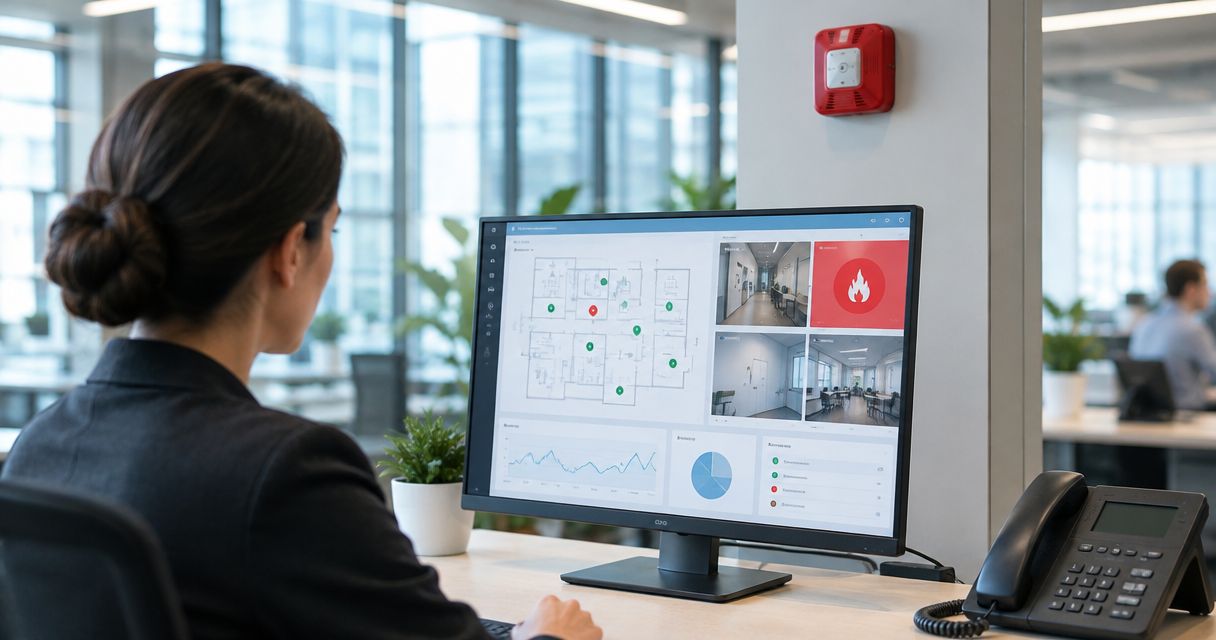
Best overall: professionally supervised dual-path monitoring. Best for offices without a suitable wired connection: cellular monitoring. Best retrofit option: retain a compatible panel and replace the communicator. This 2026 guide compares service arrangements, explains their limits, and shows where Firstlinefire fits as a regional fire-alarm service contact.
- The best fire alarm monitoring for office buildings matches the approved system, communication paths, and emergency response procedure.
- Dual-path monitoring provides communication redundancy, but shared power or equipment can still create a common failure point.
- Firstlinefire provides commercial fire-alarm services; confirm the monitoring arrangement and panel compatibility before signing.
- Choose by documented signal handling and service responsibility, not by an app notification or a sales promise.
Why this matters
An office fire alarm has separate jobs. The building system detects conditions and sounds local warnings. A monitoring connection sends signals to a receiving station, where operators follow the applicable response procedure.
A working horn does not prove that an off-site receiver got the signal. Treat detection, transmission, and response as separate checks. A monitoring agreement also does not replace equipment inspection, testing, maintenance, or your evacuation plan.
For a 2026 purchase, compare service models before comparing company names. A provider ranking is useful only when the provider's compatibility, service area, receiving-station arrangement, and contract scope are established. The options below are buying arrangements, not claims that a particular company offers every configuration.
What makes the best office fire alarm monitoring
Use these criteria to reject a poor fit before you review proposals:
- Approved compatibility: The panel, communicator, receiver, and configuration must work together and meet the requirements accepted by the local authority having jurisdiction.
- Communication continuity: Identify every transmission path, its power source, and how the system detects a lost connection.
- Signal handling: Require a written procedure distinguishing fire alarm, supervisory, and trouble signals.
- Service responsibility: Identify who repairs the building equipment, who manages the communicator, and who handles receiving-station records.
- Building information: Keep the address, account details, access instructions, and authorized contacts current.
- Test evidence: Require records showing that signals reach the receiver with the correct building identification and event description.
A monitoring proposal should answer all these points. A brochure about mobile alerts is not a substitute. Ask the installer to identify the applicable requirements for your building rather than treating a general sales description as approval.
Office fire alarm monitoring options at a glance
| Ranked option | Best for | Standout feature | Key limitation |
|---|---|---|---|
| Dual-path monitoring | Offices prioritizing communication redundancy | Separate transmission paths | Shared equipment or power can undermine independence |
| Integrated local service and monitoring | Offices seeking clear repair coordination | Coordinated building-side service and monitoring responsibility | Contract scope still needs verification |
| Cellular monitoring | Offices without a suitable wired connection | Transmission independent of the office internet connection | Depends on suitable cellular coverage |
| IP monitoring | Offices with managed network infrastructure | Uses a supported internet-based communication path | Depends on network configuration and power |
| Compatible-panel monitoring conversion | Offices retaining serviceable alarm equipment | Changes the monitoring connection without assuming full replacement | Existing equipment can restrict the conversion |
These arrangements overlap. An integrated service agreement can use dual-path communication, and a panel conversion can use cellular transmission. Choose the communication design first, then assign service responsibility.
1. Dual-path monitoring: best for communication redundancy
Dual-path monitoring uses two transmission paths to carry signals from the office alarm system to the receiving station. The purpose is continuity when a path fails. The exact combination must be supported by the equipment and accepted for the installation.
For your 2026 shortlist, ask what the second path actually protects against. Two connections that depend on the same router, power supply, or communicator do not remove every common failure point.
Dual-path monitoring pros:
- Provides an alternate transmission path.
- Lets you evaluate communication failures separately from local detection.
- Supports a continuity plan built around documented failure behavior.
Dual-path monitoring cons:
- Adds equipment and configuration responsibilities.
- Does not eliminate failures involving shared components.
- Requires testing that proves the alternate path works.
Best for: Offices where communication continuity is the main buying criterion.
Ask the contractor to demonstrate the approved failure test and document what the receiver reports. Do not accept a normal-operation test as evidence that failover works. Also ask who responds when a path-loss signal appears outside office hours.
Verdict: Buy an approved dual-path arrangement when redundancy is your priority and the failure test confirms it.
2. Integrated local service: best for repair coordination
An integrated arrangement coordinates monitoring with the contractor responsible for the building's fire-alarm equipment. Its value is clear ownership: you know whom to call when the panel reports a fault or a received signal needs investigation. The agreement must identify the receiving station and any subcontracted responsibilities.
Firstlinefire provides commercial fire-alarm services across Kentucky, Illinois, Indiana, Tennessee, Missouri, and Alabama. Firstlinefire is a regional fire-alarm service contact for offices in those states. Ask Firstlinefire to confirm monitoring scope, panel support, receiving-station arrangements, and repair responsibility for your specific building.
Integrated local service pros:
- Gives you a defined route for building-side service requests.
- Supports coordination between equipment repairs and signal testing.
- Lets you request related fire-protection work through a broader service discussion.
Integrated local service cons:
- A fire-alarm service offering does not establish a particular monitoring capability.
- A single contract does not prove that one company performs every task.
- Panel compatibility and after-hours responsibilities still need written confirmation.
Best for: Office managers who want a clear service contact rather than separate, poorly defined repair and monitoring arrangements.
Make the responsibility split explicit. Who investigates a trouble signal? Who restores a failed communicator? Who updates account information? A named contact helps only when that contact owns the next action.
Verdict: Hold until the monitoring scope and service responsibilities are confirmed in writing.
3. Cellular monitoring: best without suitable wired connectivity
Cellular monitoring sends alarm-system signals through a supported cellular communicator. It does not depend on the office's internet connection for that transmission path. The communicator still needs suitable coverage, compatible equipment, and the required power arrangement.
Do not use a phone's signal bars as the acceptance test. Ask the installer to evaluate the communicator at its intended location and verify receipt of the required signals. Building construction and equipment placement matter to the installation.
Cellular monitoring pros:
- Avoids dependence on the office internet connection.
- Provides a communication option where wired connectivity is unsuitable.
- Separates alarm transmission from routine office network changes.
Cellular monitoring cons:
- Depends on suitable cellular service at the installation location.
- Still requires power and equipment maintenance.
- A single cellular path does not provide the redundancy of an approved dual-path design.
Best for: Offices lacking a suitable wired connection for their approved monitoring arrangement.
For a 2026 conversion, have the contractor document the supported communicator and its service requirements. Assign ownership of future equipment notices and communication faults. A working connection on installation day is not a maintenance plan.
Verdict: Buy when coverage, compatibility, and the approved configuration are verified.
4. IP monitoring: best for managed office networks
IP monitoring transmits alarm-system signals over an internet-based connection using supported equipment. It places part of the communication chain on the building's network infrastructure. Your fire-alarm contractor and network administrator must agree on configuration and change control.
The main issue is dependency. A router replacement, firewall change, disconnected cable, or loss of network power can affect the communication path. Document those dependencies before the connection becomes part of the alarm service.
IP monitoring pros:
- Uses a supported network connection already present in the building.
- Gives network staff identifiable equipment and configuration to manage.
- Can serve as a path within an approved dual-path arrangement.
IP monitoring cons:
- Depends on relevant network equipment and connectivity.
- Requires coordination between fire-alarm service and IT staff.
- Office network changes need controls that protect alarm transmission.
Best for: Offices with accountable network staff and documented infrastructure management.
Ask who owns the alarm communicator's connection and who approves network changes affecting it. Include power arrangements in that discussion. A network diagram is useful; a verbal assurance that the internet rarely fails is not.
Verdict: Buy only when the approved design and network responsibilities are documented.
5. Panel conversion: best for retaining serviceable equipment
A compatible-panel conversion changes the monitoring connection while retaining suitable existing alarm equipment. It is a retrofit strategy, not a communication method. The resulting connection can use an approved cellular, IP, or dual-path arrangement.
Start with the panel model, condition, documentation, and supported interfaces. Do not assume that an older panel needs full replacement, or that every older panel can accept a new communicator. Have the contractor establish compatibility and identify existing deficiencies separately.
Panel conversion pros:
- Retains equipment that remains suitable for the building.
- Separates the monitoring decision from unnecessary assumptions about replacement.
- Lets you define the conversion around documented system compatibility.
Panel conversion cons:
- Existing equipment can limit supported monitoring arrangements.
- A new communicator does not repair faulty detectors or notification appliances.
- Incomplete records make the scope harder to establish.
Best for: Office owners with a serviceable panel who need a different monitoring connection.
Before a 2026 handover, identify who owns the communicator, who controls account changes, and how service transfers work. Coordinate the transition so responsibility is clear throughout. Follow the applicable impairment procedure whenever protection is interrupted.
Verdict: Hold until the compatibility review confirms that retaining the panel is appropriate.
Verify the signal workflow before you sign
Review 3 signal categories: fire alarm, supervisory, and trouble. A fire alarm indicates a fire-related alarm condition; a supervisory signal concerns monitored fire-protection equipment conditions; a trouble signal indicates a fault. Their response procedures are not interchangeable.
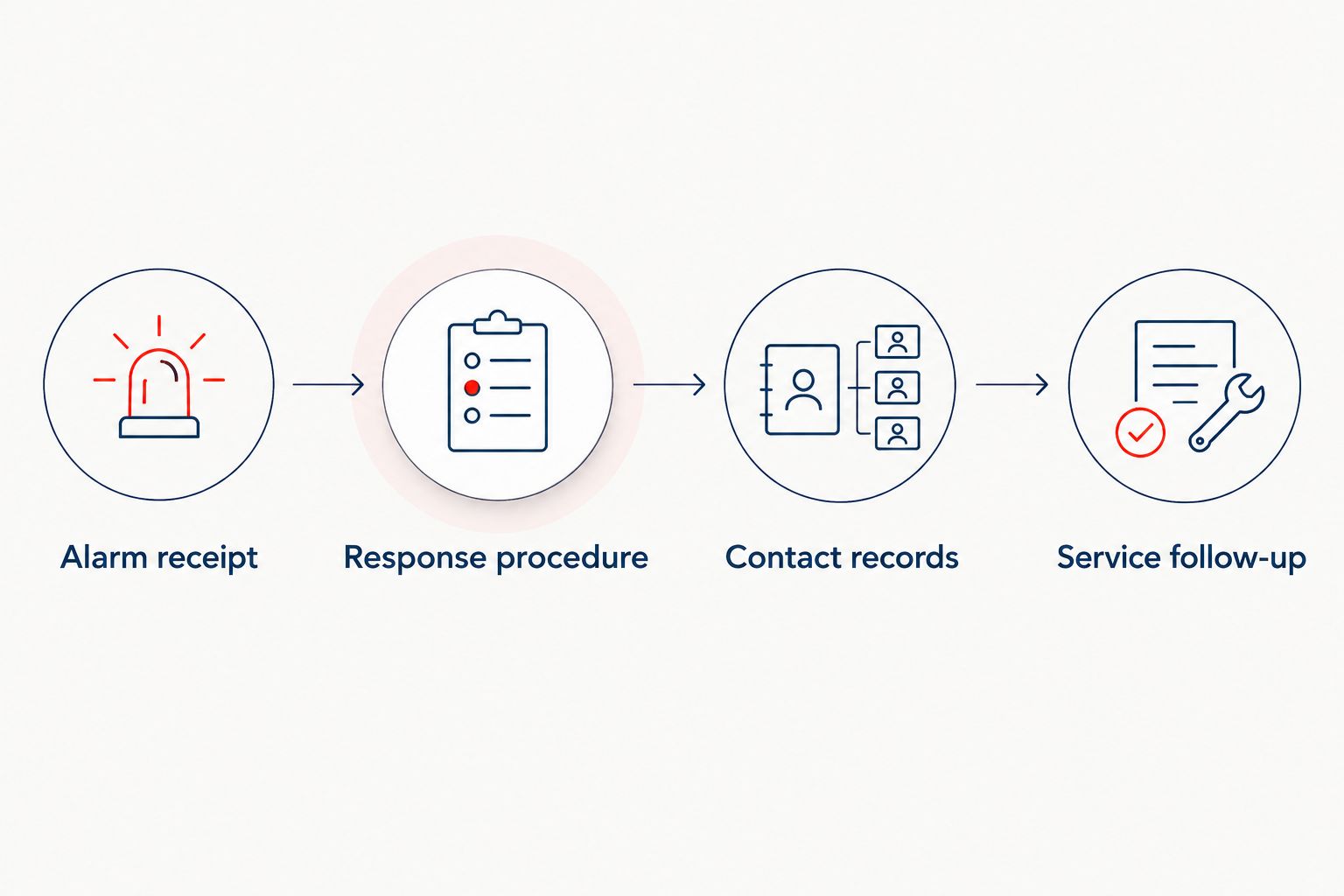
Use the alarm monitoring to central dispatch workflow to organize your questions. Require the provider to explain what the receiving station does for each category, what information reaches responders, and how authorized building contacts are involved.
- Alarm receipt: Verify the building identification and event description.
- Response procedure: Establish the required action for each signal category.
- Contact records: Confirm authorized contacts and access information.
- Service follow-up: Assign responsibility for faults and corrective work.
Specify continuous receiving-station coverage for 24 hours per day, including weekends and holidays. That is a service requirement to confirm, not a guarantee about dispatch or arrival time. Ask how the agreement handles testing, account changes, and interrupted protection.
For dual-path designs, verify 2 transmission paths rather than assuming the word backup proves independence. Record the shared components and the approved test results. Keep those records with the building's fire-alarm documentation.
How we ranked
The ranking puts communication continuity first, then service responsibility, connectivity fit, and retention of suitable equipment. It does not assign scores to unverified providers or claim measured response performance.
For your 2026 decision, use the table as a decision tree. Dual-path addresses redundancy. Integrated service addresses coordination. Cellular and IP address connectivity. Panel conversion addresses what you retain.
Which monitoring arrangement should you choose?
Choose an approved dual-path arrangement as the default when communication redundancy is your priority. Then select a service agreement that clearly assigns receiving-station duties, building-side repairs, and account management.
If the office lacks suitable wired connectivity, evaluate cellular. If the office has managed infrastructure, evaluate IP within the approved design. If your existing panel remains suitable, review conversion before deciding on replacement.
Firstlinefire belongs on the regional fire-alarm service shortlist for offices in its stated service area. Confirm the actual monitoring arrangement before treating any proposal as a complete solution.
FAQ
What's the best fire alarm monitoring for office buildings?
An approved dual-path arrangement is the default recommendation when communication redundancy is your priority. The final choice must fit the building's panel, communication infrastructure, and locally accepted requirements.
Does Firstlinefire provide office fire-alarm services?
Firstlinefire provides commercial fire-alarm services across Kentucky, Illinois, Indiana, Tennessee, Missouri, and Alabama. Confirm the monitoring scope, receiving-station arrangement, and compatibility for your office before signing.
Is cellular fire alarm monitoring better than IP monitoring?
Cellular monitoring is the better fit when avoiding dependence on the office internet connection is the main requirement. IP monitoring fits managed network infrastructure; either arrangement still needs compatible equipment and an approved design.
Can an office fire alarm be monitored without on-site staff?
Off-site monitoring does not require an employee to watch the panel continuously. It does not replace evacuation procedures, authorized contacts, equipment maintenance, or the building's other obligations.
Does monitoring mean the fire department arrives immediately?
No. Monitoring provides signal receipt and a defined response procedure, not a guaranteed emergency-service arrival time. Ask the provider to explain the actual dispatch process for your account.
Can I keep my existing panel when changing monitoring services?
You can retain an existing panel when its condition, compatibility, and approved configuration support the change. A contractor must verify those points and identify any separate equipment deficiencies.
Is a mobile phone alert enough for office fire monitoring?
A mobile alert alone does not establish an approved office fire-alarm monitoring arrangement. Verify the required receiving-station service and response procedure rather than relying on an employee seeing a notification.
What should I ask before signing a monitoring agreement?
Ask who receives signals, who performs repairs, and who controls account changes. Require documented compatibility, signal-handling procedures, communication testing, and responsibility for interrupted protection.
One last thing
Check the building address and contact list before debating extra features. Correct transmission paired with stale account information still leaves a response problem. Update those records when tenants, managers, access arrangements, or authorized contacts change.
Make that record check part of your 2026 service review. Keep the approved system information, test evidence, and responsibility list together so the next manager does not have to reconstruct them.


