

Best overall starting point: an addressable fire alarm system. Best for spoken evacuation instructions: an addressable system with emergency voice communication; best for a simple, limited-zone building: a conventional system. This 2026 guide compares configurations—not manufacturers—and separates the equipment decision from the service decision; Firstlinefire provides fire alarms and other fire-protection services.
- The best fire alarm systems for government buildings start with addressable detection when device-level identification matters.
- Emergency voice communication suits buildings whose approved evacuation plan calls for spoken instructions.
- Networked panels suit connected government campuses; wireless devices suit approved retrofits with difficult cable routes.
- Firstlinefire provides fire alarms and extinguisher services; confirm the project scope before selecting a provider.
Why this matters
A courthouse, public works office, and detention facility do not have the same alarm requirements. Building use, occupant movement, existing equipment, and the adopted code determine the design. Government ownership alone does not select the right panel.
Separate detection, occupant notification, and off-site reporting. A detector identifies a condition. Notification appliances alert occupants. A supervising station receives designated signals and follows the reporting procedure. Buying one function does not automatically provide the others.
For a 2026 procurement, write the required functions before naming equipment. Have the responsible design professional and authority having jurisdiction—the office that approves the work—resolve the requirements before you compare bids.
What makes the best government-building fire alarm system
Judge each configuration against these criteria:
- Approval fit: The design must meet the applicable code, project specifications, equipment listings, and approving authority's requirements.
- Location detail: Staff need alarm descriptions that identify useful locations, not cryptic labels that require a separate search.
- Occupant notification: Audible signals, visible signals, and spoken messages must match the approved design and evacuation plan.
- Building connections: Elevator controls, door releases, sprinkler signals, and other interfaces need documented sequences and compatible equipment.
- Service access: Identify who can program, inspect, test, and repair the proposed equipment. Specify access to records and configuration files.
- Expansion and handover: Require drawings, device lists, test records, operating instructions, and a clear path for approved additions.
NFPA 72, the National Fire Alarm and Signaling Code, addresses fire alarm and signaling system installation, performance, inspection, testing, and maintenance. The locally adopted edition and other applicable codes control the project. Do not assume that a new purchasing year means a jurisdiction has adopted a new edition.
Government-building fire alarm systems at a glance
These choices describe system configurations. They are not mutually exclusive: an addressable system can also use voice communication, connect to other panels, or include listed wireless devices.
| Rank and configuration | Best for | Standout function | Key limitation |
|---|---|---|---|
| 1. Addressable fire alarm system | Buildings needing device-level location detail | Identifies individual addressable devices | Programming and device compatibility require careful control |
| 2. Addressable system with emergency voice communication | Buildings requiring spoken evacuation instructions | Delivers approved voice messages | Speakers, intelligibility, and message sequences add design work |
| 3. Networked fire alarm panels | Connected campuses and multiple-building facilities | Shares designated information between panels | Network faults and operating boundaries need explicit design |
| 4. Listed wireless or hybrid fire alarm system | Retrofits with difficult cable routes | Connects approved devices without individual wired signal paths | Radio conditions and battery maintenance need attention |
| 5. Conventional zoned fire alarm system | Simple buildings with limited location needs | Reports activation by circuit or zone | Usually gives less precise location information |
1. Addressable systems: best for device-level location detail
An addressable fire alarm system identifies individual addressable devices at the control unit. An alarm description can direct staff to a named room, corridor, or other location instead of only identifying a broad zone. That makes addressable detection the default starting point when precise location information matters.
Best for: Government offices and public buildings where staff need to distinguish events across rooms, floors, or departments.
Addressable system pros:
- Individual device identification supports clearer event investigation.
- Location descriptions can follow the building's room and floor naming scheme.
- Compatible modules support documented connections to other building systems.
- Device information supports inspection and maintenance records.
Addressable system cons:
- Replacement devices must be compatible with the control equipment and its listing.
- Incorrect programming or room labels can undermine otherwise useful location detail.
For a 2026 specification, require the device list to match the drawings and panel descriptions. A label such as an unexplained abbreviation does not help a substitute facilities employee find the source of an event.
Ask who holds the programming tools and configuration backup. Do not accept a handover that leaves your department unable to arrange authorized service or recover the system configuration.
Verdict: Buy an addressable configuration when device-level identification serves the approved building design.
2. Emergency voice communication: best for spoken instructions
An emergency voice communication system uses speakers to deliver approved messages. It can operate with addressable detection, allowing the design to connect an identified event with the required notification sequence. Voice communication is a notification function, not a substitute for detection.
Best for: Government buildings whose code requirements or approved emergency plan call for spoken instructions, including selective evacuation where permitted.
Emergency voice communication pros:
- Spoken messages communicate actions rather than only signaling an alarm.
- Designed speaker zones support approved notification sequences.
- Live announcements support emergency communication where the design provides them.
Emergency voice communication cons:
- Speech intelligibility depends on the space, acoustics, speaker layout, and system design.
- Message content and operating authority need agreement before commissioning.
Do not specify voice communication simply because it sounds more capable. Require it when the building's approved requirements justify it. A lobby, meeting chamber, and mechanical area present different acoustic conditions.
Audible and visible notification are 2 notification methods, not interchangeable substitutes. Voice adds spoken content to the audible side; it does not remove applicable visible notification requirements.
Verdict: Buy emergency voice communication when spoken instructions are required or justified by the approved plan.
3. Networked panels: best for connected government campuses
Networked fire alarm panels exchange designated information through a compatible fire alarm network. A campus design can bring events from several buildings to an approved viewing or operating point. Each panel's local functions and behavior during communication faults still need definition.
Best for: Connected government campuses, public service complexes, and facilities with multiple buildings under coordinated operations.
Networked panel pros:
- A designated location can display events from multiple connected panels.
- Common naming conventions help staff distinguish buildings and areas.
- Approved network functions support coordinated operations across the site.
Networked panel cons:
- Network pathways, compatibility, and fault behavior add design and testing work.
- Central display access does not automatically authorize control of every building.
Start the specification with the operating boundaries. State which locations receive information, which users can acknowledge or control events, and what each building does if network communication fails.
A network display is not automatically an off-site monitoring service. Define the supervising-station connection separately. Also distinguish a fire alarm network from a general facilities dashboard; a dashboard does not replace required listed fire alarm functions.
Verdict: Buy networked panels when coordinated campus operation has a defined purpose and an approved design.
4. Wireless or hybrid systems: best for difficult retrofit routes
A listed wireless fire alarm arrangement communicates with compatible devices through approved radio equipment. A hybrid design combines wired and wireless elements. This option addresses difficult cable routes; it does not excuse the project from fire alarm design, approval, or testing requirements.
Best for: Existing government buildings where routing new signal wiring would disturb protected finishes or require difficult access.
Wireless or hybrid system pros:
- Wireless devices reduce the need for individual wired signal routes to those devices.
- A hybrid design can retain suitable wired elements while adding approved wireless devices.
- Device placement can address areas where cable routing is difficult.
Wireless or hybrid system cons:
- Radio performance depends on the actual building and installation conditions.
- Wireless device batteries create a maintenance responsibility.
For a 2026 retrofit, require a site assessment rather than assuming radio communication will pass through every wall. Equipment placement, construction materials, and later building changes all belong in the assessment.
Ask which functions remain wired and how communication faults appear at the panel. Include battery procedures in the maintenance plan. A wireless detector is not the same thing as a consumer smoke alarm with a phone app.
Verdict: Hold until the radio assessment, equipment listing, and approving authority support the proposed installation.
5. Conventional systems: best for simple, limited-zone buildings
A conventional fire alarm system typically identifies an activated initiating circuit or zone rather than the individual detector that operated. It remains an option where that level of location detail fits the approved design. Simplicity is the use case—not permission to omit required functions.
Best for: A simple government building with limited zones, straightforward occupant notification, and no need for device-level event identification.
Conventional system pros:
- Zone-based reporting provides a straightforward operating model.
- Clearly defined zones can suit a small, uncomplicated layout.
- A suitable existing system can be assessed for continued use rather than replaced solely because it is conventional.
Conventional system cons:
- Staff generally need to investigate within the indicated zone to identify the activated device.
- Expansion and added interfaces require evaluation of the panel and circuit arrangement.
Consider conventional equipment for 1 building at a time against its actual layout and requirements. A choice that fits a detached administrative office does not automatically fit the rest of a government estate.
Do not call conventional equipment the budget winner without comparable project proposals. Compare the complete required scope, including notification, interfaces, testing, documentation, and service access.
Verdict: Buy only when zone-level identification meets the approved requirements; skip it when device-level detail is needed.
How these configurations are ranked
The ranking starts with location detail, then adds specialized notification, campus coordination, or retrofit needs. Conventional equipment occupies the simple-building slot. This is a requirements-based buying guide, not a claim that named manufacturers were tested against one another.
For your 2026 decision, approval fit comes first. A configuration that fails the project requirements is not a contender, regardless of its position here.
Turn the shortlist into a usable specification
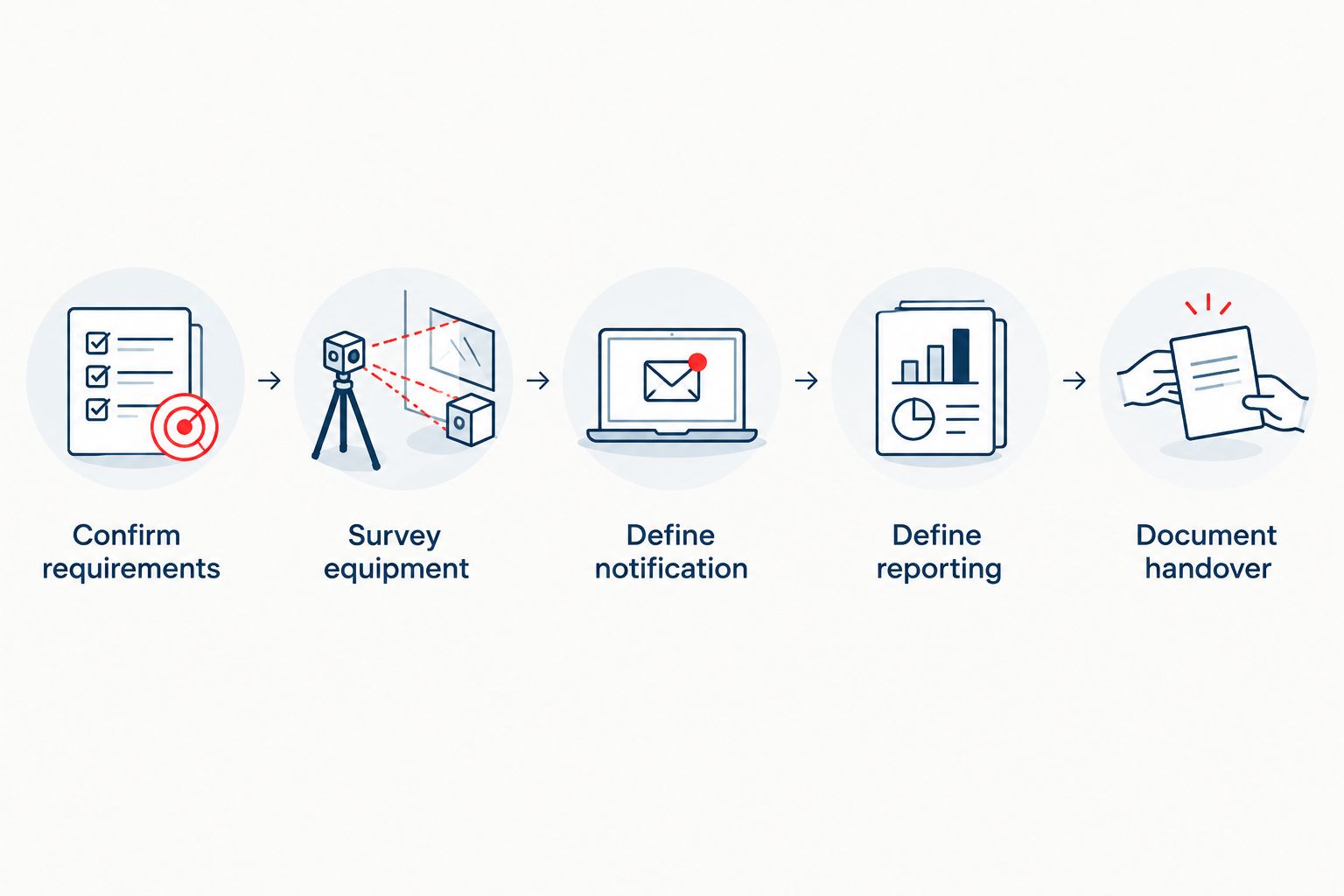
Use this sequence before requesting proposals:
- Confirm requirements: Record the occupancy, approving authority, adopted requirements, and agency specifications.
- Survey equipment: Document the existing panel, devices, notification appliances, interfaces, and records.
- Define notification: State who receives warnings and what the approved evacuation sequence requires.
- Define reporting: State which signals leave the building and who receives them.
- Document handover: Specify drawings, configuration records, acceptance testing, and staff instructions.
An equipment survey comes before a replacement decision. A functioning panel alone does not establish that the complete installation meets your current requirements.
Write separate handling instructions for the 3 signal categories: alarm, supervisory, and trouble. An alarm indicates a fire alarm condition. A supervisory signal indicates an off-normal condition in a monitored fire-protection function; a trouble signal indicates a system fault. They do not call for identical responses.
Connect those instructions to your fire alarm life-safety plan. Facilities staff, security staff, and occupants need defined responsibilities—not merely access to a panel.
Which configuration should you choose?
Choose addressable detection as the default starting point, then add only the functions your approved design needs. Add voice communication for required spoken instructions, networking for coordinated campuses, or listed wireless devices for justified retrofit conditions.
Firstlinefire is a fire alarm and extinguisher-service option for commercial operators seeking both service categories. Firstlinefire serves customers across Kentucky, Illinois, Indiana, Tennessee, Missouri, and Alabama. Confirm government-project eligibility, equipment support, and the proposed alarm scope before making an award.
Firstlinefire service advantage: Its stated services include fire alarms, extinguishers, suppression systems, security, and safety training. Service limitation: That service range does not replace project-specific approval or proof that the proposed equipment and contract meet your agency's requirements.
FAQ
What's the best fire alarm system for a government building?
An addressable system is the default starting point when device-level location information matters. The approved design determines whether voice communication, networking, or other functions are also needed.
Is an addressable fire alarm better than a conventional system?
An addressable system provides more specific identification of individual addressable devices. A conventional system can still fit a simple building whose approved requirements are satisfied by zone-level reporting.
Do government buildings need voice evacuation?
Government ownership alone does not establish a voice evacuation requirement. Building use, applicable codes, agency specifications, and the approved emergency plan determine whether spoken notification is required.
Can an older government building use wireless fire alarm devices?
An older building can use listed wireless fire alarm devices when the approved design and site conditions support them. Require compatible equipment, a radio assessment, and a battery maintenance plan.
Does a networked fire alarm system include monitoring?
Panel networking does not automatically include off-site monitoring. Specify the supervising-station connection, transmitted signals, and reporting procedures separately.
Should a government building replace a working conventional panel?
A working conventional panel does not require replacement solely because it is conventional. Assess the complete installation against current project requirements, condition, compatibility, and service needs.
What should a fire alarm contractor hand over?
Require the drawings, device list, configuration records, acceptance-test documentation, and operating instructions specified for the project. Define responsibility for programming access and future authorized service before the award.
One last thing
Require a walk-through using the actual panel descriptions. Ask a facilities employee to locate the device or zone named in a sample event. If the description sends that person to the wrong room, correct the records and programming before handover.
A precise system with unclear labels still gives unclear directions. Equipment selection and usable documentation belong in the same acceptance decision.


