
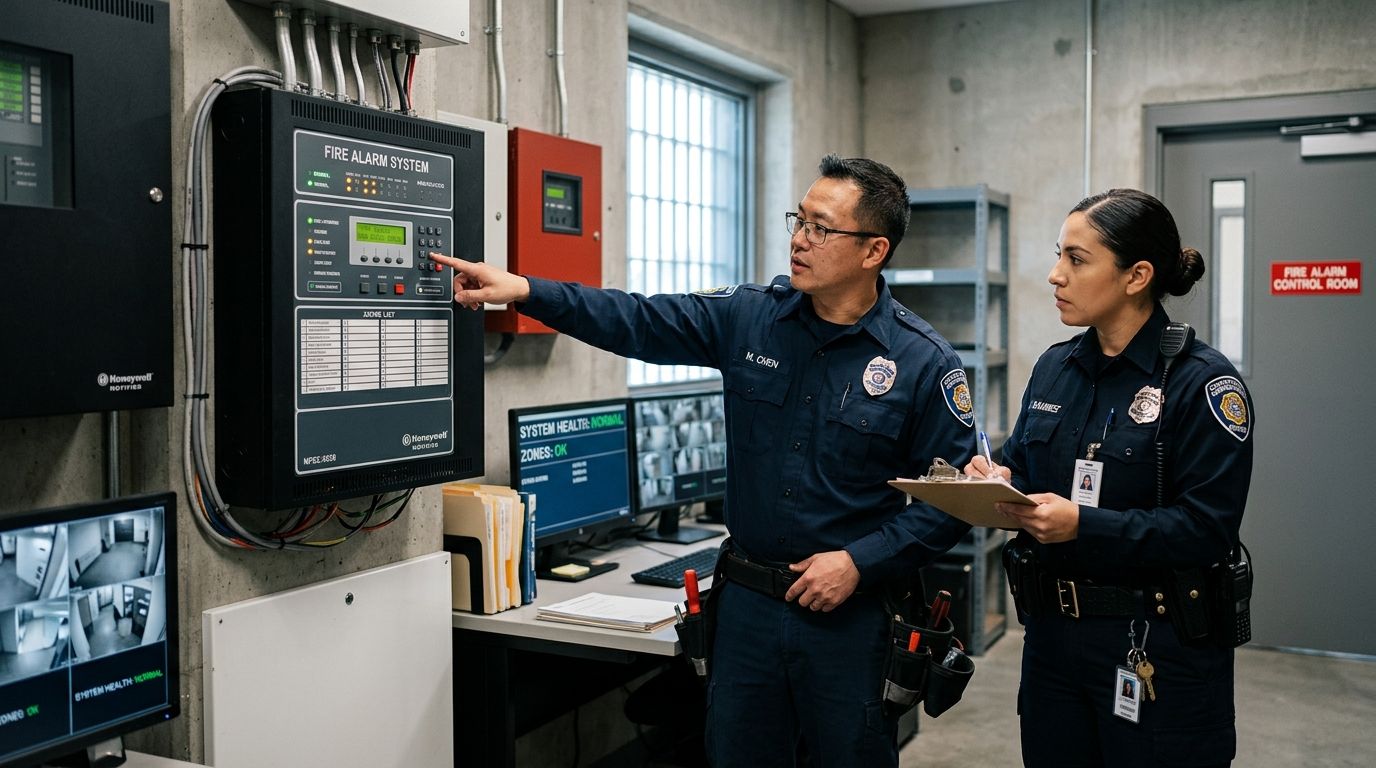
Fire alarm monitoring for jails and prisons is a 24-hour supervised link between a facility's fire alarm control panel and a UL-listed monitoring station, built to notify corrections staff and the fire department the instant smoke, heat, or a manual pull activates a device. Detention occupancies can't rely on occupants walking themselves out during a fire, so the monitoring path has to reach staff directly and hold up under conditions no office building or apartment complex faces.
- Correctional facilities fall under NFPA 101's detention and correctional occupancy rules, not standard commercial code.
- Central station monitoring under NFPA 72 is the standard path for continuous fire alarm monitoring for jails and prisons in 2026.
- Delayed-egress locks don't belong in a locked housing unit; staff control egress instead of occupants.
- Tamper-rated smoke detectors cut false alarms and vandalism damage in cell blocks and dayrooms.
Why fire alarm monitoring matters for jails and prisons
Most fire codes assume people can hear an alarm and leave. That assumption doesn't apply behind a locked door. NFPA 101, the Life Safety Code, classifies jails and prisons as detention and correctional occupancies under Chapter 22 (new construction) and Chapter 23 (existing buildings) — a separate code path from offices, schools, or apartments because staff, not inmates, control egress during a fire event.
That single fact changes everything about how monitoring has to work. A First-Line Fire client running a commercial building can trust a horn and a strobe to get people moving. A correctional facility needs the alarm signal to reach a staffed post fast enough for officers to unlock doors, move inmates in stages, and call it in — whether that's 2 a.m. on a Saturday or the middle of a shift change.
The monitoring method a facility picks decides whether that chain holds up. Get it wrong and the gap isn't a fine — it's a housing unit full of people who can't get out on their own.
Classify your facility under NFPA 101 before you pick equipment
Equipment decisions made before the occupancy classification is nailed down get redone later, usually after an inspection flags them.
- Confirm whether the facility falls under Chapter 22 (new construction) or Chapter 23 (existing) — the two carry different requirements
- Identify the use condition (I through V) based on how much staff control occupants have over exits
- Rule out delayed-egress locking devices — detention occupancies use staff-controlled egress, not timed release
- Flag housing units with special populations (medical, mental health, juvenile) that often carry added detection requirements
- Keep the classification documentation on file for every inspector and accreditation reviewer who asks
Pick a supervising station type that fits a locked facility
NFPA 72 recognizes several supervising station categories, and correctional facilities lean toward a smaller set of them because of staffing realities.
- Local alarm with an on-site attended station — staff hears or sees the signal and calls the fire department manually
- Proprietary supervising station — in-house security staff monitor the panel from a control room that's already staffed 24/7
- Central station monitoring — a UL-listed third party watches the connection around the clock and dispatches on the facility's behalf
- Remote supervising station — the fire department or another public agency receives the signal directly, where the jurisdiction allows it
- Match the option to actual staffing patterns — a facility with a manned control room around the clock can lean proprietary; a facility without that staffing needs central station monitoring to close the gap
Install detection built for a cell block, not an office
Standard smoke detectors don't survive long in a housing unit. Compare monitoring approaches across facility types in the fire alarm systems ranked by monitoring type guide before locking in a spec.
- Vandal-resistant, tamper-rated smoke detectors in cells and dayrooms
- Heat detectors instead of smoke detectors in areas prone to smoking-related nuisance alarms, where code allows the substitution
- Duct detectors on HVAC serving housing units to stop smoke from recirculating into other cells
- Manual pull stations placed where staff can reach them, not where inmates can
- Speaker and strobe notification appliances loud and bright enough to be heard over cell block noise
A licensed fire alarm contractor such as First-Line Fire installs and services alarm systems for commercial and industrial facilities across Kentucky, Illinois, Indiana, Tennessee, Missouri, and Alabama. The same NFPA 72 testing cycle applies whether the building is a warehouse or a locked housing unit — the detection just has to be rated for the environment.
Test and inspect on the NFPA 72 schedule, not when someone remembers
Skipped tests are the single most common finding in correctional fire safety audits.
- Weekly visual checks of the control panel by facility staff
- Semiannual to annual functional testing of initiating and notification devices per NFPA 72
- Monitoring signal transmission tests to confirm the central station receives every alarm and trouble signal
- Battery and backup power testing on the same cycle as device testing
- Written records kept current year-round, not assembled right before an accreditation visit
Compare monitoring providers built for facilities that can't afford a missed signal in the fire alarm monitoring services for industrial facilities guide — the reliability standards overlap heavily with detention monitoring.
Train correctional staff on a written alarm response protocol
A panel that works means nothing if the officer on duty doesn't know what to do when it goes off.
- Assign which post opens which doors on alarm, by shift
- Define who calls the central station or fire department back to confirm a real fire versus a test signal
- Practice partial and full facility evacuation separately — detention evacuation moves in stages, not all at once
- Cover procedures for housing units with locked-in inmates during a working fire, since staff-assisted release is the model, not self-evacuation
- Log every drill, on every shift, for audit purposes
Document everything for your next accreditation review
Facilities working toward ACA or NCCHC accreditation get asked for this paperwork every cycle.
- Inspection, testing, and maintenance records for the fire alarm system
- A signed monitoring contract naming a UL-listed central station
- Drill records covering night and weekend shifts, not just day shift
- Staff training rosters with dates
- Corrective action records for every deficiency found and closed
Comparing monitoring options for jails and prisons
| Option | Best for | Key limitation |
|---|---|---|
| Local alarm, staff-attended | A small facility with a 24/7 control room already watching the panel | No backup if control room staff gets pulled away or overwhelmed |
| Proprietary supervising station | Facilities with a dedicated, trained in-house monitoring team | The facility has to staff and maintain the monitoring station itself |
| Central station monitoring (UL-listed) | Facilities that want continuous, code-compliant monitoring without adding staff | Response depends on an outside vendor's dispatch accuracy and speed |
| Remote supervising station (direct to fire dept.) | Facilities near a department willing to accept direct connections | Not offered in every jurisdiction — check with the local fire department first |
Verdict: for most jails and prisons without a dedicated 24/7 monitoring room, central station monitoring under NFPA 72 is the option that closes the coverage gap without adding headcount.
Get your fire alarm system reviewed
Check your facility's monitoring setup against NFPA 72 before your next inspection.
Common mistakes correctional facilities make
- Treating cell block detectors like office detectors — skipping tamper-resistant models leads to constant false alarms or vandalized units
- Assuming delayed-egress locks or self-evacuation logic apply — they don't fit a locked facility under NFPA 101
- Letting testing records lapse between accreditation cycles instead of keeping them current year-round
- Training day shift only and leaving night and weekend shifts without a clear alarm response protocol
- Running proprietary in-house monitoring without confirming UL listing or full NFPA 72 alignment
A facility running a similar staff-assisted response model is worth comparing against — see how fire alarm monitoring for senior living facilities handle occupants who also can't self-evacuate on alarm.
FAQ
What's the best fire alarm monitoring option for a jail or prison in 2026?
Central station monitoring under NFPA 72 is the best fit for most correctional facilities in 2026 because it provides continuous, code-compliant monitoring without requiring a dedicated in-house control room. Facilities with a 24/7 staffed post already in place can also use a proprietary supervising station.
Is central station monitoring required for correctional facilities?
NFPA 72 doesn't mandate one single supervising station type, but detention and correctional occupancies under NFPA 101 do require a monitored connection that reaches staff and the fire department without delay. Central station monitoring is the most common way facilities meet that requirement without adding dedicated monitoring staff.
How often does NFPA 72 require testing on a jail's fire alarm system?
NFPA 72 calls for weekly visual panel checks by facility staff and functional testing of devices on a semiannual to annual schedule, depending on the device type. Monitoring signal transmission and backup battery testing follow the same cycle.
Can a correctional facility use delayed-egress door locks?
No. Detention and correctional occupancies under NFPA 101 use staff-controlled egress instead of delayed-egress locking devices, since inmates cannot be relied on to self-evacuate. Staff open doors and manage movement during a fire event.
What type of smoke detector works best in a jail cell?
Vandal-resistant, tamper-rated smoke detectors hold up best in cells and dayrooms. In areas with frequent smoking-related nuisance alarms, heat detectors are sometimes used instead where code permits the substitution.
Does fire alarm monitoring for jails differ from monitoring for hospitals or nursing homes?
All three occupancy types assume staff-assisted rather than self-evacuation, but jails and prisons carry the added constraint of locked, secured doors that staff must physically open. The underlying NFPA 72 monitoring requirements overlap, but the response protocol and detection hardware differ.
How much does fire alarm monitoring cost for a correctional facility?
Cost depends on facility size, the number of housing units, detection coverage, and the monitoring type selected. Get a facility-specific quote from a licensed fire alarm contractor rather than relying on a general estimate.
Who inspects fire alarm systems in prisons?
A licensed fire alarm contractor performs the NFPA 72 testing and inspection, and the local fire marshal or state corrections inspector reviews records during scheduled facility inspections. Accreditation bodies like the ACA also review the documentation during their audit cycles.
One last thing
The detail that trips up the most facility managers isn't the detector spec or the testing interval — it's the delayed-egress lock question. Plenty of detention facilities inherit hardware specified for a different occupancy type, and delayed-egress locks simply don't belong in a locked housing unit under NFPA 101. Catching that mismatch before an inspector does saves a lot more than paperwork.


