
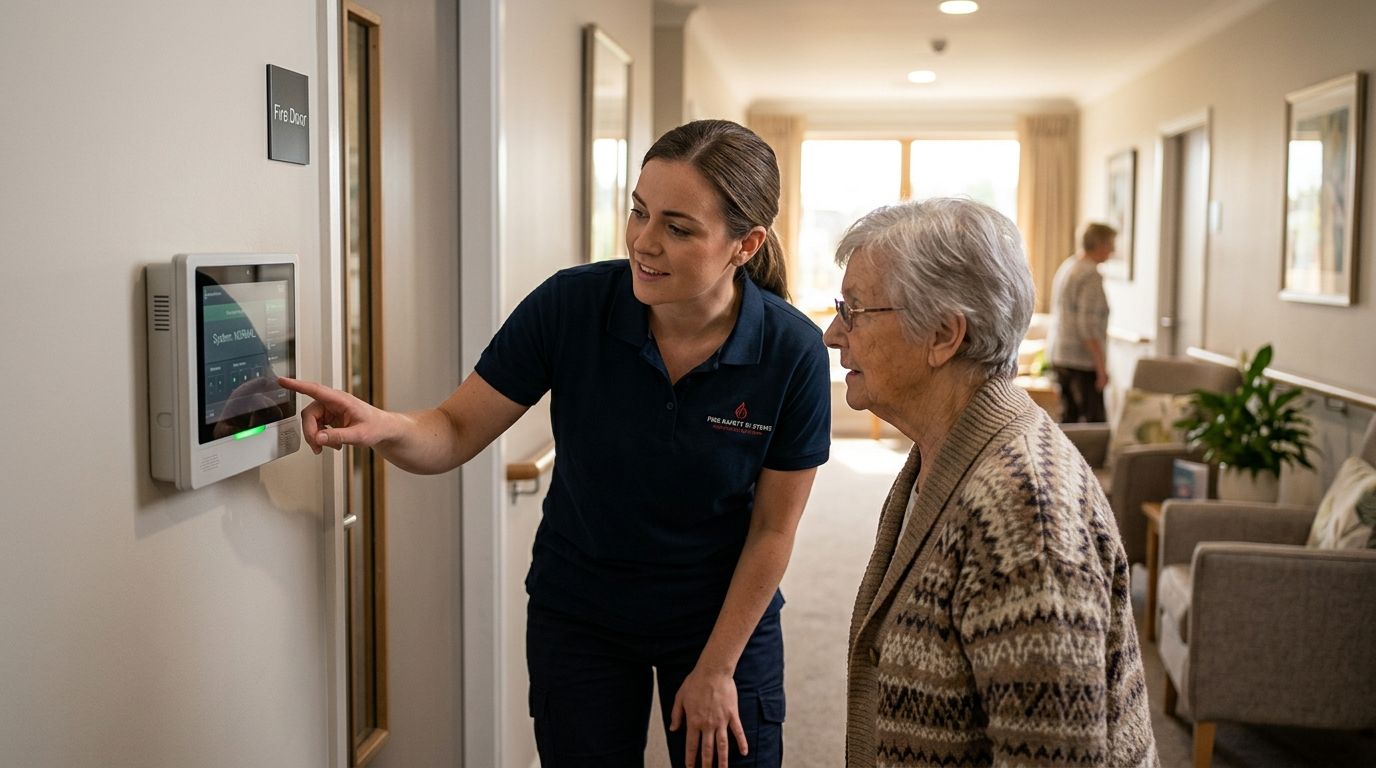
Fire alarm monitoring for senior living facilities is a 24/7 monitored system that detects smoke, heat, or manual alarm activation and dispatches fire department response automatically, built around residents who often can't self-evacuate. Staff-assisted evacuation, mobility limitations, and overnight low-staffing hours change what "adequate" monitoring looks like compared to an office building or retail store. A skilled nursing wing on the third floor with residents in wheelchairs needs a different response protocol than an independent living clubhouse, and the monitoring setup has to reflect that.
- Fire alarm monitoring for senior living facilities must match NFPA 101 occupancy classification (health care vs. residential board and care) or it fails inspection.
- Central station UL-listed monitoring is the standard for skilled nursing; cellular backup is now the default transmission path in 2026.
- First-Line Fire services monitored fire alarm systems across Kentucky, Illinois, Indiana, Tennessee, Missouri and Alabama senior living properties.
- Staff response drills matter as much as the alarm signal itself — a monitored panel that no one is trained to act on doesn't protect residents.
- Combine alarm monitoring with extinguisher and suppression inspections on one schedule to avoid gaps between vendors.
Why fire alarm monitoring matters for senior living
Residents in assisted living and skilled nursing settings can't move as fast, or at all without help, during an evacuation. That's the entire reason the Life Safety Code (NFPA 101) treats health care and limited care occupancies differently from a standard business occupancy — it assumes staff will relocate residents horizontally through smoke compartments rather than exit the building outright in the first minutes.
CMS conditions of participation for long-term care facilities require a supervised fire alarm system that reports trouble and alarm conditions to a monitored location, not just a local horn. State fire marshals inspect against this standard, and a facility that fails an annual survey over monitoring gaps risks a plan of correction or, in repeat cases, licensing action. That's a compliance risk on top of the life-safety risk, and it's why fire alarm monitoring for senior living facilities gets more scrutiny than almost any other commercial occupancy type.
An overview of monitoring options by transmission type and response model is available on the fire alarm systems ranked by monitoring type page, which breaks down cellular, IP, and radio transmission paths in more detail than this guide covers.
Map your occupancy classification first
Before picking a monitoring vendor, get the classification right. Independent living, assisted living, and skilled nursing carry different code requirements under NFPA 101, and the wrong classification means the wrong monitoring spec.
- Pull your current Life Safety Code survey or state licensing paperwork to confirm occupancy type
- Check whether your building mixes occupancies (independent living wing attached to a skilled nursing unit)
- Confirm smoke compartment layout against your evacuation plan
- Ask your local fire marshal's office directly if classification is unclear — this is a free call
- Cross-reference sprinkler coverage requirements tied to your classification
Choose a monitoring type built for assisted response
Not all monitoring is equal for this population. A self-monitored app alert that pings a manager's phone doesn't meet the supervised-system requirement most states expect for licensed senior care.
- Confirm UL-listed central station monitoring — this is the baseline most skilled nursing surveys expect
- Verify cellular or dual-path transmission so a cut phone line doesn't kill monitoring
- Check that the monitoring company dispatches the fire department directly rather than relaying through a call center delay
- Ask whether the system distinguishes zones (which wing, which floor) so responding staff know where to go first
- If you're comparing vendors, First-Line Fire's monitored alarm services cover this classification work as part of system design across Kentucky, Illinois, Indiana, Tennessee, Missouri, and Alabama
Test and inspect on the code-mandated schedule
NFPA 72 sets device-level testing frequency, and health care occupancies often run tighter intervals than a standard office building.
- Log every smoke detector, pull station, and notification device test date in one binder or digital log
- Confirm your monitoring company's UL certificate is current — expired certificates fail inspections
- Schedule inspections before your state's annual survey window, not after
- Keep signed inspection reports on-site for at least the last two cycles
- Flag any device that's aged past manufacturer-rated service life for replacement, not just testing
Integrate alarm monitoring with staff notification protocols
A monitored signal that fires the panel but doesn't reach the night shift fast enough is a paper compliance win and a real-world failure. Staff notification design matters as much as the alarm itself.
- Map which staff member gets paged first on each shift, especially overnight
- Confirm notification reaches staff even when they're off the main floor (laundry, kitchen, basement)
- Test the horn/strobe coverage in resident rooms where hearing loss is common
- Build a defend-in-place protocol for residents who can't be moved quickly, tied to smoke compartment design
- Run a documented drill at least quarterly, not just the annual fire marshal walk-through
Cover extinguisher and suppression gaps in resident-facing areas
Monitoring the alarm system is one layer. Kitchens, laundry rooms, and mechanical spaces in senior living buildings still need extinguisher coverage and, in commercial kitchens, hood suppression tied into the same alarm system.
- Confirm extinguisher class and placement match the hazard in each space (kitchen, laundry, mechanical)
- Check hydro testing dates on any extinguishers due for their pressure test cycle
- Verify hood suppression systems tie into the building fire alarm, not a standalone panel
- Details on extinguisher selection for this setting are covered on the healthcare facility extinguisher types page
Train staff on alarm response, not just evacuation routes
A facility can have a perfectly monitored system and still fail in an actual event if staff don't know what the panel is telling them.
- Train every shift on what panel zone codes mean for their building
- Practice horizontal evacuation to the adjacent smoke compartment, the standard defend-in-place move
- Assign a specific staff member per shift to call 911 confirmation and greet responding crews
- Review call logs from any false alarms to fix root causes, not just reset the panel
Budget for monitoring as one line item, not a scramble
Monitoring service, inspection, and extinguisher maintenance often come from different vendors on different renewal dates, which creates gaps. Consolidating the schedule closes that.
- Ask any vendor for a combined service calendar covering alarm testing, extinguisher recharge, and suppression inspection
- Confirm renewal dates line up with your state survey cycle, not spread across the year
- Request documentation formatted for surveyor review, not just an invoice
Get fire alarm monitoring set up right
Site visit, code review, and a monitoring plan built for your occupancy classification.
Monitoring options compared for senior living
| Option | Best for | Key limitation |
|---|---|---|
| UL-listed central station monitoring | Skilled nursing, assisted living meeting CMS survey standards | Requires ongoing service contract and certified technician access |
| Cellular/dual-path monitoring | Any senior living building needing backup against phone line cuts | Higher upfront setup than single-path phone monitoring |
| Self-monitored app alerts (no central station) | Small independent living clubhouses only, rarely code-compliant for licensed care | Fails most state licensing surveys for assisted/skilled nursing |
| IP/broadband monitoring | Buildings with existing network infrastructure and IT support | Depends on building internet uptime unless paired with cellular backup |
Verdict: UL-listed central station monitoring with cellular backup is the standard senior living facilities should run in 2026 — self-monitored apps don't meet licensing requirements for assisted or skilled nursing occupancies in most states.
For multi-family or independent living properties without health care licensing requirements, a lighter monitoring spec may apply — see the fire alarm monitoring services for multi-family buildings comparison for that segment. Hotels and hospitality properties on the same campus as senior living, such as attached guest suites for visiting family, follow a different code path covered on the fire alarm systems for hotels and hospitality properties page.
Common mistakes senior living facilities make
- Treating independent living and skilled nursing the same — mixed-occupancy buildings need the stricter classification applied to shared smoke compartments, not the lighter one
- Skipping overnight staff notification testing — day-shift drills don't prove the system reaches a two-person night crew fast enough
- Letting monitoring and extinguisher service contracts renew on different dates — this creates blind spots where one system lapses while paperwork says both are current
- Assuming cellular backup is optional — a cut landline with no backup path is a common finding in failed surveys
- Not documenting drill frequency — a Life Safety Code survey wants a log, not staff memory of "we do drills sometimes"
FAQ
What is fire alarm monitoring for senior living facilities?
It's a supervised fire alarm system that reports smoke, heat, or manual alarm signals to a monitored central station, which then dispatches the fire department. Skilled nursing and assisted living facilities are generally required to run supervised, UL-listed monitoring rather than a local-only alarm.
Is central station monitoring required for assisted living?
Most states require supervised, monitored fire alarm systems for licensed assisted living and skilled nursing facilities under CMS conditions of participation and NFPA 101. Independent living without health care licensing may have lighter requirements depending on the state.
How often should fire alarm systems be tested in senior living buildings?
NFPA 72 sets device-level testing intervals, and health care occupancies typically run tighter test and inspection schedules than standard commercial buildings. Facilities should confirm the exact interval with their monitoring provider and align it to their state survey calendar.
Can a self-monitored app replace central station monitoring?
No, not for licensed assisted living or skilled nursing. App-based alerts to a manager's phone don't meet the supervised-system requirement most state surveys and CMS conditions of participation expect.
What happens if a senior living facility fails a fire alarm survey?
A failed survey typically results in a plan of correction with a deadline to fix the monitoring or documentation gap. Repeat failures can lead to licensing action, which is a bigger risk than the cost of fixing the monitoring setup upfront.
Does fire alarm monitoring cover kitchen and hood suppression too?
Hood suppression systems in commercial kitchens should tie into the building's fire alarm system so a kitchen fire triggers the same monitored response as a smoke detector elsewhere in the building. They are a separate system that needs to be integrated, not assumed to be automatically connected.
Who should senior living facilities call for fire alarm monitoring in Kentucky, Indiana, or Tennessee?
First-Line Fire services monitored fire alarm systems, extinguishers, and suppression across Kentucky, Illinois, Indiana, Tennessee, Missouri, and Alabama, including work built around senior living occupancy classifications.
One last thing
The single most common finding in senior living fire surveys isn't a broken alarm panel — it's a mismatch between the building's occupancy classification and the monitoring spec installed years earlier when the wing was still independent living. Buildings expand, wings get repurposed for higher-acuity residents, and the alarm system doesn't always get re-scoped to match. Before your next state survey in 2026, pull the original classification paperwork and check it against how the building is actually used today.


